
Global Logistics Market by Transportation Mode, Logistics Type, End Use and Region - Global Market Size Estimation, Industry-Wide Analysis, Competitive Landscape Assessment & Long-Term Forecast to 2034
Overview
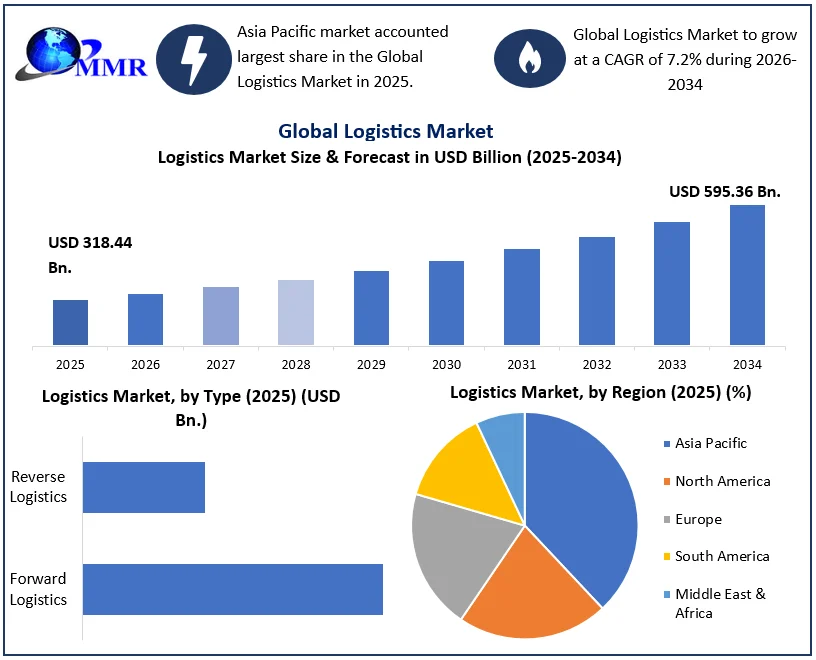
The Global Logistics Market is expected to grow from USD 318.44 Billion in 2025 to USD 595.36 Billion by 2034, at a CAGR of 7.2%, driven by e-commerce expansion, IoT-enabled tracking, automation, AI-driven supply chain management, and smart multimodal transport solutions.
Logistics Market Overview
The Global Logistics Market is experiencing significant transformation as businesses increasingly focus on improving supply chain efficiency, reducing transportation costs, and ensuring timely delivery of goods. The market encompasses a wide range of services, including freight transportation, warehousing, inventory management, distribution, cargo handling, and last-mile delivery. Growing international trade, globalization of manufacturing activities, and the increasing movement of raw materials and finished products across domestic and international markets are contributing to the demand for logistics services. Additionally, companies are investing in integrated logistics networks and third-party logistics (3PL) providers to streamline operations, improve flexibility, and manage increasingly complex supply chains.
Another important factor shaping the Global Logistics Market is the growing emphasis on sustainability, operational resilience, and customer-centric delivery services. Logistics providers are adopting electric delivery vehicles, alternative fuels, energy-efficient warehouses, and optimized transportation routes to reduce carbon emissions and support environmental objectives. The increasing use of outsourced logistics services is also enabling businesses to access specialized expertise and scalable distribution networks without making substantial investments in infrastructure. Furthermore, rising expectations for faster deliveries, improved shipment visibility, and reliable cross-border transportation are encouraging logistics companies to strengthen their service capabilities. These developments are creating opportunities for logistics providers to expand their geographical presence, diversify service offerings, and enhance their competitiveness in the evolving global supply chain industry.
Global Logistics Market Key Highlights:
• E-commerce Growth: Global e-commerce sales surged from USD 4.98 trillion in 2021 to USD 6.86 trillion in 2025, driving demand for last-mile and cross-border logistics.
• Parcel Volume: China leads with over 900 million parcels annually, followed by the USA with 500 million and Germany at 400 million, emphasizing concentrated logistics activity.
• Automation Adoption: 53% of OECD logistics firms use robotics in warehouses, improving operational efficiency and handling over 1.2 million shipments daily in high-volume regions.
• Delivery Efficiency: Average urban delivery time decreased from 2.36 days in 2022 to 2.15 days in 2023, reflecting enhanced performance through micro-fulfilment centers and regional hubs.
• Dominating Region – Asia Pacific: Asia Pacific leads global logistics, handling over 1.8 billion e-commerce parcels annually, driven by China, India, and Southeast Asia’s rapid digital commerce expansion.
• IoT & Digital Logistics: 48% of advanced economy logistics firms leverage IoT tracking, while 67% of cross-border operators utilize digital documentation for predictive delivery and supply chain transparency.
Logistics Market Size, Growth and Share Analysis
To know about the Research Methodology :- Request Free Sample Report
Logistics Market Trends – Consumer Demand for Faster Last-Mile Delivery
The global logistics market is increasingly shaped by consumer demand for faster last-mile delivery, driven by the surge in e-commerce and urban online shopping. Last-mile deliveries are projected to grow 78% globally by 2030, while delivery vehicles may increase 36% in the 100 busiest cities, contributing up to 13% of urban emissions. Average urban delivery time decreased from 2.36 days (2022) to 2.15 days (2023), reflecting operational responsiveness.
• Micro-fulfilment centres and regional hubs for faster e-commerce logistics.
• KPIs aligned with World Bank LPI to monitor efficiency and consumer satisfaction.
• Collaboration with municipalities to manage congestion and optimize freight and cargo transportation.
• Adoption of green logistics and low-emission vehicles to reduce environmental impact.
Logistics Market Dynamics:
Logistics Market Drivers – E-Commerce & Online Shopping Expansion
The global logistics market growth is significantly driven by the rapid expansion of e commerce and online shopping, which increases demand for transportation, warehousing, fulfilment, and last mile delivery services. The global logistics market was valued at USD 318.44 Billion in 2025 and is projected to reach USD 595.36 Billion by 2034, registering a CAGR of 7.2% during 2026–2034. This sustained expansion of digital commerce is increasing demand for third-party logistics (3PL), advanced supply chain management, digital logistics platforms, and real-time shipment tracking solutions to support cross-border fulfilment, inventory visibility, and delivery optimization.
Logistics Market Opportunities – Technology-Enabled & Personalized Logistics
• Digital Infrastructure Adoption: High-income and 32% of developing countries’ logistics firms leverage cloud-based logistics platforms for real-time shipment visibility and coordination.
• Automation & Robotics: 53% of OECD logistics companies use robotics for warehousing, enhancing operational efficiency and throughput.
• IoT-Enabled Tracking: 48% adoption in advanced economies enables precise cargo monitoring, predictive delivery, and smart logistics solutions.
• Digital Documentation: 67% of cross-border operators implement electronic workflows for streamlined supply chain management.
• Blockchain & AI Integration: 45% exploring blockchain for transparency and AI-driven analytics for predictive insights, creating strategic differentiation.
Logistics Market Restraints – Rising Logistics & Transportation Costs
Rising logistics and transportation costs are constraining the global logistics market, impacting supply chain efficiency, delivery pricing, and consumer satisfaction. Freight transportation, labor, and warehousing expenses create financial pressure on logistics providers, reducing profit margins and increasing operating costs for businesses across industries. These challenges highlight the need for smart logistics solutions, automation, and digital logistics platforms. Consequently, companies are focusing on route optimization, fuel-efficient transportation, warehouse automation, and improved load management to control costs and enhance overall supply chain efficiency. Additionally, fluctuating fuel prices, toll charges, vehicle maintenance expenses, and cross-border regulatory requirements further increase logistics operating costs. Small and medium-sized logistics providers face particular challenges in adopting advanced technologies due to high initial investment requirements. As a result, businesses are increasingly exploring integrated logistics networks, predictive analytics, and digital freight management systems to improve resource utilization and maintain competitive pricing.
• Operational Optimization: Optimize multimodal transport for cost, speed, and service, and implement IoT- and AI-enabled supply chain management to enhance efficiency.
• Technology & Sustainability Investment: Invest in automated warehousing, handling technologies, and adopt green logistics solutions for cost-effective and eco-friendly last-mile delivery.
Global Logistics Market Analysis by Segments
The Global Logistics Market segmentation reveals how transportation modes, service types, logistics types, and end use industries drive operational strategy, cost efficiency, and growth forecasts. Asia Pacific dominates volume and segment demand within the global supply chain and logistics market outlook.
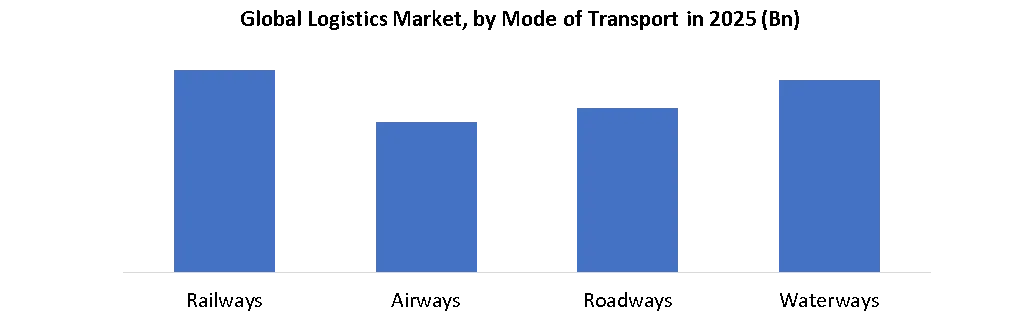
By Transportation Mode: Rail, road, waterways, and air define cost speed trade offs and service reach. In 2025, road and air transport together held nearly 45% share of intermodal freight value, while rail remains cost efficient for bulk freight and essential to multimodal logistics strategies within global supply chains. The growing integration of different transportation modes enables logistics providers to improve delivery flexibility, optimize freight costs, and expand connectivity across domestic and international markets.
Additionally, investments in transportation infrastructure, digital freight management, and real-time cargo tracking are supporting more reliable and efficient movement of goods.
By Service Type: Core logistics functions encompass transportation, warehousing, inventory management, order fulfilment, packaging, material handling, reverse logistics, and solutions that improve delivery performance and supply chain responsiveness across industries. Additionally, third-party logistics (3PL) and fourth-party logistics (4PL) services are gaining importance as businesses increasingly outsource logistics operations to specialized providers. The growing adoption of digital platforms, real-time shipment tracking, and automated warehouse systems is helping logistics companies improve operational visibility and resource utilization. Furthermore, integrated logistics services support efficient coordination between suppliers, manufacturers, distributors, and end customers, enabling businesses to streamline operations and respond effectively to changing market demand.
Logistics Market Regional Insights:
The global logistics market is segmented into North America, Europe, Asia Pacific, South America, and the Middle East and Africa, with each region contributing to market development through its transportation infrastructure, trade activities, and supply chain capabilities. Asia Pacific dominates the market, supported by strong manufacturing activities, expanding international trade, infrastructure investments, and growing demand for freight transportation and warehousing services in China, India, Japan, and South Korea. North America maintains a significant market presence due to its advanced logistics infrastructure, established third-party logistics providers, extensive highway networks, and adoption of digital supply chain technologies.
Europe benefits from integrated cross-border transportation systems, developed rail and road infrastructure, international trade connections, and increasing investments in sustainable logistics solutions. South America is experiencing opportunities for market expansion through improvements in port facilities, road connectivity, regional trade, and freight transportation infrastructure, particularly in Brazil, Argentina, and Chile. Meanwhile, the Middle East and Africa region is strengthening its logistics capabilities through investments in seaports, airports, logistics parks, and international trade corridors. Growing infrastructure development, economic diversification, and strategic geographic connectivity are supporting the region's role in global freight movement and supply chain operations.
Logistics Market Competitive Landscape
• Global and regional logistics integrators such as DHL, Kuehne + Nagel, DSV, UPS, and Sinotrans leverage multimodal transportation, cross-border logistics compliance, and digital logistics tracking to serve high-volume international supply chains. North America specialists and emerging regional players focus on last-mile delivery, domestic freight, and e-commerce logistics, optimizing transportation, warehousing, and third-party logistics capabilities.
• Specialized providers such as Lineage Logistics and Americold operate over 120 temperature-controlled warehouses globally, serving 400 million cold chain shipments annually, differentiating through IoT-enabled monitoring, predictive analytics, and AI-driven supply chain management to strengthen last-mile delivery efficiency.
Logistics Market Recent Developments
| Date | Company | Development | Impact |
| 25 March 2026 | UPS | UPS unveiled its Taoyuan International Logistics Center in Taiwan, spanning more than 81,000 square meters and featuring advanced automation technology. | The facility strengthens UPS's Asia Pacific network and supports higher productivity, efficient warehousing, and improved supply chain resilience. |
| 04 June 2026 | DHL Group | DHL announced plans to invest approximately EUR 160 million in France during 2026–2027 to expand logistics capacity, upgrade infrastructure, and accelerate decarbonization. | The investment is expected to strengthen logistics infrastructure, increase operational capacity, and support lower-emission supply chains. |
| 09 June 2026 | DHL Supply Chain | DHL expanded its Asia Pacific data center logistics capabilities, with more than 160,000 square meters of dedicated warehousing capacity operating or committed for expansion. | The expansion improves specialized storage and handling capacity to meet rising demand from data center operators and technology supply chains. |
| 01 July 2026 | CMA CGM Group | CMA CGM announced an agreement to acquire FedEx Supply Chain at an enterprise value of USD 1.4 billion, strengthening its North American contract logistics business. | The proposed acquisition is intended to expand CEVA Logistics' regional scale and strengthen its end-to-end contract logistics capabilities. |
| 11 August 2026 | DHL Express | DHL expanded its Shenzhen logistics gateway following a EUR 177 million investment and introduced a new dedicated freighter route connecting Shanghai, Bangkok, Bahrain, and Brussels. | The expansion adds shipment-processing capacity and air connectivity, supporting cross-border e-commerce and international express deliveries. |
| 24 August 2026 | UPS | UPS announced more than USD 2 billion in ongoing investments across its international, healthcare, and supply chain solutions businesses through 2028. | The investments aim to improve delivery speed, network connectivity, and reliability while helping customers build more resilient global supply chains. |
Logistics Market Scope: Inquiry Before Buying
| Logistics Market | |||
|---|---|---|---|
| Report Coverage | Details | ||
| Base Year: | 2025 | Forecast Period: | 2026-2034 |
| Historical Data: | 2020 to 2025 | Market Size in 2025: | 318.44 USD Billion |
| Forecast Period 2026-2034 CAGR: | 7.2% | Market Size in 2034: | 595.36 USD Billion |
| Segments Covered: | by Services | Transportation Services Warehousing and Distribution Services Freight Forwarding Services Inventory Management Services Value-Added Logistics Services Integration & Consulting Services |
|
| by Type | Forward Logistics Reverse Logistics |
||
| by Model | 1PL 2PL 3PL 4PL 5PL |
||
| by Operation | Domestic International |
||
| by Mode of Transport | Railways Airways Roadways Waterways |
||
| by Category | Conventional Logistics E-Commerce Logistics |
||
| by Usage | B2B (Business-to-Business) B2C (Business-to-Consumer) |
||
| by End Use | Healthcare Manufacturing Aerospace Telecommunication Government and Public Utilities Banking and Financial Services Retail |
||
Logistics Market, by Region:
North America (United States, Canada and Mexico)
Europe (UK, France, Germany, Italy, Spain, Sweden, Austria and Rest of Europe)
Asia Pacific (China, South Korea, Japan, India, Australia, Indonesia, Malaysia, Vietnam, Taiwan, Bangladesh, Pakistan and Rest of APAC)
Middle East and Africa (South Africa, GCC, Egypt, Nigeria and Rest of ME&A)
South America (Brazil, Argentina Rest of South America)
Global Logistics Market Key players:
1. DHL Group
2. FedEx Corporation
3. United Parcel Service, Inc. (UPS)
4. Kuehne + Nagel International AG
5. DSV A/S
6. C.H. Robinson Worldwide, Inc.
7. DB Schenker
8. Nippon Express Holdings, Inc.
9. CEVA Logistics
10. GXO Logistics, Inc.
11. XPO, Inc.
12. Expeditors International of Washington, Inc.
13. J.B. Hunt Transport Services, Inc.
14. Ryder System, Inc.
15. Schneider National, Inc.
16. Kintetsu World Express, Inc.
17. Sinotrans Limited
18. Yusen Logistics Co., Ltd.
19. Geodis
20. Bolloré Logistics
21. Maersk
22. CMA CGM Group
23. COSCO Shipping Logistics Co., Ltd.
24. Hapag-Lloyd AG
25. Nippon Yusen Kabushiki Kaisha (NYK Line)
26. Mitsui O.S.K. Lines, Ltd. (MOL)
27. SF Express Co., Ltd.
28. JD Logistics, Inc.
29. ZTO Express (Cayman) Inc.
30. STO Express Co., Ltd.
31. Blue Dart Express Limited
32. Delhivery Limited
33. Allcargo Logistics Limited
34. TCI (Transport Corporation of India) Limited
35. Mahindra Logistics Limited
36. Gati Limited
37. Aramex PJSC
38. Qatar Airways Cargo
39. Kuehne + Nagel (Asia Pacific)
40. Kerry Logistics Network Limited
FAQs of Global Logistics Market:
Q1: What is driving the growth of the global logistics market?
A1: The growth is driven by e-commerce expansion, IoT-enabled tracking, automation, AI-driven supply chain management, and smart multimodal transport solutions.
Q2: Which region dominates the global logistics market?
A2: Asia Pacific dominates, Global Logistics Market.
Q3: How is technology transforming logistics operations?
A3: Adoption of robotics, IoT-enabled tracking, cloud platforms, and AI enhances operational efficiency, predictive delivery, and supply chain transparency.
Q4: What are the main challenges in logistics?
A4: Rising transportation, labor, and warehousing costs, along with freight expenditure exceeding 80% of logistics spending, constrain efficiency and pricing.
Q5: What are the major opportunities in the logistics market?
A5: Opportunities include cloud-based platforms, automation & robotics, IoT-enabled tracking, digital documentation, blockchain, and AI-driven predictive analytics for supply chain optimization.