
Protective Coating Market Size – Strategic Growth Drivers, Risk Assessment Framework, Regulatory Landscape Review, Competitive Intensity Mapping & Long-Term Industry Outlook to 2034
Overview
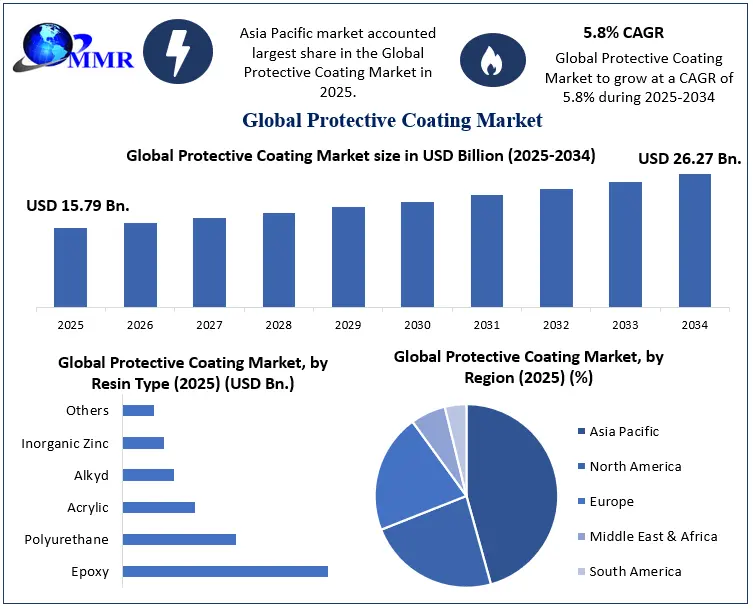
The Global Protective Coating Market was valued at USD 15.79 billion in 2025 and is projected to reach USD 26.27 billion by 2034, registering a CAGR of 5.8% during 2025–2034.
Protective Coating Market Overview:
The global protective coatings market comprises specialized coating solutions that protect metal, concrete, and other surfaces against corrosion, abrasion, chemicals, moisture, weathering, and environmental damage. The market experiences steady growth as industries such as oil and gas, marine, automotive, construction, power generation, and industrial manufacturing increasingly prioritize equipment protection, infrastructure durability, and lower maintenance costs. Rising demand for eco-friendly water-borne coatings, high-performance epoxy and polyurethane coatings, UV-curable technologies, and nanocoatings supports product innovation and strengthens market development. At the same time, volatile raw material prices, stringent environmental regulations, and increasing manufacturing costs influence production strategies and pricing trends.
Asia-Pacific dominates the global protective coatings market, accounting for a major share in 2025, supported by rapid urbanization, infrastructure development, expanding industrial production, and growing investment in energy, marine, and manufacturing projects. North America holds the second-largest market share, led by the U.S., where stringent regulations for asset protection, coupled with aging infrastructure, are driving demand for advanced coating technologies. Major industry participants include PPG Industries, The Sherwin-Williams Company, AkzoNobel, Jotun, Hempel, and Kansai Paint, which compete through advanced formulations, product development, strategic partnerships, and global distribution networks.
The report explores the Protective Coating market's segments (Material Type, Technology, End-User, and Region). Data has been provided by market participants, and regions (North America, Asia Pacific, Europe, Middle East & Africa, and South America). This market report provides a thorough analysis of the rapid advances that are currently taking place across all industry sectors. Facts and figures, illustrations, and presentations are used to provide key data analysis for the historical period from 2020 to 2025. The report investigates the Protective Coating market's drivers, limitations, prospects, and barriers. This MMR report includes investor recommendations based on a thorough examination of the Protective Coating market's contemporary competitive scenario.
Global Protective Coating Market Size, Share and Forecast Analysis
To know about the Research Methodology :- Request Free Sample Report
Protective Coatings Market Highlights
• The global protective coatings market reaches USD 15.79 billion in 2025 and projects to USD 26.27 billion by 2034, registering a CAGR of 5.8% during 2025–2034.
• Asia Pacific dominates the market with a 45.7% share in 2025, driven by urbanization, infrastructure development, industrial expansion, and energy investments.
• North America accounts for 23.3% of the market in 2025, supported by aging infrastructure, asset-protection requirements, and demand for advanced coating technologies.
• Epoxy coatings lead by resin type, accounting for 39.9% of market share in 2025, due to their durability and resistance to harsh environmental conditions.
• Infrastructure development and industrial demand drive market growth as protective coatings extend the service life of bridges, pipelines, storage tanks, offshore structures, and industrial equipment.
• Oil and gas operations generate significant demand for coatings that protect pipelines, refineries, offshore platforms, and storage tanks against corrosion and chemical exposure.
• Sustainable coating technologies gain traction, including water-based, powder, and high-solids formulations, as manufacturers respond to environmental regulations and demand for lower-VOC products.
• Smart and advanced coatings attract growing interest, including self-healing technologies that can reduce maintenance requirements and improve asset protection.
• Maintenance and refurbishment create opportunities as industries seek to extend the life of aging infrastructure and equipment, reduce unplanned shutdowns, and lower replacement costs.
• Raw material price fluctuations, energy costs, and stringent environmental regulations remain key challenges, putting pressure on production costs, pricing, and product development.
• Major market participants include PPG Industries, Sherwin-Williams, AkzoNobel, Jotun, Hempel, and Kansai Paint, which compete through product innovation, sustainable formulations, and global distribution networks.
Protective Coating Market Dynamics:
Protective Coating Market Driver:
• Increasing Infrastructure Development and Industrial Demand: The global protective coatings market experiences strong demand from construction, oil and gas, marine, automotive, power generation, and industrial manufacturing. Protective coatings prevent corrosion, abrasion, chemical damage, moisture penetration, and weather-related deterioration, extending the service life of bridges, pipelines, storage tanks, offshore structures, and industrial equipment. Government infrastructure investments, expanding manufacturing facilities, and urban development projects strengthen demand for long-lasting coating solutions
• Growing Demand from the Oil and Gas Industry: The protective coatings market benefits from increasing demand across upstream, midstream, and downstream oil and gas operations. Pipelines, offshore platforms, storage tanks, refineries, and processing equipment require protective coatings to resist corrosion, chemicals, moisture, and extreme operating conditions.
Protective Coating Market Restraint:
• High Raw Material Prices and Energy Costs: The protective coatings market faces cost pressures from fluctuations in crude oil prices, epoxy resins, polyurethane components, titanium dioxide, solvents, and other chemical inputs.Rising energy, transportation, packaging, and manufacturing costs further increase operating expenses. Manufacturers either absorb these additional costs, which reduces profit margins, or increase product prices, which places pressure on customer purchasing decisions and price-sensitive applications.
• Complex Application Processes and Skilled Labor Requirements: Protective coatings often require specialized surface preparation, controlled application conditions, and adequate curing time to achieve the required performance. Industrial coating applications may require abrasive blasting, humidity control, and multiple coating layers, increasing labor costs and project completion time.
Protective Coating Market Opportunity:
• Rising Demand for Maintenance and Refurbishment of Existing Assets: The growing need to maintain aging infrastructure, industrial equipment, pipelines, ships, bridges, and storage tanks creates significant opportunities for the protective coatings market. Protective coatings help extend asset life, reduce corrosion-related failures, minimize unplanned shutdowns, and lower equipment replacement costs. For example, the U.S. infrastructure sector faces substantial maintenance requirements, while industrial facilities increasingly adopt preventive maintenance strategies to improve operational reliability. The global emphasis on life-cycle cost reduction supports recurring demand for recoating, refurbishment, and industrial maintenance services.
• Expansion of Renewable Energy Infrastructure: Growing investment in offshore wind farms, solar power facilities, hydropower projects, and energy storage infrastructure creates new opportunities for protective coatings. Wind turbine towers, offshore foundations, solar mounting structures, and energy infrastructure require protection against corrosion, UV radiation, moisture, and temperature variations.
Protective Coating Market Challenge:
• Developing Cost-Effective Products Under Strict Environmental Regulations: Protective coatings manufacturers face the challenge of developing environmentally compliant products while maintaining corrosion resistance, adhesion, chemical durability, weather resistance, and competitive pricing. Regulations governing volatile organic compounds (VOCs) and hazardous air pollutants encourage the transition toward water-borne, powder, and high-solids coatings. However, reformulation requires investment in research and development, production equipment, testing, and application processes. Water-borne systems also require formulation adjustments to deliver consistent performance under different temperature and humidity conditions. These technical and cost considerations challenge manufacturers to balance regulatory compliance, product performance, production efficiency, and affordability.
• Intense Competition and Pricing Pressure: The global protective coatings market includes established multinational manufacturers and regional producers competing across industrial, marine, construction, and energy applications. Companies face pressure to maintain competitive prices while investing in research and development, sustainable formulations, and advanced production technologies.
Protective Coating Market Trend:
• Increasing Adoption of Smart and Advanced Coating Technologies: Protective coating manufacturers increasingly explore smart coatings that detect corrosion, respond to environmental changes, or provide additional monitoring capabilities. Self-healing coatings attract attention because they can repair certain types of minor coating damage and potentially reduce maintenance requirements.
• Increasing Adoption of Sustainable and High-Performance Coatings: Demand for low-VOC, water-borne, powder, and high-solids coatings increases as industries prioritize environmental compliance and sustainable operations. Advanced coatings provide improved corrosion resistance, UV protection, chemical durability, and longer maintenance intervals. Powder coatings gain adoption in architectural and industrial applications because they provide durable finishes without VOC emissions during application.
For example, AkzoNobel offers its Interpon powder coating range for architectural components, supporting durable finishes and sustainability objectives.
Protective Coating Market Segment Analysis:
Based on Resin Type, the Protective Coating Market is segmented into epoxy, polyurethane, alkyd, acrylic, inorganic zin, and others. The epoxy segment is holding the major share of the market in 2025, and it is expected to maintain it during the forecast period. Epoxy coatings can resist extreme weather and also it dries quickly causing a minimum delay in production. Polyurethane coatings also gain demand because of their weather resistance, UV protection, and durability in demanding environments.
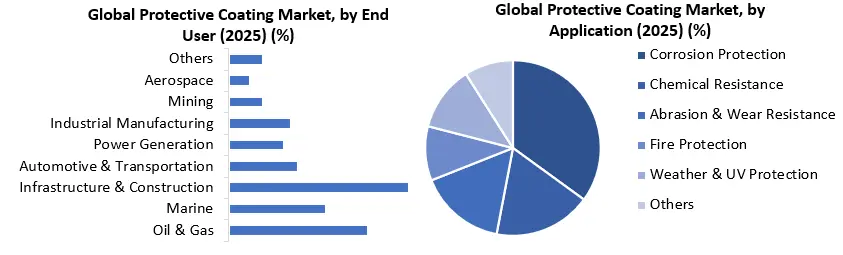
Based on End User, The global protective coatings market is segmented into oil and gas, marine, infrastructure and construction, automotive and transportation, power generation, industrial manufacturing, mining, aerospace, and others. The oil and gas industry uses protective coatings to safeguard pipelines, refineries, offshore platforms, and storage tanks against corrosion and chemical exposure. Marine coatings protect vessels and offshore structures from seawater corrosion and marine fouling. Infrastructure and construction applications include bridges, buildings, tunnels, and steel structures, where coatings improve durability and weather resistance. Automotive and transportation industries use coatings to protect vehicle bodies and components, while power generation and industrial manufacturing rely on them to protect machinery, turbines, and processing equipment. Mining applications require abrasion- and wear-resistant coatings, whereas aerospace applications demand specialized coatings that withstand corrosion, temperature variations, and demanding operating conditions.
By Application, The global protective coatings market covers corrosion protection, chemical resistance, abrasion and wear resistance, fire protection, weather and UV protection, and others. Corrosion protection coatings prevent the deterioration of metals and concrete caused by moisture, oxygen, and corrosive substances. Chemical-resistant coatings protect surfaces exposed to acids, alkalis, solvents, and industrial chemicals. Abrasion and wear-resistant coatings reduce surface damage caused by friction, impact, and abrasive materials, particularly in mining and industrial operations. Fire-protection coatings improve the fire resistance of structural components, while weather and UV-protection coatings protect exposed surfaces from sunlight, moisture, temperature variations, and environmental degradation. Other applications include antifouling, electrical insulation, and specialized surface protection.
Protective Coating Market Regional Insights:
North America holds the second-largest market share, led by the U.S., where stringent regulations for asset protection, coupled with aging infrastructure, are driving demand for advanced coating technologies.
The European region is expected to witness significant growth at a CAGR of xx% through the forecast period. As the government has taken initiatives for preventing the corrosion of bridges and other infrastructures for improving their durability and appearance, which will further drive the market forward.
• Germany: Automotive manufacturing, industrial machinery, and infrastructure maintenance support demand for corrosion-resistant coatings.
• France and the United Kingdom: Aerospace, marine, energy, and transportation projects create opportunities for specialized protective coating formulations.
Asia-Pacific dominates the global protective coatings market, accounting for a major share in 2025, supported by rapid urbanization, infrastructure development, expanding industrial production, and growing investment in energy, marine, and manufacturing projects.
• South America experiences growing demand for protective coatings through mining, oil and gas, infrastructure development, marine activities, and industrial manufacturing. Brazil leads regional demand through its energy infrastructure, offshore petroleum operations, mining activities, and construction projects.
• Brazilian oil and gas sector: Oil and gas accounts for xx% of Brazil's protective coatings end-user demand in 2025, according to the same source.
• Brazil: Offshore energy operations, refineries, mining, and infrastructure projects support demand for epoxy and polyurethane coatings.
The Middle East and Africa market benefits from oil and gas infrastructure, petrochemical production, mining, power generation, marine activities, and large construction projects. Saudi Arabia, the United Arab Emirates, and South Africa represent important demand centers across energy and industrial applications.
• South Africa: Mining, mineral processing, and power generation support demand for abrasion-resistant and corrosion-resistant coatings.
• United Arab Emirates: Ports, industrial facilities, commercial construction, and energy infrastructure generate demand for coatings that withstand high temperatures, humidity, and saline conditions.
The objective of the report is to present a comprehensive analysis of the global Protective Coating Market to the stakeholders in the industry. The past and current status of the industry with the forecasted market size and trends are presented in the report with the analysis of complicated data in simple language. The report covers all the aspects of the industry with a dedicated study of key players that include market leaders, followers, and new entrants.
PORTER, PESTEL analysis with the potential impact of micro-economic factors of the market have been presented in the report. External as well as internal factors that are supposed to affect the business positively or negatively have been analyzed, which will give a clear futuristic view of the industry to the decision-makers.
The reports also help in understanding the Protective Coating Market dynamic, and structure by analyzing the market segments and projecting the Protective Coating Market size. Clear representation of competitive analysis of key players by Design, price, financial position, product portfolio, growth strategies, and regional presence in the Protective Coating Market make the report investor’s guide.
Protective Coatings Market Competitive Landscape
The global protective coatings market is fragmented and highly competitive, with multinational manufacturers competing alongside regional and local suppliers. Companies strengthen their competitive positions through product innovation, sustainable coating technologies, strategic acquisitions, distribution expansion, and investments in research and development. Competition focuses on corrosion resistance, coating durability, chemical protection, application efficiency, environmental compliance, and long-term maintenance costs.
| Company | Competitive Position and Key Strategies |
| PPG Industries, Inc. | Offers protective, marine, industrial, and corrosion-resistant coatings for infrastructure, energy, and heavy industrial applications. Focuses on specialized formulations, technical services, and sustainable coating technologies. |
| AkzoNobel N.V. | Develops protective and marine coatings for industrial assets, infrastructure, and offshore applications. Emphasizes high-performance coating systems, powder coatings, and sustainable solutions. |
| The Sherwin-Williams Company | Serves industrial maintenance, infrastructure, energy, and fireproofing applications. Focuses on specialized coating systems, technical support, and broad distribution capabilities. |
| Jotun | Provides marine, offshore, energy, and industrial protective coatings. Specializes in corrosion protection, passive fire protection, and coatings for demanding operating environments. |
| Hempel A/S | Supplies protective coating systems for infrastructure, marine assets, energy facilities, and industrial equipment. Emphasizes durability, corrosion prevention, and reduced maintenance requirements. |
| RPM International Inc. | Through brands such as Carboline, competes in industrial corrosion protection, tank linings, fireproofing, and high-performance coatings for infrastructure and industrial facilities. |
| Axalta Coating Systems | Competes in industrial and performance coatings, with a focus on coating technologies, product development, and expansion across industrial and transportation applications. |
| Kansai Paint Co., Ltd. | Provides industrial and automotive coatings and develops specialized coating solutions for manufacturing, infrastructure, and transportation applications. |
| Nippon Paint Holdings Co., Ltd. | Offers protective and industrial coating products and strengthens its presence through product innovation, manufacturing capabilities, and regional market expansion. |
| Sika AG | Provides protective coatings and related construction solutions for concrete, steel structures, infrastructure, and industrial applications. Focuses on durability, surface protection, and construction performance. |
Protective Coatings Market Recent Developments
| Date | Company | Recent Development | Market Significance |
| August 31, 2026 | PPG Industries | Introduces the PPG ONE RANGE portfolio of five single-component marine coatings at SMM 2026 in Hamburg, Germany. The ready-to-use products simplify onboard maintenance and include water-borne, alkyd, and polyurethane technologies. | Improves maintenance efficiency and supports marine asset protection. |
| July 30, 2026 | Hempel A/S | Launches Hempafire Optima 515, a water-borne passive fire protection coating for steel structures. The product provides fire protection for up to 150 minutes under the specified BS 476 standard and aims to reduce coating consumption. | Strengthens demand for fire-protective, low-VOC coatings in infrastructure projects. |
| April 20, 2026 | PPG Industries | Announces end-to-end protective coating solutions and application services for data centers. | Addresses growing requirements for durable coatings in digital infrastructure. |
| March 10, 2026 | PPG Industries | Announces a global price increase of up to 20% across specified product categories. | Highlights cost pressures and pricing adjustments across the coatings industry. |
| July 1, 2026 | BASF and Carlyle | Complete the transaction involving BASF's former coatings business, with an enterprise value of €7.7 billion. The business operates under the name Surventis, while BASF retains a 40% equity stake. | Reshapes ownership structures and competitive positioning within the coatings industry. |
Protective Coating Market Scope: Inquiry Before Buying
| Protective Coating Market | |||
|---|---|---|---|
| Report Coverage | Details | ||
| Base Year: | 2025 | Forecast Period: | 2026-2034 |
| Historical Data: | 2020 to 2025 | Market Size in 2035: | US$ 15.79 Bn. |
| Forecast Period 2026 to 2034 CAGR: | 5.8% | Market Size in 2034: | US$ 26.27 Bn. |
| Segments Covered: | by Resign Type | Epoxy Polyurethane Alkyd Acrylic Inorganic zin Others |
|
| by Technology | Solvent-based Water-based Powder-based High-Solids Coatings others |
||
| by Application | Corrosion Protection Chemical Resistance Abrasion & Wear Resistance Fire Protection Weather & UV Protection Others |
||
| by End Users | Oil & Gas Marine Infrastructure & Construction Automotive & Transportation Power Generation Industrial Manufacturing Mining Aerospace Others |
||
Protective Coating Market, by Region
North America (United States, Canada and Mexico)
Europe (UK, France, Germany, Italy, Spain, Sweden, Austria and Rest of Europe)
Asia Pacific (China, South Korea, Japan, India, Australia, Indonesia, Malaysia, Vietnam, Taiwan, Bangladesh, Pakistan and Rest of APAC)
Middle East and Africa (South Africa, GCC, Egypt, Nigeria and Rest of ME&A)
South America (Brazil, Argentina Rest of South America)
Protective Coating Market Key Players:
1. Akzo Nobel N.V.
2. PPG Industries Inc.
3. The Sherwin-Williams Company
4. The Valspar Corporation
5. Jotun
6. Hempel Group
7. Kansai Paints Co. Ltd.
8. Axalta Coating Systems
9. Sika AG
10. Nippon Paint Holdings Company Limited
11. Arkema Group
12. Kansai Paint Company Limited
13. RPM International, Inc.
14. Wacker Chemie AG
15. Valspar Corporation.
16. Protective Coating System - PCS
17. Kroonint Protective Coating
18. Valmont Industries, Inc.
19. Graco
20. Nanto Protective Coating
21. Saveto Group
22. Graco Spray Foam and Polyurea Equipment
23. ProCoat Specialities Pvt. Ltd.
24. BASF SE
25. Asian Paints Limited
26. Berger Paints India Limited
27. Chugoku Marine Paints, Ltd.
28. Teknos Group Oy
29. Tnemec Company, Inc.
30. Carboline Company
31. A.W. Chesterton Company
32. Belzona International Ltd.
33. KCC Corporation
34. WEG S.A.
35. 3M Company
36. Henkel AG & Co. KGaA
37. Covestro AG
38. Ashland Inc.
39. Tikkurila Oyj
40. HMG Paints Limited
Frequently asked questions
1. Which industry is influencing the growth of the Protective Coatings Market?
Ans: The Infrastructure and construction segment is influencing the growth of the Protective Coating Industry.
2. Who are the Major Key Players?
Ans: The Akzo Nobel N.V., PPG Industries Inc., The Sherwin-Williams Company, The Valspar Corporation, Jotun, Hempel Group, Kansai Paints Co. Ltd.
3. Why the protective coating market is gaining importance?
Ans: The protective coating is applied to various surfaces for their protection from elements that are harmful and can affect the item’s function or integrity. A protecting coating is used for reducing erosion. The expansion of Construction, Automotive, oil and gas, industrial, mining, power generation, and other markets have contributed to the rising demand for the protective coating market.
4. What are the end-users of the protective coating market?
Ans: Infrastructure and construction, Oil and Gas, Industrial, Marine, Automotive, and Power generation.
5. What is the expected CAGR of the forecast period?
Ans: The market is expected to grow with a CAGR of 5.8% during the forecast period.