HVDC Transmission Market Size by Component, Technology, Transmission Type, Application, Region – Revenue Pool Analysis, Margin Structure Assessment, Capital Flow Trends, Competitive Benchmarking & Forecast to 2032

8.7%
CAGR (2026-2032)
12.84 USD Bn.
Market Size
306
Report Pages
122
Market Tables

Overview

Global HVDC Transmission Market size was valued at USD 12.84 Bn in 2025 and is expected to reach USD 23.03 Bn by 2032, at a CAGR of 8.7 %.

Overview

HVDC (High-Voltage Direct Current) transmission is a method of transmitting electrical power over long distances using high-voltage direct current instead of alternating current. This approach offers several advantages over traditional AC transmission, such as reduced line losses, increased transmission capacity, and the ability to interconnect power systems and integrate renewable energy sources. Also, HVDC transmission systems are cheap for long-distance electricity transmission & they also produce lower electrical losses. High voltage direct current systems allow transmission of power generated from solar panels & wind plants which are far away.

The interconnection of High voltage direct current & the Alternative Current grid has strengthened the reliability & capacity of power grids. Rising electricity consumption is one of the main factors driving the global HVDC transmission market. The populace is rising rapidly, thereby growing electricity consumption. More & more electrically powered devices are currently being used. Fossil fuels & CO2 emissions are being replaced by new technologies which is also the reason for higher electricity consumption.

The rising need for cable-based transmission as an alternative to transmission through overhead lines is the other influence responsible for the development of the global HVDC transmission market. Overhead transmission lines are not protected & hence the threat to human safety is high. Cable-based transmission lines need insulation so that the live cables do not touch the earth & get shorted, & hence the acceptance of cable-based transmission lines is growing, thereby improving the development of the HVDC transmission Industry.
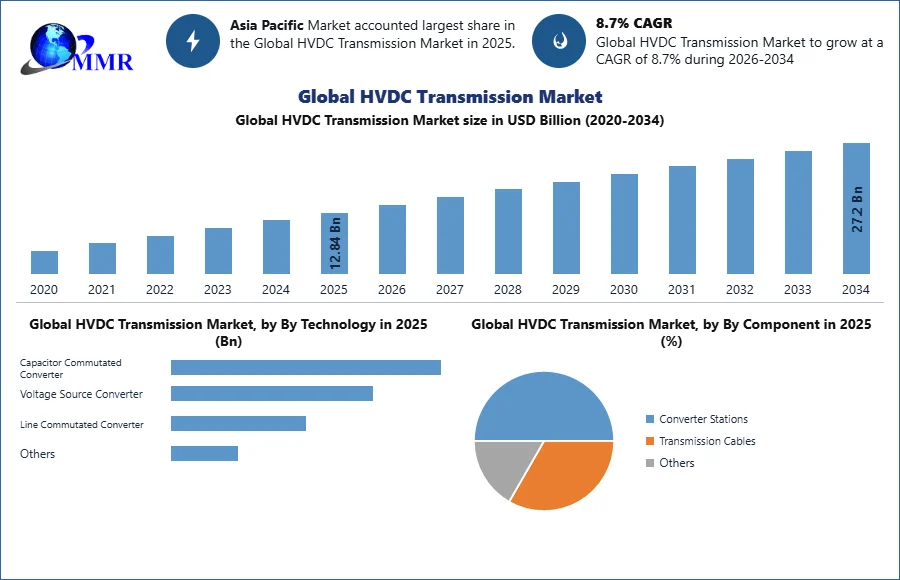
HVDC Transmission Market Snapshot

To know about the Research Methodology :- Request Free Sample Report

HVDC Transmission Market Dynamics

Interconnection of Power Grids to Boost the Market

POWERGRID is committed to operating sustainably and has been taking proactive steps for the HVDC Transmission Market as a sustainability initiative. POWERGRID has set a target for meeting 50% of its internal energy needs from renewable sources by 2025 and achieving net zero status by 2047. As of December 2023, the installation of 8.7 MWp rooftop solar PV systems at more than 110 locations is completed and about 10.1 MWp Projects are under implementation/planning. POWERGRID’s first large-scale commercial project for the establishment of an 85 MW Solar PV project at Nagda is under development and is likely to be commissioned in June 2024. Additionally, to, reduce the consumption of diesel use in the organization, diesel vehicles are replaced with Electrical Vehicles (EVs).

The interconnection of regional and international power grids is a significant factor driving the HVDC transmission market. HVDC links enable the exchange of electricity between different grids, enhancing grid stability and reliability. They allow countries to trade power, balance supply and demand, and optimize resource utilization. This interconnectivity is essential for creating a resilient and flexible global power network, capable of withstanding fluctuations in generation and consumption. As countries aim for energy security and the integration of renewables, HVDC interconnections are becoming increasingly vital.

The US grid system is a complex machine consisting of several moving parts more than 3300 utilities, 7700 power plants, and 160,000 miles of high voltage transmission lines. At the local level, any grid has generators that produce energy transmission lines that transfer high-voltage energy to the distribution system. These distribution systems comprise substations that convert and distribute lower-voltage power transformers. These reduce voltage further before the electricity finally reaches our homes.

Government initiatives and investments play a crucial role in the growth of the HVDC transmission market. Many governments are investing in HVDC projects to modernize their power infrastructure, reduce transmission losses, and support renewable energy targets. Policies and incentives aimed at promoting clean energy and grid modernization are encouraging the adoption of HVDC technology. Additionally, international collaborations and funding from development banks for cross-border HVDC projects are further driving market expansion, facilitating the development of a sustainable and interconnected global power network.

Smart Grid Initiatives: US Department of Energy - ARRA Smart Grid Project, Includes Advanced Metering Infrastructure, smart meters, customer interface systems, and renewable energy integration projects. Focuses on harnessing solar power in the MENA region to meet local and European energy demands. This $10.5 billion program will assist the nation in enhancing grid flexibility and improving the resilience of the po­wer system against growing threats of extreme weather and climate change. The goals of the GRIP program are tr­a­ns­forming community, regional, interregional, and national resilience, particularly in consideration of future shifts in generation and load; catalyzing and leveraging the private sector and non-federal public capital for impactful technology and infrastructure deployment; and advancing community benefits.

US Government Funding Under the Program Divided across Three Subprogrammes:

Grip Program Total Funding (FY 2022-26) in Billion Purpose
Grid Resilience Utility and Industry Grants 2.5 Focuses on funding comprehensive transmission and distribution technology solutions to mitigate hazards, including extreme weather events.
Grid Innovation Program 5.0 Provides financial assistance to states, tribes, local governments, and public utility commissions for collaborative projects to enhance grid resilience and reliability through innovative approaches.
Smart Grid Grants 3 Aims to increase transmission capacity through grid-enhancing technologies (GETs); mitigate wildfires; enable electrification of edge devices for better load management; and incorporate secure communications and cybersecurity.

Other Federal Initiatives Include funds from the Inflation Reduction Act ($3 billion), fast-tracking permitting for key transmission lines, and next-generation transmission planning studies (e.g., National Transmission Planning Study, Atlantic Offshore Wind Transmission Study). Such factors are expected to boost the HVDC Transmission Market growth.

Technological Advancements in HVDC Transmission to Drive the Market Growth

Technological advancements in HVDC systems are pivotal in driving HVDC Transmission Market growth. Innovations in converter technologies, cable design, and insulation materials have significantly improved the efficiency and reliability of HVDC transmission. Modern HVDC systems offer lower transmission losses, higher capacity, and the ability to connect asynchronous power grids, making them highly attractive for long-distance and underwater power transmission. The advancements in power electronics and control systems enhance the stability and flexibility of HVDC networks, supporting the integration of renewable energy sources and facilitating the development of smart grids. For instance, total grid investments have averaged USD 450bn/year in the past decade. The expansion of renewable power leads to a steady increase in grid investments, reaching levels of USD 500bn/year in the 2030s, and growing up to USD 1.1trn/year by 2050. Measured by circuit kilometres, transmission, and distribution lines will almost triple during our forecast period.

Renewable Energy Integration to Create Opportunity for the Market

The rise of renewable energy sources such as wind, solar, and hydropower has created a significant opportunity for High Voltage Direct Current (HVDC) transmission and to boost the HVDC Transmission Market growth. HVDC technology is particularly advantageous for integrating these intermittent energy sources into the grid due to its ability to efficiently transmit power over long distances with minimal losses. This is crucial for connecting remote renewable energy farms to urban centers where the demand is highest. Also, HVDC systems help balance supply and demand by interconnecting different regions and enabling the sharing of excess renewable energy, thereby enhancing grid stability and reducing reliance on fossil fuels. HVDC is preferred for long-distance transmission due to lower line losses (around 2%).

Existing HVDC projects in India are integrated into the proposed smart grid. India's renewable energy capacity, particularly wind and solar power, is integrated into the smart grid to enhance energy sustainability. India's energy demand is rising rapidly. Despite being the world's 6th largest energy consumer, India faces significant transmission and distribution losses (15-20%). The adoption of HVDC and smart grid technologies addresses these inefficiencies. As a result, this factor is expected to increase the HVDC Transmission Market size growth. A central HVDC backbone will form the core of the Indian power network, integrating energy from conventional and renewable sources. The system will feature smart metering and two-way communication for real-time energy monitoring and control. Implementing a smart grid with HVDC transmission and renewable microgrids can significantly improve the efficiency, reliability, and stability of India's power sector.

HVDC Transmission Market

The world’s capacity to generate renewable electricity is expanding faster than at any time in the last three decades, giving it a real chance for HVDC Transmission Market growth to achieve the goal of tripling global capacity by 2030. The amount of renewable energy capacity added to energy systems around the world grew by 50% in 2023, reaching almost 510 gigawatts (GW), with solar PV accounting for three-quarters of additions worldwide. The largest growth took place in China, which commissioned as much solar PV in 2023 as the entire world did in 2022, while China’s wind power additions rose by 66% year-on-year. The increases in renewable energy capacity in Europe, the United States, and Brazil also hit all-time highs.

HVDC Transmission Market

Economically, HVDC systems offer cost savings over AC transmission for long-distance and high-capacity applications due to lower transmission losses and reduced infrastructure costs. The economic and environmental benefits of HVDC transmission are significant drivers of HVDC Transmission Market growth. Environmentally, HVDC transmission supports the integration of renewable energy sources, helping to reduce greenhouse gas emissions and reliance on fossil fuels. These benefits align with global efforts to combat climate change and promote sustainable development, making HVDC technology an attractive choice for utilities and governments worldwide.

Requirement of High Initial Capital Investment to Restrain the Market Growth

One of the primary restraining factors for the HVDC transmission market is the significant initial capital investment required. Establishing HVDC transmission systems involves considerable expenses in building converter stations, which are critical for converting alternating current (AC) to direct current (DC) and vice versa. These stations incorporate advanced technology and specialized equipment, leading to high costs. The development of HVDC lines, which span vast distances, requires substantial financial outlays. Such significant upfront investments are a deterrent for many stakeholders, including utility companies and governments, especially in regions with limited financial resources. This financial barrier delays project approvals and implementations, slowing down the overall HVDC Transmission Industry growth despite the long-term efficiency and cost benefits HVDC systems offer over traditional AC systems.

HVDC Transmission Market Segment Analysis

By Technology:
Based on technology, the Line Commutated Converter (LCC) segment held the largest global HVDC transmission market share in 2025. High‐voltage direct current (HVDC) systems are becoming more and more common in modern power systems. This chapter introduces line‐commutated current source converter (LCC) HVDC transmission systems and discusses AC and DC protection schemes for these systems. It focuses on the two‐terminal LCC HVDC system, consisting of two converter stations, one controlled to operate as a rectifier and the other operating as an inverter, connected by a DC transmission line. The high efficiency, reliability, and cost-effectiveness. LCCs are preferred for transmitting bulk power over larger distances. The LCC technology is advanced and has been used for many years, making it a reliable option.

By Transmission Type:
Based on transmission type, the overhead HVDC transmission lines experience lower electricity losses compared to high voltage alternating current (HVAC) lines, particularly over long distances. This makes HVDC an ideal choice for transmitting electricity from remote power generation sources such as offshore wind farms. HVDC transmission systems typically include converter stations at each end of the line, where AC electricity is converted to DC for transmission and then back to AC at the receiving end. These converter stations are often situated near the overhead transmission lines. Such factors are expected to drive the segment growth in HVDC Transmission Market.
HVDC Transmission Market Regional Analysis

Asia Pacific held the largest HVDC Transmission Market share in 2023. The regional growth is driven by rapid urbanization, a key factor in the region's socioeconomic landscape. Massive population growth and migration to cities demand a shift in energy infrastructure planning. As urban centers expand, the need for dependable, high-capacity power transmission drives the adoption of HVDC technology, which is essential for modern urban development. The rapid development of both conventional and renewable power plants highlights Asia-Pacific's pivotal role in expanding the global HVDC transmission industry. Rising energy demands due to urbanization, industrialization, and improved living standards push governments and utilities to boost and diversify power production.

HVDC transmission efficiently connects remote generation facilities, such as hydroelectric dams, solar farms, and wind parks, to urban and industrial centers, overcoming traditional AC line limitations. Thus, Asia-Pacific is set to lead the HVDC transmission industry, driven by urbanization, smart city proliferation, industrialization, and power generation growth. This region’s demand for HVDC systems will confirm its role in energy transmission innovation and growth.

HVDC Transmission Market Scope: Inquire before buying

HVDC Transmission Market
Report Coverage Details
Base Year: 2025 Forecast Period: 2026-2032
Historical Data: 2020 to 2025 Market Size in 2025: 12.84 USD Billion
Forecast Period 2026-2032 CAGR: 8.7% Market Size in 2032: 23.03 USD Billion
Segments Covered: by Component Converter Stations
Transmission Cables
Others
by Technology Capacitor Commutated Converter
Voltage Source Converter
Line Commutated Converter
Others
by Transmission Type Submarine
Overhead
Underground
by Project Type Point-to-Point Transmission
Back-to-Back Stations
Multi-Terminal Systems
by Application Bulk Power Transmission
Interconnecting Grids
Infeed Urban Areas
Others

HVDC Transmission Market, by Region

North America (United States, Canada and Mexico)
Europe (UK, France, Germany, Italy, Spain, Sweden, Austria and Rest of Europe)
Asia Pacific (China, South Korea, Japan, India, Australia, Indonesia, Malaysia, Vietnam, Taiwan, Bangladesh, Pakistan and Rest of APAC)
Middle East and Africa (South Africa, GCC, Egypt, Nigeria and Rest of ME&A)
South America (Brazil, Argentina Rest of South America)

HVDC Transmission Key players

1. Siemens Energy
2. ABB Ltd.
3. General Electric (GE Vernova)
0. Hitachi Energy
5. Mitsubishi Electric
6. Toshiba Corporation
7. Nexans
8. NKT A/S
9. Prysmian Group
10.Sumitomo Electric
11.Schneider Electric
12.TBEA Co., Ltd.
13.LS Cable & System Ltd.
14.ZTT Group
15.Furukawa Electric Co., Ltd.
16.Hyosung Heavy Industries
17.Bharat Heavy Electricals Ltd. (BHEL)
18.CG Power and Industrial Solutions
19.Taihan Cable & Solution Co., Ltd.
20.XD Group
21.Hydro‑Québec
22.Xu Ji Group Co., Ltd.
23.KEI Industries Ltd.
24.Polycab India Ltd.
25.Brugg Kabel AG
26.Southwire Company

Frequently Asked Questions:

1] What is the growth rate of the Global HVDC Transmission Market?
Ans. The Global HVDC Transmission Market is growing at a significant rate of 8.7 % during the forecast period.

2] Which region is expected to dominate the Global HVDC Transmission Market?
Ans. APAC is expected to dominate the HVDC Transmission Market during the forecast period.

3] What is the expected Global HVDC Transmission Market size by 2032?
Ans. The HVDC Transmission Market size is expected to reach USD 23.03 Bn by 2032.

4] Which are the top players in the Global HVDC Transmission Market?
Ans. The major top players in the Global HVDC Transmission Market are ABB, Siemens, General Electric and others.

5] What are the factors driving the Global HVDC Transmission Market growth?
Ans. The growth of smart grid and renewable energy projects is expected to drive the HVDC Transmission Market growth.

6] Which country held the largest Global HVDC Transmission Market share in 2025?
Ans. China held the largest HVDC Transmission Market share in 2025.

Table of Contents

1. HVDC Transmission Market: Executive Summary 1.1. Executive Summary 1.1.1 Market Size (2025) & Forecast (2026-2032), 1.1.2 Market Size (Value in USD and Volume in MW) - By Segments, Regions and Country 2. HVDC Transmission Market: Competitive Landscape 2.1. MMR Competition Matrix 2.2. Competitive Positioning 2.3. Key Players Benchmarking 2.3.1 Company Name 2.3.2 Headquarters 2.3.3 Product Portfolio 2.3.4 End-User Segments 2.3.5 Revenue (2025) 2.3.6 Operating Margin (%) 2.3.7 Net Profit Margin (%) 2.3.8 YoY Revenue Growth (%) 2.3.9 R&D Spend (% of Revenue) 2.3.10 Installation Capability & EPC Expertise 2.3.11 Premium vs. Mass Portfolio Mix 2.3.12 Technology Integration 2.3.13 Patents Filed / Granted 2.3.14 Strategic Alliances 2.3.15 Geographic Presence 2.4. Strategic Positioning Of Key Players 2.4.1 Market Leaders 2.4.2 Market Followers 2.4.3 Emerging Players 2.5. Mergers and Acquisitions Details 2.6. Global vs. Regional Players Comparative Analysis 2.6.1 Dominance of global HVDC transmission companies vs. regional players 2.6.2 Market control by national players vs. international players 2.6.3 Operational scale, project capacity, and technology adoption 2.6.4 Technological capabilities and efficiency in HVDC transmission solutions 2.6.5 Influence of regional policies, government regulations, and ownership structures 2.7. Market Share & Positioning by Segment (2025) 2.7.1 Market share by HVDC technology type (Point-to-Point, Back-to-Back, Multi-Terminal Systems) 2.7.2 Market share by region (Asia-Pacific, Europe, North America, etc.) 2.7.3 Market share by major producing countries (China, India, EU, etc.) 2.7.4 Market positioning matrix based on project scale, cost efficiency, and global reach 2.7.5 Segment-based positioning analysis (Transmission Networks, Converter Stations, etc.) 2.8. Profitability Analysis by Major Players (2020–2025) 2.8.1 Gross margin comparison across HVDC projects 2.8.2 Operational margin efficiency in the development of HVDC infrastructure 2.8.3 Profitability by system type (Conversion stations, transmission lines, etc.) 2.8.4 Impact of pricing fluctuations (energy prices, transmission tariffs) on margins 2.8.5 Break-even cost analysis for HVDC technology deployment 2.8.6 Regional policy and tariff impact on profitability 2.9. Patent Strength & Technology Landscape of Key Players 2.9.1 Advanced HVDC transmission technologies (Multi-terminal, HVDC-Light, etc.) 2.9.2 Energy efficiency technologies and system upgrades 2.9.3 Digitalization and automation adoption in HVDC projects 2.9.4 Investments in smart grid technology and system integration 2.9.5 Research and development (R&D) spending comparison among key players 2.10. Supply Chain Resilience by Major Players (2025) 2.10.1 Vertical integration across the HVDC value chain (converter stations, cables, power electronics) 2.10.2 Raw material sourcing (copper, aluminum, etc.) and logistics flexibility 2.10.3 Infrastructure strength (HVDC cables, converter stations, grid integration facilities) 2.10.4 Response strategies to geopolitical disruptions, market fluctuations, and global supply chain risks 2.10.5 Inventory management, storage capacity, and diversification of suppliers 2.11. Mergers & Acquisitions (M&A) Analysis 2.11.1 Recent M&A activities in the HVDC market 2.11.2 Strategic asset acquisitions (HVDC cable systems, converter stations, renewable energy projects) 2.11.3 Market consolidation trends and strategic market positioning 2.11.4 Cross-border joint ventures, technology partnerships, and capital investments 2.11.5 Role of state-backed investments and private equity in driving market growth 2.12. Regional Competitive Intensity & Growth Opportunities 2.12.1 Regional production and demand growth rates for HVDC projects 2.12.2 Key players by region (Asia-Pacific, North America, Europe, etc.) 2.12.3 Growth opportunities in emerging markets (India, China, Africa, Latin America) 2.12.4 Resource availability and renewable energy integration for HVDC transmission 2.12.5 Government policies, foreign investment attraction, and infrastructure development 2.13. Competitor Strategy & Market Differentiation 2.13.1 Production and deployment strategy (HVDC projects, cable systems, converter stations) 2.13.2 Expansion into renewable energy markets, particularly offshore wind integration 2.13.3 Integration of HVDC technology with renewable energy generation sources (solar, wind) 2.13.4 Competitive advantages based on technology leadership, cost efficiency, and system scalability 2.13.5 Strategic focus on sustainability, carbon reduction targets, and energy transition 2.13.6 Long-term contracts, global supply agreements, and power purchase agreements (PPAs) 3. HVDC Transmission Market Dynamics 3.1. HVDC Transmission Market Trends 3.2. HVDC Transmission Market Dynamics 3.2.1 Drivers 3.2.2 Restraints 3.2.3 Opportunities 3.2.4 Challenges 3.3. PORTER’s Five Forces Analysis 3.4. PESTLE Analysis 3.5. Key Opinion Leader Analysis For the Industry 4. Production Analysis 4.1 Installation-readiness of HVDC components and integration complexity 4.2 Global HVDC Transmission Trends (2020–2025) 4.3 Leading Countries in HVDC System Deployment and Infrastructure Production 4.4 Key Components: Converter Stations, Cables, Transformers, and Grid Integration Systems 4.5 Technological Advancements in HVDC Systems (HVDC-Light, Multi-Terminal Systems) 4.6 Challenges in HVDC Production: Capital Costs, Infrastructure Limitations, System Integration 4.7 Innovative HVDC Manufacturing Techniques: Adoption of 3D printing and automation in HVDC system production. 5. Demand Analysis 5.1 Global HVDC Transmission Demand Overview and Forecasts 5.2 Regional and Country-Level HVDC Demand Insights 5.3 Per Capita Energy Consumption Patterns and Increasing Need for Long-Distance Power Transmission 5.4 End-Use Industry Demand Analysis (Renewables Integration, Offshore Wind, Large-Scale Power Transmission) 5.5 Impact of Electrification, Renewable Substitution, and Energy Transition on HVDC Demand 5.6 Increased Energy Demand from Urbanisation: Accelerating growth in urban centers 5.7 Governmental Energy Targets: National policies and decarbonization goals are influencing HVDC system demand. 6. Global HVDC Transmission Trade Overview 6.1 Major Exporting Countries of HVDC Technology and Key Infrastructure Providers 6.2 Major Importing Countries and Demand Centers for HVDC Solutions 6.3 Trade Infrastructure for HVDC Systems (Pipeline Networks, Power Line Networks) 6.4 Barriers to HVDC Trade (Tariffs, Regulations, Geopolitical Risks) 6.5 Geopolitical Implications: Middle East, Russia-Ukraine Conflict, U.S.-China Relations in HVDC Deployment 6.6 Impact of Trade Wars on HVDC Markets 6.7 Regulatory requirements and the complexities 7. Pricing Analysis (2025) 7.1 Historical Pricing Trends of HVDC Systems and Components (2020–2025) 7.2 HVDC Cable, Converter Station, and Grid System Price Benchmarking 7.3 Price Volatility Impact from Supply and Demand Dynamics 7.4 Regional Price Differentials and Variations in HVDC Components (Asia-Pacific, Europe, North America) 7.5 Impact of Currency Fluctuations, Inflation, and Global Economic Factors on Pricing 7.6 Pricing Models for Emerging Markets: Examining price structuring and affordability in developing economies. 8. Supply Chain & Distribution 8.1 Logistics for installation including cable-laying vessels and heavy equipment transport 8.2 Global HVDC Transmission Supply Chain Overview 8.3 Midstream Infrastructure for HVDC Systems (Conversion Stations, Interconnections, Grid Integration) 8.4 Distribution Systems for HVDC Cables and Equipment (Tankers, Rail, Ships) 8.5 Infrastructure Resilience to Disruptions, Geopolitical Constraints, and Supply Chain Bottlenecks 8.6 Innovations in Distribution and Logistics for HVDC Systems, including Automated Solutions 8.7 Vendor Diversification: Strategies for securing HVDC supply chains through multi-sourcing and strategic vendor relationships. 9. Technology & Innovation 9.1 Advancements in HVDC Transmission Technologies (HVDC-Light, Multi-Terminal HVDC, Voltage Source Converters) 9.2 Advanced installation technologies such as automated cable laying and seabed mapping 9.3 Innovations in Power Flow Control, Grid Integration, and Voltage Regulation 9.4 Smart Grid Integration, Automation, and Digitalization in HVDC Deployment 9.5 Technological Developments in Offshore HVDC Systems, Renewable Energy Integration (Offshore Wind) 9.6 Research and Development in High-Voltage Cables, Converters, and Power Electronics for HVDC 9.7 AI and Big Data in HVDC Operations 9.8 Innovations in hybrid systems that integrate HVDC transmission with energy storage solutions. 10. Sustainability & Environmental Impact 10.1 Environmental Benefits of HVDC Systems (Reduced Transmission Losses, Long-Distance Power Transfer) 10.2 Role of HVDC in Renewable Energy Integration and Energy Transition 10.3 Methane Emissions Management and Impact of HVDC Technology on Carbon Footprint Reduction 10.4 Water Use, Environmental Protection, and Mitigation Measures in HVDC Projects 10.5 ESG (Environmental, Social, Governance) Compliance and Sustainability in HVDC Transmission 10.6 Circular Economy Initiatives: Implementing recycling and resource efficiency in HVDC system components. 10.7 Sustainability Benchmarks for HVDC Projects: Adoption of international sustainability standards 11. Policy & Regulatory Framework 11.1 Government Policies Supporting HVDC Transmission Deployment and Grid Modernization 11.2 Permitting and environmental approvals for HVDC installation, especially for offshore projects 11.3 Regulations and Standards for HVDC Technologies (Voltage Regulation, Grid Synchronization, and Safety Standards) 11.4 National and Regional Regulatory Challenges Impacting HVDC Projects (U.S. Energy Regulations, EU Grid Policies) 11.5 Environmental and Sustainability Regulations Affecting HVDC System Integration 11.6 Global Policy and Trade Regulations: Impact on HVDC Systems and Cross-Border Transmission 11.7 Cross-Border Regulatory Coordination 11.8 National Energy Security Policies 12. Strategic Alliances and Collaborations 12.1 Key Strategic Partnerships Between HVDC Providers, Utilities, and Governments 12.2 Cross-Border Energy Agreements and HVDC Interconnectors Between Countries 12.3 Collaborations in Offshore Wind Integration, HVDC-Based Power Transmission Systems 12.4 Technology Partnerships with Renewable Energy Developers and Grid Operators 12.5 Joint Ventures in Large-Scale HVDC Projects Across Borders 12.6 Academic and Research Collaborations: Partnerships between universities, research institutions, and HVDC providers 12.7 Public-Private Partnerships: Government collaboration with private companies 13. Investment & Funding Landscape 13.1 Capital Expenditure (CAPEX) Trends in HVDC Transmission System Development 13.2 Government Investments and Subsidies for HVDC Infrastructure 13.3 Role of Private Equity and Institutional Investors in HVDC Projects 13.4 M&A and Asset Acquisition Trends in the HVDC Market 13.5 Return on Investment (ROI) and Profitability Analysis for HVDC Project Developers and Operators 13.6 Green Bonds and Sustainable Investment 13.7 Investment in emerging technologies related to HVDC, such as high-capacity cables and smart grid solutions. 14. R&D and Innovation 14.1 Research in Advanced HVDC Transmission Technologies (Cables, Converters, Voltage Control) 14.2 Development of High-Efficiency HVDC Solutions for Offshore and Long-Distance Power Transmission 14.3 Low-Emission Technologies and Sustainable Practices in HVDC Systems 14.4 Development of Hybrid Systems (HVDC-AC) for Flexible Grid Operations 14.5 Emerging Trends in HVDC Transmission and Research Investments in the Sector 14.6 Research on superconducting cables and other advanced materials to improve HVDC efficiency. 15. Digital Transformation in HVDC Transmission 15.1 Smart Oilfields, Digital Grids, and Automation in HVDC Systems 15.2 AI and Data Analytics in Grid Management, Fault Detection, and System Optimization for HVDC 15.3 Blockchain in Energy Trading, Supply Chain Transparency, and HVDC System Integrity 15.4 Digital Twin Technology for HVDC Transmission Simulation, System Performance, and Asset Management 15.5 Predictive Maintenance, Remote Monitoring, and Autonomous Operation for HVDC Systems 15.6 IoT Integration: Using Internet of Things (IoT) devices for real-time monitoring and diagnostics 16. Government Programs and Initiatives 16.1 National and International Programs Supporting HVDC Infrastructure Development 16.2 Government Funding for Grid Modernization and HVDC Energy Transition Projects 16.3 Energy Security and Sustainability Initiatives Encouraging HVDC System Deployment 16.4 National Hydrocarbon Exploration Policies Impacting HVDC and Renewable Energy Integration 16.5 Global Policy Benchmarking and Regulatory Support for HVDC Market Development 16.6 Incentives for Renewable Integration 16.7 Carbon Reduction Commitments: National commitments to reducing emissions 17. HVDC Transmission Infrastructure and Asset Development 17.1 Global Trends in HVDC Infrastructure Development (Cables, Converter Stations, Interconnections) 17.2 Pipeline, Substation, and Storage Facility Development for HVDC Transmission Projects 17.3 Expansion and Upgrades in HVDC Infrastructure, with a Focus on Renewable Energy Integration 17.4 Infrastructure Investment Trends and Capital Allocation Strategies for HVDC Projects 17.5 Identifying Capacity Constraints and Bottlenecks in HVDC Infrastructure and Grid Integration 17.6 Sustainability in Infrastructure Design 17.7 High Voltage Installation & Commissioning Analysis 17.8 Installation Lifecycle in HVDC Projects 17.9 Site preparation and civil works 17.10 Cable routing and trenching (onshore & offshore) 17.11 Cable laying (submarine and underground systems) 17.12 Converter station installation and integration 17.13 Grid synchronization and commissioning 17.14 Installation Cost Contribution in HVDC Projects 17.15 Share of installation cost in total HVDC CAPEX 17.16 Higher installation cost in submarine and offshore projects 17.17 Cost variations based on terrain (mountains, seabed, urban areas) 17.18 Key Installation Challenges 17.19 Deep-sea cable installation complexity (critical for Nordic region) 17.20 Weather and environmental risks 17.21 Right-of-way and regulatory approvals 17.22 Skilled labor and specialized vessel availability 17.23 Global High Voltage Installation Dynamics 17.24 Strong global demand driven by large-scale renewable energy integration, particularly offshore wind and solar projects 17.25 Increasing deployment of HVDC interconnectors for cross-border and long-distance power transmission across regions such as Europe, Asia-Pacific, and North America 17.26 Rising importance of submarine and underground cable installations due to grid modernization and urbanization constraints 18. Risk Assessment in HVDC Transmission Market 18.1 Market Risks Associated with HVDC Project Development (Price Fluctuations, Technology Adoption) 18.2 Operational Risks in HVDC System Deployment and Grid Integration 18.3 Geopolitical Risks Impacting HVDC Interconnections and Energy Trade 18.4 Environmental and Regulatory Risks Affecting HVDC Infrastructure Projects 18.5 Strategic Risk Mitigation Approaches and Best Practices in HVDC Transmission Systems 18.6 Technological Failure Risks: Risk management strategies to mitigate potential failures 19. Comprehensive Risk Assessment in the HVDC Transmission Market 19.1 Identifying Risks in HVDC Market Entry and Development (Technological, Operational, Financial) 19.2 Risk from Global Demand Volatility, Supply Chain Issues, and Price Fluctuations 19.3 Geopolitical Risks in Cross-Border HVDC Power Transmission and Trade Flows 19.4 Environmental and Regulatory Compliance Risks for HVDC Projects 19.5 Strategies to Mitigate Operational Risks in HVDC Grid Transmission 19.6 Cybersecurity Risks: Managing vulnerabilities in HVDC systems’ control networks and preventing cyberattacks. 20. HVDC Reserves & Resource Assessment Analysis 20.1 Global Reserves of Hydrocarbon-Based Energy for HVDC Projects (Natural Gas, Coal, Wind, Solar) 20.2 Assessment of the Availability of Resources for HVDC Transmission Development 20.3 Reserve Replacement Ratios and Impact on HVDC System Long-Term Viability 20.4 Exploration Success Rates for Integrating Renewable Energy with HVDC Systems 20.5 Analysis of Long-Term Resource Availability and Sustainability Outlook for HVDC Market Growth 20.6 Resource Dependency Risks: Potential impact of resource depletion on long-term HVDC system development. 21. Energy Transition and Decarbonization Pathways 21.1 Role of HVDC Systems in Supporting Global Energy Transition and Carbon Reduction Goals 21.2 Integration of Renewable Energy Sources (Wind, Solar) with HVDC for Decarbonization 21.3 Transition from Fossil Fuels to Low-Carbon Power Solutions Through HVDC 21.4 Carbon Intensity Reduction Initiatives in Energy Transmission with HVDC Technology 21.5 Industry Net-Zero Commitments and HVDC's Role in Achieving These Goals 21.6 Carbon Pricing Mechanisms: The impact of carbon taxes and emissions trading schemes 22. HVDC Storage & Strategic Reserves Analysis 22.1 Commercial Storage Capacities and Usage for HVDC System Projects 22.2 HVDC Storage Solutions for Renewable Energy Integration 22.3 Impact of Storage Capacity on HVDC Power Distribution and Market Stability 22.4 Strategic Reserves Management for HVDC Projects Amid Market Fluctuations 22.5 Battery Storage Systems: Integration of large-scale battery storage for enhanced stability in HGlobal Strategic Petroleum Reserve (SPR) Infrastructure Overview for HVDC Projects 22.6 VDC grids. 22.7 Flexible Storage Solutions: Emerging storage technologies optimized for HVDC applications. 23. Downstream Market & End-Product Consumption Analysis 23.1 End-Product Demand Trends for HVDC Power Transmission Systems (Residential, Commercial, Industrial Use) 23.2 Petrochemical Feedstock Utilization and Integration in HVDC Applications 23.3 Residential and Industrial Energy Consumption Trends for HVDC Electricity Supply 23.4 Export-Oriented HVDC Systems and Product Distribution Across Markets 23.5 Shifts Toward Cleaner Energy Solutions and Renewable Integration in HVDC Transmission Systems 23.6 Consumer Awareness and Adoptio 23.7 Energy Efficiency Standards: Emerging regulatory frameworks pushing for higher energy efficiency 24. HVDC Demand-Supply Balance Analysis 24.1 Global and Regional HVDC Power Transmission Demand vs. Supply 24.2 Surplus/Deficit Regions for HVDC Solutions and Trade Dependencies 24.3 Mapping Import-Export Flow of HVDC Systems and Technology 24.4 Seasonal Demand Fluctuations and Supply Response in HVDC Networks 24.5 Impact of Geopolitical Disruptions on HVDC Demand and Supply Stability 25. HVDC vs Renewable Energy Utilization 25.1 Share of Renewable Energy Integration via HVDC vs. AC Systems 25.2 Shift Toward HVDC for Long-Distance Renewable Power Transmission 25.3 Impact of Offshore Wind Farms and Solar Plants on HVDC Adoption 25.4 Sector-Wise Consumption of HVDC Power in Transport, Industry, and Energy Generation 25.5 Energy Density Considerations: The influence of energy density on the adoption 25.6 Sustainability and lifecycle of HVDC infrastructure in renewable energy integration. 26. Infrastructure and Logistics Bottlenecks 26.1 Identifying Constraints in HVDC Power Line Development (Pipeline, Substations, Grid Integration) 26.2 Port Capacity and Logistics Challenges in HVDC System Deployment 26.3 Impact on Supply Chain Efficiency for HVDC Equipment and Infrastructure 26.4 Storage Limitations and Availability of HVDC-Related Materials (Copper, Cables) 26.5 Cross-Border Regulatory Challenges for HVDC Projects 27. HVDC Grid Expansion and Optimization 27.1 Expansion of HVDC Transmission Grids and Cross-Border Energy Flow 27.2 Optimization of HVDC Systems for Greater Power Transmission Efficiency 27.3 Integration with Smart Grids for Real-Time Power Flow Management 27.4 Technologies for Expanding and Upgrading Existing HVDC Networks 27.5 Grid Flexibility Innovations: Grid adaptability and reliability through innovative HVDC grid management technologies. 27.6 Optimizing HVDC networks for integrated operation with other energy sectors 28. Renewable Energy Integration with HVDC 28.1 The Role of HVDC in Offshore Wind and Solar Energy Transmission 28.2 Scaling Renewable Energy through Efficient HVDC Grid Connection 28.3 Long-Term Impact of Renewable Integration on HVDC System Evolution 28.4 Optimization Strategies for Renewables-Based HVDC Grid Integration 28.5 Large-Scale Renewable Projects 28.6 Energy Storage for Renewables 29. Storage and Backup Solutions in HVDC Transmission 29.1 Advanced Storage Solutions for HVDC Projects 29.2 Integration of Battery Storage and Energy Management Systems with HVDC 29.3 Ensuring Continuous Power Flow through Energy Storage and HVDC Systems 29.4 Grid Stabilization Through Backup Storage 29.5 Integration of energy management software 30. Future Trends in HVDC Transmission 30.1 Forecasts for Future Growth and Technological Developments in HVDC 30.2 Trends in Hybrid HVDC-AC Systems for Grid Flexibility and Resilience 30.3 Innovations in Offshore HVDC Integration and Intercontinental Power Grids 30.4 The Growing Role of HVDC in Decarbonizing Power Transmission Networks 30.5 Integration of Smart Technologies 30.6 Increasing adoption of HVDC technology in developing economies 31. HVDC Transmission Market: Global Market Size and Forecast by Segmentation (by Value in USD Million and Volume in MW) (2025-2032) 31.1. Global HVDC Transmission Market Size and Forecast, By Component 31.1.1 Converter Stations 31.1.2 Transmission Cables 31.1.3 Others 31.2. Global HVDC Transmission Market Size and Forecast, By Technology 31.2.1 Capacitor Commutated Converter 31.2.2 Voltage Source Converter 31.2.3 Line Commutated Converter 31.2.4 Others 31.3. Global HVDC Transmission Market Size and Forecast, By Transmission Type 31.3.1 Submarine 31.3.2 Overhead 31.3.3 Underground 31.4. Global HVDC Transmission Market Size and Forecast, By Project Type 31.4.1 Point-to-Point Transmission 31.4.2 Back-to-Back Stations 31.4.3 Multi-Terminal Systems 31.5. Global HVDC Transmission Market Size and Forecast, By Technology 31.5.1 Bulk Power Transmission 31.5.2 Interconnecting Grids 31.5.3 Infeed Urban Areas 31.5.4 Others 31.6. Global HVDC Transmission Market Size and Forecast, by Region 31.6.1 North America 31.6.2 United States 31.6.3 Canada 31.6.4 Mexico 31.6.5 Europe 31.6.6 United Kingdom 31.6.7 France 31.6.8 Germany 31.6.9 Italy 31.6.10 Spain 31.6.11 Netherlands 31.6.12 Russia 31.6.13 Sweden 31.6.14 Switzerland 31.6.15 Rest of Europe 31.6.16 Asia Pacific 31.6.17 China 31.6.18 South Korea 31.6.19 Japan 31.6.20 India 31.6.21 Australia 31.6.22 South Africa 31.6.23 Philippines 31.6.24 Malaysia 31.6.25 Vietnam 31.6.26 Thailand 31.6.27 Rest of Asia Pacific 31.6.28 Middle East and Africa 31.6.29 GCC 31.6.30 Egypt 31.6.31 Nigeria 31.6.32 South Africa 31.6.33 Rest of MEA 31.6.34 South America 31.6.35 Brazil 31.6.36 Argentina 31.6.37 Colombia 31.6.38 Chile 31.6.39 Peru 31.6.40 Rest of South America 32. Company Profile: Key Players 32.1 Siemens Energy Company Overview 32.1.1 Business Portfolio 32.1.2 Financial Overview 32.1.3 SWOT Analysis 32.1.4 Strategic Analysis 32.1.5 Recent Developments 32.2 ABB Ltd. 32.3 General Electric (GE Vernova) 32.4 Hitachi Energy 32.5 Mitsubishi Electric 32.6 Toshiba Corporation 32.7 Nexans 32.8 NKT A/S 32.9 Prysmian Group 32.10 Sumitomo Electric 32.11 Schneider Electric 32.12 TBEA Co., Ltd. 32.13 LS Cable & System Ltd. 32.14 ZTT Group 32.15 Furukawa Electric Co., Ltd. 32.16 Hyosung Heavy Industries 32.17 Bharat Heavy Electricals Ltd. (BHEL) 32.18 CG Power and Industrial Solutions 32.19 Taihan Cable & Solution Co., Ltd. 32.20 XD Group 32.21 Hydro‑Québec 32.22 Xu Ji Group Co., Ltd. 32.23 KEI Industries Ltd. 32.24 Polycab India Ltd. 32.25 Brugg Kabel AG 32.26 Southwire Company 32.26.1 Others 33. Key Findings 34. Analyst Recommendations 35. Research Methodology

Custom Market Research Services

We Will Customise The Research For You, In Case The Report Listed Above Does Not Meet With Your Requirements