
HVDC Cables Market - Industry Structure Evaluation, Demand Drivers Analysis, Growth Analysis and Identification, Competitive Positioning Review & Market Size Forecast to 2034
Overview
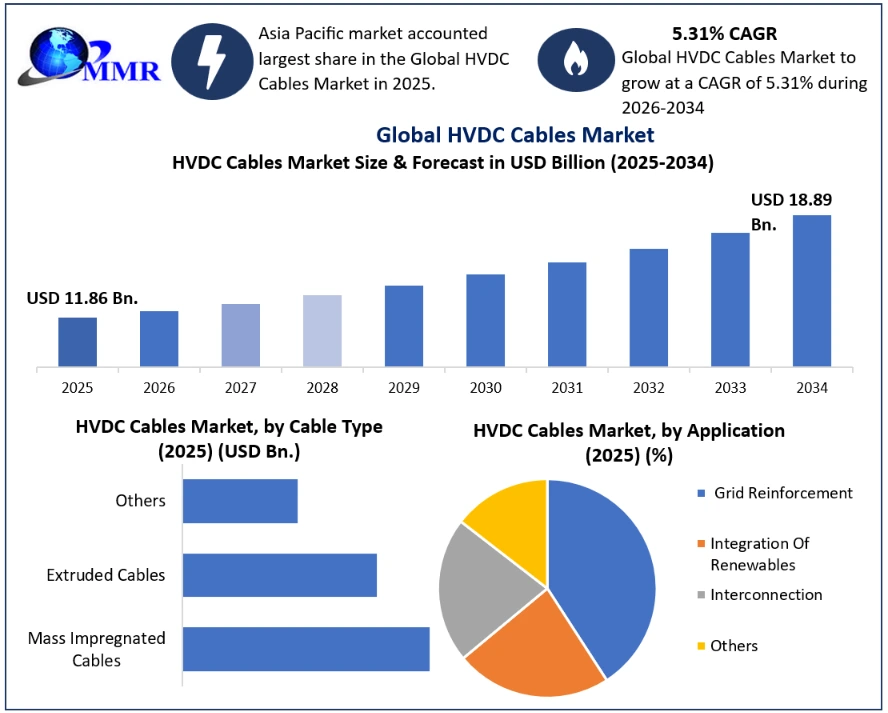
The HVDC Cables Market size was valued at USD 11.86 Billion in 2025 and the total HVDC Cables revenue is expected to grow at a CAGR of 5.31% from 2026 to 2034, reaching nearly USD 18.89 Billion by 2034.
HVDC Cables Market Overview:
A high-voltage direct current (HVDC) cable is the preferred transmission technology for long-distance bulk electric power transmission. HVDC cables connect power networks across countries and continents to ensure that energy infrastructures are secure and reliable A conductor and insulator make comprise a cable, which can be run underground or underwater. HVDC cables are a superior alternative for carrying energy over long distances than alternating current (AC) cables, which are more widely utilized.
The HVDC cables have numerous advantages over traditional cables and are mostly used to supply energy to oil and gas facilities such as floating production storage and offloading and other platforms located in or near the ocean. The majority of HVDC cables used voltages ranging from 100 to 800 kV. Power can also be transferred across grid systems that operate at different frequencies, such as 50 Hz and 60 Hz, using HVDC.
HVDC Cables Market Growth Outlook
To know about the Research Methodology :- Request Free Sample Report
HVDC Cables Market Dynamics:
Trends that are expected to boost the HVDC Cables Market perspective:
• Growing demand for UHVDC cables:
The Ultra-high voltage direct current cables are used to transmit electricity over long distances with minimum power loss. This ability to minimize power loss over long distances has raised the demand along with installations across the globe. Many major industry companies are launching a new products in order to keep up with the pace of the market. For instance, NKT launched their 525 kV HVDC XLPE subterranean cables in May 2021, which is expected to be used in planned high voltage direct current corridor projects in Germany. According to an MMR analyst, the market segment is expected to be worth US$ 530 million by the end of the forecast period.
• An increase in the number of transmission projects is expected to increase the use of overhead HVDC cables
The growing demand for energy in emerging countries, such as India and China has increased as a result of rapid industrialization and urbanization. This has also resulted in the upgrading of existing power infrastructure in order to extend the reach of electrical supplies, leads necessitating the installation of overhead HVDC cables. In addition, land-based transmission grids are simple to operate and maintain, and HVDC cables can be constructed in difficult terrain. A steady increase in the number of power transmission projects in China and India has fueled the use of overhead HVDC cables, which is driving the market growth.
• German government initiatives to alter the market for HVDC cables
In Germany, the growing number of wind farms, along with transmission line and power station upgrades, has resulted in an increase in demand for HVDC cables. The government has taken steps to meet the electrical needs of their growing industry and urban areas by heavily investing in these projects and collaborating with industry players. For instance, in 2020, Prysmian inked an agreement with Amprion GmbH, a German grid operator, to supply a 525 kV HVDC cable system for project A-Nord. Such activities are expected to aid in increasing the country's HVDC cable consumption rate.
Increase In Usage of XLPE HVDC Cables:
The growing use of HVDC cable in Oil and gas sector is driving the HVDC cable market growth across the globe. XLPE HVDC cable cables have several advantages that make them more popular than standard cables. These polymer insulated cables are lighter and easier to handle. They're also easier to connect than paper-insulated cables and offer a greater conductor temperature. As a result, the wire can be smaller and the construction can be more compact. XLPE cables allow the use of several additives including antioxidants, cross-linking agents, lubricating additives, and scorch-resistant additives. These factors are expected to uplift the HVDC cable market growth during the forecast period.
The Growing Demand for Subsea HVDC Cables across the globe:
The underwater HVDC cables market is driven by increased capital investment to build offshore wind farms, along with rising sustainable power demand across the globe. The technical adoption is expected to push by the growth of island linkages, followed by safe and dependable offshore transmission. For instance, Siemens Gas & Power was awarded a contract for over USD 450 million in June 2020 to build a 300-kilometer HVDC link across mainland Greece. In addition, increased public and private investments in modern transmission lines, along with government attempts to adopt renewable energy assets, are expected to uplift the HVDC cables market during the forecast period.
HVDC Cables Market Segment Analysis:
Based on the Application, the HVDC Cables Market is segmented into Overhead Line, Submarine, and Underground. The Submarine segment held the largest market share, accounting for 51.3% in 2025. The growing adoption of HVDC cables in Submarine projects across the globe is boosting the market growth. In addition, ongoing off-shore projects across the globe are increasing the product demand. For instance, The BRITIB project, a 1330 km undersea HVDC installation for energy transmission, has brought together the United Kingdom, Spain, and France. Russia and Japan have decided to build a Russia-Japan grid, which will use high-voltage direct current (HVDC) cables to connect the two nations' energy grids. China's state grid corporation is constructing 3200 kilometers of high-voltage direct current (HVDC) cables for energy transmission. In addition, by 2034, the United States is expected to invest more than US$ 70 billion in subsea wind energy installations.
HVDC Cables Market Regional Insights:
Asia Pacific region held the largest market share accounted for 38.3% in 2025. The Asia Pacific HVDC cables market share will be driven by the rising need for reliable and uninterrupted electricity, along with increasing measures to electrify rural places across the region. Growing investment towards upgrading power capacities and electric infrastructure, in countries like China and India, is expected to drive the HVDC cables market growth.
In India, POWERGRID's EHVAC (up to 765 kV) and +800/+500kV HVDC transmission networks are used for bulk power transmission. As of June 30, 2021, POWERGRID's transmission network has 172,154 circuit kilometers of transmission lines with a transformation capacity of 446,940 Mega Volt Amperes (MVA) and 262 substations.
The market for HVDC cables in Japan is predicted to rise as investments in clean energy networks increase, along with the number of submarine power cable projects in the region. The growing demand for improved submersible cables across offshore installations to provide effective power supply is boosting the product demand.
The European region is expected to grow at CAGR of 5.17% during the forecast period. Icelink, a 1200km subsea HVDC link between the United Kingdom and Iceland, has been announced by the United Kingdom. The EuroAfrica Interconnector, which is separated into two sections, is expected to install a 1396 km submarine HVDC between Egypt, Cyprus, and Greece. The first phase has finished in 2020, while the second phase is expected to complete in 2021. In 2021, Germany announced its DolWin5 project in Europe, which will be completed in 2025 and is located 100 kilometres distant in the North Sea. As a result, factors including a rise in offshore wind turbine installations, particularly in the European region, are expected to uplift the HVDC cables market.
The objective of the report is to present a comprehensive analysis of the global HVDC Cables Market to the stakeholders in the industry. The past and current status of the industry with the forecasted market size and trends are presented in the report with the analysis of complicated data in simple language. The report covers all the aspects of the industry with a dedicated study of key players that include market leaders, followers, and new entrants.
PORTER, PESTEL analysis with the potential impact of micro-economic factors of the market have been presented in the report. External as well as internal factors that are supposed to affect the business positively or negatively have been analyzed, which will give a clear futuristic view of the industry to the decision-makers.
The reports also help in understanding the Market dynamic, structure by analyzing the market segments and projecting the HVDC Cables Market size. Clear representation of competitive analysis of key players by Application, price, financial position, product portfolio, growth strategies, and regional presence in the HVDC Cables Market make the report investor’s guide.
HVDC Cables Market Recent Developments:
| Date | Company | Development | Impact |
|---|---|---|---|
| 19 January 2026 | NKT A/S | NKT signed final contracts valued at €2 billion with SSEN Transmission for two major 525 kV HVDC power cable links connecting Western Isles and Spittal to Peterhead in Scotland. | The agreement delivers 3.8 GW of combined transmission capacity to transmit offshore wind energy and reinforce the UK National Grid. |
| 03 February 2026 | Prysmian Group | Prysmian Group secured a €2.3 billion contract for Eastern Green Link 4 (EGL4) with SP Energy Networks and National Grid Electricity Transmission. | The turn-key cable system will supply 880 km of 525 kV subsea HVDC cables to transmit up to 2 GW of renewable power between Scotland and England. |
| 04 March 2026 | NKT A/S | NKT executed a record-breaking €2.2 billion firm contract for Eastern Green Link 3 (EGL3) with National Grid Electricity Transmission and SSEN Transmission. | The landmark project covers the design, manufacture, and installation of a 680 km 525 kV HVDC subsea and onshore power cable system. |
| 15 June 2026 | LS Cable & System | LS Cable & System won a KRW 146 billion (~$104 million) contract from KEPCO for Section 1 of the 500kV East Coast–East Seoul HVDC Phase 2 project. | The development deploys independently developed 500kV 90°C high-temperature HVDC underground power cables to deliver energy directly to the Seoul metropolitan area. |
| 27 August 2026 | Nexans SA | Nexans successfully qualified its 525 kV HVDC mass impregnated submarine cable system for ultra-deepwater installation down to 3,000 meters. | Presented at CIGRE 2026, this technology milestone unlocks record-breaking deepwater routing options for the Great Sea Interconnector (Crete–Cyprus). |
HVDC Cables Market Scope: Inquiry Before Buying
| HVDC Cables Market | |||
|---|---|---|---|
| Report Coverage | Details | ||
| Base Year: | 2025 | Forecast Period: | 2026-2034 |
| Historical Data: | 2020 to 2025 | Market Size in 2025: | USD 11.86 Billion |
| Forecast Period 2026 to 2034 CAGR: | 5.31% | Market Size in 2034: | USD 18.89 Billion |
| Segments Covered: | by Cable Type | Mass Impregnated Cables Extruded Cables Others |
|
| by Installation | Overhead Submarine (Underwater) Cables Underground |
||
| by Conductor Material | Aluminum Copper |
||
| by Voltage | High Voltage (33 kV - 200 kV) Extra High Voltage (200 kV - 800 kV) Ultra High Voltage (Above 800 kV) |
||
| by Technology | Line Commutated Converter (LCC) Voltage Source Converter (VSC) |
||
| by Power Transmission Type | Intra-Regional Cross Border Others |
||
| by Application | Grid Reinforcement Integration Of Renewables Interconnection Others |
||
| by End-User Industry | Industrial Renewable Energy Oil And Gas Utilities Others |
||
HVDC Cables Market by Region
North America (United States, Canada and Mexico)
Europe (UK, France, Germany, Italy, Spain, Sweden, Austria, Turkey, Russia and Rest of Europe)
Asia Pacific (China, India, Japan, South Korea, Australia, ASEAN and Rest of APAC)
Middle East and Africa (South Africa, GCC, Egypt, Nigeria and Rest of ME&A)
South America (Brazil, Argentina, Columbia and Rest of South America)
HVDC Cables Market, Key Players
1. Sumitomo Electric Industries, Ltd.
2. Prysmian Group
3. Nexans
4. General Electric
5. Hitachi Energy
6. Siemens Energy
7. Mitsubishi Electric
8. Eaton Corporation
9. NKT A/S
10. LS Cable & System Ltd.
11. ZTT
12. Taihan Cable & Solution Co., Ltd.
13. TBEA
14. ZMS Cable
15. ILJIN Electric
16. Alfanar Group
17. Southwire
18. Sudkabel GmbH
19. Borealis AG
20. Furukawa Electric Co., Ltd.
21. RPG Cables
22. XLCC
23. ABB Ltd.
24. Hengtong Optic-Electric Co., Ltd.
25. Jiangsu Zhongtian Technology Co., Ltd.
26. Brugg Kabel AG
Others
Frequently Asked Questions:
1] What segments are covered in the HVDC Cables Market report?
Ans. The segments covered in the HVDC Cables Market report are based on Type, Application, and region
2] Which region is expected to hold the highest share of the HVDC Cables Market?
Ans. The Asia Pacific region is expected to hold the highest share of the HVDC Cables Market.
3] What is the market size of the HVDC Cables Market by 2034?
Ans. The market size of the HVDC Cables Market by 2034 is USD 18.89 Bn.
4] What is the growth rate of the HVDC Cables Market?
Ans. The Global HVDC Cables Market is growing at a CAGR of 5.31% during the forecasting period 2026-2034.
5] What was the market size of the HVDC Cables Market in 2025?
Ans. The market size of the HVDC Cables Market in 2025 was USD 11.86 Bn.