HVAC Systems Market- Industry Structure Evaluation, Demand Drivers Analysis, Regional Growth Analysis and Identification, Competitive Positioning / Landscape Review & Global Market Size Forecast to 2034

5.8%
CAGR (2026-2034)
169 USD Bn.
Forecast Market Size
305
Report Pages
138
Market Tables

Overview

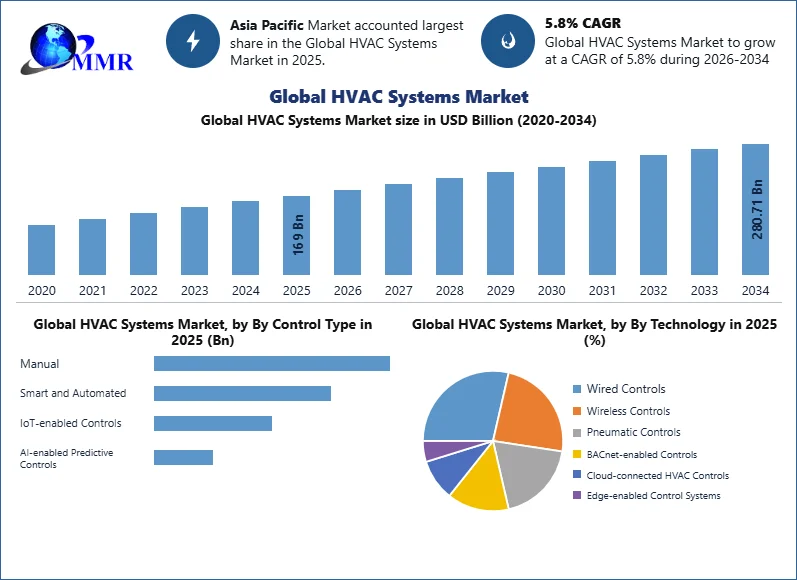
The HVAC Systems Market size was valued at USD 169 Billion in 2025 and the total HVAC Systems revenue is expected to grow at a CAGR of 5.8% from 2025 to 2034, reaching nearly USD 280.71 Billion by 2034.

HVAC Systems Market Overview:

HVAC stands for heating and cooling both residential and commercial buildings, as well as the many systems used to move air between indoor and outdoor locations. They are the systems that keep you warm and comfortable in the winter and cool and refreshing in the summer. Heat Pumps, Furnaces, Boilers, and Unitary Heaters are the types of heating equipment. Humidifiers, Dehumidifiers, Air Purifiers, Air Filters, Ventilation Fans, and Air Handling Units are the types of ventilation equipment. Room Air Conditioners, Unitary Air Conditioners, Chillers, Coolers, Cooling Towers, and VRF Systems are the types of cooling Equipment.

The value of the Global HVAC Systems Market was estimated at USD 169 Billion in 2025, with an expected value of USD 280.71 Billion by 2034, representing a CAGR of 5.8% during the forecast period. The development of Internet of Things based HVAC systems, artificial intelligence based predictive maintenance, wireless controls and integrated Building Management Systems (BMS) is revolutionizing the industry through enhanced efficiency and lower energy usage. The global HVAC Systems market is gaining momentum from increased focus on energy efficiency standards, adoption of lower GWP refrigerants and green building initiatives. The Asia-Pacific region is leading the market due to rapid infrastructural development and rising construction activities, whereas North America and Europe regions are experiencing robust growth due to building retrofits, decarbonization and upgrading commercial and industrial buildings. High competitive rivalry prevails in the market and companies strive for innovations and digitalization of products, partnership programs and building smart HVAC ecosystems.
 

To know about the Research Methodology :- Request Free Sample Report

HVAC Systems Market Dynamics:

The launch of new technologically enhanced products that are energy-efficient and can be remotely accessed is driving the growth of the global HVAC systems market. Moreover, the global market is expected to be driven by the usage of natural refrigerants such as CO2, as well as increased initiatives by governments throughout the world to promote energy-efficient products. A paradigm shift toward the use of energy-efficient air conditioners that minimize prices and power waste is expected to maintain HVAC demand.

The demand for HVAC systems has increased as customer’s preferences for comfort have shifted. Companies are manufacturing products that not only meet the customer's comfort demands, but also provide a number of additional benefits. IoT-enabled heating and cooling systems allow for real-time monitoring of the system's functionality and condition. These HVAC systems also notify consumers or management when a system fails, exhibits unexpected behaviour, or is nearing the end of its maintenance cycle, lowering repair costs.

One of the major factors driving the rising adoption of heating and cooling technology is climate change. This is due to the uncertainty of weather and rising temperatures, many consumers see HVAC equipment as a good investment. Furthermore, HVAC systems enhance the aesthetic value of both residential and commercial buildings. Companies are manufacturing the products that are attractive to the eye and provide a variety of design possibilities. During the forecast period, increased product demand is expected as a result of improved designs and changing client preferences. These are the key drivers that are expected to boost the growth of the global HVAC Systems market during the forecast period 2025-2034.

HVAC Systems Market Segment Analysis:

Based on product type, the HVAC Systems Market is segmented into Heating, Ventilation, and Cooling. The Cooling segment is expected to hold the largest market share through 2034, driven by rising temperatures, rapid urbanization, increasing air-conditioner penetration, and expanding commercial and residential construction. Growing demand from data centers, healthcare facilities, industrial buildings, and retail infrastructure, along with the adoption of energy-efficient chillers, inverter air conditioners, VRF systems, and low-GWP refrigerants, will further support segment growth during 2026–2034.

 

Hvac Systems Market By Product Type 2025

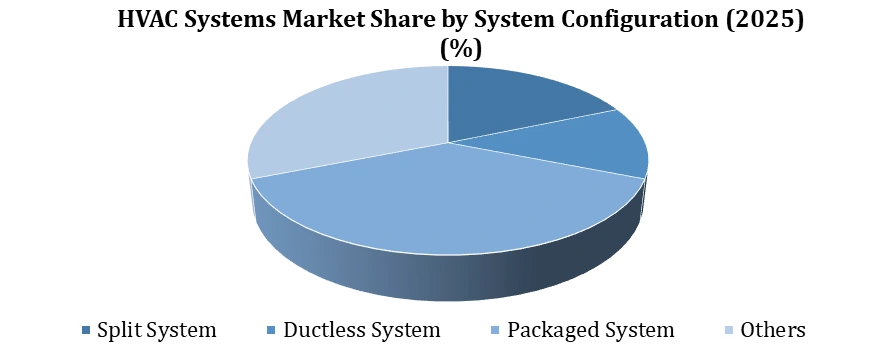
Based on system configuration, the HVAC Systems Market is segmented into Split Systems, Ductless Systems, Packaged Systems, and Others. Split Systems are expected to hold the largest market share through 2034, supported by their widespread use in residential and commercial buildings, flexible installation, energy efficiency, and independent temperature control. Rising construction activity, replacement demand, and growing adoption of inverter-based and smart HVAC systems will further support segment growth.
 

Based on system technology, the HVAC Systems Market is segmented into Direct Expansion Systems and Central Air Conditioning Systems. Direct Expansion Systems are expected to hold the largest market share through 2034, supported by their widespread use in residential and light-commercial buildings, lower installation costs, flexible configurations, and efficient zone-level cooling. Central Air Conditioning Systems will continue to gain demand across large commercial buildings, hospitals, airports, data centres, and industrial facilities requiring centralized temperature control and high-capacity cooling.

Based on installation type, the HVAC Systems Market is segmented into New Construction and Replacement/Retrofit. The Replacement/Retrofit segment is expected to hold the larger market share through 2034, driven by ageing HVAC infrastructure, stricter energy-efficiency standards, refrigerant transition, and demand for smart controls. New Construction will remain important across residential, commercial, industrial, and data-centre projects.


Based on distribution channel, the HVAC Systems Market is segmented into Online, Retail Stores, Wholesale Stores, and Others. Wholesale Stores are expected to hold the largest market share through 2034, driven by bulk procurement from contractors, installers, builders, and commercial customers. Online channels will grow rapidly due to wider product availability, price transparency, and increasing digital sales of residential HVAC equipment.

Based on end user, the HVAC Systems Market is segmented into Residential, Commercial, and Industrial. The Commercial segment is expected to hold the largest market share through 2034, driven by rising demand across offices, hospitals, retail spaces, hotels, data centres, and institutional buildings. Growing adoption of energy-efficient HVAC equipment, smart controls, and building management systems will further support segment growth.

Global HVAC Systems Market Regional Insights:

Asia Pacific dominates the Global HVAC Systems market during the forecast period 2025-2034. Asia Pacific is expected to hold the largest market share of xx% by 2034. China, India, and Japan are the key countries that boost the growth of the HVAC systems market in the Asia Pacific region. This is due to the growing population and increasing construction activities in China, India, and Japan. These are the major factors that drive the growth of this region in the Global market during the forecast period 2025-2034.

North America and Europe are expected to grow rapidly at a CAGR of xx% and xx% during the forecast period 2025-2034. This is due to the region's thriving tourist and real estate industries. Subsidies and tax breaks are being offered by the governments of both regions to support the usage of energy-efficient systems. Due to this reasons, present customers are upgrading to new energy-efficient systems in addition to new developments.

The objective of the report is to present a comprehensive analysis of the Global HVAC Systems Market to the stakeholders in the industry. The past and current status of the industry with the forecasted market size and trends are presented in the report with the analysis of complicated data in simple language. The report covers all the aspects of the industry with a dedicated study of key players that include market leaders, followers, and new entrants.

PORTER, PESTEL analysis with the potential impact of micro-economic factors of the market have been presented in the report. External as well as internal factors that are supposed to affect the business positively or negatively have been analyzed, which will give a clear futuristic view of the industry to the decision-makers.

The reports also help in understanding the Global HVAC Systems Market dynamic, structure by analyzing the market segments and project the Global HVAC Systems Market size. Clear representation of competitive analysis of key players by product, price, financial position, product portfolio, growth strategies, and regional presence in the Global HVAC Systems Market make the report investor’s guide.
Competitive Analysis HVAC Systems Market 2025

Competitive landscape of the HVAC Systems market can be described as highly competitive, where players are competing on the basis of energy efficiency, smart building technologies, and digitalization. The companies differentiate their products in terms of HVAC controls, internet of things (IoT) connected HVAC equipment, building management platforms based in the cloud, predictive maintenance systems, and use of low GWP refrigerants. Investments made are directed at decarbonization, electrification using heat pumps, data centers cooling systems, and Building Management Systems (BMS). These systems aim to provide optimized energy consumption along with improved comfort for the occupants of buildings.

Current developments within the strategic arena reinforce the trend towards digitalization and sustainability in HVAC products and services. Johnson Controls continues adding new elements to its OpenBlue digital ecosystem, such as connected building solutions based on artificial intelligence that incorporate predictive maintenance, remote diagnostics, and net-zero optimization features as well as streamlining its portfolio of commercial buildings by prioritizing smart and sustainable infrastructures. Carrier Global adds to its portfolio of climate solutions by acquiring Viessmann Climate Solutions, thereby increasing the range of heat pumps and energy transition services as well as investments in high-performance cooling equipment for AI-powered data centers. Trane Technologies moves forward with its innovations in electrified heating and thermal management systems and sustainable HVAC solutions in accordance with its decarbonization strategy. Honeywell is broadening its portfolio of connected buildings through its Honeywell Forge platform that provides for advanced analytics and building performance optimization. Schneider Electric and Siemens Smart Infrastructure are enhancing their interoperable building automation ecosystems through integration of HVAC control solutions with energy management and smart buildings platforms.


Global HVAC Systems Market Scope: Inquire before buying


Global HVAC Systems Market
Report Coverage Details
Base Year: 2025 Forecast Period: 2026-2034
Historical Data: 2020 to 2025 Market Size in 2025: USD 169Bn.
Forecast Period 2026 to 2034 CAGR: 5.8% Market Size in 2034: USD 280.71 Bn.
Segments Covered:  By Product Type Heating
By Technology Wired Controls
Wireless Controls
Pneumatic Controls
BACnet-enabled Controls
Cloud-connected HVAC Controls
Edge-enabled Control Systems
by Cooling Equipment Room Air Conditioners
Unitary Air Conditioners
Chillers
Coolers
Cooling Towers
VRF Systems
by Implementation Type New Construction
Retrofit
By System Temperature Control Systems
Ventilation Control Systems
Humidity Control Systems
Integrated Control Systems
Airflow & Pressure Control Systems
Hydronic Control Systems
Data Center Cooling Control Systems

HVAC Systems Market, by Region

North America (United States, Canada and Mexico)
Europe (UK, France, Germany, Italy, Spain, Sweden, Austria and Rest of Europe)
Asia Pacific (China, South Korea, Japan, India, Australia, Indonesia, Malaysia, Vietnam, Taiwan, Bangladesh, Pakistan and Rest of APAC)
Middle East and Africa (South Africa, GCC, Egypt, Nigeria and Rest of ME&A)
South America (Brazil, Argentina Rest of South America)

HVAC Systems Market, Key Players

  1. Honeywell International
  2. Belimo
  3. Vertiv
  4. Carrier Global
  5. Trane Technologies
  6. Lennox International
  7. Schneider Electric
  8. Siemens (Smart Infrastructure)
  9. Delta Controls
  10. Reliable Controls
  11. Distech Controls
  12. Copeland (Emerson)
  13. KMC Controls
  14. Automated Logic (Carrier)
  15. Resideo
  16. Tridium
  17. Danfoss
  18. Daikin Industries
  19. Mitsubishi Electric
  20. ABB
  21. Fr. Sauter AG
  22. Bosch Building Technologies (Bosch)
  23. Eaton
  24. Azbil Corporation
  25. Regin Controls
  26. OJ Electronics
  27. LG Electronics (HVAC Controls Division)
  28. Computrols
  29. Sontay
  30. Trend Controls (Honeywell)
  31. Emerson Electric
  32. Midea Building Technologies
  33. Swegon (Latour Industries)
  34. Systemair
  35. Priva
  36. Others

Frequently Asked Questions:

1] What segments are covered in Global Market report?
Ans. The segments covered in Global HVAC Systems Market report are based on Heating Equipment, Ventilation Equipment, Cooling Equipment, Implementation Type, and Application.

2] Which region is expected to hold the highest share in the Global Market?
Ans. Asia Pacific is expected to hold the highest share in the Global HVAC Systems Market.

3] Who are the top key players in the Global Market?
Ans. Daikin, United Technologies, Johnson Controls, Ingersoll-Rand, LG Electronics, and Electrolux are the top key players in the Global HVAC Systems Market.

4] Which segment holds the largest market share in the Global market by 2034?
Ans. VRF Systems segment hold the largest market share in the Global HVAC Systems market by 2032.

5] What is the market size of the Global HVAC Systems market by 2034?
Ans. The market size of the Global HVAC Systems market is USD 280.71 Bn. by 2034.

6] What was the market size of the Global HVAC Systems market in 2025?
Ans. The market size of the Global HVAC Systems market was worth USD 169 Bn. in 2025.

Table of Contents

1. Global HVAC Controls Market: Executive Summary 1.1. Executive Summary 1.2. Market Size (2025) & Forecast (2026-2034), 1.3. Market Size (Value in USD Million, Volume in 000'Units) and Market Share (%) – By Segments and Country 2. Competitive Landscape 2.1. MMR Competition Matrix 2.2. Competitive Positioning Of Key Players 2.3. Key Players Benchmarking 2.3.1 Company Name 2.3.2 Headquarter 2.3.3 Business Portfolio 2.3.4 Key Clients 2.3.5 Technological Integration 2.3.6 Distribution Network 2.3.7 Aftermarket and Retrofit Capabilities 2.3.8 Installation and Commissioning Network 2.3.9 Partnerships and Collaborations 2.3.10 Revenue (2025) 2.3.11 Market Share (%) 2.3.12 Profit Margin (%) 2.3.13 Growth Rate Y-O-Y (%) 2.3.14 R&D Investment (%) 2.3.15 Geographical Presence 2.3.16 Control Valve Portfolio Assessment 2.3.17 Actuator Product Benchmarking (Valve & Damper Actuators) 2.3.18 OEM HVAC Control Product Portfolio (VAV, FCU, DC/CDU Controllers) 2.4. Market Structure 2.4.1 Market Leaders 2.4.2 Market Followers 2.4.3 Emerging Players 2.5. Mergers and Acquisitions Details 3. Market Dynamics 3.1. Market Trends 3.2. Global HVAC Controls Market Dynamics 3.2.1 Drivers 3.2.2 Restraints 3.2.3 Opportunities 3.2.4 Challenges 3.3. PORTER’s Five Forces Analysis 3.4. PESTLE Analysis 3.5. Macroeconomic Impact Analysis on HVAC Controls Industry 3.6. Impact of AI, IoT, and Smart Buildings on Market Growth 4. Global HVAC Industry Overview 4.1 Market size, growth trends, and outlook (2020–2025) 4.2 HVAC system demand by sector (residential, commercial, industrial) 4.3 Regional dynamics (US vs Canada vs Mexico) 4.4 Impact of construction activity and infrastructure spending on HVAC demand 4.5 Energy consumption trends and role of HVAC in building energy use 4.6 Global Smart Building and Green Construction Trends 4.7 HVAC Electrification and Decarbonization Trends 5. Building Automation Systems (BAS) Integration 5.1 Role of HVAC controls within BAS architecture 5.2 Integration of HVAC with lighting, security, and energy management systems 5.3 Centralized vs decentralized building control architectures 5.4 BAS adoption across commercial and industrial buildings 5.5 Interoperability challenges across multi-vendor systems 5.6 Data flow, analytics, and real-time monitoring within BAS environments 5.7 Cloud-based BAS platforms and remote facility management 5.8 AI-enabled Building Automation and Autonomous Optimization Trends 6. HVAC Control System Components & Architecture 6.1 Core components of HVAC control systems (sensors, controllers, actuators) 6.2 Control system hierarchy (field devices → controllers → supervisory systems) 6.3 Direct Digital Control (DDC) system architecture and functionality 6.4 Sensor types and applications (temperature, humidity, occupancy, IAQ) 6.5 Controller types (standalone, programmable, networked controllers) 6.6 Actuators, dampers, and valves in airflow and temperature regulation 6.7 Embedded Software and Edge Device Architecture 6.8 Control Valve Types and Functional Analysis (Ball, Globe, Butterfly, PICV) 6.9 Valve Actuator Technologies (Electric, Pneumatic, Electro-Mechanical) 6.10 Damper Actuator Architecture and Application Assessment 6.11 OEM HVAC Control Components for VAV, FCU, and DC/CDU Systems 6.12 Control Accuracy, Energy Optimization, and Flow Management Analysis 7. Market Ecosystem & Industry Structure 7.1 Value chain mapping from components to end users (sensors → controllers → OEMs → integrators → end users) 7.2 Role of OEMs, system integrators, distributors, and contractors 7.3 Positioning of Building Management System (BMS) providers within the ecosystem 7.4 Integration of HVAC controls within broader building automation systems 7.5 Role of ESCOs and facility management companies in influencing demand 7.6 Degree of fragmentation vs consolidation across the ecosystem 7.7 Software Vendors and Cloud Service Providers within the Ecosystem 8. Regulatory & Compliance Landscape 8.1 Energy efficiency standards (ASHRAE, IECC, Title 24) and impact on control systems 8.2 Building codes and mandates driving HVAC control adoption 8.3 Indoor Air Quality (IAQ) regulations and post-COVID compliance shifts 8.4 Federal and state-level incentives for smart HVAC and retrofits 8.5 Regional regulatory variations (California vs other US states, Canada dynamics) 8.6 Compliance cost implications for end users and manufacturers 8.7 Net-Zero Building Regulations and Carbon Reduction Policies 9. Technology Architecture & Evolution 9.1 Transition from pneumatic to Direct Digital Control (DDC) systems 9.2 Emergence of IoT-enabled and cloud-connected HVAC control systems 9.3 Role and architecture of Building Management Systems (BMS) 9.4 Communication protocols and interoperability standards (BACnet, Modbus, KNX) 9.5 Cybersecurity risks and mitigation in connected HVAC environments 9.6 Edge vs cloud processing in real-time HVAC control optimization 9.7 AI, Machine Learning, and Predictive HVAC Control Technologies 10. Product Innovation & Roadmap Trends 10.1 Evolution of smart thermostats and AI-driven HVAC optimization 10.2 Advancements in multi-parameter and occupancy-based sensors 10.3 Integration of edge computing capabilities in control devices 10.4 Smart grid and demand-response integration features 10.5 Vendor-led innovation strategies and product differentiation 10.6 Software-led innovation (analytics platforms, predictive control systems) 10.7 Digital Twin and Predictive Maintenance Innovation Trends 10.8 Innovation Trends in Smart Valves and Intelligent Actuators 10.9 Development of Pressure Independent Control Valves (PICVs) 10.10 OEM Control Platform Evolution for VAV and FCU Applications 11. Supply Chain & Distribution Structure 11.1 Component sourcing landscape (sensors, semiconductors, control boards) 11.2 Manufacturing concentration across US, Mexico, and import dependency 11.3 Distribution models (direct sales, distributors, contractor-led channels) 11.4 Role of contractors in product specification and brand selection 11.5 Supply chain disruptions, lead times, and inventory strategies 11.6 Channel margins and value capture across the distribution network 11.7 Semiconductor Dependency and Electronics Supply Risk Assessment 11.8 HVAC Field Device Supply Chain Analysis (Valves, Actuators, OEM Controllers) 12. Production & Manufacturing Landscape 12.1 Manufacturing footprint of key HVAC control system providers 12.2 Localization vs import reliance in North America 12.3 OEM manufacturing vs outsourced production models 12.4 Capacity utilization and expansion strategies 12.5 Impact of nearshoring trends on HVAC control manufacturing 12.6 Production cost drivers and regional competitiveness 12.7 Automation and Smart Factory Adoption in HVAC Controls Manufacturing 12.8 Manufacturing Analysis of Control Valves and Damper Actuators 12.9 OEM Production Landscape for VAV, FCU, and DC/CDU Controllers 13. Installation & Integration Dynamics 13.1 Installation complexity across residential, commercial, and industrial systems 13.2 Role of system integrators and HVAC contractors in deployment 13.3 Installation cost structure and time requirements 13.4 Integration challenges with legacy HVAC infrastructure 13.5 Commissioning processes and performance optimization 13.6 Skill gap and workforce availability for advanced system installation 13.7 Regional Differences in Installation Practices and Standards 14. Replacement & Retrofit Market Dynamics 14.1 Installed base analysis of legacy HVAC control systems 14.2 Key retrofit triggers (energy savings, regulatory compliance, system failure) 14.3 Cost-benefit analysis of retrofit vs full system replacement 14.4 Retrofit penetration across building types and regions 14.5 Impact of building age and infrastructure condition on upgrade cycles 14.6 Financing models and incentives supporting retrofit adoption 15. Pricing, Cost Structure & Margin Analysis (2025) 15.1 Component-level pricing trends (sensors, controllers, actuators) 15.2 System-level pricing across residential, commercial, and industrial segments 15.3 Installation, maintenance, and lifecycle cost analysis 15.4 Margin distribution across manufacturers, distributors, and contractors 15.5 Pricing premium for smart and connected HVAC control systems 15.6 Impact of input cost fluctuations on final system pricing 15.7 Pricing Benchmark Analysis for Control Valves and Actuators 15.8 OEM Controller Cost Structure Analysis (VAV, FCU, DC/CDU) 16. Material & Component Analysis 16.1 Key material inputs (semiconductors, plastics, metals) in HVAC controls 16.2 Sensor-specific material dependencies and cost implications 16.3 Electronic component supply risks and shortages 16.4 Impact of material cost volatility on manufacturing economics 16.5 Substitution trends and material innovation in components 16.6 Sustainability considerations in material selection 17. Demand Analysis & Consumption Patterns 17.1 Demand distribution by building type and end-user segment 17.2 Seasonal demand fluctuations and climate-driven consumption patterns 17.3 Split between new installation and replacement-driven demand 17.4 Regional demand variation across US and Canada 17.5 Demand sensitivity to energy prices and utility costs 17.6 Impact of macroeconomic factors on HVAC control demand 17.7 Demand Analysis for HVAC Field Devices Across Commercial Buildings and Data Centers 17.8 Adoption Trends of Intelligent Valves and Smart Actuation Systems 18. Adoption & Penetration Analysis 18.1 Penetration of smart and connected HVAC control systems 18.2 Installed base split between DDC, pneumatic, and legacy systems 18.3 Adoption trends across residential, commercial, and industrial sectors 18.4 Key barriers to adoption (cost, complexity, awareness, interoperability) 18.5 Adoption lifecycle across different building categories 18.6 Role of incentives and ROI visibility in accelerating adoption 19. End-User Behavior & Decision-Making 19.1 Key purchasing criteria (cost, energy efficiency, compliance, ease of use) 19.2 Decision-making stakeholders (facility managers, contractors, building owners) 19.3 Vendor selection and brand preference factors 19.4 ROI expectations and payback period analysis 19.5 Differences in buying behavior across end-user segments 19.6 Influence of contractors and integrators on final purchase decisions 20. Sustainability & Energy Efficiency Impact 20.1 Contribution of HVAC controls to building energy efficiency 20.2 Carbon emission reduction potential across applications 20.3 Role in achieving green building certifications (LEED and equivalents) 20.4 ESG-driven investment and adoption trends 20.5 Integration with renewable energy and smart grid systems 20.6 Regulatory push toward low-energy and net-zero buildings 21. Trade Analysis & Cross-Border Dynamics (2025) 21.1 Import-export trends for HVAC control systems and components 21.2 Key trade corridors (US–Mexico–China–Southeast Asia) 21.3 Dependency on imported electronic components and sensors 21.4 Impact of tariffs, duties, and trade policies on pricing 21.5 Role of nearshoring and USMCA in supply chain restructuring 21.6 Trade balance and domestic manufacturing competitiveness 22. Aftermarket, Services & Maintenance Ecosystem 22.1 Share of aftermarket vs new installation revenue 22.2 Preventive vs predictive maintenance trends 22.3 Role of service contracts and AMC models 22.4 Software upgrades and recurring revenue streams 22.5 Retrofit-driven service demand 22.6 Role of contractors and OEM service arms 22.7 Replacement Cycles and Maintenance Trends for Valves & Actuators 22.8 Retrofit Opportunities for Legacy VAV and FCU Control Systems 23. Project Economics & ROI Analysis 23.1 Capex vs Opex comparison for HVAC control investments 23.2 Payback period across different system types and end users 23.3 Energy savings potential and cost reduction analysis 23.4 ROI comparison: retrofit vs new construction 23.5 Impact of incentives and rebates on project economics 23.6 Sensitivity analysis (energy prices, usage intensity, building type) 24. Use Case & Application Deep Dive 24.1 HVAC control requirements in office buildings 24.2 Retail and hospitality-specific control needs 24.3 Healthcare and critical environment control systems 24.4 Industrial and warehouse HVAC automation use cases 24.5 Data center cooling and precision control requirements 24.6 Residential smart HVAC adoption use cases 24.7 VAV Control Applications in Commercial Buildings 24.8 FCU Control Optimization in Hospitality and Healthcare Infrastructure 24.9 DC/CDU Control Applications in Data Center Cooling Systems 25. Digitalization & Software Ecosystem 25.1 Role of software platforms in HVAC control systems 25.2 Data analytics and performance optimization tools 25.3 Integration with enterprise systems (ERP, facility management) 25.4 SaaS-based HVAC control platforms 25.5 Remote monitoring and diagnostics trends 25.6 Monetization of software and data services 26. Global HVAC Controls Market: Market Size and Forecast by Segmentation (by Value in USD Million and Volume in 000 Units) (2025-2034) 26.1. Global HVAC Controls Market Size and Forecast, By Component (2025-2034) 26.1.1Sensors 26.1.1.1Temperature Sensors 26.1.1.1.1 Humidity Sensors 26.1.1.1.2 Occupancy Sensors 26.1.1.1.3 Pressure Sensors 26.1.1.1.4 Flow Sensors 26.1.1.1.5 Others 26.1.2Controllers and Controlled Equipment 26.1.2.1Controlled Equipment 26.1.2.1.1 Control Valves 26.1.2.1.1Ball Valves 26.1.2.1.1.1 Globe Valves 26.1.2.1.1.2 Butterfly Valves 26.1.2.1.1.3 Pressure Independent Control Valves (PICVs) 26.1.2.3 Heating & cooling Oils 26.1.2.3.1 Dampers 26.1.2.3.2 Actuators Valve Actuators 26.1.2.3.3 Damper Actuators 26.1.2.3.4 Electric Actuators 26.1.2.3.5 Pneumatic Actuators 26.1.2.3.6 Electromechanical Actuators 26.1.2.3.7 o Others 26.1.2.3.8 Smart Vents 26.1.2.3.9 Controllers 26.1.2.3.10 Variable Air Volume 26.1.2.3.11 VAV Controllers 26.1.2.3.12 Fan Coil Unit 26.1.2.3.13 FCU Controllers 26.1.2.3.14 Programmable 26.1.2.3.15 Direct Digital 26.1.2.3.16 DC/CDU Controllers 26.1.2.3.17 AHU Controllers 26.1.2.3.18 Others 26.1.2.3.19 Thermostats 26.1.2.3.20 Others 26.2. Global HVAC Controls Market Size and Forecast, By Control Type (2025-2034) 26.2.1 Manual 26.2.2 Smart and Automated 26.2.3 IoT-enabled Controls 26.2.4 AI-enabled Predictive Controls 26.3. Global HVAC Controls Market Size and Forecast, By System (2025-2034) 26.3.1 Temperature Control Systems 26.3.2 Ventilation Control Systems 26.3.3 Humidity Control Systems 26.3.4 Integrated Control Systems 26.3.5 Airflow & Pressure Control Systems 26.3.6 Hydronic Control Systems 26.3.7 Data Center Cooling Control Systems 26.4. Global HVAC Controls Market Size and Forecast, By Implementation Type(2025-2034) 26.4.1 New Construction 26.4.2 Retrofit 26.4.3 Replacement & Upgrade Projects 26.5. Global HVAC Controls Market Size and Forecast, By Technology (2025-2034) 26.5.1 Wired Controls 26.5.2 Wireless Controls 26.5.3 Pneumatic Controls 26.5.4 BACnet-enabled Controls 26.5.5 Cloud-connected HVAC Controls 26.5.6 Edge-enabled Control Systems 26.6. Global HVAC Controls Market Size and Forecast, By End User (2025-2034) 26.6.1 Residential 26.6.2 Commercial 26.6.3 Office 26.6.4 Retail 26.6.5 Education 26.6.6 Healthcare 26.6.7 Hospitality 26.6.8 Commercial Complexes & Smart Buildings 26.6.9 Others 26.6.10 Industrial 26.6.11 Manufacturing 26.6.12 Data Centers 26.6.13 Telecom Facilities 26.6.14 Pharmaceutical & Clean Room Facilities 26.6.15 Warehouses 26.6.16 Others 26.7. Global HVAC Controls Market Size and Forecast, By Region (2025-2034) 26.7.1 North America 26.7.2 United States 26.7.3 Mexico 26.7.4 Canada 26.7.5 Europe 26.7.6 United Kingdom 26.7.7 France 26.7.8 Germany 26.7.9 Italy 26.7.10 Spain 26.7.11 Sweden 26.7.12 Russia 26.7.13 Rest of Europe 26.7.14 Asia Pacific 26.7.15 China 26.7.16 South Korea 26.7.17 Japan 26.7.18 India 26.7.19 Australia 26.7.20 Indonesia Philippines 26.7.21 Malaysia 26.7.22 Vietnam 26.7.23 Thailand 26.7.24 Rest of Asia Pacific 26.7.25 Middle East and Africa 26.7.26 South Africa 26.7.27 Saudi Arabia 26.7.28 Qatar 26.7.29 UAE 26.7.30 Egypt 26.7.31 Nigeria 26.7.32 Rest of ME&A 26.7.33 South America 26.7.34 Brazil 26.7.35 Argentina 26.7.36 Colombia 26.7.37 Chile 26.7.38 Rest Of South America 27. Company Profile: Key Players 27.1. Johnson Controls 27.1.1 Company Overview 27.1.2 Business Portfolio 27.1.3 Financial Overview 27.1.4 SWOT Analysis Strategic Analysis 27.1.5 Recent Developments 27.2. Honeywell International 27.3. Belimo 27.4. Vertiv 27.5. Carrier Global 27.6. Trane Technologies 27.7. Lennox International 27.8. Schneider Electric 27.9. Siemens (Smart Infrastructure) 27.10. Delta Controls 27.11. Reliable Controls 27.12. Distech Controls 27.13. Copeland (Emerson) 27.14. KMC Controls 27.15. Automated Logic (Carrier) 27.16. Resideo 27.17. Tridium 27.18. Danfoss 27.19. Daikin Industries 27.20. Mitsubishi Electric 27.21. ABB 27.22. Fr. Sauter AG 27.23. Bosch Building Technologies (Bosch) 27.24. Eaton 27.25. Azbil Corporation 27.26. Regin Controls 27.27. OJ Electronics 27.28. LG Electronics (HVAC Controls Division) 27.29. Computrols 27.30. Sontay 27.31. Trend Controls (Honeywell) 27.32. Emerson Electric 27.33. Midea Building Technologies 27.34. Swegon (Latour Industries) 27.35. Systemair 27.36. Priva 27.36.1 Others 28. Key Findings 29. Analyst Recommendations 30. Research Methodology

Custom Market Research Services

We Will Customise The Research For You, In Case The Report Listed Above Does Not Meet With Your Requirements