
Global Gelatin Market Analysis: Industry Trends, Industry 4.0, Top Technology Advancements in Gelatin Manufacturing Industry 2032
Overview
The Gelatin Market Size was valued at USD 3.40 Billion in 2025, and the total revenue is expected to grow at a CAGR of 6.7% from 2026 to 2032, reaching USD 6.50 Billion by 2032
The Gelatin Market is driven by rising demand across pharmaceuticals, nutraceuticals, food & beverages, and cosmetics. Gelatin is widely used in capsule manufacturing, confectionery, dairy stabilization, and collagen-based supplements. Growing health awareness, protein fortification trends, and clean-label preferences are accelerating collagen peptide demand. Asia-Pacific leads production, while Europe and North America dominate high-value pharmaceutical applications. The market is shifting toward halal-certified, marine-derived, and specialty pharmaceutical-grade gelatin segments.
Gelatin Market – Key Highlights
Pharmaceutical Demand Surge: Over 42% of global gelatin consumption is attributed to pharmaceutical applications, with capsule manufacturing accounting for nearly 65–70% of pharma-grade gelatin usage.
Functional Nutrition Expansion: Collagen and gelatin-based functional foods recorded 38% growth in demand (2020–2024), driven by protein fortification, gut health, and joint-support products.
Capsule Production Dominance: Hard and soft gelatin capsules represent approximately 75% of total global capsule production, with softgel demand increasing 12–15% annually due to nutraceutical expansion.
Premium Confectionery Growth: Gelatin-based confectionery contributes nearly 45% of food-grade gelatin demand, with gummy supplements growing 20%+ YoY globally.
Halal & Kosher Shift: Halal-certified gelatin demand increased by 18–22% in the past three years, especially across Southeast Asia and the Middle East.
Marine & Alternative Sources Expansion: Fish-derived gelatin production rose by 14% annually, driven by religious restrictions and clean-label requirements.
Asia-Pacific Leadership: Asia-Pacific accounts for approximately 35–38% of global gelatin production, with China and India being key processing hubs.
Clean Label & Collagen Trend: Hydrolyzed collagen (collagen peptides) usage increased by 40%+ between 2020–2024, particularly in sports nutrition and beauty-from-within products.
Industrial & Technical Applications: Photography, microencapsulation, and biomedical applications account for 8–10% of total gelatin utilization, with biomedical scaffolding demand rising steadily.
Price Volatility Factor: Raw material costs (bovine & porcine hides) fluctuated by 15–25% annually, impacting gelatin pricing dynamics globally.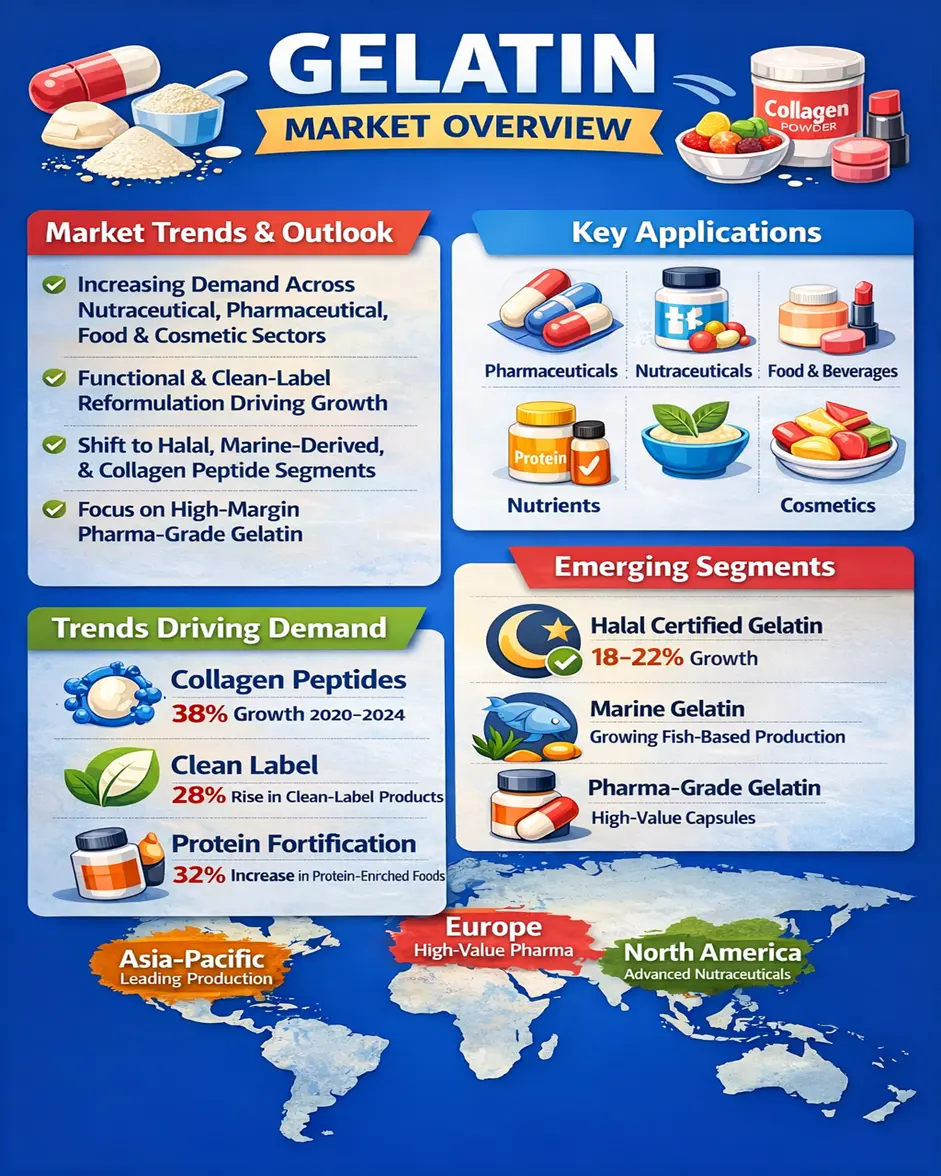 To know about the Research Methodology :- Request Free Sample Report
Industry Adoption Trends in the Gelatin Market
Pharmaceutical & Nutraceutical Sector
Gelatin contributes up to 35–45% of total excipient usage in capsule manufacturing Nearly 70% of oral drug capsules globally use gelatin shells 65% of nutraceutical brands use gelatin or collagen peptides in softgels and gummies 52% of consumers prefer capsule formats over tablets for easier ingestion 48% of supplement manufacturers expanded gummy production lines between 2021–2024 Softgel production capacity increased by 12–15% annually driven by omega-3 and vitamin demand
Food & Beverage Industry
Gelatin accounts for approximately 40–50% of total hydrocolloid usage in confectionery applications 45% of gummy confectionery products use animal-based gelatin Functional gummy supplements recorded 20%+ YoY growth globally Dairy desserts using gelatin stabilizers increased by 9–12% annually Premium confectionery manufacturers report 18% higher margins on gelatin-based products vs starch alternatives.
Cosmetics & Personal Care
Collagen-infused beauty supplements grew by 38% (2020–2024) 60% of ingestible beauty brands use hydrolyzed gelatin/collagen peptides Skin-health positioning drives 25% higher retail pricing for collagen-based formulations Asia-Pacific accounts for nearly 40% of beauty-from-within product demand
Opportunity: Rising Functional & Clean Label Trends in the Gelatin Market
Functional health positioning has become a structural growth driver across global markets.
Protein Fortification Growth
● Protein enrichment has become central to product innovation across food, beverage, and supplement categories.
● Protein-enriched food and beverage launches increased by 32% globally between 2020–2024
● Collagen peptide consumption grew by 38–40% during the same period, driven by sports nutrition and beauty-from-within products
● Functional gummy supplements expanded at 20–25% annual growth rates, significantly increasing gelatin utilization
● Nearly 55% of new supplement launches in North America include collagen or gelatin derivatives
● Ready-to-mix collagen beverage powders saw double-digit retail sales growth across the U.S., Europe, and Japan
Halal & Religious Compliance Expansion
1. Religious compliance is reshaping sourcing strategies and geographic trade flows in the Gelatin Market.
2. Halal-certified gelatin demand increased by 18–22% over the last three years
3. Southeast Asia and Middle East markets report 12–15% annual growth in fish-derived gelatin imports
4. Marine gelatin production expanded by 14–16% annually, outpacing bovine and porcine growth rates
5. More than 60% of pharmaceutical exporters to OIC countries now require halal-certified capsule shells
6. Indonesia and Malaysia have tightened halal labeling regulations, increasing demand for certified gelatin supply chains
Single-Ingredient & Clean Label Preference
● Consumers are actively reducing artificial additives and synthetic stabilizers in processed foods.
● Clean-label product launches increased by 28% globally between 2020–2024
● Nearly 48% of consumers prefer products with recognizable ingredients
● Gelatin-based stabilizers are replacing synthetic hydrocolloids in 15–20% of reformulated SKUs
● Premium confectionery brands report 18–22% pricing premiums for clean-label positioning
● Organic and grass-fed bovine gelatin demand increased by double-digit rates in North America
● Gelatin’s positioning as a natural protein-derived stabilizer provides a competitive advantage over synthetic gelling agents such as modified starches and synthetic gums.
● Strategic Implication:
● Clean-label reformulation is pushing gelatin producers toward traceability systems, sustainable sourcing certifications, and antibiotic-free livestock sourcing.
Premiumization & Application Diversification
● Growth is increasingly concentrated in value-added segments rather than bulk commodity volumes.
● Pharmaceutical-grade gelatin commands 25–40% higher pricing than standard food-grade variants
● Softgel capsule production capacity expanded by 12–15% annually, driven by omega-3 and vitamin D supplements
● Biomedical gelatin applications (wound care, tissue scaffolds) are growing at high single to low double-digit rates
● Microencapsulation technologies using gelatin are expanding in flavor and probiotic delivery systems
Gelatin Market Segment Analysis
Based on Source Type
Bovine gelatin remains the dominant segment, accounting for approximately 55–60% of Gelatin market share.
Bovine Gelatin: Widely used in pharmaceuticals and confectionery due to strong gel strength and availability.
Porcine Gelatin: Represents nearly 30–35% of global production, dominant in capsule manufacturing.
Marine Gelatin: Fastest-growing segment, expanding at 14–16% annually, driven by halal and clean-label demand.
Others (Poultry & Alternative Sources): Emerging niche applications in biomedical and specialty food formulations.
Based on Application
Pharmaceuticals: Largest revenue-generating segment, contributing 40%+ of global gelatin demand, primarily in capsule shells in 2025.
Food & Beverages: Accounts for 35–40%, led by confectionery, desserts, and dairy stabilization.
Nutraceuticals: Rapidly growing segment, expanding at 15%+ annually, particularly in collagen peptides and gummies.
Industrial & Biomedical: Accounts for 8–10%, including photography, microencapsulation, and tissue engineering scaffolds.
Gelatin Market Regional Analysis
Europe remains a dominant but high-value market in 2025, driven by premium pharmaceutical-grade gelatin and strict regulatory compliance standards. Germany and France are key production centers with advanced collagen peptide manufacturing capabilities.
Asia Pacific is emerging as the fastest-growing region in the Gelatin Market in 2025, accounting for 38% of global production capacity. China and India serve as major processing hubs due to abundant raw material availability and lower manufacturing costs. Rising pharmaceutical manufacturing, expanding nutraceutical consumption, and increasing confectionery demand are driving double-digit growth in select markets. Expanding halal-certified production further strengthens regional export competitiveness.
Gelatin Market Recent Development:
November 2025 : GELITA to introduce MEDELLAPRO® Ultra Low Endotoxin Gelatin, a highly versatile gelatin excipient engineered specifically for high - purity, bioprinting-grade applications in bioscience, tissue engineering and regenerative medicine.
May 2025: Darling Ingredients announced a strategic merger with Tessenderlo Group’s PB Leiner to form Nextida, strengthening global collagen capacity.
February 2025 : Nitta Gelatin India Limited received approval to expand its gelatin production facilities in Kerala, India. This strategic expansion reflects Nitta Gelatin’ commitment to meeting growing global demand, particularly as hard capsules and soft gels continue to gain popularity as the preferred delivery format in the pharmaceutical and nutraceutical industries.
Gelatin Industry Ecosystem

Gelatin Market Scope: Inquiry Before Buying
| Gelatin Market | |||
|---|---|---|---|
| Report Coverage | Details | ||
| Base Year: | 2025 | Forecast Period: | 2026-2032 |
| Historical Data: | 2020 to 2025 | Market Size in 2025: | USD 3.4 Bn. |
| Forecast Period 2026 to 2032 CAGR: | 6.7% | Market Size in 2032: | USD 6.5 Bn. |
| Segments Covered: | by Type | Type A Type B |
|
| by Source | Porcine Bovine Marine Others |
||
| by Function | Stabilizer Thickener Gelling Agent Others |
||
| by Application | Food & Beverages ○ Functional Foods ○ Meat Processing ○ Functional Beverages ○ Dietary Supplements ○ Confectionery ○ Desserts Pharmaceuticals Cosmetics & Personal Care Others |
||
Gelatin Market Key Players are:
- Darling Ingredients Inc.
- GELITA AG
- PB Leiner
- Nitta Gelatin NA Inc.
- SAS Gelatines Weishardt
- Sterling Biotech Ltd.
- Lapi Gelatine S.p.A.
- Trobas Gelatine BV
- Juncà Gelatines
- Italgelatine S.p.A.
- India Gelatine & Chemicals Ltd.
- Gelnex
- Ewald Gelatine GmbH
- Reinert Gruppe Ingredients GmbH
- Kubon Gelatin Pte. Ltd.
- Pioneer Jellice India Private Limited
- Healan Ingredients
- Pure Gelatin
- Nutra Food Ingredients
- Bernard Jensen Products Inc.
- Geltech Co., Ltd.
- Jiliding Marine Biotech Co. Ltd.
- Qinghai Gelatin Ltd. Co.
- Jiangxi Cosen Biochemical Co., Ltd.
- Narmada Gelatines Ltd.
- Kenney & Ross Limited
- Geliko LLC
- Jellice Pioneer Europe B.V.
- Others