
Fish Farming Market Size by Fish Type, Environment, Production System, Feed Type, Region – Revenue Pool Analysis, Margin Structure Assessment, Capital Flow Trends, Competitive Benchmarking & Forecast to 2034
Overview
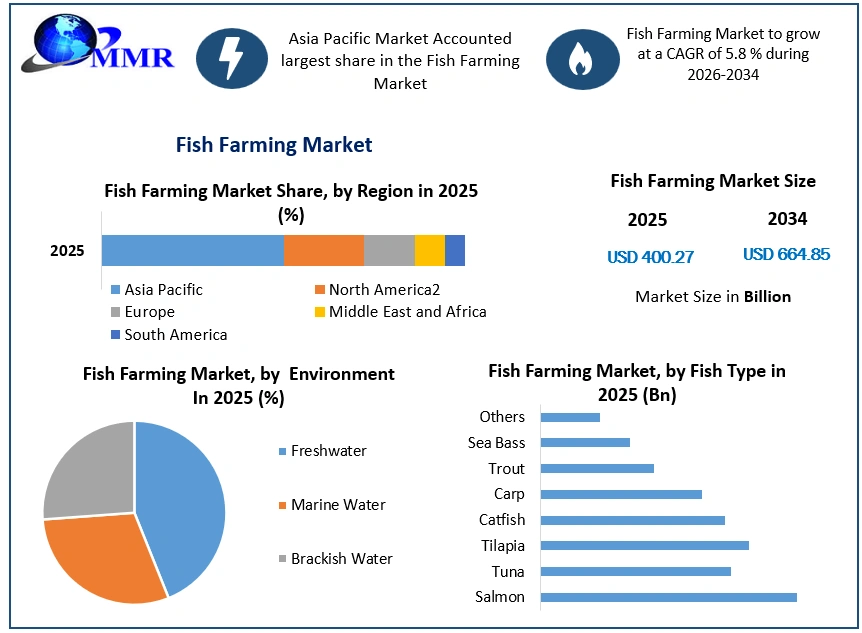
The Fish Farming Market was valued at USD 400.27 Bn in 2025, and total global Fish Farming Market revenue is expected to grow at a CAGR of 5.8% and reach nearly USD 664.85 Bn from 2026 to 2034.
Fish Farming Market Overview:
Aquaculture, often known as pisciculture, is the practise of growing, breeding, and rearing fish species. Fish farming is the process of commercially raising fish in tanks, ponds, or other enclosures. It is a crucial part of the food producing process. Overfishing has been addressed through fish aquaculture. Many people's cultural traditions include fish. Protein, fatty acids, vitamins, minerals, and critical micronutrients are all abundant in them. Fish farming takes place in three different conditions, depending on the fish's habitat: freshwater, marine water, and brackish water.
Fish Farming Market Growth and Share Analysis
To know about the Research Methodology :- Request Free Sample Report
Fish Farming Market Dynamics:
Changes in people's food consumption habits all around the world have contributed to the rise of the fish farming market. Consumers find it convenient to purchase packaged fish farming due to the increase of the retail market and easy availability of the product through multiple sales channels, which drives sales figures. Fish aquaculture is currently a requirement to meet food demand and supply. This industry raises fish in a clean environment to ensure that they are of excellent quality and disease-free. Fish farming is also used by companies to help save species that are on the edge of extinction. These are the key factor that drives the growth in the global market during the forecast period 2024-2030.
The surge in vegetarianism and strict laws against animal cruelty are the major factor that hampers the growth of the global fish farming market during the forecast period. On the contrary, the global fish farming industry is expected to benefit from the surge in popularity of protein-rich diets.
Fish Farming Market Segment Analysis:
Based on fish type, the market is segmented into salmon, tuna, tilapia, catfish, carp, trout, sea bass, and others. Salmon is expected to dominate global demand due to their premium positioning and high consumption across North America, Europe, and the Asia-Pacific. Tilapia, catfish, and carp remain popular in developing regions as cost-effective protein sources. Trout and sea bass cater to niche but growing markets, particularly in Europe. Rising urbanization, health consciousness, and changing dietary patterns are driving demand across all fish types, with a strong focus on sustainable and high-quality species.
Based on the Production System, the market is segmented into pond culture, cage culture, recirculating aquaculture systems (RAS), open sea culture, tanks & raceways, and others. Pond culture remains the most widely used system due to low operational cost and ease of management, especially in Asia-Pacific. Cage culture is gaining traction in coastal regions due to scalability and higher yield. RAS is witnessing rapid adoption in developed economies as a sustainable and high-tech solution, despite higher initial costs. Open sea culture and tanks & raceways serve specialized farming needs, driven by technological innovations and export-oriented production.
Fish Farming Market Regional Insights:
Asia Pacific dominates the Global Fish Farming market during the forecast period 2026-2034. Asia Pacific is expected to hold the largest market shares of xx% by 2034. This is due to rise in demand of seafood in the country and growing inclination of government and private sectors to prepare national fisheries development plan to increase fish farming. Furthermore, the region is expected to grow at the highest CAGR of 4.8% during the forecast period. These are the key factor that drives the growth of the Asia Pacific region in the global market during the forecast period 2026-2034.
South America and Middle East and Africa are expected to grow rapidly at a CAGR of xx% and xx% during the forecast period. Fish farming has slowed in North America in recent years, but it has continued to grow strongly in South America, particularly in Brazil and Peru. The fish farming industry in LAMEA is expected to rise as a result of technological advancements in South America and some countries in South Africa. Furthermore, the LAMEA market is growing due to rapid growth in the Middle East in terms of infrastructure and technology. These are the major factor that drives the growth of this regions in the global market during the forecast period 2026-2034.
The objective of the report is to present a comprehensive analysis of the Global Fish Farming Market to the stakeholders in the industry. The past and current status of the industry with the forecasted market size and trends are presented in the report with the analysis of complicated data in simple language. The report covers all the aspects of the industry with a dedicated study of key players that include market leaders, followers, and new entrants.
PORTER, PESTEL analysis with the potential impact of micro-economic factors of the market have been presented in the report. External as well as internal factors that are supposed to affect the business positively or negatively have been analyzed, which will give a clear futuristic view of the industry to the decision-makers.
The reports also helps in understanding the Global Fish Farming Market dynamic, structure by analyzing the market segments and project the Global Fish Farming Market size. Clear representation of competitive analysis of key players by product, price, financial position, product portfolio, growth strategies, and regional presence in the Global Fish Farming Market make the report investor’s guide.
Fish Farming Market Recent Development
| Date | Company | Development | Impact |
|---|---|---|---|
| 12 May 2025 | Mowi ASA | The company successfully completed the strategic acquisition of Nova Sea to expand its Northern Norway farming platform. | This integration significantly strengthens Mowi’s long-term growth potential and value chain from broodstock to sales. |
| 15 June 2025 | Cooke Aquaculture | The firm launched a major land-based salmon facility expansion to increase production capacity using controlled environments. | This development enhances operational scale and reduces dependence on traditional open-water farming risks. |
| 22 January 2026 | Cermaq Group AS | The company officially scaled its disease-resistant salmon genetics programme to improve stock health and survival rates. | This initiative supports sustainable production by significantly lowering mortality rates across oceanic farm sites. |
| 10 February 2026 | Blue Ridge Aquaculture | The company commissioned an expansion of its Recirculating Aquaculture Systems (RAS) for high-density tilapia production. | The investment improves resource efficiency and allows for consistent, year-round harvest cycles independent of climate. |
| 05 March 2026 | Mowi ASA | The firm completed a company-wide deployment of AI-driven precision feeding technology across its primary salmon sites. | This automation reduces feed waste and optimizes growth rates, directly lowering the overall cost per kilogram of output. |
Fish Farming Market Scope: Inquire before buying
| Global Fish Farming Market | |||
|---|---|---|---|
| Report Coverage | Details | ||
| Base Year: | 2025 | Forecast Period: | 2026-2034 |
| Historical Data: | 2020 to 2025 | Market Size in 2025: | USD 400.27 Bn. |
| Forecast Period 2026 to 2034 CAGR: | 5.8% | Market Size in 2034: | USD 664.85 Bn. |
| Segments Covered: | by Fish Type | Salmon Tuna Tilapia Catfish Carp Trout Sea Bass Others |
|
| by Environment | Freshwater Marine Water Brackish Water |
||
| by Production System | Pond Culture Cage Culture Recirculating Aquaculture Systems (RAS) Open Sea Culture Tanks & Raceways Others |
||
| by Feed Type | Artificial Feed Natural Feed Compound Feed |
||
Fish Farming Market, by Region
North America (United States, Canada and Mexico)
Europe (UK, France, Germany, Italy, Spain, Sweden, Austria and Rest of Europe)
Asia Pacific (China, South Korea, Japan, India, Australia, Indonesia, Malaysia, Vietnam, Taiwan, Bangladesh, Pakistan and Rest of APAC)
Middle East and Africa (South Africa, GCC, Egypt, Nigeria and Rest of ME&A)
South America (Brazil, Argentina Rest of South America)
Fish Farming Market, Key Players are:
1. Alpha Group Ltd.
2. Fish farming Technologies Asia Limited
3. Cermaq Group AS
4. Cooke Aquaculture
5. Leroy Seafood Group ASA
6. Marine Harvest ASA
7. Nippon Suisan Kaisha, Ltd.
8. P/F Bakkafrost
9. Tassal Group Limited
10.Thai Union Group PLC.
11.Nireus Aquaculture S.A.
12.Blue Ridge Aquaculture
13.The Waterbase Limited
14.Zeal Aqua
15.Selonda Aquaculture S.A.
16.Carter & Sons Ltd
17.NSF Certification UK Ltd
18.Mowi ASA
19.Grupo Farallon Fish farming
20.Stolt Sea Farm
Frequently Asked Questions:
1] What segments are covered in Market report?
Ans. The segments covered in Market report are based on Environment, Production, Feed Type, and Fish Type.
2] Which region is expected to hold the highest share in the Global Fish Farming Market?
Ans. Asia Pacific is expected to hold the highest share in the Global Fish Farming Market.
3] Who are the top key players in the Global Market?
Ans. Alpha Group Ltd., Fish Farming Technologies Asia Limited, Cermaq Group AS, Cooke Aquaculture, and Leroy Seafood Group ASA are the top key players in the Global Fish Farming Market.
4] Which segment is expected to hold the largest market share in the Global Fish Farming market by 2034?
Ans. The Fresh Water segment is expected to hold the largest market share in the Global Fish Farming market by 2034.
5] What is the market size of the Global Fish Farming market by 2034?
Ans. The market size of the Global Fish Farming market is USD 664.85 Bn by 2034.
6] What was the market size of the Global Fish Farming market in 2025?
Ans. The market size of the Global Fish Farming market was worth USD 400.27 Bn by 2025.