
Fencing Equipment Market by Product, Distribution Channel, End Use and Region – Global Market Size Estimation, Industry-Wide Analysis, Competitive Landscape Assessment & Long-Term Forecast to 2032
Overview
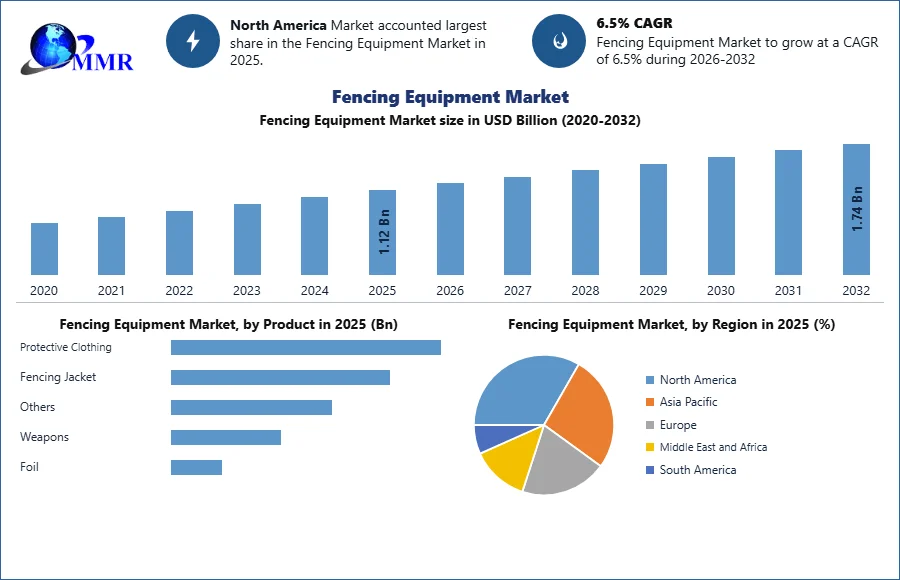
Global Fencing Equipment Market size was valued at USD 1.12 bn. in 2025 and the total Fencing Equipment Market revenue is expected to grow by 6.5% from 2026 to 2032, reaching nearly USD 1.74 Mn.
Fencing Equipment Market Overview:
Fencing equipment, including protective clothing (jackets, breeches, masks, plastrons, gloves), weapons (foil, épée, sabre), and accessories such as body wires, bags, and electronic scoring systems, is designed to ensure safety, performance, and compliance with Fédération Internationale d'Escrime (FIE) standards. The global market covers production, trade, and consumption of these items across professional, competitive, and recreational fencing. Growth is driven by rising participation in schools, universities, and clubs, increased funding from national federations, and visibility from international competitions, with North America currently leading due to established programs, suppliers like Absolute Fencing Gear and Blue Gauntlet, and interest ahead of the Los Angeles 2028 Olympics.
 To know about the Research Methodology :- Request Free Sample Report
Major international players such as Leon Paul (UK), Allstar/Uhlmann (Germany), PBT Fencing (Hungary), Prieur Sports (France), and Negrini (Italy) are expanding through innovation and global outreach, while end-users—from professional athletes to recreational participants—contribute significantly to demand. Looking ahead, the market is expected to grow steadily with technological advancements in electronic scoring and protective gear, rising global adoption of fencing, and emerging opportunities in regions such as Asia-Pacific and Latin America fuelled by youth engagement and increased sports awareness.
Fencing Equipment Market Dynamics
Rising Popularity of Fencing and Safety Standards to Boost Fencing Equipment Market
The considerable growth in the fencing equipment market is driven primarily by the growing popularity of fencing as an Olympic and competitive sport, and this has shaped demand for professional-grade equipment. Furthermore, increased engagement in fencing across clubs, schools, and colleges, particularly in Europe and North America will continue growth in the market. The increased urgency and continued emphasis of safety standards of participation in sports have created an unfailing and continual demand for high-quality protective clothing, which is a consistent driver for the fencing equipment industry.
Emerging Markets and Technological Innovation to Drive Growth Opportunities
Market opportunities for the fencing equipment market have been largely expanded through emerging market opportunities in the Asia-Pacific and Latin American regions. There is increasing awareness surrounding niche sports in these markets as user experiences and participation rise. Further, companies have the opportunity to utilize new inventive materials or technologies to provide growth opportunities for manufacturers of lighter protective gear or smart wearable technology used to monitor performance. E-commerce business opportunities and other online sports retailers continue to provide more opportunities through wider customer bases globally.
High Costs and Regulatory Compliance to restrain Fencing Equipment Market Growth
The fencing equipment market continue to face challenges, primarily due to the cost of prior purchasing professional gear in general, which will often deter novice and casual fencers alike (for example, weapons and protective clothing). The players are often required to replace worn-out equipment regularly, putting an additional financial burden on players. Also, due to the technical nature of fencing equipment, producers comply with the international regulations for fencing gear, which affects ease and increases complexity, and raises production costs.
Fencing Equipment Market Segment Analysis
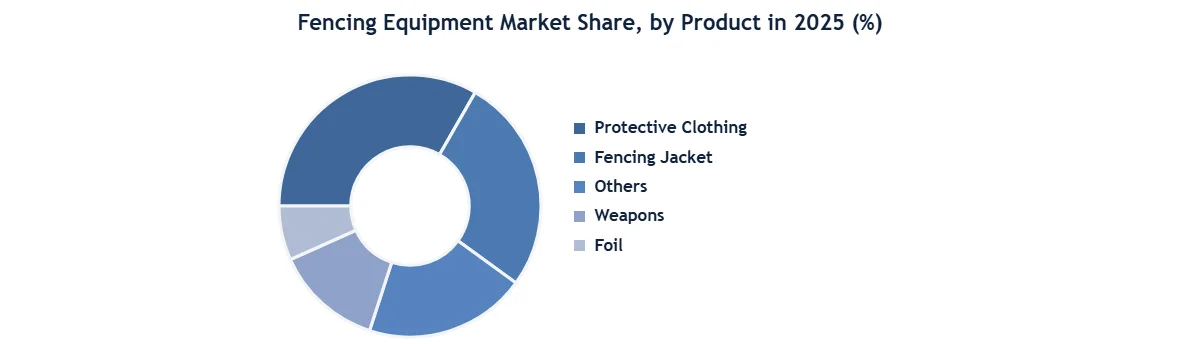
Based on Product, Fencing Equipment Market is segmented into protective clothing and weapons where Protective clothing is expected to dominate in forecast period 2025-2032. Protective clothing is the largest segment in the fencing equipment market because it is mandatory for every fencer, regardless of level or type of competition. Unlike weapons or accessories, which can be shared or chosen, protective clothing (in the form of masks, jackets, plastrons, gloves, and breeches) is required for the purposes of safety, regulations, and training or officiated matches, and are subject to a slow adoption cycle. In addition, protective clothing is worn repeatedly, becomes worn or absorbent from sweat, and is subject to safety regulations and wear/tear which requires replacement or updating, which established a steady demand in protective clothing. As such, protective clothing is the highest revenue segment and most repeat revenue segment in the fencing equipment market.
Based on End Use, Fencing Equipment Market is segmented into Men, Women and Children where Men segment is expected to dominate in forecast period 2025-2032. Men's segment led the fencing equipment market because participation in fencing for men at professional and amateur levels is greater (globally) than for women. In fencing's historical perspective, fencing is dominated by men as a competitive sport, competitive tournaments, competitions at the Olympic level and relationship to instructional programs, that has added to the demand for men's fencing equipment. In addition, men's fencing is facilitated in all three weapon categories (foil, epee, sabre) and has a higher number of registered players, which includes increased purchase of protective clothing, weapons and accessories from the participatory level, than for women.
Regional Insights
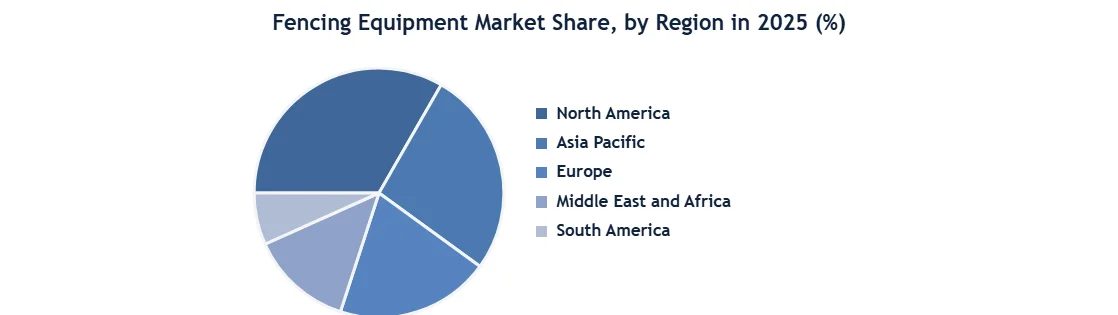
North America has the largest share of xx% in the global fencing equipment market. With the introduction of new technology in fencing, the demand for fencing equipment is seeing an increase in the use of a variety of solutions. During the forecast period, the region is expected to provide market vendors with several opportunities for development. The increasing number of promotional activities has a major impact on the growth of the fencing equipment market in this area. Vendors gain more strategic knowledge and learn about regional opportunities. During the forecast period, North America will account for 32% of the market's growth. The main markets for fencing equipment in the area are the United States, the Russian Federation, China, France, the United Kingdom, and Japan.
Competitive Landscape of Fencing Equipment:
The Fencing Equipment Market is moderately concentrated, featuring some international players, such as market leaders and differing regional players and new entrants. From market leaders Leon Paul (UK), Allstar/Uhlmann (Germany), and PBT Fencing (Hungary) to their more affordable competitors: Absolute Fencing Gear (US), Negrini (Italy), and Prieur Sports (France), each company in this sector has a focus on developing market access. Established global leaders have broad product offerings through deep product portfolios (at least in fencing gear and uniforms), and laterally broadened companies in fencing gear reflect brand credibilities as leaders with special, or fixed, contracted fencer and federation champions, or consistently report a compliance with general safety international standards independently according to each federation, or become closely partnered with federations where its athletes have achieved Olympic success. These companies have made massive investments in research and development, and now differentiate on advanced blades, state-of-the art light-weight masks, breathable FIE fabrics, integrated electronic systems, so that it is generally accepted these brands become the brand by those fencers on the Olympic circuit. Expanded challengers, Absolute Fencing Gear (US), Negrini (Italy), and Prieur Sports (France), by comparison, have a stated objective of serving clubs, schools, and youth programs while providing more affordable lines of equipment/product by competing on quality. These companies may also undertake sponsorships or projects with their country's national federations to build credibility when the federation themselves have further links. New entrants that are emerging, Blue Gauntlet (US), Alliance Fencing Equipment (US), BOPAC/OKFencing (China), and FWF Fechtwelt (Germany/Austra), depend on price, or being able to refresh their product ranges regularly or through e-commerce (including boxing up club fencer parts) for three reasons: increased demand in grassroots fencing communities, increased collected revenues now that provides opportunities in new Asia and Pacific (APAC) and Latin American markets combined by either G7, 'G20', and Asia Pacific local federated economies.
Recent Development in the Fencing Equipment Market:
1. December 2024, United States, Absolute Fencing Gear renewed and expanded its partnership with the Union Internationale de Pentathlon Moderne (UIPM), doubling its investment and ensuring the supply of high-quality fencing equipment through the Los Angeles 2028 Olympic cycle, along with continued involvement in technical studies and innovations.
2. December 2024, United Kingdom, Leon Paul Equipment Co.
Awarded the prestigious King’s Award for Enterprise, recognizing their long-standing excellence, innovation, and contributions to the fencing equipment industry.
3. Jan-2025, Negrini Fencing, Italy, introduced a new soft case made of semi-rigid fabric, combining practicality and style with high-quality materials.
4. March 2022, France Prieur Sports signed a technical partnership with the French Fencing Federation (FFE), becoming the official supplier supporting foil, épée, and sabre teams through the Paris 2024 Olympic cycle.
Key Trends in the Fencing Equipment Market
1. Increasing Emphasis on Partnering and Sponsorship
Companies like Absolute Fencing Gear and Prieur Sports are partnering with international sports federations (UIPM, FFE) which not only provides visibility during key events but may be securing a more official sponsorship relationship during high-profile global events like the Olympic Games. The long-term aspect of relationships with sponsorship and partnerships is the important takeaway here, as it reinforces brand visibility, consistency of demand, and credibility in professional fencing.
2. Newness and Diversity of Product Offerings
Some newer brands (like Negrini Fencing) are returning to familiar products like semi-rigid fabric soft cases which do a decent job of balancing traditional with usefulness and beauty. There are also more established brands like Leon Paul that capitalize on their innovation and reputation for innovation with the combination of design, new technology, and high-end materials, and provide competition both athletes in safer equipment and secure convenience.
3. Quality and Consumer Feedback Loops
The barrel tolerance discomfort with Allstar Fencing is another instance of how end-user feedback has altered the marketplace. As the sport becomes more technical, even minor equipment issues can impact performance. As a result, there is external pressure to improve the quality control process, with many manufacturers investing in precision engineering or feeling compelled by their customers.
Fencing Equipment Market Report Scope: Inquire before buying
| Fencing Equipment Market | |||
|---|---|---|---|
| Report Coverage | Details | ||
| Base Year: | 2025 | Forecast Period: | 2026-2032 |
| Historical Data: | 2020 to 2025 | Market Size in 2025: | 1.12 USD Billion |
| Forecast Period 2026-2032 CAGR: | 6.5% | Market Size in 2032: | 1.74 USD Billion |
| Segments Covered: | by Product | Protective Clothing Fencing Jacket Plastrons Masks Others Weapons Foil Epee Sabre Others |
|
| by Distribution Channel | Online Offline |
||
| by End Use | Men Women Children |
||
Fencing Equipment Market, by Region
Asia Pacific (China, South Korea, Japan, India, Australia, Indonesia, Malaysia, Vietnam, Taiwan, Bangladesh, Pakistan and Rest of APAC)
Europe (UK, France, Germany, Italy, Spain, Sweden, Austria and Rest of Europe)
North America (United States, Canada and Mexico)
Middle East and Africa (South Africa, GCC, Egypt, Nigeria and Rest of ME&A)
South America (Brazil, Argentina Rest of South America)
Fencing Equipment Market, Key Players
- Absolute Fencing Gear
- Allstar Fecht-Center GmbH
- Blue Gauntlet Fencing
- Leon Paul Equipment Co. Ltd.
- Uhlmann Fechtsport
- PBT Hungary Kft.
- Prieur Sports
- Triplette Competition Arms
- Negrini Fencing Line
- Carmimari Srl
- Favero Electronics
- FWF Fencing
- StM Fencing
- Blade Fencing Equipment
- Radical Fencing
- Alliance Fencing Equipment
- The Fencing Post
- ASD Fencing
- Sokol Armory
- Fechtsport Lieffertz
- Jiangsu Jinlu Group
- Wuxi Fencing Sports
- QP Sport
- Santelli Inc.
- American Fencers Supply
- House of Fencing
- UNIC Fencing Gear
- Katana Fencing Gear
- Mergs
- BG Fencing Equipment