
Emulsifying Salt Market Size by Nature, End User, Product Type, Region – Revenue Pool Analysis, Margin Structure Assessment, Capital Flow Trends, Competitive Benchmarking & Forecast to 2032
Overview
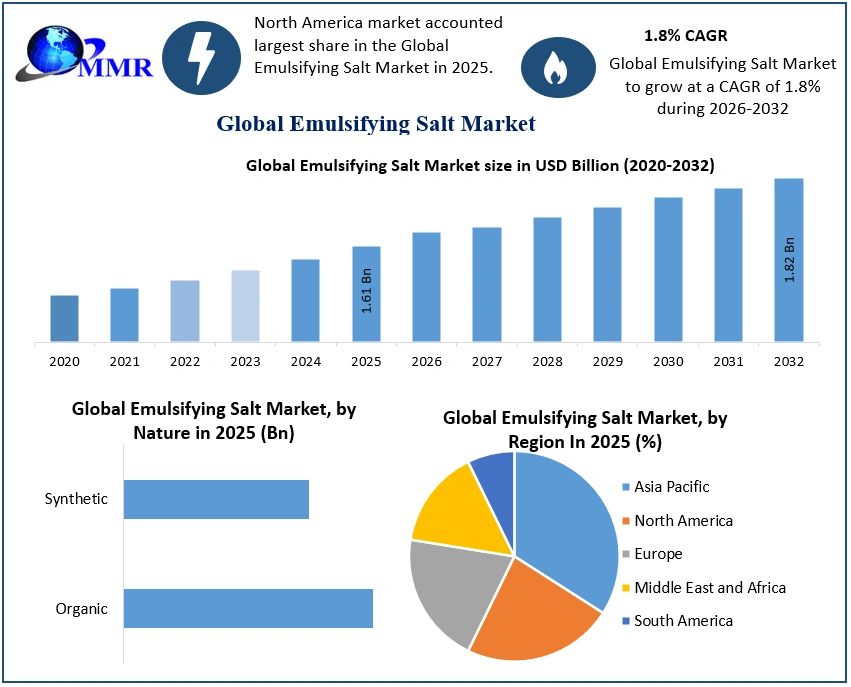
The Emulsifying Salt Market size was valued at USD 1.61 Billion in 2025 and the total Emulsifying Salt revenue is expected to grow at a CAGR of 1.8% from 2025 to 2032, reaching nearly USD 1.82 Billion by 2032.
Global Emulsifying Salt Market Overview:
Emulsifying Salts or Melting Salts are sodium, potassium, and calcium salts of phosphates or citrates that are used on a large scale in manufacturing processed and imitation cheese. Emulsifying Salts hold properties to dissolve and hydrate protein. The presence of this factor has resulted in a wide-scale use of Emulsifying Salts in the manufacturing of milk powder, sterilized cream, and processed cheese.
Phosphate Based Emulsifying Salts play an important role in pH adjustment that is used on a large scale in manufacturing different food products and beverages. With such a wide range of applications from Food & Beverages to the Pharmaceuticals Industry, demand for Emulsifying Salt is rising. An increase in demand for food products as a result of the rising population has resulted in the growth in the Global Emulsifying Salt Market.
 To know about the Research Methodology :- Request Free Sample Report
Global Emulsifying Salt Market Dynamics:
A report by L. Chen and H. Liu published by Tianjin University of Science and Technology suggest that the use of Emulsifying Salts to chelate Calcium in the process of manufacturing processed cheese is superior and cost-friendly as compared to other elements. Being the major user of Emulsifying Salts, more than 40% of dairy products manufacturers in the US have started using Emulsifying Salts in manufacturing processed cheese.
EU Specialty Food Ingredients, a society having its association with the FAO, has stated that the use of Emulsifying Salts in limited amount comes under essential additive in the food products and Beverages.
Emulsifying Salt possesses anti-bacterial properties that are used on a large scale in manufacturing medicines. A research report published by BioMed Research International in the year 2016 states that Calcium, Magnesium, and Zinc based Emulsifying Salts can be used on a large scale in manufacturing low-cost Anti-microbial medicines.
An increase in demand for additives with a wide-scale application in the Food and Beverages Industry is driving the growth of the Global Emulsifying Salt Market.
Restraints:
Overdose of Emulsifying Salts causes bitterness in food products they are mixed with. This is the major restraining factor.
Segment Analysis:
The Global Emulsifying Salt Market is segmented on the basis of
By Nature, It is observed that more than 70% of the Emulsifying Salts consumed by the Food & Beverages Industry is in Synthetic form. Rising demand for organic food products has resulted in a 6% increase in demand for Emulsifying Salts from Organic sources.
By End User, the Food & Beverages Industry is the major consumer of Emulsifying Salts. Demand for mineral-rich food products has resulted in a 2.1% increase in consumption of Emulsifying Salts by the Food & Beverages Industry. The Dairy Industry consumes more than 20% of the total Emulsifying Salt produced and contributes to more than 35% of the total revenue of the Global Emulsifying Salt Market. Different Industries like Bakery, Pharmaceuticals, and Processed Fish and Meat industries use Emulsifying Salt on a large scale.
By Product Type, It is observed that Phosphate and Acetate based Emulsifying Salt dominate the total consumption of Emulsifying Salts Market. Citrate Based Emulsifying Salt is used on a large scale in manufacturing Beverages. Acid-Based Emulsifying Salt is used in the Processed Meat and Fish Industry. Different types of Emulsifying Salts are used as per need by different industries.
It is observed that increasing demand for processed cheese and other dairy products has resulted in a 3% increase in demand for Emulsifying Salt by the Dairy Industry in the US and Europe. The preference for emulsified health supplements, dietary products, and beverages has resulted in a 3.7% increase in revenue generated by the Global Food & Beverages Industry.
An increase in the number of mineral deficiency diseases has resulted in a 6% increase in sales of mineral-based medicines. A rising preference for mineral-rich drugs regularly has resulted in a 4% increase in consumption of Emulsifying Salt by the Pharmaceuticals Industry. An increase in consumption of bakery and confectionery products and the use of Emulsifying Salts in its process of manufacturing has resulted in a 7% increase in consumption of it by the Bakery Industry.
Rising preference for Meat products as a rich source of minerals has resulted in a 2.1% increase in demand for Emulsifying Salt by the Processed Meat Industry. Different industries use Emulsifying Salt as per need.
Regional Insights:
Increasing demand for Emulsifying additives by the Dairy Industry has resulted in a 6% increase in consumption of Emulsifying Salt in North America. It is observed that consumption of Emulsifying Salt by the Bakery & Pharmaceuticals Industry has risen by 2% in this region. The presence of a big Dairy and Meat Processing Industry in this region has resulted in a 4% increase in sales of Emulsifying Salt in this region.
Europe is the biggest consumer of Phosphate based Emulsifying Salts. Preference for processed cheese on a large scale has resulted in a 3.8% increase in consumption of Emulsifying Salt in this region. Increasing preference for Bakery products and large-scale consumption of anti-bacterial medicine has resulted in a 3% increase in consumption of Emulsifying Salts in the Asia-Pacific region. Increasing population and ever-rising demand for food products are expected to increase the consumption of Emulsifying Salt at a growth rate of 6% in this region in the coming future.
The presence of pH adjusting factors in Emulsifying Salt is used on a large scale in the Processed Meat Industry in South America. It is observed that demand for Emulsifying Salt has increased by 2.7% in this region. The Middle East and Africa’s Market is showing a growth rate of in the range of 1 to 1.3% from last 6 years. The reason for limited growth is attributed to the presence of a weak business cycle and the presence of different economic and political restraints.
The objective of the report is to present a comprehensive analysis of the global Emulsifying Salt market to the stakeholders in the industry. The past and current status of the industry with the forecasted market size and trends are presented in the report with the analysis of complicated data in simple language. The report covers all the aspects of the industry with a dedicated study of key players that include market leaders, followers, and new entrants.
PORTER, SVOR, PESTEL analysis with the potential impact of micro-economic factors of the market have been presented in the report. External as well as internal factors that are supposed to affect the business positively or negatively have been analyzed, which will give a clear futuristic view of the industry to the decision-makers.
The report also helps in understanding the global Emulsifying Salt market dynamics, structure by analyzing the market segments and Project the global Emulsifying Salt market size. Clear representation of competitive analysis of key players by product, price, financial position, product portfolio, growth strategies, and regional presence in the global Emulsifying Salt market make the report investor’s guide.
Global Emulsifying Salt Market Scope: Inquire before buying
| Emulsifying Salt Market | |||
|---|---|---|---|
| Report Coverage | Details | ||
| Base Year: | 2025 | Forecast Period: | 2026-2032 |
| Historical Data: | 2020 to 2025 | Market Size in 2025: | USD 1.61 Bn. |
| Forecast Period 2026 to 2032 CAGR: | 1.8% | Market Size in 2032: | USD 1.82 Bn. |
| Segments Covered: | by Nature | Organic Synthetic |
|
| by End User | Food & Beverages Industry Dairy Industry Bakery Industry Pharmaceuticals Industry Processed Fish & Meat Industry Others |
||
| by Product Type | Phosphate Based Citrate Based Acetate Based Acid Based Gluconate Based Others |
||
Global Emulsifying Salt Market, by Region
North America (United States, Canada and Mexico)
Europe (UK, France, Germany, Italy, Spain, Sweden, Austria and Rest of Europe)
Asia Pacific (China, South Korea, Japan, India, Australia, Indonesia, Malaysia, Vietnam, Taiwan, Bangladesh, Pakistan and Rest of APAC)
Middle East and Africa (South Africa, GCC, Egypt, Nigeria and Rest)
South America (Brazil, Argetina and Rest of South America)
Global Emulsifying Salt Market, Key Players
1. AB Mauri Food Inc.
2. Archer Daniels Midland Company
3. Associated British Foods
4. Cargill, Inc.
5. BK Giulini Corporation
6. FBC Industries Inc.
7. Fosfa Industries Ltd.
8. MTC Industries Inc.
9. Fuso Chemical Co. Ltd.
10. WTI Inc.
11. DOW
12. DuPont
13. Corteva
14. Innophos Investments Holdings
15. Montana Industrie-Holding AG
Frequently Asked Questions:
1. Which region has the largest share in Global Emulsifying Salt Market?
Ans: Europe region held the highest share in 2025.
2. What is the growth rate of Global Emulsifying Salt Market?
Ans: The Global Emulsifying Salt Market is growing at a CAGR of 1.8 % during forecasting period 2026-2032.
3. What is scope of the Global Emulsifying Salt Market report?
Ans: Global Emulsifying Salt Market report helps with the PESTEL, PORTER, COVID-19 Impact analysis, Recommendations for Investors & Leaders, and market estimation of the forecast period.
4. What was the Global Emulsifying Salt Market size in 2025?
Ans: The Global Emulsifying Salt market was valued at USD 1.61 Bn. In 2025.
5. What is the study period of this Market?
Ans: The Global Emulsifying Salt Market is studied from 2025 to 2032.