
Electroplating Market by Type, Material, Application, Material, End-Use Industry, Process Type and Region
Overview
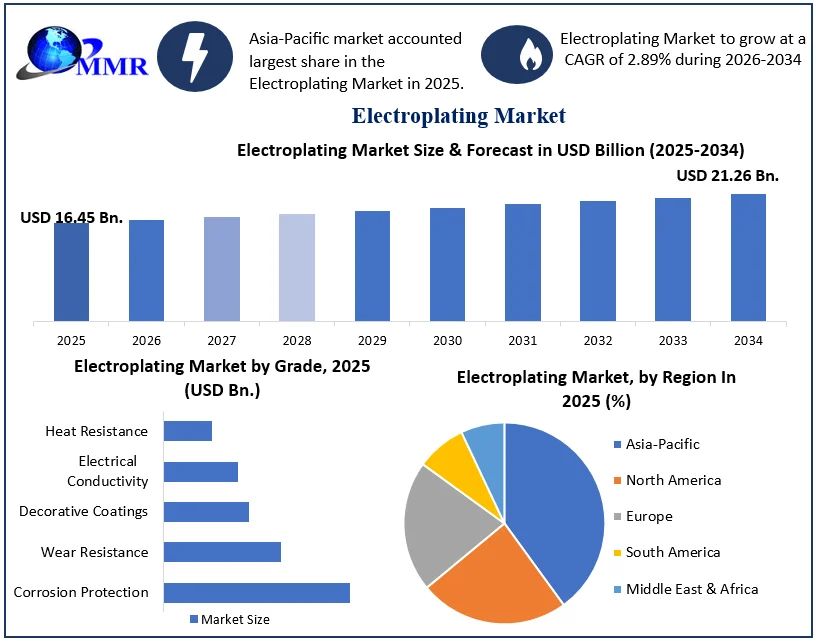
The Electroplating Market size was valued at USD 16.45 Billion in 2025 and the total revenue is expected to grow at a CAGR of 2.89 % from 2026 to 2034, reaching USD 21.26 Billion.
Electroplating Market Overview:
Electroplating is a surface-finishing process in which an electric current is used to deposit a thin layer of metal onto a component or substrate. Common plating metals include nickel, copper, chromium, zinc, tin, silver, gold, and palladium, depending on the required application. The process improves corrosion resistance, wear resistance, electrical conductivity, solderability, surface hardness, durability, and appearance, making electroplating important across automotive components, electronics, printed circuit boards (PCBs), aerospace parts, medical devices, industrial machinery, connectors, fasteners, and decorative products. The U.S. EPA identifies electroplating as an electrodeposition process and regulates associated wastewater and emissions because of the use of metals such as nickel, chromium, copper, zinc, and other chemicals.
The Global Electroplating Market is expanding as manufacturers increase the use of surface-treated components in automotive, electric vehicles, consumer electronics, semiconductor equipment, industrial machinery, aerospace, and electrical systems. Demand is also shifting toward high-performance coatings, zinc-nickel plating, trivalent chromium, precious-metal plating, automated plating lines, and environmentally compliant electroplating systems. Asia-Pacific represents a major manufacturing base for the industry, supported by automotive and electronics production across China, Japan, South Korea, India, and Southeast Asia; several market assessments identify the region as the leading regional market. As an industry-regulation example, the U.S. EPA's Electroplating Effluent Guidelines cover seven subcategories, including common metals, precious metals, anodizing, coatings, chemical etching and milling, electroless plating, and printed circuit boards, demonstrating the importance of wastewater management and compliant plating operations.
The MMR Electroplating Market Report will provide a detailed analysis of market size, forecast, CAGR, market dynamics, trends, opportunities, challenges, segmentation, regional analysis, and competitive landscape. It will cover major plating types, metal types, applications, and end-use industries, along with key developments in automotive, electronics, aerospace, medical devices, industrial machinery, sustainable plating technologies, automation, and wastewater treatment, helping clients identify emerging market opportunities and industry trends.
Electroplating Market Size, Growth and Share Analysis
To know about the Research Methodology :- Request Free Sample Report
Electroplating Market Dynamics:
Rising Demand for Durable and Corrosion-Resistant Components Is Increasing the Use of Electroplating
Growing production of automobiles, electric vehicles, electronic devices, electrical components, industrial machinery, aerospace equipment, and precision components is driving demand for electroplated surfaces. Manufacturers use nickel, copper, chromium, zinc, tin, gold, and silver coatings to improve corrosion resistance, surface hardness, electrical conductivity, wear resistance, solderability, and product life. The U.S. EPA identifies electroplating and metal-finishing operations involving more than 20 different metal pollutants, demonstrating the wide range of materials and industrial applications supported by surface-treatment processes.
High Chemical, Energy, Wastewater Treatment, and Compliance Costs Are Limiting Conventional Plating Operations
Electroplating companies need to manage expenses related to metal salts, plating baths, electricity, equipment maintenance, wastewater treatment, sludge disposal, worker protection, and environmental monitoring. The use of materials such as chromium, nickel, cadmium, lead, copper, zinc, and cyanide can increase operational and compliance requirements, particularly for large-scale facilities. In the United States, EPA requirements cover facilities with wastewater streams involving regulated pollutants and, for certain electroplating categories, treatment requirements apply to operations handling 10,000 gallons or more of wastewater per day, adding to the cost of maintaining compliant production systems.
Sustainable Plating Technologies and Process Automation Are Creating New Market Opportunities
The transition toward environmentally compliant plating chemicals, trivalent chromium, zinc-nickel coatings, cyanide-free processes, automated plating lines, closed-loop water systems, and metal-recovery technologies is creating opportunities for equipment manufacturers and plating service providers. Increasing demand for consistent coating thickness, reduced material wastage, improved process control, and lower wastewater generation is encouraging manufacturers to upgrade conventional plating facilities. The U.S. EPA has also evaluated technologies such as advanced wastewater treatment, water reuse, and zero-liquid-discharge approaches, supporting the development of more resource-efficient electroplating operations.
Stringent Environmental Regulations and Hazardous Waste Management Remain Key Industry Challenges
Electroplating manufacturers must control heavy-metal wastewater, chemical residues, plating sludge, air emissions, and worker exposure, while maintaining consistent coating quality across different component shapes and production volumes. Regulatory requirements can vary across countries and regions, requiring companies operating internationally to adapt their processes and documentation to different environmental standards. The U.S. EPA's electroplating framework covers seven major subcategories, including common metals, precious metals, anodizing, coatings, electroless plating, chemical etching and milling, and printed circuit boards, illustrating the complexity of environmental management across the industry.
Electroplating Market Segment Analysis:
1. By Type
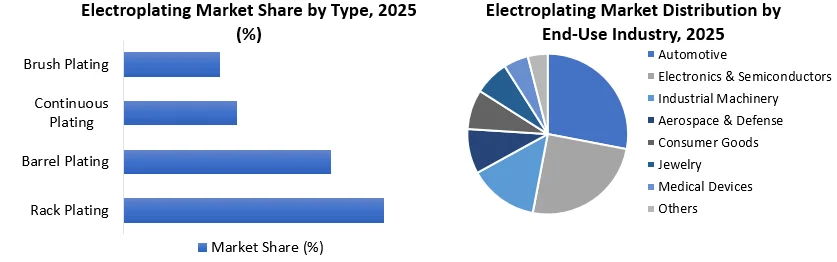
The By Type segment is divided into Barrel Plating, Rack Plating, Continuous Plating, and Brush Plating. Barrel plating is mainly used for high-volume processing of small components such as fasteners, screws, nuts, washers, and electrical parts, offering efficient batch processing and lower handling requirements. Rack plating is suitable for larger, delicate, complex, or high-value components where individual positioning provides better control over coating quality and thickness. Continuous plating is used for long and continuously fed materials such as wires, strips, and foils, making it important for electronics and electrical applications requiring high production speed. Brush plating is a selective process used to coat specific areas of a component and is particularly useful for repair, maintenance, localized corrosion protection, and wear restoration.
2. By End-Use Industry
The By End-Use Industry segment includes Automotive, Electronics & Semiconductors, Aerospace & Defense, Industrial Machinery, Jewelry, Medical Devices, Consumer Goods, and Others. Automotive applications use electroplating for fasteners, connectors, braking components, decorative parts, and other components requiring corrosion and wear resistance. Electronics & Semiconductors require precise plating for connectors, PCBs, contacts, and semiconductor-related components where conductivity and reliability are important. Aerospace & Defense uses specialized coatings for components exposed to demanding operating conditions, while industrial machinery relies on plating to improve component durability and resistance to wear and corrosion. Jewelry and consumer goods primarily use decorative and protective coatings, whereas medical devices require controlled surface finishes for equipment, surgical instruments, and selected components.
Electroplating Market Regional Insights:
Asia Pacific dominates the Electroplating Market with the highest share in 2025. The region's focus on corrosion-resistant and high-performance materials, particularly in the electronics industry, contributes substantially to market growth. APAC has emerged as the dominant market for the automotive industry, with significant growth potential. According to MMR research China, Japan, India, and South Korea account for over 50% of global passenger car production.
China, the world's largest car market, faces intense domestic competition, especially in the electric vehicle (EV) sector. Chinese manufacturers such as BYD, Geely, and SAIC hold over 35% of the global market share in plug-in EV sales.
As per MMR report by 2026, Asia-Pacific is projected to hold the largest market share in the global metal coatings market, reaching 31.64%. North America follows with an estimated share of 29.04%, while Europe is expected to account for 28.39%. The global metal coatings market size is forecasted to reach approximately $16.46 billion by 2026, driven by increasing demand across automotive, aerospace, and industrial applications.
North America holds a significant share of the electroplating market, with the United States leading due to its strong automotive sector. The demand for electroplating is driven by the need for corrosion-resistant and aesthetically enhanced vehicle parts, along with advancements in plating techniques for electric vehicle components. In Europe, the market thrives on high-quality manufacturing standards, with Germany, France, the UK, Italy, and Spain contributing to steady demand, particularly in the automotive and aerospace industries.
South America, led by Brazil, is witnessing growth due to increasing industrialization and the expansion of the automotive and electronics sectors, which rely on electroplating for enhanced component durability. Meanwhile, the Middle East and Africa are emerging markets, benefiting from rising industrial investments in construction, automotive, and electronics. Overall, these regional dynamics highlight the crucial role of electroplating in diverse industries, supporting infrastructure, technological advancements, and product longevity worldwide.
Report Scope and Objective
The objective of the report is to present a comprehensive analysis of the global Electroplating Market to the stakeholders in the industry. The past and current status of the industry with the forecasted market size and trends are presented in the report with the analysis of complicated data in simple language. The report covers all the aspects of the industry with a dedicated study of key players that include market leaders, followers, and new entrants.
PORTER, PESTEL analysis with the potential impact of micro-economic factors of the market have been presented in the report. External as well as internal factors that are supposed to affect the business positively or negatively have been analyzed, which will give a clear futuristic view of the industry to the decision-makers.
The reports also help in understanding the Electroplating Market dynamic, and structure by analyzing the market segments and projecting the Electroplating Market size. Clear representation of competitive analysis of key players by Product type, price, financial position, product portfolio, growth strategies, and regional presence in the Electroplating Market make the report an investor’s guide.
Recent Industry Development
| Date | Company | Development | Impact |
| 01 April 2026 | Elsyca | Acquired Hivelix, a specialist in advanced surface-treatment simulation, including multiphysics modelling and AI-assisted process optimization. (elsyca.com) | Strengthens the use of digital simulation, AI-assisted optimization, and computer-aided engineering in electrochemical surface finishing, supporting better process control and coating quality. |
| 27 March 2026 | B & B Electroplating Co., Inc. | Completed the acquisition of Rapid Electroplating Process, Inc., a manufacturer of portable electroplating equipment, systems, supplies, and chemicals. The transaction closed on 16 March 2026. (generational.com) | Expands B & B Electroplating's capabilities in portable and field-based plating solutions, supporting industrial repair, restoration, and precision metal-finishing applications. |
| 09 March 2026 | Metalor Technologies | Completed the acquisition of Gannon & Scott after receiving regulatory approvals, bringing the precious-metal refining and recovery company into the Metalor/TANAKA group. (METALOR) | Strengthens precious-metal recovery, recycling, and refining capabilities serving electroplating, electronics, aerospace, medical-device, and jewelry applications. |
| 03 February 2026 | Lutron Electronics | Acquired Tanury Industries, a surface-finishing and metal-coatings company that has supplied Lutron with metal faceplates for more than 25 years. (Lutron) | Brings plating and coating capabilities in-house, strengthening supply-chain integration for decorative metal finishes used in lighting, electronics, automotive, aviation, and luxury applications. |
| 18–20 February 2026 | MKS Atotech / MFAI | MKS Atotech participated in Indian Surface Finishing 2026 (ISF 2026) in Bengaluru, showcasing sustainable surface-finishing technologies, while the event placed strong emphasis on environmentally responsible processes and replacing hazardous chemicals. (Atotech) | Highlights the industry's movement toward sustainable electroplating, safer chemicals, Cr(VI)-free technologies, and environmentally compliant surface-finishing processes. |
| 20 January 2026 | Sumco / Industrial Manufacturing Group | Sumco, a division of Industrial Manufacturing Group, acquired National Integrated Industries, whose American Electro Products division provides gold, silver, rhodium, palladium, nickel, and tin electroplating services. (Carter Morse & Goodrich) | Expands the group's metal processing and finishing portfolio, strengthening capabilities across precious-metal and industrial electroplating applications. |
| 22 January 2026 | Westfield Electroplating Company / U.S. Naval Sea Systems Command | Westfield Electroplating received a USD 26,940 U.S. Navy purchase order for cadmium-zinc plating services, with completion scheduled for May 2026. (GovTribe) | Demonstrates continued demand for specialized corrosion-resistant plating in defense equipment, naval systems, maintenance, repair, and component refurbishment. |
Electroplating Market Scope: Inquire before buying
| Electroplating Market | |||
|---|---|---|---|
| Report Coverage | Details | ||
| Base Year: | 2025 | Forecast Period: | 2026-2034 |
| Historical Data: | 2020 to 2025 | Market Size in 2025: | 16.45 USD Billion |
| Forecast Period 2026-2034 CAGR: | 2.89% | Market Size in 2034: | 21.26 USD Billion |
| Segments Covered: | by Type | Barrel Plating Rack Plating Continuous Plating Brush Plating |
|
| by Material | Gold Silver Copper Nickel Zinc Chromium Others (Platinum, Palladium, Tin, etc.) |
||
| by Application | Corrosion Protection Wear Resistance Decorative Coatings Electrical Conductivity Heat Resistance |
||
| by End-Use Industry | Automotive Electronics & Semiconductors Aerospace & Defense Industrial Machinery Jewelry Medical Devices Consumer Goods Others |
||
| by Process Type | Electroplating Electroless Plating |
||
Electroplating Market by Region
North America (United States, Canada and Mexico)
Europe (UK, France, Germany, Italy, Spain, Sweden, Austria and Rest of Europe)
Asia Pacific (China, South Korea, Japan, India, Australia, Indonesia, Malaysia, Vietnam, Taiwan, Bangladesh, Pakistan and Rest of APAC)
Middle East and Africa (South Africa, GCC, Egypt, Nigeria and Rest of ME&A)
South America (Brazil, Argentina Rest of South America)
Key Players / Competitors Profiles Covered in Brief in Global Electroplating Market Report in Strategic Perspective:
1. Aalberts N.V.
2. Atotech (MKS Instruments, Inc.)
3. MacDermid Enthone Industrial Solutions (Element Solutions Inc.)
4. Umicore
5. Sharretts Plating Company, Inc.
6. Technic Inc.
7. Pioneer Metal Finishing, LLC
8. Klein Plating Works, Inc.
9. Dr.-Ing. Max Schlötter GmbH & Co. KG
10. Jing Mei Industrial Ltd.
11. Plateco, Inc.
12. SS Electroplaters
13. Frost Electroplating
14. Solarplating
15. Columbia Chemical
16. JCU Corporation
17. PAVCO, Inc.
18. Aman Metal Finishers Ltd.
19. The Plating Place
20. SSoss Cast Pte Ltd.
21. Kuntz Electroplating, Inc.
22. Peninsula Metal Finishing, Inc.
23. Superchem Finishers
24. Advanced Plating Technologies
25. Precision Plating Company, Inc.
26. Uyemura & Co., Ltd.
27. Coventya International
28. Metalor Technologies SA
29. DuPont de Nemours, Inc.
30. Mitsubishi Materials Corporation
31. Allied Finishing, Inc.
32. Electro-Spec, Inc.
33. Interplex Holdings Pte. Ltd.
34. SIFCO Applied Surface Concepts
35. Advanced Surface Technologies, Inc.
36. Valence Surface Technologies LLC
37. Arlington Plating Company
38. Industrial Metal Finishing
39. Karas Plating Ltd.
40. Alpha Metal Finishing
41. Metal Craft Plating
42. Erie Plating Company
43. Roy Metal Finishing
44. Bronson Plating Company
45. Tawas Plating Company
46. ECO Finishing Company
47. ENS Technology Ltd.
48. Gold Touch, Inc.
49. Bajaj Electroplaters Pvt. Ltd.
50. Sheen Electroplaters Pvt. Ltd.
Frequently Asked Questions:
1. What was the size of the Global Electroplating Market in 2025?
The Global Electroplating Market was valued at USD 16.45 million in 2025.
2. What is the expected size of the Global Electroplating Market by 2034?
The Global Electroplating Market is expected to reach USD 21.26 million by 2034, growing at a CAGR of 2.89% during 2026–2034.
3. What are the major segments covered in the Global Electroplating Market?
The market is segmented by Type, Material, Application, End-Use Industry, and Process Type. Major categories include barrel plating, rack plating, gold, silver, copper, nickel, corrosion protection, automotive, electronics & semiconductors, and electroplating.
4. Which industries are driving demand for electroplating?
Key industries driving demand include automotive, electronics & semiconductors, aerospace & defense, industrial machinery, medical devices, jewelry, and consumer goods, where electroplating is used to improve corrosion resistance, durability, conductivity, wear resistance, and surface appearance.
5. What are the key factors influencing the Global Electroplating Market?
The market is influenced by increasing demand for corrosion-resistant and durable components, growth in automotive and electronics manufacturing, adoption of advanced plating technologies, environmental regulations, wastewater-treatment requirements, and the shift toward sustainable and automated electroplating processes.