
Global Dips & Hummus Market By Product Type, By Ingredient Base, By Product Category, By Packaging Type, By Product Shelf Life, By End User, By Distribution Channel, by Region and Forecast 2034
Overview
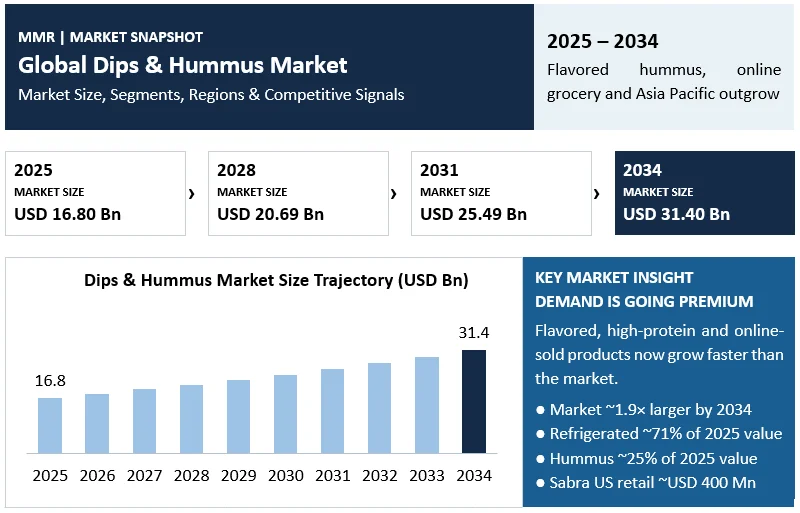
The Global Dips & Hummus Market was valued at USD 16.80 billion in 2025 and is projected to reach USD 31.40 billion by 2034, growing at a CAGR of 7.2% during 2026–2034, according to Maximize Market Research (MMR). Dips and hummus are chilled and shelf-stable savory spreads and dippers built on chickpeas and tahini, tomatoes and peppers, avocado, dairy and cheese, beans and vegetables. They are eaten with chips, pita, crackers and fresh vegetables, or used in sandwiches, wraps, salads and bowls.
This Dips & Hummus Market analysis answers both sides of the search: what the market is worth for food manufacturers, retailers and investors, and what shoppers and category buyers want to know, from what counts as a dip to the global hummus market, packaged dips market, savory dips market, plant-based dips market, flavored hummus market and ready-to-eat dips. This market overview and market analysis offer market insights into Dips & Hummus consumption, Dips & Hummus demand and Dips & Hummus supply, with a clear market summary and market outlook for stakeholders.
Refrigerated hummus, salsa and tomato-based dips anchor the market and households are the largest buyers, but Dips & Hummus Market growth is shifting toward flavored and high-protein products, online grocery, foodservice and Asia Pacific as healthy snacking trends, plant-based eating and convenient ready-to-eat formats widen the number of eating occasions. These industry trends and consumer behavior trends highlight emerging markets and growth prospects across the industry landscape.
Maximize Market Research provides comprehensive analysis of global Dips & Hummus Market size, share, product type, ingredient base, product category, packaging type, shelf life, distribution channel, end-user and regional segmentation, the Dips & Hummus competitive landscape, strategic scenarios and growth opportunities. The report helps dip and hummus manufacturers, ingredient and packaging suppliers, cold-chain providers, retailers, foodservice operators and investors decide which segments, channels and countries to prioritise through 2034. The market research findings also cover market segmentation, market dynamics, key players, market strategies and market entry options, along with the revenue generated by each segment.
|
2025 | BASE YEAR |
2034 | FORECAST |
GROWTH RATE |
LARGEST REGION |
|
USD 16.80 Bn |
USD 31.40 Bn |
7.2% |
North America |
Global Dips & Hummus Market Overview: Size, Share, Trends and Outlook to 2034
The market is measured at retail and foodservice level across hummus, salsa and tomato-based dips, guacamole and avocado-based dips, cheese-based and yogurt-based dips, bean and legume dips, vegetable dips and other specialty dips, sold refrigerated, shelf-stable or frozen in tubs, cups, pouches and jars to households, restaurants, institutions and food manufacturers. Mayonnaise, dressings, sweet spreads and nut butters are excluded.
Three shifts shape 2026–2034: demand is broadening from traditional Mediterranean hummus into flavored, high-protein and plant-based dips; value is moving toward premium, organic and clean-label products and single-serve formats; and growth is rotating toward Asia Pacific, online grocery and foodservice. Brands are answering private-label competition with new flavors, shorter ingredient lists and extended shelf-life processing. This market synopsis reflects the key growth drivers, market opportunities and challenges, along with economic factors, technological advancements and regulatory influences affecting Dips & Hummus demand and Dips & Hummus supply.
To know about the Research Methodology :- Request Free Sample Report
Key Findings: Eight Insights Shaping the Global Dips & Hummus Market
MMR’s analysis of published market data, company announcements, regulatory frameworks and industry developments points to eight findings that explain where Dips & Hummus Market growth and value are created through 2034.
|
Sr.No. |
Findings |
Evidence |
So what |
|
1 |
The market |
USD 16.80 Bn |
Ingredient |
|
2 |
Refrigerated |
Refrigerated |
Flavor |
|
3 |
North America |
38.0% share |
US retail |
|
4 |
Asia Pacific |
9.2% CAGR; |
Local |
|
5 |
Hummus |
Hummus ~25% |
Chickpea and |
|
6 |
High-protein |
High-protein |
Functional |
|
7 |
Large food |
PepsiCo |
Scale and |
|
8 |
Clean label |
Cedar’s |
Shorter |
Global Dips & Hummus Market Dynamics: Growth Drivers, Restraints, Opportunities and Trends
Global Dips & Hummus Market Growth Drivers: Plant-Based Eating, Healthy Snacking Trends, Mediterranean Cuisine and Convenience
The Global Dips & Hummus Market is supported by the mainstreaming of Mediterranean cuisine, plant-based eating and convenient snacking. Hummus and other dips are easy to use across snacking, meals and entertaining, which makes them a practical entry point for shoppers who want vegetable-forward, protein-containing foods without cooking. Healthy snacking trends are a major pull factor: consumers pair dips with vegetable sticks, pita, crackers and whole-grain chips, and chickpea-based products carry plant protein and fiber positioning that supports Dips & Hummus Market growth in both retail and foodservice. Refrigerated products account for about 71% of 2025 value, and repeat purchasing, with households buying tubs weekly or monthly, gives the market a recurring revenue base. These factors support steady Dips & Hummus Market growth across mature and emerging regions, although purchasing decisions still depend on taste, price and freshness. Demand and supply dynamics, innovation in the industry and consumer preferences evolution act as market drivers and growth catalysts for Dips & Hummus consumption.
Flavor innovation and convenience are adding new layers of demand. The flavored hummus market is expanding through roasted garlic, spicy, truffle, pesto and seasonal toppings: in January 2026 Cedar’s Foods introduced a limited-edition Pineapple Jalapeño hummus at Kroger, and in August 2026 it added a Topped Organic Lemon Dill Hommus. Ready-to-eat dips in single-serve cups, snack kits and multi-compartment packs bring the category to on-the-go occasions, and single-serve cups are projected to grow at 8.8% CAGR. Scale players are investing as well: in November 2024 PepsiCo agreed to acquire the remaining 50% of Sabra and Obela from the Strauss Group for about ILS 900 million (roughly USD 241 million), having helped build Sabra into a brand with nearly USD 400 million in US retail sales. Food manufacturers and ready-to-eat producers, about 10% of 2025 value, use dips as ingredients in sandwiches, wraps, salad kits and meal solutions, which keeps B2B volume demand high.
Global Dips & Hummus Market Restraints: Ingredient Price Volatility, Short Shelf Life, Cold-Chain Cost and Private-Label Pressure
Ingredient cost volatility is the main restraint. Chickpeas, sesame and tahini, olive and vegetable oils, avocados, dairy and cheese are agricultural commodities exposed to weather, crop yield, trade policy and currency movements, and avocado and dairy-based dips are particularly sensitive to seasonal price swings. Refrigerated dips also have a short shelf life, which raises waste at retail, limits distribution radius and requires reliable cold-chain storage and transport. Retailers can protect shelf space by sourcing private-label products at lower prices, so branded manufacturers must justify price premiums through flavor, quality and clean-label formulation. Market constraints, market volatility, industry fluctuations and macroeconomic factors, along with environmental factors such as crop conditions, shape Dips & Hummus supply and market fluctuation analysis.
Food safety, regulation and consumer perception also limit growth. Fresh dips are vulnerable to microbial growth, so manufacturers must follow HACCP-based systems, pasteurization or high-pressure processing and strict temperature control, and a single recall can damage a brand. Labeling and allergen rules, including the declaration of sesame in the United States and of allergens in the European Union, add time and cost, while organic and non-GMO claims require certification. Rigid plastic packaging faces growing recycling and plastic-reduction requirements, and competition from alternative snacks and spreads, such as nut butters, cheese snacks and flavored yogurts, can divert occasions. Energy costs for refrigeration and processing add further pressure on margins.
What Are the Biggest Dips & Hummus Market Opportunities Through 2034?
Flavored, high-protein and plant-based products, online grocery and foodservice represent the most significant opportunities because they extend revenue beyond standard refrigerated hummus. The plant-based dips market benefits from protein-rich chickpea, bean and legume formulations, and high-protein and functional products are projected to grow at 10.4% CAGR as brands add pulse proteins and fiber. Clean-label moves, such as Cedar’s June 2026 launch of a seed-oil-free organic hommus without guar gum or citric acid, show how reformulation can become a marketing advantage. Online retail, projected at 11.2% CAGR, lets brands reach shoppers outside the refrigerated aisle, and suppliers with validated recipes, strong cold-chain partners and e-commerce-ready packs may be better positioned to win new listings.
Emerging-market expansion, foodservice and premiumization offer further routes to growth. Asia Pacific is projected to be the fastest-growing region at 9.2% CAGR as China, India, Japan, Australia and Southeast Asia expand modern retail and refrigerated distribution, while Middle East & Africa, where hummus is a traditional food, benefits from modern retail expansion. Commercial foodservice, about 20% of 2025 value, is a growth route through restaurants, quick-service chains, hotels, catering and travel catering that use bulk dips and hummus in sandwiches, wraps, bowls and mezze. Premium and specialty lines, organic and non-GMO products, and extended shelf-life technologies, such as high-pressure processing and modified atmosphere packaging, can widen distribution and cut waste. Emerging trends, a market gap in convenient healthy snacking and untapped market areas create attractive segment-specific opportunities.
Dips & Hummus Market Trends: Flavor Innovation, Clean Label, Convenient Formats and Plant-Based Protein
Four Dips & Hummus Market trends stand out through 2034. First, flavor innovation: roasted garlic, jalapeño, truffle, pesto and international profiles are broadening the category, supported by limited editions and toppings. Second, clean label: shorter ingredient lists, organic and non-GMO claims, and the removal of seed oils and gums are moving from niche to mainstream. Third, convenient formats: single-serve cups, snack kits and multi-compartment packs are making ready-to-eat dips a grab-and-go product. Fourth, plant-based protein: chickpea, bean and legume dips, along with high-protein and low-sodium variants, align with healthy snacking trends. Packaging sustainability, high-pressure processing and automated filling enable these shifts, while private-label and premium brands expand side by side. Customer engagement dynamics and technology trends further support market trends analysis and industry evolution.
Global Dips & Hummus Market Segmentation: By Product Type, Ingredient Base, Product Category, Packaging Type, Shelf Life, Distribution Channel, End User and Region
Dips & Hummus Market by End User and Distribution Channel: Households, Foodservice, Retail and Online
Hummus Market, Packaged Dips Market, Product Type and Packaging Analysis
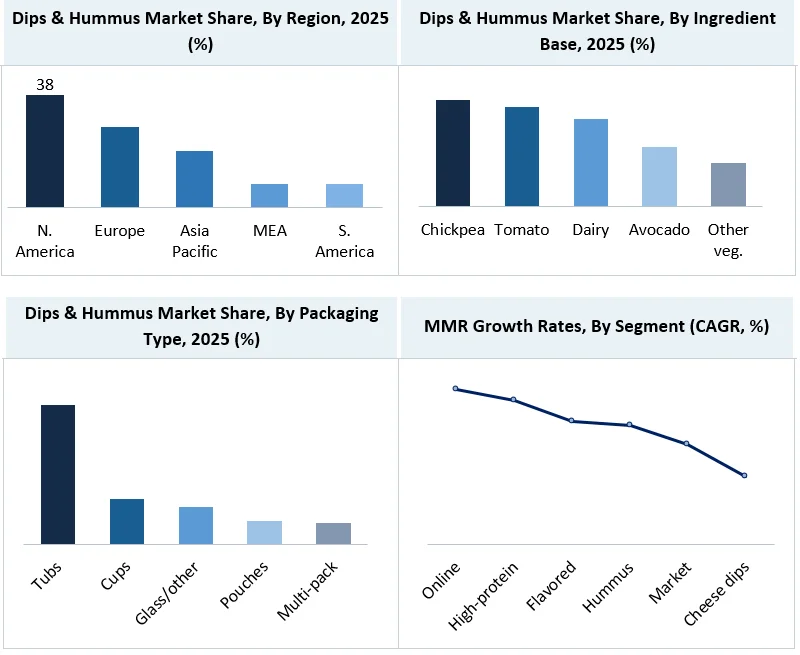
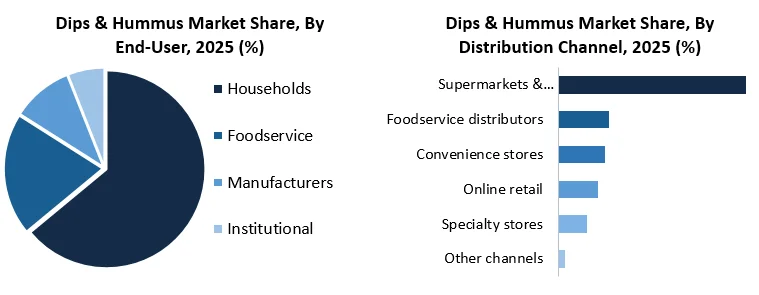
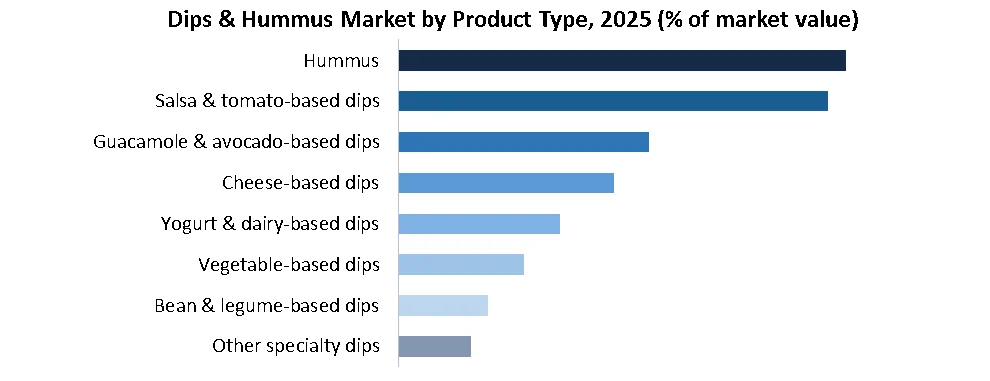
Hummus is the largest product type at about 25% of 2025 value, with the global hummus market growing at 8.6% CAGR, while salsa and tomato-based dips hold about 24%, guacamole and avocado-based dips about 14%, cheese-based dips about 12%, yogurt and dairy-based dips about 9%, vegetable-based dips about 7%, bean and legume dips about 5% and other specialty dips about 4%. The packaged dips market is led by rigid plastic tubs at about 52% of 2025 value, followed by single-serve cups at 17%, glass jars and other formats at 14%, pouches at 9% and multi-compartment packs at 8%. Flavored and seasoned products hold about 31% of value and refrigerated products about 71%. Supermarkets and hypermarkets remain the largest channel at about 52%, while online retail is the fastest at about 11.2% CAGR. This market segment analysis covers product segmentation, industry segmentation, geographic segmentation, market share by segment and segment growth analysis.
Global Dips & Hummus Market Regional Analysis: North America, Europe, Asia Pacific, Middle East & Africa and South America
North America is the largest regional market, accounting for about 38% of global value in 2025. The United States is the principal anchor, supported by high household penetration of hummus, guacamole and salsa, large refrigerated retail sections, strong private-label programs and the presence of major manufacturers, including Sabra, Cedar’s Foods, Good Foods Group and Hormel Foods. Canada contributes through fresh Mediterranean and plant-based dips and Mexico through salsa and guacamole. The region is mature, so growth is projected at about 6.2% CAGR, led by flavored, organic and high-protein products. Europe holds about 27% of 2025 value, supported by Mediterranean food consumption in Spain, Italy and France, strong supermarket private-label programs in the United Kingdom and Germany, and demand for specialty dips; Europe is expected to grow at about 6.6% CAGR. Regional market trends, market performance by region and regional market share show how local consumer behavior and regional economic factors influence Dips & Hummus consumption.
Asia Pacific is projected to be the fastest-growing region, with a 9.2% CAGR through 2034. China, Japan, India, South Korea and Australia are expanding modern retail, refrigerated distribution and interest in Mediterranean and plant-based foods; Indian brands such as Wingreens Farms, Veeba and Cornitos, and Australian suppliers such as Obela and Haig’s Delicacies, are broadening local offers and building demand for ready-to-eat dips. Middle East & Africa is a smaller market, about 8% of 2025 value, with growth of about 8.1% CAGR as traditional hummus consumption meets modern retail and cold-chain expansion in Israel, the Gulf, Turkey, Egypt and South Africa. South America, also about 8%, is projected to grow at about 7.4% CAGR, led by Brazil, Argentina, Chile and Colombia, where processed-food demand and supermarket expansion support emerging dip consumption. Regional competitive landscape, area-specific opportunities and geopolitical influences, including regional market challenges, shape the region-specific industry outlook.
Dips & Hummus Companies and Competitive Landscape: Who Are the Top Dips & Hummus Manufacturers and Players?
The Dips & Hummus competitive landscape includes several distinct groups rather than a single set of comparable companies. Established global food manufacturers such as PepsiCo (Sabra, Obela and Frito-Lay), Hormel Foods, Conagra Brands, The Kraft Heinz Company, Campbell Soup Company, General Mills and Nestlé supply dips through large retail and foodservice networks. Hummus and Mediterranean specialists, including Cedar’s Foods, Hope Foods, Boar’s Head, Ithaca Hummus, Lantana Foods, Strauss Group, Al Wadi Al Akhdar and Halwani Bros, focus on chickpea-based products. Non-hummus dip producers such as Good Foods Group, Litehouse, T. Marzetti Company, Wholly Guacamole, Yucatan Foods, La Terra Fina and Heluva Good!, together with private-label and contract manufacturers such as Bakkavor, Greencore and Summer Fresh, complete the ecosystem. These groups compete on different dimensions and should not be ranked as though they were identical producers. Competitor analysis, competitive intelligence and competitor profiling help assess competitive positioning and competitive advantage assessment among industry players.
Competition is increasingly shaped by flavor innovation, ingredient transparency, shelf access and cold-chain reach. In November 2024 PepsiCo agreed to take full ownership of Sabra and Obela by buying the Strauss Group’s 50% interest, while Cedar’s Foods widened distribution to more than 1,500 Target stores in April 2026 and reformulated its Organic hommus in June 2026 to remove seed oils, guar gum and citric acid. Good Foods Group added three dairy dips in June 2026. Smaller players differentiate through organic and plant-based positioning, regional recipes, premium specialty lines and price, and private label continues to press on mainstream brands. Consolidation and portfolio moves are likely to continue as manufacturers seek scale in refrigerated dips and spreads. Company revenue, company net sales, rival market share and competitive strategy review are central to strategic analysis and competitive benchmark analysis of the market.
Global Dips & Hummus Market Recent Developments, Product Launches and Industry News | 2024–2026
|
Date |
Development |
Why it matters |
|
Jan 2026 |
Cedar’s Foods |
Sweet-heat |
|
Apr 2026 |
Cedar’s Foods |
Wider |
|
Jun 2026 |
Cedar’s |
Clean-label |
|
Jun 2026 |
Good Foods |
Dairy dips |
|
Aug 2026 |
Cedar’s |
Premium, |
Global Dips & Hummus Market Scope: Inquire before buying
|
Global Dips & Hummus Market |
|||
|
Report Coverage |
Details |
||
|
Base |
2025 |
Forecast Period: |
2026-2034 |
|
Historical |
2020 to 2025 |
Market Size in 2025: |
USD 16.80 Billion |
|
Forecast |
7.2% |
Market Size in 2034: |
USD 31.40 Billion |
|
Segments |
By Product Type |
Hummus; Salsa and Tomato-Based Dips; |
|
|
By Ingredient Base |
Chickpea and Tahini-Based Ingredients; |
||
|
By Product Category |
Traditional and Original Products; Flavored |
||
|
By Packaging Type |
Rigid Plastic Tubs and Containers; Flexible |
||
|
By Product Shelf Life |
Refrigerated Dips and Hummus; Shelf-Stable |
||
|
By End User |
Household and Individual Consumers; |
||
|
By Distribution Channel |
Supermarkets and Hypermarkets; Convenience |
||
Global Dips & Hummus Market, By Region
North America (United States, Canada, Mexico)
Europe (Germany, United Kingdom, France, Italy, Spain, Netherlands, Belgium, Sweden, Denmark, Switzerland, Poland, Rest of Europe)
Asia Pacific (China, Japan, India, South Korea, Australia, New Zealand, Singapore, Indonesia, Thailand, Malaysia, Rest of Asia Pacific)
Middle East & Africa (Israel, United Arab Emirates, Saudi Arabia, Turkey, South Africa, Egypt, Nigeria, Algeria, Morocco, Angola, Kenya, Ghana, Rest of Middle East & Africa)
South America (Brazil, Argentina, Chile, Colombia, Rest of South America)
Global Dips & Hummus Market, Key Players
North America
1. Sabra Dipping Company (PepsiCo / Strauss Group)
2. Cedar’s Mediterranean Foods
3. Hope Foods
4. Lakeview Farms
5. Boar’s Head
6. Good Foods Group
7. Ithaca Hummus
8. Lantana Foods
9. Hormel Foods Corporation
10. Conagra Brands
11. The Kraft Heinz Company
12. Campbell Soup Company
13. T. Marzetti Company
14. Litehouse Inc.
15. Ventura Foods
16. Frito-Lay
17. General Mills
18. Nestlé USA
19. Bakkavor Foods USA
20. Haliburton International Foods
21. Fontaine Santé Foods
22. Summer Fresh Salads
23. Fountain of Health
24. Yorgo’s Foods
25. Hannah Foods
26. Abraham’s Natural Foods
27. Blue Moose of Boulder
28. Fresh Cravings
29. Little Sesame
30. Roots Hummus
31. Delighted By
32. Garden Fresh Gourmet
33. La Terra Fina
34. Heluva Good!
35. Wholly Guacamole
36. Yucatan Foods
Europe
37. Bakkavor Group plc
38. Groupe Savencia
39. Deldiche N.V.
40. Sevan AB
41. Greencore Group plc
42. Dina Foods Ltd.
43. Pilpel Fine Foods
44. Moorish
45. Zorba Delicacies
46. Ramona’s Kitchen
47. Labeyrie Fine Foods
48. Beliès
49. Orexis Fresh Foods
50. Meze Foods
51. Mackie’s of Scotland
Middle East & Africa
52. Strauss Group Ltd.
53. Al Wadi Al Akhdar
54. Mehadrin Dairy
55. Tsabar
56. Halwani Bros
57. Siniora Food Industries
58. Shukran Foods
Asia Pacific
59. Obela
60. Wingreens Farms
61. Veeba Food Services
62. Dr. Oetker India
63. Salsalito
64. Greendot Health Foods
65. Cornitos
66. AVT Gavia Foods
67. Cremica Food Industries
68. Veeba Foods Australia
69. Haig’s Delicacies
70. The Gourmet Merchant
Others
Global Dips & Hummus Market FAQs: Frequently Asked Questions
What is the size and forecast of the global Dips & Hummus market?
MMR values the global Dips & Hummus Market at USD 16.80 billion in 2025, USD 18.01 billion in 2026 and USD 31.40 billion in 2034, a 7.2% CAGR. Published estimates vary by scope: hummus-only estimates for 2025 range from about USD 3.3 billion to USD 4.7 billion, while broader dips and spreads estimates exceed USD 100 billion because they include mayonnaise and other spreads. This market size view reflects Dips & Hummus demand, Dips & Hummus supply and Dips & Hummus consumption trends.
Which region and country is the largest Dips & Hummus market?
North America holds the largest Dips & Hummus Market share at 38.0% in 2025, with the United States as the principal country. Asia Pacific is the fastest-growing region at 9.2% CAGR, followed by Middle East & Africa at 8.1% and South America at 7.4%. Geographic analysis and regional market performance confirm these regional insights.
Which Dips & Hummus segments are growing fastest?
Hummus is the largest product type at about 25% of 2025 value and grows at 8.6% CAGR, making the global hummus market the core growth category. By product category, high-protein and functional products lead growth at 10.4% CAGR, followed by flavored and seasoned products at 8.9%. Single-serve cups, the format behind ready-to-eat dips, grow at 8.8% CAGR, shelf-stable products at 8.0%, and online retail is the fastest channel at 11.2% CAGR.
Who are the leading Dips & Hummus companies?
Leading names include Sabra and Obela (PepsiCo), Cedar’s Foods, Good Foods Group, Hormel Foods (Wholly Guacamole), Strauss Group, Boar’s Head, Conagra Brands, The Kraft Heinz Company, Litehouse, T. Marzetti Company, Bakkavor, Greencore and Ithaca Hummus, along with regional producers such as Al Wadi Al Akhdar, Halwani Bros, Wingreens Farms, Veeba and Cornitos. The Dips & Hummus competitive landscape is fragmented by role: global food majors, hummus specialists, non-hummus dip makers and private-label producers each compete in different channels.
Are dips and hummus still growing compared with other snacks and spreads?
Yes. Dips and hummus compete with nut butters, cheese snacks and flavored yogurts, and ingredient costs, short refrigerated shelf life and private-label pricing are real pressures. But Mediterranean food adoption, plant-based protein demand, convenient formats and flavor innovation support a 7.2% CAGR through 2034, while shelf-stable and frozen formats and high-pressure processing extend reach beyond the refrigerated aisle.
Global Dips & Hummus Market Research Methodology
MMR sized the market top-down from a 2025 base of USD 16.80 billion and cross-checked it bottom-up using category sales of hummus, salsa and tomato-based dips, guacamole, cheese and dairy dips, bean and vegetable dips and other specialty dips by channel, pack format and region. Inputs included company announcements and filings, trade and regulatory publications, retail and foodservice data, raw material price series for chickpeas, sesame, oils, avocados and dairy, and published third-party estimates, which were reconciled to MMR’s scope of hummus and savory dips (excluding mayonnaise, dressings and sweet spreads). Segment shares and growth rates were then modelled by product type, ingredient base, product category, packaging type, shelf life, distribution channel, end user and region, and reviewed for consistency with the 2026–2034 forecast.