
Dialyzer Market Size – Industry Structure Evaluation, Demand Drivers Analysis, Regional Growth Analysis and Identification, Competitive Positioning Review & Global Market Size Forecast to 2034
Overview
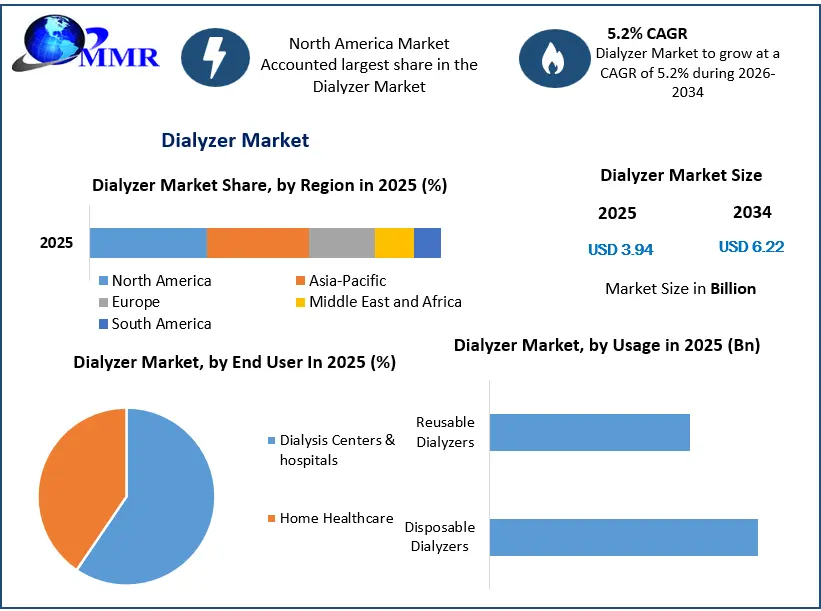
Dialyzer Market size was valued at USD 3.94 Billion in 2025 and the Dialyzer Market revenue is expected to reach USD 6.22 Billion by 2034, at a CAGR of 5.2 % over the forecast period.
Dialyzer Market Overview
A dialyzer is often referred to as an “artificial kidney.” Its function is to remove the excess wastes and fluid from the blood when the patient's kidneys can no longer perform that task. Dialyzers are made of a thin, fibrous material. During hemodialysis, a hemodialyzer, or artificial kidney, is used to filter fluids and wastes from a dialysis patient's blood. Reuse of a hemodialyzer means that the same hemodialyzer (filter) is used more than once for the same patient. When dialyzers are reused, they are cleaned and disinfected after each treatment.
Dialyzer Market Analysis from 2025 to 2034
To know about the Research Methodology :- Request Free Sample Report
This allows consumers to choose products that suit their preferences and dietary habits. Dialyzers are not limited to a specific geographical region. The dialyzer market has a global presence, with consumers across different continents showing interest in these supplements. This Dialyzer Market Report offers a specific and detailed market overview with statistical as well as pre-sized trendy data. This Dialyzer Market report showcases the Dialyzer market situation with Dynamics, Market Segment, Regional Analysis, and Top competitor's Market Position.
Dialyzer Market Dynamics
The global dialyzer market has experienced noteworthy growth in recent years, driven by the increasing prevalence of end-stage renal disease (ESRD) and the rising number of dialysis procedures.
The rising number of dialysis procedures globally, both hemodialysis and peritoneal dialysis, is a crucial driver for the dialyzer market. The growing patient population requiring dialysis, coupled with increased access to healthcare facilities and improved awareness, fuels the demand for dialyzers. Favorable reimbursement policies and insurance coverage for dialysis treatments in many countries incentivize patients to undergo dialysis, thereby driving the demand for dialyzers. Recompense support decreases the financial weight on patients and inspires the adoption of dialysis therapy.
Dialyzers are vital medical devices used in hemodialysis, a process that filters unused products and excess fluids from the blood in individuals with impaired kidney function. The dialyzer market growth is primarily credited to the increasing number of geriatric people, who are more susceptible to kidney disorders and require regular dialysis treatment. Also, the growing prevalence of chronic diseases such as diabetes and hypertension, which are major contributors to kidney damage, has contributed to the huge demand for dialyzers. Technological advancements have also played an important role in the dialyzer market development. Manufacturers are continually introducing innovative dialyzer designs and materials to enhance the efficiency and performance of the devices. For instance, high-flux dialyzers offer superior clearance of small and middle molecules, leading to improved patient outcomes.
Shortage of Skilled Healthcare Professionals and Dialyzer-Related Complications Restraining the Dialyzer Market
The demand for dialysis services is outpacing the availability of skilled healthcare professionals, such as nephrologists and dialysis specialists. This lack can result in longer waiting times for patients, compromised superiority of care, and limited capacity to meet the growing dialysis requirements, thereby affecting the dialyzer market. Complications associated with dialyzers, such as clotting, infection, and membrane bio-incompatibility, pose risks to patient safety and treatment efficacy. These complications can lead to adverse events, increased healthcare costs, and reduced patient confidence in dialysis treatment, acting as a restraint for the dialyzer market.
Despite the positive growth trajectory, the global dialyzer market faces certain challenges. One of the primary challenges is the high cost associated with dialysis treatment, including the use of dialyzers. This poses a significant financial burden on patients, particularly in developing countries with limited healthcare resources and insurance coverage. Another challenge is the limited availability of skilled healthcare professionals capable of performing dialysis procedures. The demand for dialysis services is outpacing the supply of qualified nephrologists and dialysis technicians, leading to a potential quality of care issue and longer waiting times for patients. Moreover, dialyzer-related complications such as clotting, infection, and membrane bio-incompatibility can impact patient safety and treatment efficacy. Manufacturers and healthcare providers are continually striving to mitigate these risks by developing improved dialyzer designs and implementing rigorous infection control protocols.
Dialyzer Market Segment Analysis
Global Dialyzer Market is segmented based on type, usage, and region. By type, the market is segmented into high-flux dialyzers and low-flux dialyzers. By usage, the market is segmented into disposable dialyzers and reusable dialyzers. The market is segmented by End-User into Dialysis Centers & Hospitals, and Home Healthcare.
By Type, The global dialyzer market can be segmented by type into two main categories: high-flux dialyzers and low-flux dialyzers. High-flux dialyzers are categorized by their ability to efficiently remove small and middle molecules, providing better clearance during hemodialysis. These dialyzers have increased prominence in recent years due to their enhanced performance compared to low-flux dialyzers. They are designed with larger pore sizes and enhanced membrane materials, allowing for increased solute removal. High-flux dialyzers are often chosen for patients with high molecular weight toxins and those requiring more intensive dialysis therapy. They offer better patient outcomes and are broadly used in clinical settings. Therefore, high-flux dialyzers can be considered the dominant segment in the global dialyzer market.
On the other hand, the fastest-growing segment in the dialyzer market is low-flux dialyzers. Although high-flux dialyzers have a main position, low-flux dialyzers have been experiencing noteworthy growth due to their cost-effectiveness and widespread application in certain regions. Low-flux dialyzers have smaller pore sizes, limiting the removal of larger molecules and toxins associated with high-flux dialyzers. They are often used for stable patients with lower molecular weight waste products. The growth of the low-flux dialyzer segment can be attributed to the increasing demand for affordable dialysis solutions, mostly in developing economies where cost reflections play a significant role in treatment decisions.

By Usage, The global dialyzer market can be segmented by usage into two main categories: disposable dialyzers and reusable dialyzers. Disposable dialyzers are designed for single use and are discarded after each dialysis session. They offer convenience, reduce the risk of contamination or cross-infection, and eliminate the need for cleaning and sterilization. Disposable dialyzers are widely used in healthcare settings due to their ease of use and reduced infection risk. They have a dominant position in the global dialyzer market, as they are preferred by healthcare providers for their safety and time-saving benefits.
However, the fastest-growing segment in the dialyzer market is reusable dialyzers. These dialyzers are designed to be sterilized and reused for multiple dialysis sessions. Reusable dialyzers offer cost advantages over disposable dialyzers in the long term, particularly in regions where healthcare resources and budgets are limited. Reusable dialyzers undergo stringent sterilization processes to ensure patient safety. The growing demand for cost-effective dialysis solutions and sustainable healthcare practices has contributed to the increased adoption of reusable dialyzers in recent years.
Dialyzer Market Regional Analysis
North America has a well-established healthcare infrastructure, high healthcare expenditure, and a significant prevalence of end-stage renal disease (ESRD). The region has a robust dialysis market, driven by factors such as a large patient population, advanced healthcare facilities, and favorable reimbursement policies. The dominant position of North America in the global market is further strengthened by the presence of key market players and continuous technological advancements in the region.
In terms of the fastest-growing region, Asia Pacific stands out. The region has witnessed rapid economic development, improved healthcare infrastructure, and increasing awareness about kidney diseases and dialysis treatment. Factors such as a large geriatric population, a rising incidence of chronic kidney diseases, and expanding access to healthcare services contribute to the growth of the dialyzer market in Asia Pacific. Additionally, government initiatives aimed at improving healthcare facilities and addressing the growing burden of chronic diseases further propel the market growth in this region. With a combination of factors driving market expansion, Asia Pacific is anticipated to be the fastest-growing region in the global dialyzer market.
Dialyzer Market Competitive Landscape
The global dialyzer market is characterized by intense competition among various players striving to gain a significant market share. The competitive landscape is shaped by factors such as product innovation, strategic partnerships, mergers and acquisitions, and geographical expansions. Market players focus on developing advanced dialyzer designs, materials, and technologies to improve dialysis efficiency and patient outcomes. Technological advancements, such as the introduction of high-flux dialyzers and the integration of nanotechnology, contribute to the competitive edge of companies in the market. These innovations aim to enhance solute clearance, reduce membrane fouling, and minimize dialyzer-related complications. Strategic collaborations and partnerships are also common among market players.
In January 2023, Baxter International Inc. announced the launch of its new EverlinQ endoAVF System. The EverlinQ endoAVF System is a catheter-based dialyzer that is designed to create a connection between a patient's vein and artery. This connection allows blood to be filtered more efficiently than with traditional dialyzers.
In February 2023, Asahi Kasei Corporation announced the development of a new dialyzer that is specifically designed for home hemodialysis. The new dialyzer is smaller and lighter than traditional dialyzers, making it easier for patients to use at home.
Dialyzer Market Recent Industry Developments
| Date | Company | Development | Impact |
|---|---|---|---|
| 28 July 2026 | Nipro Corporation | Nipro Corporation received U.S. FDA 510(k) clearance for its ELISIO-HX dialyzer, featuring super high-flux Polynephron membrane technology for expanded hemodialysis. | The approval enables U.S. healthcare providers to deliver enhanced middle-molecule clearance without upgrading existing dialysis machine infrastructure. |
| 04 August 2026 | Nipro Medical Corporation | Nipro Medical Corporation officially announced the commercial launch of the ELISIO-HX medium-cutoff dialyzer across dialysis centers in the United States. | The launch significantly expands access to HDs therapy for up to 95% of eligible end-stage renal disease patients while preserving essential albumin levels. |
| 01 August 2025 | Vantive (Baxter International Inc.) | Vantive secured FDA 510(k) clearance (K250508) for its high-permeability dialyzer and bloodline accessories integrated with the AK 98 Dialysis System. | This regulatory milestone strengthens Vantive's standalone renal care portfolio following its corporate separation from Baxter, enhancing treatment precision and delivery efficiency. |
| 17 March 2025 | B. Braun Melsungen AG | The U.S. FDA added hemodialysis bloodlines connecting to dialyzers to its Device Shortage List following supply chain disruptions reported by B. Braun. | The disruption triggered industry-wide conservation strategies and accelerated clinic transitions to alternative dialyzer and bloodline suppliers like Fresenius and Nipro. |
| 15 December 2025 | Asahi Kasei Medical Co., Ltd. | Asahi Kasei Medical advanced the global commercial expansion of its high-performance polysulfone membrane dialyzers aimed at improving internal filtration efficiency. | The expansion addresses growing demand in Asia-Pacific markets by delivering higher small and middle molecule clearance rates with enhanced biocompatibility. |
Dialyzer Market Scope: Inquire before buying
| Global Dialyzer Market | |||
|---|---|---|---|
| Report Coverage | Details | ||
| Base Year: | 2025 | Forecast Period: | 2026-2034 |
| Historical Data: | 2020 to 2025 | Market Size in 2025: | US $ 3.94 Bn. |
| Forecast Period 2026 to 2034 CAGR: | 5.2% | Market Size in 2034: | US $ 6.22 Bn. |
| Segments Covered: | by Type | High-Flux Low-Flux |
|
| by Usage | Disposable Dialyzers Reusable Dialyzers |
||
| by End User | Dialysis Centers & hospitals Home Healthcare |
||
Dialyzer Market, by Region:
North America (United States, Canada and Mexico)
Europe (UK, France, Germany, Italy, Spain, Sweden, Austria and Rest of Europe)
Asia Pacific (China, South Korea, Japan, India, Australia, Indonesia, Malaysia, Vietnam, Taiwan, Bangladesh, Pakistan and Rest of APAC)
Middle East and Africa (South Africa, GCC, Egypt, Nigeria and Rest of ME&A)
South America (Brazil, Argentina Rest of South America)
Leading Dialyzer Key Players Includes
1. Fresenius Medical Care AG & Co. KGaA
2. Baxter International Inc. (Vantive)
3. Nipro Corporation
4. B. Braun Melsungen AG
5. Asahi Kasei Medical Co., Ltd.
6. Toray Medical Co., Ltd.
7. Shandong Weigao Group Medical Polymer Co., Ltd.
8. Nikkiso Co., Ltd.
9. JMS Co., Ltd.
10. Dialife SA
11. Medica S.p.A.
12. Farmasol S.r.l.
13. Browndove Healthcare (P) Ltd.
14. Cantel Medical Corporation (Steris plc)
15. Medtronic plc
16. SB-KAWASUMI Laboratories, Inc.
17. Allmed Medical Care Holdings Limited
18. Bain Medical Equipment (Guangzhou) Co., Ltd.
19. Haemonetics Corporation
20. Kawasumi Laboratories, Inc.
21. Membrana GmbH (3M Company)
22. SWS Hemodialysis Care Co., Ltd.
23. Jiangsu Sanxin Medical Technology Co., Ltd.
24. Tianjin Alpha Medical Equipment Co., Ltd.
25. Anhui Shanhe Pharmaceutical Accessories Co., Ltd.
26. Farmagid Ltd.
27. Renal Advantage Inc.
28. Nipro Medical Corporation
29. Sainome Medical Devices
30. TCM Healthcare
Frequently Asked Questions in the Dialyzers Market:
1. What is Dialyzer (TSP)?
Ans: Dialyzer is a versatile meat substitute made from soybeans.
2. What is the global market size of the Dialyzer Market?
Ans: Dialyzer Market size was valued at USD 3.94 Billion in 2025 and the Dialyzer Market revenue is expected to reach USD 6.22 Billion by 2034, at a CAGR of 5.2 % over the forecast period.
3. Who are the key vendors in the Global Dialyzer Market?
Ans: Fresenius Medical Care - Germany, Baxter International Inc. - US, B. Braun Melsungen AG - Germany, Nikkiso Co., Ltd. - Japan, Asahi Kasei Medical Co., Ltd. - Japan, Nipro Corporation - Japan, Toray Industries, Inc. – Japan.
4. What is the key driver of the Global Dialyzer Market?
Ans: The rising number of dialysis procedures globally, both hemodialysis and peritoneal dialysis, is a crucial driver for the dialyzer market. The growing patient population requiring dialysis, coupled with increased access to healthcare facilities and improved awareness, fuels the demand for dialyzers.
5. What is the key market trend for Global Dialyzer Market?
Ans: Shift towards High-Flux Dialyzers: High-flux dialyzers are gaining prominence over low-flux dialyzers due to their superior solute clearance properties. High-flux dialyzers effectively remove small and middle molecules, providing better patient outcomes. This trend is driven by the increasing emphasis on achieving optimal dialysis efficacy and improving the overall quality of care.