
Consumer Robotics Market Size by Type, Application, Product, Component, Connectivity, Region – Segment-Level Market Assessment, Growth Opportunity Analysis, Competitive Mapping & Forecast to 2032
Overview
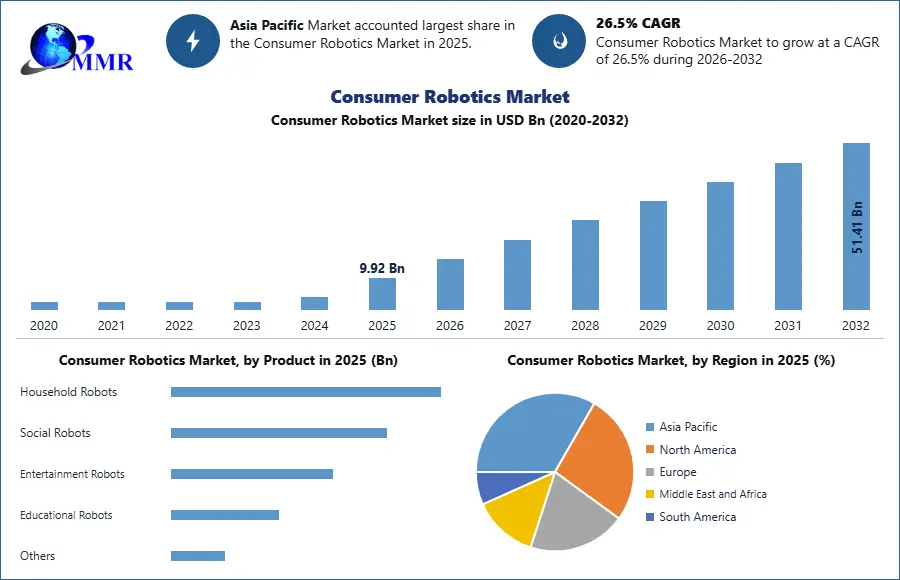
Global Consumer Robotics Market size was valued at USD 9.92 Bn. in 2025 and the total Consumer Robotics Market revenue is expected to grow by 26.5% from 2025 to 2032, reaching nearly USD 51.41 Bn.
Consumer robotics covers the application of robotic technology within the consumer market, offering a diverse array of products tailored to meet various needs and preferences. These products range from autonomous robots to industrial-grade machines and cover a wide spectrum of applications, including lawn-mowing robots, pool-cleaning robots, robot vacuums, and home automation systems. The demand for consumer robots has experienced steady growth in recent years, fueled by increasing affordability and accessibility to consumers. These robots have gained popularity among both businesses and households due to their ability to automate mundane tasks with greater efficiency than humans.
To know about the Research Methodology :- Request Free Sample Report
From performing basic household chores like mopping floors and vacuuming carpets to executing complex manufacturing processes in factories, consumer robotics has transformed the way people live and work. As technology continues to advance rapidly, companies stay up-to-date on emerging trends to remain competitive in this dynamic field, offering enhanced quality and value to customers at reduced costs. Major players in consumer robotics development and production play a significant role in driving innovation and shaping the future of this growing consumer robotics market.
1. Aug 5, 2022, Amazon invested USD 1.7 billion in acquiring iRobot, renowned for its Roomba vacuum line, signaling Amazon's strategic bet on the burgeoning consumer robotics sector. With a vision for smart home integration, Amazon aims to leverage iRobot's expertise alongside its own AI technology and algorithms for enhanced functionality. This move intensifies competition among tech giants like Google, Apple, and Tesla, all vying to pioneer breakthroughs in consumer robotics. The acquisition underscores Amazon's ambition to dominate this rapidly evolving market, poised for transformative innovations in home automation and robotics.
Consumer Robotics Market Dynamics:
The Role of Robotics and AI in Accelerating Contactless Services
The increasing demand for contactless services is accelerated by advancements in technology and exacerbated. With the rapid progression of robotics, artificial intelligence (AI), and Internet of Things (IoT) technologies, industries across various sectors have begun deploying robots to carry out a wide range of activities. The initial intent behind utilizing robots was to enhance productivity, but the pandemic has underscored the importance of contactless service delivery, further fueling the adoption of robots in the Consumer Robotics Market.
During the pandemic, the need for social distancing and minimizing human contact has become paramount. As a result, industries such as hospitality, transportation, and retail have turned to robots to provide contactless services. For example, in hotels, robots have been deployed for tasks such as room service delivery, cleaning, and concierge services. Similarly, airports have implemented robots for tasks like disinfecting surfaces, guiding passengers, and delivering baggage for the Consumer Robotics Market.
Integration of AI and Smart Robotics Technologies
The healthcare sector has also witnessed significant adoption of robots to alleviate the burden on hospital staff and reduce the risk of infection. Service robots are being used for tasks such as patient monitoring, disinfection of hospital premises, and delivery of medical supplies. For instance, in hospitals, robots equipped with UV-C lights are employed for disinfecting patient rooms and common areas, thereby minimizing the spread of pathogens. Furthermore, the integration of AI and smart robotics technologies has enabled robots to perform tasks with greater efficiency and autonomy. For example, autonomous robots equipped with sensors and AI algorithms can navigate crowded environments, identify obstacles, and adapt their movements accordingly. This capability has made them invaluable in settings where social distancing measures need to be strictly observed, such as retail stores and public spaces which boost Consumer Robotics Market growth.
The pivotal aspects of manipulation, cognition, and interaction. Moreover, the involvement of top-tier component providers and cutting-edge technology has significantly modernized the robotics ecosystem. For instance, Preferred Networks, a Tokyo-based startup, provides AI technology utilized in Toyota Motor's autonomous driving systems and Fanuc robots, showcasing the transformative role of technology providers. Furthermore, the Asia Pacific region, particularly countries like China and Japan, is at the forefront of medical technology growth, thereby creating a vast market for service robots in the region. Japan, for instance, faces a significant demographic shift with a rapidly aging population, as highlighted by statistics from the Japanese Ministry of Internal Affairs and Communications. Additionally, South Korean companies like LG Electronics have tested robots designed to automate various tasks in the service industry, potentially replacing human workers in roles such as hospitality and transportation boosting Consumer Robotics Market growth.
Consumer Robotics Market Segment Analysis:
Based on type, the market has been divided into Autonomous and Semi-autonomous. Among these, the Autonomous sub-segment is expected to generate the maximum revenue. The Autonomous sub-segment witnessed the highest market share in the global consumer robotics market in 2025. One prominent application is in the field of home automation, where autonomous robots are increasingly being adopted to perform household tasks such as vacuuming, mopping, and lawn mowing. These robots offer convenience and time-saving benefits to homeowners, allowing them to delegate repetitive chores to intelligent machines. In addition to home automation, autonomous robots are making significant strides in industries such as healthcare and eldercare. They can assist healthcare professionals by performing tasks like medication delivery, patient monitoring, and even surgical procedures with precision and efficiency. Similarly, in eldercare settings, autonomous robots serve as companions and caregivers, providing assistance with daily activities and enhancing the quality of life for elderly individuals. The Autonomous sub-segment is witnessing rapid adoption in the logistics and transportation sectors, where autonomous drones and delivery robots are revolutionizing last-mile delivery operations. These robots navigate autonomously through urban environments, delivering packages to customers' doorsteps efficiently and securely within the Consumer Robotics Market.
Based on Product, the Household Robots segment dominated in 2025 and is expected to dominate during forecast period. This is mainly because products like robotic vacuum cleaners, floor moppers, window cleaners, and lawn mowers have moved from being niche gadgets to mainstream household appliances, driven by rising disposable incomes, busy lifestyles, and growing consumer preference for convenience and automation. The technological improvements in navigation, AI, and voice assistant integration have also enhanced their functionality and appeal. As a result, household robots capture the largest market share in 2025, significantly outpacing segments like social, entertainment, and educational robots, which remain more specialized or emerging.
Consumer Robotics Market Regional Insights:
Asia Pacific dominated consumer robotics market in 2025. The increasing smart home adoption, rising disposable income, and rapid technological advancements in AI and IoT-enabled robotics solutions. Countries such as China, Japan, South Korea, and India are leading the regional demand owing to strong electronics manufacturing ecosystems and increasing consumer preference for automation-based lifestyle products. Robotic vacuum cleaners, lawn mowers, educational robots, companion robots, and entertainment robots are witnessing high penetration across urban households.
China dominates the Asia-Pacific consumer robotics market because of large-scale production capabilities, strong domestic demand, and government support for robotics and AI innovation. Japan and South Korea continue to invest heavily in humanoid and eldercare robots to address aging population challenges and labor shortages. Meanwhile, India and Southeast Asian countries are emerging as high-growth markets due to expanding middle-class populations and rising e-commerce penetration. Technological advancements such as voice recognition, machine learning, smart navigation systems, and
Global Consumer Robotics Market size was valued at USD 9.92 Bn. in 2025 and the total Consumer Robotics Market revenue is expected to grow by 26.5% from 2025 to 2032, reaching nearly USD 51.41 Bn.
Consumer robotics covers the application of robotic technology within the consumer market, offering a diverse array of products tailored to meet various needs and preferences. These products range from autonomous robots to industrial-grade machines and cover a wide spectrum of applications, including lawn-mowing robots, pool-cleaning robots, robot vacuums, and home automation systems. The demand for consumer robots has experienced steady growth in recent years, fueled by increasing affordability and accessibility to consumers. These robots have gained popularity among both businesses and households due to their ability to automate mundane tasks with greater efficiency than humans.
To know about the Research Methodology :- Request Free Sample Report
From performing basic household chores like mopping floors and vacuuming carpets to executing complex manufacturing processes in factories, consumer robotics has transformed the way people live and work. As technology continues to advance rapidly, companies stay up-to-date on emerging trends to remain competitive in this dynamic field, offering enhanced quality and value to customers at reduced costs. Major players in consumer robotics development and production play a significant role in driving innovation and shaping the future of this growing consumer robotics market.
1. Aug 5, 2022, Amazon invested USD 1.7 billion in acquiring iRobot, renowned for its Roomba vacuum line, signaling Amazon's strategic bet on the burgeoning consumer robotics sector. With a vision for smart home integration, Amazon aims to leverage iRobot's expertise alongside its own AI technology and algorithms for enhanced functionality. This move intensifies competition among tech giants like Google, Apple, and Tesla, all vying to pioneer breakthroughs in consumer robotics. The acquisition underscores Amazon's ambition to dominate this rapidly evolving market, poised for transformative innovations in home automation and robotics.
Consumer Robotics Market Dynamics:
The Role of Robotics and AI in Accelerating Contactless Services
The increasing demand for contactless services is accelerated by advancements in technology and exacerbated. With the rapid progression of robotics, artificial intelligence (AI), and Internet of Things (IoT) technologies, industries across various sectors have begun deploying robots to carry out a wide range of activities. The initial intent behind utilizing robots was to enhance productivity, but the pandemic has underscored the importance of contactless service delivery, further fueling the adoption of robots in the Consumer Robotics Market.
During the pandemic, the need for social distancing and minimizing human contact has become paramount. As a result, industries such as hospitality, transportation, and retail have turned to robots to provide contactless services. For example, in hotels, robots have been deployed for tasks such as room service delivery, cleaning, and concierge services. Similarly, airports have implemented robots for tasks like disinfecting surfaces, guiding passengers, and delivering baggage for the Consumer Robotics Market.
Integration of AI and Smart Robotics Technologies
The healthcare sector has also witnessed significant adoption of robots to alleviate the burden on hospital staff and reduce the risk of infection. Service robots are being used for tasks such as patient monitoring, disinfection of hospital premises, and delivery of medical supplies. For instance, in hospitals, robots equipped with UV-C lights are employed for disinfecting patient rooms and common areas, thereby minimizing the spread of pathogens. Furthermore, the integration of AI and smart robotics technologies has enabled robots to perform tasks with greater efficiency and autonomy. For example, autonomous robots equipped with sensors and AI algorithms can navigate crowded environments, identify obstacles, and adapt their movements accordingly. This capability has made them invaluable in settings where social distancing measures need to be strictly observed, such as retail stores and public spaces which boost Consumer Robotics Market growth.
The pivotal aspects of manipulation, cognition, and interaction. Moreover, the involvement of top-tier component providers and cutting-edge technology has significantly modernized the robotics ecosystem. For instance, Preferred Networks, a Tokyo-based startup, provides AI technology utilized in Toyota Motor's autonomous driving systems and Fanuc robots, showcasing the transformative role of technology providers. Furthermore, the Asia Pacific region, particularly countries like China and Japan, is at the forefront of medical technology growth, thereby creating a vast market for service robots in the region. Japan, for instance, faces a significant demographic shift with a rapidly aging population, as highlighted by statistics from the Japanese Ministry of Internal Affairs and Communications. Additionally, South Korean companies like LG Electronics have tested robots designed to automate various tasks in the service industry, potentially replacing human workers in roles such as hospitality and transportation boosting Consumer Robotics Market growth.
Consumer Robotics Market Segment Analysis:
Based on type, the market has been divided into Autonomous and Semi-autonomous. Among these, the Autonomous sub-segment is expected to generate the maximum revenue. The Autonomous sub-segment witnessed the highest market share in the global consumer robotics market in 2025. One prominent application is in the field of home automation, where autonomous robots are increasingly being adopted to perform household tasks such as vacuuming, mopping, and lawn mowing. These robots offer convenience and time-saving benefits to homeowners, allowing them to delegate repetitive chores to intelligent machines. In addition to home automation, autonomous robots are making significant strides in industries such as healthcare and eldercare. They can assist healthcare professionals by performing tasks like medication delivery, patient monitoring, and even surgical procedures with precision and efficiency. Similarly, in eldercare settings, autonomous robots serve as companions and caregivers, providing assistance with daily activities and enhancing the quality of life for elderly individuals. The Autonomous sub-segment is witnessing rapid adoption in the logistics and transportation sectors, where autonomous drones and delivery robots are revolutionizing last-mile delivery operations. These robots navigate autonomously through urban environments, delivering packages to customers' doorsteps efficiently and securely within the Consumer Robotics Market.
Based on Product, the Household Robots segment dominated in 2025 and is expected to dominate during forecast period. This is mainly because products like robotic vacuum cleaners, floor moppers, window cleaners, and lawn mowers have moved from being niche gadgets to mainstream household appliances, driven by rising disposable incomes, busy lifestyles, and growing consumer preference for convenience and automation. The technological improvements in navigation, AI, and voice assistant integration have also enhanced their functionality and appeal. As a result, household robots capture the largest market share in 2025, significantly outpacing segments like social, entertainment, and educational robots, which remain more specialized or emerging.
Consumer Robotics Market Regional Insights:
Asia Pacific dominated consumer robotics market in 2025. The increasing smart home adoption, rising disposable income, and rapid technological advancements in AI and IoT-enabled robotics solutions. Countries such as China, Japan, South Korea, and India are leading the regional demand owing to strong electronics manufacturing ecosystems and increasing consumer preference for automation-based lifestyle products. Robotic vacuum cleaners, lawn mowers, educational robots, companion robots, and entertainment robots are witnessing high penetration across urban households.
China dominates the Asia-Pacific consumer robotics market because of large-scale production capabilities, strong domestic demand, and government support for robotics and AI innovation. Japan and South Korea continue to invest heavily in humanoid and eldercare robots to address aging population challenges and labor shortages. Meanwhile, India and Southeast Asian countries are emerging as high-growth markets due to expanding middle-class populations and rising e-commerce penetration. Technological advancements such as voice recognition, machine learning, smart navigation systems, and cloud connectivity are improving product efficiency and consumer experience. Companies are increasingly focusing on affordable robotic solutions and strategic partnerships with smart home ecosystem providers. Additionally, increasing adoption of smart homes and connected devices is accelerating the integration of consumer robotics into daily household activities across the Asia-Pacific region.
Recent Developments
January 2025: iRobot strengthened its position in the consumer robotics market by expanding its Roomba Combo product portfolio with advanced AI-enabled navigation and smart mapping capabilities. The company focused on improving home automation integration through compatibility with Alexa, Google Home, and Apple Home ecosystems. iRobot also increased investments in machine learning-based obstacle detection and self-cleaning technology to enhance user convenience. The company emphasized subscription-based robotic cleaning services and software upgrades to improve recurring revenue generation.
March 2025: Neato Robotics announced strategic technology enhancements in its laser-guided robotic vacuum systems to improve precision cleaning and intelligent home navigation. The company focused on LiDAR-based mapping technology and energy-efficient robotic solutions targeting premium smart home consumers. Neato strengthened its app-based monitoring platform, enabling consumers to customize cleaning schedules and zone-specific operations remotely. The company also expanded collaborations with smart appliance ecosystem providers to improve connected home interoperability.
Consumer Robotics Market Scope: Inquiry Before Buying
| Consumer Robotics Market | |||
|---|---|---|---|
| Report Coverage | Details | ||
| Base Year: | 2025 | Forecast Period: | 2026-2032 |
| Historical Data: | 2020 to 2025 | Market Size in 2025: | 9.92 USD Bn |
| Forecast Period 2026-2032 CAGR: | 26.5% | Market Size in 2032: | 51.41 USD Bn |
| Segments Covered: | by Type | Autonomous Semi-autonomous |
|
| by Product | Household Robots Social Robots Entertainment Robots Educational Robots Others |
||
| by Component | Microcontrollers Displays |
||
| by Connectivity | Wi-Fi Bluetooth Others |
||
| by Application | Household Robots Entertainment Robots Educational Robots Others |
||
Consumer Robotics Market, by Region
North America (United States, Canada and Mexico)
Europe (UK, France, Germany, Italy, Spain, Sweden, Austria and Rest of Europe)
Asia Pacific (China, South Korea, Japan, India, Australia, Indonesia, Malaysia, Vietnam, Taiwan, Bangladesh, Pakistan and Rest of APAC)
Middle East and Africa (South Africa, GCC, Egypt, Nigeria and Rest)
South America (Brazil, Argentina Rest of South America)
Key players/Competitors profiles covered in the Consumer Robotics Market report in strategic perspective
Major Contributors in the Consumer Robotics Market in North America:
1. iRobot Corporation (United States)
2. Neato Robotics (United States)
3. Anki (United States)
4. SharkNinja Operating LLC (United States)
5. Bissell Homecare, Inc. (United States)
6. Jibo, Inc. (United States)
7. Eufy (United States)
Major Leading Players in the Consumer Robotics Market in Europe:
1. Vorwerk & Co. KG (Germany)
2. Miele & Cie. KG (Germany)
3. Dyson Ltd. (United Kingdom)
Major Leading Players in the Consumer Robotics Market in Asia Pacific:
1. Ecovacs Robotics (China)
2. Xiaomi Corporation (China)
3. Deebot (China)
4. Roborock (China)
5. Samsung Electronics Co., Ltd. (South Korea)
6. SoftBank Robotics (Japan)
7. LG Electronics Inc. (South Korea)
8. Honda Motor Co., Ltd. (Japan)
Major Leading Players in the Consumer Robotics Market in the Middle East and Africa:
1. Ecoppia (Israel)
2. Maytronics Ltd. (Israel)
connectivity are improving product efficiency and consumer experience. Companies are increasingly focusing on affordable robotic solutions and strategic partnerships with smart home ecosystem providers. Additionally, increasing adoption of smart homes and connected devices is accelerating the integration of consumer robotics into daily household activities across the Asia-Pacific region.
Recent Developments
January 2025: iRobot strengthened its position in the consumer robotics market by expanding its Roomba Combo product portfolio with advanced AI-enabled navigation and smart mapping capabilities. The company focused on improving home automation integration through compatibility with Alexa, Google Home, and Apple Home ecosystems. iRobot also increased investments in machine learning-based obstacle detection and self-cleaning technology to enhance user convenience. The company emphasized subscription-based robotic cleaning services and software upgrades to improve recurring revenue generation.
March 2025: Neato Robotics announced strategic technology enhancements in its laser-guided robotic vacuum systems to improve precision cleaning and intelligent home navigation. The company focused on LiDAR-based mapping technology and energy-efficient robotic solutions targeting premium smart home consumers. Neato strengthened its app-based monitoring platform, enabling consumers to customize cleaning schedules and zone-specific operations remotely. The company also expanded collaborations with smart appliance ecosystem providers to improve connected home interoperability.
Consumer Robotics Market Scope: Inquiry Before Buying
| Consumer Robotics Market | |||
|---|---|---|---|
| Report Coverage | Details | ||
| Base Year: | 2025 | Forecast Period: | 2026-2032 |
| Historical Data: | 2020 to 2025 | Market Size in 2025: | 9.92 USD Bn |
| Forecast Period 2026-2032 CAGR: | 26.5% | Market Size in 2032: | 51.41 USD Bn |
| Segments Covered: | by Type | Autonomous Semi-autonomous |
|
| by Product | Household Robots Social Robots Entertainment Robots Educational Robots Others |
||
| by Component | Microcontrollers Displays |
||
| by Connectivity | Wi-Fi Bluetooth Others |
||
| by Application | Household Robots Entertainment Robots Educational Robots Others |
||
Consumer Robotics Market, by Region
North America (United States, Canada and Mexico)
Europe (UK, France, Germany, Italy, Spain, Sweden, Austria and Rest of Europe)
Asia Pacific (China, South Korea, Japan, India, Australia, Indonesia, Malaysia, Vietnam, Taiwan, Bangladesh, Pakistan and Rest of APAC)
Middle East and Africa (South Africa, GCC, Egypt, Nigeria and Rest)
South America (Brazil, Argentina Rest of South America)
Key players/Competitors profiles covered in the Consumer Robotics Market report in strategic perspective
Major Contributors in the Consumer Robotics Market in North America:
1. iRobot Corporation (United States)
2. Neato Robotics (United States)
3. Anki (United States)
4. SharkNinja Operating LLC (United States)
5. Bissell Homecare, Inc. (United States)
6. Jibo, Inc. (United States)
7. Eufy (United States)
Major Leading Players in the Consumer Robotics Market in Europe:
1. Vorwerk & Co. KG (Germany)
2. Miele & Cie. KG (Germany)
3. Dyson Ltd. (United Kingdom)
Major Leading Players in the Consumer Robotics Market in Asia Pacific:
1. Ecovacs Robotics (China)
2. Xiaomi Corporation (China)
3. Deebot (China)
4. Roborock (China)
5. Samsung Electronics Co., Ltd. (South Korea)
6. SoftBank Robotics (Japan)
7. LG Electronics Inc. (South Korea)
8. Honda Motor Co., Ltd. (Japan)
Major Leading Players in the Consumer Robotics Market in the Middle East and Africa:
1. Ecoppia (Israel)
2. Maytronics Ltd. (Israel)