
Consumer Electronics Sensor Market Size – Industry Structure Evaluation, Demand Drivers Analysis, Regional Growth Analysis and Identification, Competitive Positioning Review & Global Market Size Forecast to 2032
Overview
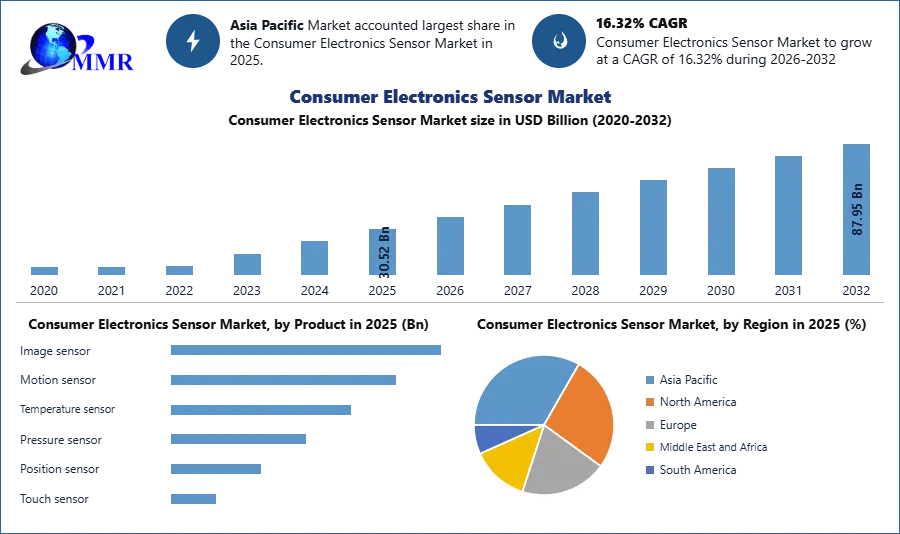
Consumer Electronics Sensor Market is expected to reach USD 87.95 Bn. by 2032 at a CAGR of 16.32% during the forecast period.
Consumer Electronics Sensor Market Overview:
Sensors aren't a new addition to the world of consumer electronics. They have, however, experienced significant progress as a result of smart producer’s spending money on developing more effective models. As a result, consumer gadgets are becoming smaller, more effective, and more affordable. This has made them ideal for portable devices, such as tablets and smartphones, games (in which the sensors track the user's movements and communicate them to the screen), home appliances, and navigation.
 To know about the Research Methodology :- Request Free Sample Report
Consumer Electronics Sensor Market Dynamics:
Increased investments in R&D are likely to drive the global consumer electric sensors market growth over the forecast period. In addition, the global consumer electronic sensors market will grow as wearable technology becomes more prominent. Furthermore, the global consumer electronic market is expected to grow because of an increase in demand for multimedia devices with diverse characteristics such as motion stabilization and indoor navigation. Moreover, throughout the forecast period, the worldwide consumer electronic sensors market is predicted to rise due to the adoption of security and surveillance solutions in combination with growing entertainment and gaming applications.
However, the global consumer electronic sensors market is expected to be limited by the lack of a standard fabrication technique for MEMS sensors. The availability of cheaper alternatives and limited opportunities for product differentiation, on the other hand, are impeding the growth of the consumer electronic sensor industry. However, their increasing use in digital health and the automobile industry, particularly in safety, power steering, and automated driving, will aid in overcome such constraints.
Sensor technological advances have created several opportunities for the worldwide consumer electronics sensor industry. Sensors are now accessible to fit any demand, from home automation to robots and digital health. They are more advanced and intelligent. There are smartphone sensors, for example, that enable a touch-free analysis of a person's heart rate by analyzing their skin tone! Such advancements, together with rising consumer buying power around the world, have fueled a surge in demand for consumer electronics sensors.
Consumer Electronics Sensor Market Segment Analysis:
Based on Product, the market is segmented into Image sensor, motion sensor, temperature sensor, pressure sensor, and position sensor are all examples of sensor types. With the increased demand for tablets and mobile phones, the image sensors market is expected to continue its lead during the forecast years. The temperature and motion section is widely employed in a variety of home appliances for great energy applications, as well as in mobile phones for the excellent user interface.
Over the forecast period, pressure sensors are expected to grow at a CAGR of 9.5%, GPS systems, home appliances, gaming consoles, and mobile phones all employ these sensors. STMicroelectronics, for example, released the LPS331AP, which improves GPS in 3D indoor locating and portable devices.
Based on Application, the market is segmented into Communication, Entertainment, Home appliances, and IT. With the high demand for smartphones and PDAs, communication is expected to be the most popular segment for the near future. The expansion of entertainment applications is expected to be aided by increased demand for various gaming equipment. Consumers are increasingly seeking smart features in dishwashers, washing machines, air conditioners, and kitchen appliances, leading to increased demand for various sensors in these products. In 2025, the entertainment segment accounted for more than 15% of total revenue.
Over the forecast period, the product's different application areas are expected to evolve, with industry participants concentrating on continuous product innovation. Samsung, for example, equipped its Note 4 with UV sensors for health and environmental applications in 2025. It also included humidity and pulse sensing capabilities in the Galaxy S4 and Galaxy S5 models, respectively.
Consumer Electronics Sensor Market Regional Insights:
The increased demand for consumer electronics in India and China, Asia Pacific is likely to be the largest market over the projection years. Increasing per capita income and a growing population of smartphone users are expected to continue to be positive influences. Smartphones are continuously being updated with new features to make them more user-friendly. Secondary and primary cameras, for example, are used to enable video calling, screen recording, slow motion, and other applications.
The incorporation of cameras into palmtops is also expected to boost regional market growth. Growing trends of sharing photos on various social media platforms, as well as an increase in first-time camera buyers, are expected to grow demand in the Asia Pacific. Customers in North America, on the other hand, choose to trade in their electronic equipment for technologically advanced products.
The objective of the report is to present a comprehensive analysis of the global Consumer Electronics Sensor Market to the stakeholders in the industry. The past and current status of the industry with the forecasted market size and trends are presented in the report with the analysis of complicated data in simple language. The report covers all the aspects of the industry with a dedicated study of key players that include market leaders, followers, and new entrants.
PORTER, PESTEL analysis with the potential impact of micro-economic factors of the market has been presented in the report. External as well as internal factors that are supposed to affect the business positively or negatively have been analyzed, which will give a clear futuristic view of the industry to the decision-makers.
The report also helps in understanding the global Consumer Electronics Sensor Market dynamics, structure by analyzing the market segments and projects the global Consumer Electronics Sensor Market size. Clear representation of competitive analysis of key players by Product, price, financial position, Product portfolio, growth strategies, and regional presence in the global Consumer Electronics Sensor Market make the report investor’s guide.
Recent Industry Developments
| Exact Date | Company | Development | Impact |
|---|---|---|---|
| 02 March 2026 | Ceva, Inc. | The company's NeuPro-Nano NPU won the 2026 Artificial Intelligence Award for its ultra-efficient AI acceleration in resource-constrained consumer sensors. | This validation accelerates the adoption of on-device Physical AI in next-generation wearables and smart home products. |
| 24 July 2025 | STMicroelectronics | Announced the planned acquisition of NXP Semiconductors' MEMS sensors business for approximately $950 million to strengthen its position in consumer and automotive markets. | The merger scales ST's MEMS production capacity and diversifies its sensor portfolio for smart devices. |
| 05 January 2026 | Samsung Electronics | Unveiled "AI Companions for Everyday Life" at CES 2026, integrating advanced contextual sensors into the Galaxy ecosystem. | This strategy drives the market toward proactive health monitoring and seamless device-to-human interaction. |
| 07 November 2025 | Sony Semiconductor Solutions | Partnered with IIJ to establish a joint venture utilizing soil moisture sensors and edge-sensing navigation for precision data applications. | Broadens Sony's sensing-as-a-service footprint beyond standard mobile image sensors into sustainable IoT solutions. |
| 15 January 2025 | Bosch Sensortec | Set a strategic target to deliver 10 billion deeply integrated MEMS units by 2030 following a record production year in 2024. | Secures Bosch’s market leadership by leveraging massive economies of scale for consumer electronics manufacturers. |
| 09 March 2026 | STMicroelectronics | Entered high-volume production for its silicon photonics-based PIC100 platform to support surging AI infrastructure and optical sensing demand. | Enhances bandwidth and energy efficiency for data-heavy consumer AI services and connected networking. |
Consumer Electronics Sensor Market Report Scope: Inquire before buying
| Consumer Electronics Sensor Market | |||
|---|---|---|---|
| Report Coverage | Details | ||
| Base Year: | 2025 | Forecast Period: | 2026-2032 |
| Historical Data: | 2020 to 2025 | Market Size in 2025: | 30.52 USD Billion |
| Forecast Period 2026-2032 CAGR: | 16.32% | Market Size in 2032: | 87.95 USD Billion |
| Segments Covered: | by Product | Image sensor Motion sensor Temperature sensor Pressure sensor Position sensor Touch sensor |
|
| by Application | Communication Entertainment Home appliances IT |
||
Consumer Electronics Sensor Market, by Region
North America (United States, Canada and Mexico)
Europe (UK, France, Germany, Italy, Spain, Sweden, Austria and Rest of Europe)
Asia Pacific (China, South Korea, Japan, India, Australia, Indonesia, Malaysia, Vietnam, Taiwan, Bangladesh, Pakistan and Rest of APAC)
Middle East and Africa (South Africa, GCC, Egypt, Nigeria and Rest of ME&A)
South America (Brazil, Argentina Rest of South America)
Key Players / Competitors Profiles Covered in Brief in Global Consumer Electronics Sensor Market Report in Strategic Perspective:
- STMicroelectronics
- Bosch Sensortec
- Texas Instruments
- Sony Semiconductor Solutions
- Samsung Electronics
- TDK Corporation
- TE Connectivity
- Infineon Technologies
- Analog Devices
- NXP Semiconductors
- Honeywell International
- Panasonic Corporation
- Murata Manufacturing
- Omron Corporation
- Vishay Intertechnology
- Renesas Electronics
- ams OSRAM
- Allegro MicroSystems
- Semtech Corporation
- Knowles Corporation
- Hamamatsu Photonics
- Sensata Technologies
- Melexis
- Asahi Kasei Microdevices (AKM)
- Alps Alpine