
Global Chemical Tankers Market Size by Product Type, Fleet Type, Tanker Size, Fleet Material, Region – Segment-Level Market Assessment, Growth Opportunity Analysis, Competitive Mapping & Forecast to 2034
Overview
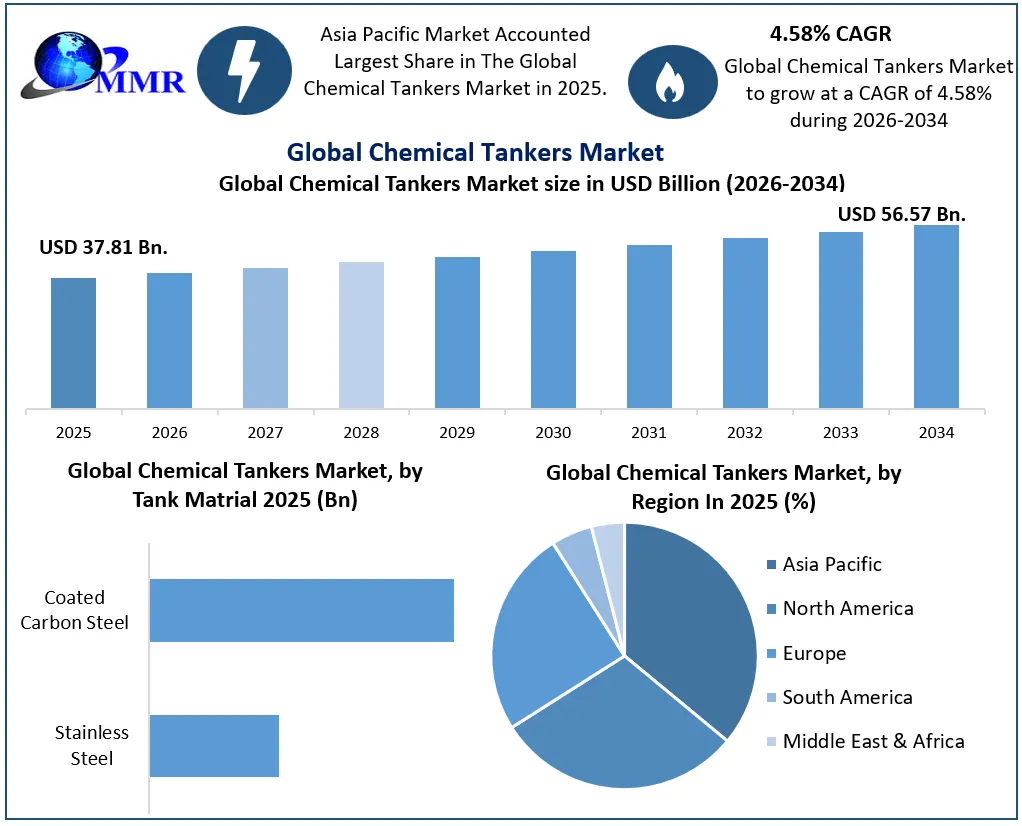
The Global Chemical Tankers Market size was valued at USD 37.81 Billion in 2025 and the total Chemical Tankers revenue is expected to grow at a CAGR of 4.58% from 2026 to 2034, reaching nearly USD 56.57 Billion.
Global Chemical Tankers Market Growth and Share Analysis
To know about the Research Methodology :- Request Free Sample Report
A chemical tanker is a type of tanker ship used to transport any chemicals in bulk. The major hazards associated with the safe transportation of liquid chemical cargoes in bulk is related to cargo compatibility, toxicity, and flammability. The range of chemicals shipped in bulk has increased extremely in modern days and a special class of ships has been designed and developed to meet the current needs.
The chemical tankers market based on product type is segmented into organic chemicals, vegetable oils & fats, inorganic chemicals, and others. The vegetable oils & fats segment are expected to be major contributors to the market during the forecast period. This is due to the rising awareness about the health benefits resulting from the consumption of vegetable oils & fats.
The market based on fleet type is categorized into IMO 1, IMO 2 and IMO 3. The IMO 2 fleet type segment is expected to hold the largest shares of the market during the forecast period. The growth of this segment is attributed to the use of IMO 2 chemical tankers for shipping of vegetable oils & fats with various chemicals such as alkenyl amide, alkanes, and alcohols. Among tanker size, the deep sea chemical tankers are generally used chemical tankers for transporting chemicals as they have a large number of separations.
Geographically, the Chemical Tankers market has been segmented into North America, Europe, Asia Pacific, Middle East & Africa, and Latin America. The Asia Pacific is expected to be the largest market for chemical tankers during the forecast period. The growth is attributed to the growth of the chemical industry and rising demand for oilseeds or vegetable oils & fats in this region.
Global Chemical Tankers Market Dynamics
Global Chemical Tankers Market Drivers
Rising Global Chemical Trade and Industrial Demand: Growing demand for organic chemicals, inorganic chemicals, petrochemicals, specialty chemicals, and vegetable oils drives the global chemical tankers market. Chemical manufacturers increasingly depend on specialized maritime transportation to move liquid cargo between production hubs and international consumption centres. In 2025, global chemical seaborne trade reaches approximately 385.6 million tonnes, supporting demand for chemical tanker capacity and international shipping services. Expanding chemical production, industrialization, and cross-border trade strengthen fleet utilization and market growth.
Expansion of Petrochemical and Specialty Chemical Industries: Increasing investments in petrochemical complexes, refining facilities, and specialty chemical manufacturing generate demand for IMO-certified chemical tankers. These vessels provide segregated cargo tanks, stainless-steel construction, specialized coatings, and temperature-control systems to transport sensitive liquid chemicals safely. Growing chemical exports from Asia and the Middle East further support long-distance shipping requirements and encourage operators to expand specialized tanker fleets.
Global Chemical Tankers Market Restraints
High Capital Investment and Operating Costs: Chemical tankers require substantial investment in vessel construction, stainless-steel tanks, advanced coatings, cargo-handling equipment, and safety systems. Rising shipbuilding costs, marine fuel expenses, maintenance requirements, insurance premiums, and crew expenses increase operational expenditure. These financial requirements create entry barriers for smaller shipping operators and restrict fleet expansion during periods of uncertain freight rates.
Volatility in Chemical Trade and Freight Rates: Fluctuations in industrial production, chemical consumption, international trade policies, and freight rates affect vessel utilization and shipping profitability. Global chemical seaborne trade declines from 388.9 million tonnes in 2024 to 385.6 million tonnes in 2025, representing a 0.8% contraction. Such fluctuations create uncertainty for tanker owners, charterers, and investors.
Global Chemical Tankers Market Opportunities
Fleet Modernization and Replacement Demand: The aging global chemical tanker fleet creates opportunities for new vessel construction and replacement investments. Around 9% of the chemical tanker fleet is more than 25 years old, increasing the need for modern, efficient, and regulation-compliant vessels. Shipping companies invest in stainless-steel tankers, improved cargo segregation, energy-efficient propulsion, and advanced navigation systems to strengthen operational performance and meet evolving maritime requirements.
Adoption of Sustainable and Advanced Tanker Technologies: Growing emphasis on maritime decarbonization creates opportunities for energy-efficient engines, alternative-fuel-ready vessels, optimized hull designs, and digital fleet-management systems. Investments in LNG-ready, methanol-ready, and ammonia-ready vessels support the transition toward lower-emission chemical transportation. These advancements help operators improve fuel efficiency, reduce environmental impact, and strengthen competitiveness.
Global Chemical Tankers Market Challenges
Stringent Maritime Safety and Environmental Regulations: Chemical tanker operators face strict requirements related to hazardous cargo handling, vessel construction, pollution prevention, crew training, and emissions management. Compliance with IMO standards and evolving environmental regulations increases investment in vessel upgrades, safety equipment, inspections, and operational monitoring. Maintaining compliance across international shipping routes remains a major challenge for fleet operators.
Geopolitical Tensions and Supply Chain Disruptions: Regional conflicts, trade restrictions, sanctions, and disruptions along major maritime routes affect chemical cargo movements and shipping schedules. Rerouting vessels around restricted or high-risk waterways increases voyage distances, fuel consumption, insurance costs, and delivery times. These disruptions create uncertainty in freight rates, vessel availability, and international chemical supply chains.
Global Chemical Tankers Market Segment Analysis
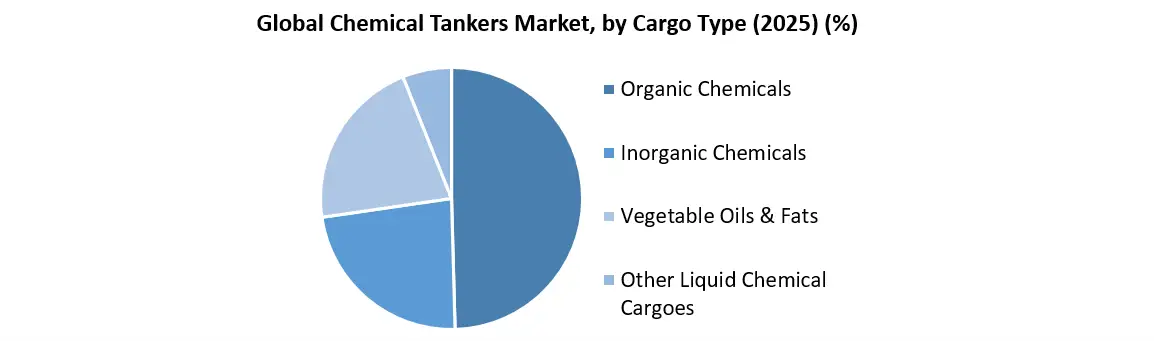
By Cargo Type, The organic chemicals segment accounts for a significant share of the Global Chemical Tankers Market due to strong transportation demand for methanol, ethanol, benzene, toluene, and other petrochemical derivatives. Inorganic chemicals, including sulfuric acid, phosphoric acid, and caustic soda, require specialized tank materials and strict handling procedures. Vegetable oils and fats represent an important cargo category, supported by international food processing and biofuel industries. Other liquid chemical cargoes include specialty chemicals, additives, and industrial liquid products that require dedicated storage and transportation facilities.
By IMO / IBC Ship Type, Type 2 Chemical Tankers hold a significant position due to their ability to transport a wide range of hazardous and moderately hazardous chemical cargoes under specific safety requirements. Type 1 Chemical Tankers handle highly hazardous cargoes and require enhanced containment, protective arrangements, and specialized vessel designs. Type 3 Chemical Tankers transport cargoes presenting comparatively lower hazards and support the movement of less hazardous liquid chemicals. Demand across these vessel categories depends on cargo toxicity, pollution risk, handling requirements, and international maritime safety regulations.
By Operating Area, Deep-Sea chemical tankers support long-distance international transportation of bulk liquid chemicals across major global trade routes and account for substantial demand due to expanding cross-border chemical trade. Coastal and short-sea tankers transport chemicals between nearby ports, industrial hubs, and regional markets, supporting flexible distribution and shorter delivery schedules. Inland chemical tankers operate through rivers, canals, and inland waterways, providing cost-effective transportation between manufacturing facilities, storage terminals, and distribution centres.
Global Chemical Tankers Market Regional Analysis
Asia Pacific dominates the Global Chemical Tankers Market, supported by strong chemical manufacturing capacity, expanding petrochemical production, and increasing international chemical trade. China, India, Japan, South Korea, and Singapore generate substantial demand for chemical tanker transportation through exports and imports of organic chemicals, inorganic chemicals, specialty chemicals, and vegetable oils. Growing industrialization, pharmaceutical production, and food processing activities strengthen regional cargo volumes. Expanding port infrastructure, shipbuilding capabilities, and intra-regional trade further support market growth. MMR identifies Asia Pacific as a key regional market with strong growth potential.
Europe maintains a significant position in the chemical tankers market due to its established chemical and petrochemical industries, advanced port infrastructure, and extensive maritime trade networks. Germany, the Netherlands, Belgium, France, and the United Kingdom generate demand for specialized transportation of industrial chemicals, specialty chemicals, and chemical intermediates. Major port hubs such as Rotterdam and Antwerp support regional and international cargo distribution. Stringent maritime safety and environmental regulations also encourage fleet modernization and the adoption of efficient chemical tankers.
North America represents an important market, supported by strong petrochemical production, established chemical manufacturing facilities, and international export activities. The United States and Canada generate demand for chemical tankers transporting methanol, solvents, industrial chemicals, and specialty chemical products. Access to major ports along the Gulf Coast and Atlantic and Pacific coastlines supports domestic and international shipping. Investments in petrochemical infrastructure, advanced vessel technologies, and efficient cargo-handling systems further strengthen regional demand.
The Middle East & Africa market benefits from expanding petrochemical production, energy-sector investments, and growing chemical export activities. Saudi Arabia, the United Arab Emirates, and Qatar generate substantial demand for chemical transportation through petrochemical manufacturing and international trade. Increasing investments in industrial infrastructure, port facilities, and chemical production capacity support tanker utilization. Africa also contributes through growing demand for imported industrial chemicals, fertilizers, and liquid chemical products.
South America experiences growing demand for chemical tankers due to expanding agricultural processing, mining, petrochemical production, and industrial activities. Brazil, Argentina, and Chile support regional transportation requirements for vegetable oils, fertilizers, inorganic chemicals, and industrial liquid cargoes. Increasing agricultural exports and demand for specialty chemicals strengthen maritime trade. Improvements in port infrastructure and regional shipping connectivity further support market development.
Global Chemical Tankers Market Competitive Landscape
The Global Chemical Tankers Market features a competitive environment comprising established shipping companies, specialized chemical tanker operators, and regional maritime transportation providers. Leading players compete based on fleet capacity, vessel quality, cargo-handling capabilities, geographical presence, operational efficiency, and safety compliance. Companies focus on expanding stainless-steel chemical tanker fleets, upgrading IMO-certified vessels, and strengthening transportation networks to handle organic chemicals, inorganic chemicals, vegetable oils, and specialty liquid cargoes. MMR observes that fleet modernization, strategic acquisitions, operational partnerships, and sustainable shipping solutions remain important factors influencing competitive positioning.
Key Competitive Strategies
- Fleet Expansion and Modernization: Companies invest in new chemical tankers with advanced cargo segregation, stainless-steel tanks, and improved fuel efficiency to increase transportation capacity and operational reliability.
- Strategic Acquisitions and Partnerships: Market participants strengthen their global presence through acquisitions, joint ventures, and vessel-pooling arrangements that improve fleet utilization and expand customer reach.
- Geographical Expansion: Operators expand their shipping networks across Asia Pacific, Europe, the Middle East, and North America to capture growing international chemical trade and regional transportation demand.
- Technology and Operational Efficiency: Companies adopt digital fleet management, automated cargo monitoring, advanced navigation, and optimized voyage-planning systems to improve vessel performance and reduce operating costs.
- Sustainability and Regulatory Compliance: Players invest in energy-efficient vessels, alternative-fuel-ready technologies, and emission-reduction measures to meet evolving maritime environmental standards.
Global Chemical Tankers Market Recent Developments
- November 2026 – Swan Defence and Heavy Industries: Secures a six-vessel chemical tanker construction programme for European shipowner Rederiet Stenersen. The 18,000 DWT IMO Type II tankers feature advanced propulsion technology and support India's entry into specialized chemical tanker manufacturing.
- November 2026 – Odfjell: Arranges two 40,000 DWT stainless-steel chemical tankers through a chartering agreement with Kitanihon Shipbuilding. The vessels are scheduled for delivery in 2029, strengthening its future fleet capacity.
- September 2026 – Uni-Tankers: Arranges eight 7,600 DWT stainless-steel chemical tankers from China's Haidong Shipyard under time-charter agreements, with deliveries beginning in 2028. The order supports its fleet renewal and expansion strategy.
- September 2026 – Ernst Russ: Expands its chemical and product tanker fleet by acquiring two additional 18,500 DWT IMO Type II vessels from Wuhu Shipyard. The vessels operate under long-term charter agreements and support its fleet modernization strategy.
Global Chemical Tankers Market Recent Industry Development
| Date | Company | Development | Impact |
|---|---|---|---|
| 15 January 2025 | Stolt-Nielsen | Stolt Tankers expanded its fleet by taking delivery of a 26,000 DWT stainless-steel chemical tanker designed for high-efficiency bulk liquid transport. | The acquisition enhances the company's long-haul cargo capacity while reducing overall fuel consumption and carbon emissions per ton-mile. |
| 28 February 2025 | Odfjell | Odfjell entered into a strategic long-term charter agreement for two dual-fuel LNG chemical tankers equipped with energy-saving sail systems. | This partnership strengthens Odfjell's commitment to maritime decarbonization by lowering greenhouse gas output on major transoceanic chemical shipping routes. |
| 14 May 2025 | MOL Chemical Tankers | MOL Chemical Tankers finalized the full integration of Fairfield Chemical Carriers to consolidate global parcel tanker operations. | The merger significantly expands MOL's global market presence and fleet versatility across key Asian and transatlantic chemical corridors. |
| 10 September 2025 | Hansenn Tankers | Hanseatic tank operators placed a order for four 18,000 DWT eco-design chemical tankers equipped with advanced internal cargo tank coatings. | The upgraded internal coatings allow for broader specialty chemical versatility and faster vessel cleaning turnaround times in port. |
Global Chemical Tankers Market Scope : Inquire before buying
| Global Chemical Tankers Market | |||
|---|---|---|---|
| Report Coverage | Details | ||
| Base Year: | 2025 | Forecast Period: | 2026-2034 |
| Historical Data: | 2020 to 2025 | Market Size in 2025: | USD 37.81 Bn. |
| Forecast Period 2026 to 2034 CAGR: | 4.58% | Market Size in 2034: | USD 56.57 Bn. |
| Segments Covered: | by Cargo Type | Organic Chemicals Inorganic Chemicals Vegetable Oils & Fats Other Liquid Chemical Cargoes |
|
| by IMO / IBC Ship Type | Type 1 Chemical Tankers Type 2 Chemical Tankers Type 3 Chemical Tankers |
||
| by Vessel Size | Below 10,000 DWT 10,000–20,000 DWT 20,001–40,000 DWT Above 40,000 DWT |
||
| by Tank Material | Stainless Steel Coated Carbon Steel |
||
| by Vessel Configuration | Dedicated Chemical Tankers Chemical/Product Tankers |
||
| by Production Type | Conventional Fuel LNG/Dual-Fuel Alternative-Fuel & Hybrid |
||
| by Ownership/ Operation | Owner-Operated Time Charter Voyage Charter |
||
| by Operating Area | Inland Coastal / Short-Sea Deep-Sea |
||
| by Vessel Age | Up to 5 Years 6–10 Years 11–15 Years Above 15 Years |
||
Global Chemical Tankers Market, by Region
North America (United States, Canada and Mexico)
Europe (UK, France, Germany, Italy, Spain, Sweden, Austria, Turkey, Russia and Rest of Europe)
Asia Pacific (China, India, Japan, South Korea, Australia, ASEAN and Rest of APAC)
Middle East and Africa (South Africa, GCC, Egypt, Nigeria and Rest of ME&A)
South America (Brazil, Argentina, Columbia and Rest of South America)
Global Chemical Tankers Market, Key Players are
North America:
1. Ardmore Shipping Corporation
2. International Seaways, Inc.
3. Overseas Shipholding Group (OSG)
4. Fairfield Chemical Carriers
5. Seabulk Tankers
6. Waterfront Shipping
7. Chembulk Tankers
8. SeaRiver Maritime
Others
Europe:
1. Stolt-Nielsen Limited / Stolt Tankers
2. Odfjell SE
3. Ace Tankers
4. Stena Bulk
5. Uni-Tankers A/S
6. Hansa Tankers
7. Seatrans Chemical Tankers
8. GEFO Shipping Group
9. John T. Essberger
10. Chemikalien Seetransport GmbH
11. Thun Tankers
12. Sirius Shipping
13. Tarbit Shipping AB
14. Rederiet Stenersen AS
15. E&S Tankers
16. Fjord Shipping AS
Others
Asia Pacific:
1. MOL Chemical Tankers Pte. Ltd.
2. IINO Kaiun Kaisha, Ltd.
3. PT Berlian Laju Tanker Tbk
4. Womar
5. KOYO KAIUN Co., Ltd.
6. M.T.M. Ship Management Pte Ltd.
7. Navig8 Group / Navig8 Chemicals
8. Hafnia
9. MISC Berhad
10. Wilmar International – Shipping
11. Sinochem Shipping
12. Nanjing Tanker Corporation
13. Asahi Tanker Co., Ltd.
14. Meiji Shipping Co., Ltd.
Others
Rest of World:
1. Bahri
2. Ultratank
Others
Frequently Asked Questions:
1. Which region has the largest share in Global Chemical Tankers Market?
Ans: North America region held the highest share in 2025.
2. What was the Global Chemical Tankers Market size in 2025?
Ans: The Global Chemical Tankers Market size was USD 37.81 Billion in 2025.
3. What is scope of the Global Chemical Tankers market report?
Ans: Global Chemical Tankers Market report helps with the PESTEL, PORTER, Recommendations for Investors & Leaders, and market estimation of the forecast period.
4. Who are the key players in Global Chemical Tankers market?
Ans: The important key players in the Global Chemical Tankers Market are – Bahri, Navig8, Stolt-Nielsen, Odfjell, Nordic Tankers A/S, Mol Chemical Tankers Pte. Ltd., Wilmar International Ltd., Team Tankers International Ltd., MISC Berhad, Iino Kaiun Kaisha, Ltd., Laurine Maritime, Stena Bulk, Chembulk, Aurora Tankers Management Pte. Ltd., Maersk Tankers, PT Berlian Laju Tanker Tbk, Tokio Marine Asia Pte. Ltd, TSM Group, Global Chemical Co. Ltd, Global Chemical Data, Inc, Chemical Manufactures Inc., Market Actives, LLC,, and Global Pump Marketing Inc.
5. What is the study period of this market?
Ans: The Global Chemical Tankers Market is studied from 2025 to 2034.