Champagne Market By Colour, By Sweetness Level, By Price Point, By Packaging Size, By Champagne Producer Type, By End Use / Consumption Occasion and Regional Insights 2034

3.2%
CAGR (2026-2034)
6.84 USD Bn.
Forecast Market Size
330
Report Pages
131
Market Tables

Overview

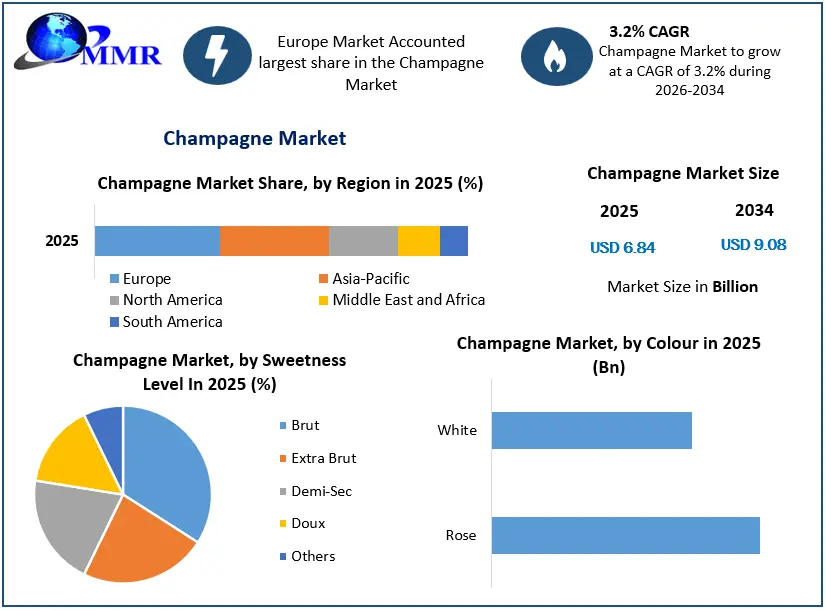
The Champagne Market size was valued at USD 6.84 Billion in 2025 and the total Champagne revenue is expected to grow at a CAGR of 3.2% from 2026 to 2034, reaching nearly USD 9.08 Billion by 2034.

Champagne Market Overview:

The world’s top sparkling wines may be found on the global champagne market. It is expected to rise steadily, owing to a growing emphasis on celebrating common accomplishment, a greater emphasis on identifying individual milestones, and the timeless and ephemeral understanding of life impermanence. For many people, champagne is just sparkling wine. In many cultures though it is virtually sacred during festivals. Champagne market operators are only allowed to describe their products as champagne if the wine comes from the champagne area of France, according to EU regulation.

Champagne Market Analysis from 2025 to 2034
Champagne Market Growth

To know about the Research Methodology :- Request Free Sample Report

Champagne Market Dynamics:

The growing popularity of champagne and increasing preference for low-calorie drinks among individuals are major factors driving the growth of the target market. Rising growth of the global market. Furthermore, the growing availability of different types of champagne and increasing adoption of champagne during celebration festivals are factors propelling the growth of the global market.

The growing demand for premium alcoholic beverages is essentially driving the global champagne market. This can be due to millennial shifting consumption and increasing sociability trends. Also, different product improvements such as introduction of champagne in new and exotic flavors such as strawberry, blueberry, peach etc. are driving the market growth. Pubs, hotels, restaurants and cafes are also experimenting with wine to create new foods in order to deliver more authentic experiences for their consumers.

However, the high cost of champagne and less availability of flavored champagne in small bottles are major factors expected to hinder the growth of the champagne market globally. Development of cost-effective champagne and introduction of new flavors in champagne can create high revenue opportunities for players in the champagne market.

The report on the global champagne market covers segments such as product, distribution channel, grade type, and region. Based on the distribution channel, off-trade held the leading share of more than xx% in 2025, because of the high market visibility of liquor shops as a key buying source among consumers.

Champagne Market Segment Analysis:

The Consumer Electronics Market is sub-segmented into Product, Distribution channel and Grade type.

Based on Product, the market is sub-segmented into Prestige Cuvee, Blanc De Noirs, Blanc De Blancs, Rose Champagne and Others. Blanc de Blancs held the largest share of more than xx% in the global market in 2025. Referred to as the soul of champagne, this product variant is prepared from chardonnay alone. It is extensively popular among consumers owing to its good natural acidity and distinct minerality. Moreover, it can be paired with an extensive range of foods such as shellfish, turbot, sea bass, or even strongly flavoured aged cheese. A market in Europe accounts for largest market share in terms of revenue and is expected to maintain its dominance over the forecast period, because of the presence of a large number of wineries and increasing consumption of alcoholic beverages in the region. The market in North America is expected to witness the fastest growth in the market in terms of revenue over the forecast period, owing to the rising number of recreational clubs and lounges in the region.

Champagne Market Regional Analysis:

Europe holds largest shares in the global champagne market in 2025 also champagne was the seventh largest wine-growing in France. Similar to Bordeaux and Burgundy, champagne was considered a ripe wine- growing because the value of its wine was considered relatively stable. From 2018 to 2025. CIVC recorded a worldwide decline in the sale of champagne (-1.7% compared to +0.4% in 2018-2025). Again the backdrop of falling British exports and weak French market. Industry analysts saw the decline in champagne consumption in 2018-2019 as a result of weak consumer prospects and intense export competition from other sparkling wines such as Italian Prosecco.

The objective of the report is to present a comprehensive assessment of the market and contains thoughtful insights, facts, historical data, industry-validated market data and projections with a suitable set of assumptions and methodology. The report also helps in understanding Global Champagne Market dynamics, structure by identifying and analyzing the market segments and project the global market size. Further, the report also focuses on the competitive analysis of key players by product, price, financial position, product portfolio, growth strategies, and regional presence. The report also provides PEST analysis, PORTER’s analysis, and SWOT analysis to address the question of shareholders to prioritizing the efforts and investment shortly to the emerging segment in the Global Champagne Market.

Champagne Market Recent Industry Developments

Date Company Development Impact
07 January 2026 Taittinger Champagne Taittinger officially extended its multi-year partnership with Formula E to remain the exclusive official champagne supplier for the 2025–2026 racing season. Strengthens global brand visibility and premium hospitality engagement across international motorsport events.
26 February 2026 Vranken-Pommery Monopole The prominent champagne group officially rebranded and transitioned to operate under the new corporate name Maison Pommery & Associés. Modernizes corporate identity and emphasizes its dedication to sustainable viticulture and heritage terroirs.
11 March 2026 Lanson-BCC Group Lanson-BCC reported full-year 2025 financial results achieving €233.3 million in consolidated revenues while strategically prioritizing value preservation over volume in a contracting market. Protects profit margins and strengthens brand positioning through targeted premiumization and the integration of Heidsieck & C° Monopole.
01 June 2026 Laurent-Perrier Laurent-Perrier announced a robust return to growth with operating profit climbing to €76.1 million and net income increasing by 4.5% to €49.5 million. Demonstrates exceptional resilience against broader market contraction through strict distribution control and high brand equity.
07 September 2026 Maison Pommery & Associés The company filed its 2026 half-year financial report with the French Autorité des Marchés Financiers (AMF), detailing international performance metrics. Provides complete financial transparency and regulatory compliance across European stock exchanges.

Champagne Market Scope: Inquire before buying

Champagne Market
Report Coverage Details
Base Year: 2025 Forecast Period: 2026-2034
Historical Data: 2020 to 2025 Market Size in 2025: 6.84 USD Billion
Forecast Period 2026-2034 CAGR: 3.2% Market Size in 2034: 9.08 USD Billion
Segments Covered: by Colour Rose
White
by Sweetness Level Brut
Extra Brut
Demi-Sec
Doux
Others
by Price Point Economy
Luxury
Ultra Luxury
by Packaging Size Mini (187 ml) and Half (375 ml)
Standard (750 ml)
Magnum (1.5 L) and Large Formats
by Champagne Producer Type Champagne Houses
Independent Grower-Producers
Champagne Cooperatives
by Distribution Channel On-Trade
Hotels
Restaurants
Bars & Clubs
Events & Catering
Off-Trade
Supermarkets & Hypermarkets
Wine & Liquor Specialty Stores
Duty-Free / Travel Retail
Online Retail
Others
by End Use / Consumption Occasion Household / Personal Consumption
Hospitality & Foodservice
Celebrations & Events
Corporate & Gifting
Travel & Leisure
Others

Champagne Market, by Region

North America (United States, Canada and Mexico)
Europe (UK, France, Germany, Italy, Spain, Sweden, Austria and Rest of Europe)
Asia Pacific (China, South Korea, Japan, India, Australia, Indonesia, Malaysia, Vietnam, Taiwan, Bangladesh, Pakistan and Rest of APAC)
Middle East and Africa (South Africa, GCC, Egypt, Nigeria and Rest of ME&A)
South America (Brazil, Argentina Rest of South America)

Champagne Market, Key Players are:

Sr. No. Company Headquarters Primary Focus
1 Moët & Chandon France Premium Champagne, Non-Vintage, Vintage, Rosé, Prestige Cuvées
2 Veuve Clicquot France Premium Champagne, Brut, Rosé, Vintage, Prestige Cuvées
3 Ruinart France Luxury Champagne, Blanc de Blancs, Rosé, Prestige Cuvées
4 Krug France Ultra-Luxury Champagne, Prestige Cuvées, Vintage Champagne
5 Dom Pérignon France Prestige Cuvée, Vintage and Rosé Champagne
6 Laurent-Perrier France Premium Champagne, Brut, Rosé, Vintage, Prestige Cuvées
7 Louis Roederer France Premium & Luxury Champagne, Vintage, Cristal Prestige Cuvée
8 Bollinger France Premium & Luxury Champagne, Vintage, Prestige Cuvées
9 Taittinger France Premium Champagne, Brut, Rosé, Blanc de Blancs, Prestige Cuvées
10 Perrier-Jouët France Luxury Champagne, Blanc de Blancs, Rosé, Prestige Cuvées
11 G.H. Mumm France Premium Champagne, Brut, Rosé, Vintage Champagne
12 Piper-Heidsieck France Premium Champagne, Brut, Rosé, Vintage, Prestige Cuvées
13 Charles Heidsieck France Premium & Luxury Champagne, Brut, Rosé, Vintage Cuvées
14 Billecart-Salmon France Premium Champagne, Rosé, Blanc de Blancs, Prestige Cuvées
15 Pol Roger France Premium & Luxury Champagne, Vintage and Prestige Cuvées
16 Nicolas Feuillatte France Brut, Rosé, Vintage and Premium Champagne
17 Lanson France Premium Champagne, Brut, Rosé and Vintage Champagne
18 Pommery France Premium Champagne, Brut, Rosé and Prestige Cuvées
19 Deutz France Premium & Luxury Champagne, Brut, Rosé and Vintage Cuvées
20 Gosset France Premium & Prestige Champagne, Vintage and Rosé Cuvées
21 Duval-Leroy France Premium Champagne, Blanc de Blancs, Rosé and Vintage Cuvées
22 Henriot France Premium Champagne, Blanc de Blancs, Rosé and Vintage Cuvées
23 Barons de Rothschild France Luxury Champagne, Blanc de Blancs, Rosé and Prestige Cuvées
24 Canard-Duchêne France Premium Champagne, Brut, Rosé and Vintage Champagne
25 Champagne Thiénot France Premium Champagne, Brut, Rosé and Vintage Cuvées
26 Joseph Perrier France Premium Champagne, Brut, Rosé, Vintage and Prestige Cuvées
27 Philipponnat France Premium & Luxury Champagne, Vintage and Prestige Cuvées
28 Ayala France Premium Champagne, Brut, Rosé and Low-Dosage Cuvées
29 Salon France Ultra-Luxury Blanc de Blancs Vintage Champagne
30 Delamotte France Blanc de Blancs, Brut, Rosé and Vintage Champagne
31 Besserat de Bellefon France Premium Champagne, Brut, Rosé and Vintage Cuvées
32 Boizel France Premium Champagne, Brut, Rosé, Vintage and Prestige Cuvées
33 De Venoge France Premium & Luxury Champagne, Brut, Rosé and Prestige Cuvées
34 Chanoine Frères France Brut, Rosé and Premium Champagne
35 Mercier France Mainstream & Premium Champagne, Brut and Rosé
36 Vranken France Premium Champagne, Brut, Rosé and Vintage Cuvées
37 G.H. Martel & Co. France Brut, Rosé, Vintage and Premium Champagne
38 Charles de Cazanove France Brut, Rosé, Vintage and Premium Champagne
39 Bruno Paillard France Premium & Luxury Champagne, Extra Brut and Vintage Cuvées
40 Telmont France Premium Champagne, Organic Viticulture, Brut and Rosé Cuvées
41 Pierre Péters France Premium Grower Champagne, Blanc de Blancs, Chardonnay, Grand Cru and Vintage Cuvées
42 Agrapart & Fils France Luxury Grower Champagne, Blanc de Blancs, Extra Brut, Terroir-Driven and Grand Cru Cuvées
43 Egly-Ouriet France Premium and Luxury Grower Champagne, Pinot Noir, Grand Cru, Blanc de Noirs and Vintage Cuvées
44 Jacques Selosse France Ultra-Luxury Grower Champagne, Blanc de Blancs, Single-Vineyard and Terroir-Specific Cuvées
45 Larmandier-Bernier France Premium Grower Champagne, Biodynamic Viticulture, Blanc de Blancs and Extra Brut Cuvées
46 Georges Laval France Boutique Grower Champagne, Organic Viticulture, Low-Dosage and Terroir-Specific Cuvées
47 Ulysse Collin France Ultra-Premium Grower Champagne, Single-Vineyard, Blanc de Blancs and Blanc de Noirs Cuvées
48 Laherte Frères France Premium Grower Champagne, Extra Brut, Rosé, Single-Vineyard and Specialty Grape Cuvées
49 Chartogne-Taillet France Premium Grower Champagne, Single-Vineyard, Terroir-Focused, Blanc de Blancs and Blanc de Noirs Cuvées
50 Vilmart & Cie France Luxury Grower Champagne, Oak-Aged Cuvées, Vintage, Rosé and Prestige Champagne
51 Pierre Gimonnet & Fils France Premium Grower Champagne, Chardonnay, Blanc de Blancs, Premier Cru and Vintage Cuvées
52 René Geoffroy France Premium Grower Champagne, Pinot Noir, Rosé, Extra Brut and Vintage Cuvées
53 Bérêche & Fils France Premium and Luxury Champagne, Terroir-Driven, Vintage, Reserve and Single-Vineyard Cuvées
54 Franck Pascal France Boutique Grower Champagne, Biodynamic Viticulture, Extra Brut and Terroir-Focused Cuvées
55 André Clouet France Premium Champagne, Pinot Noir, Grand Cru, Blanc de Noirs, Brut and Rosé Cuvées

Frequently Asked Questions:

1. Which region has the largest share in Global Champagne Market?
Ans: Europe region holds the highest share in 2025.

2. What is the growth rate of Global Champagne Market?
Ans: The Global Champagne Market is growing at a CAGR of 3.2% during forecasting period 2026-2034.

3. What segments are covered in Global Champagne market?
Ans: Global Champagne Market is segmented into Product, distribution channel, grade type and region.

4. Who are the key players in Global market?
Ans: The important key players in the Global Market are – Moet & Chandon, Nicolas Feuillatte, Veuve Clicquot, Laurent Perrier, Dom Perignon, Mumm, Piper Heidsieck, Pommery, Taittinger, Louis Roederer

5. What was the Global Champagne Market size in 2025?
Ans:
The Global Champagne Market size was USD 6.84 Billion in 2025.

Table of Contents

1. Executive Market Landscape and Industry Overview 1.1. Global Champagne Market Size and Industry Outlook (Value USD Mn. & Volume Mn Bottles), 2025–2034 1.2. Market Definition, Scope, Boundaries, and Key Segmentation Criteria 1.3. Global Champagne Industry Structure and Ecosystem Overview 1.4. Evolution of Champagne Consumption from Celebration-Led Demand toward Premium Lifestyle, Fine Dining, Gifting, and Experiential Consumption 1.5. Champagne Industry Structure across Champagne Houses, Growers, Cooperatives, Négociants, Importers, Distributors, and Retailers 1.6. Evolution of White, Rosé, Vintage, Non-Vintage, Blanc de Blancs, Blanc de Noirs, and Prestige Cuvée Offerings 1.7. Global Champagne Production, Domestic French Consumption, and Export Market Overview 1.8. Competitive Landscape Overview – Leading Champagne Houses, Grower-Producers, Cooperatives, and Luxury Groups 2. Global Champagne Market Dynamics 2.1. Global Champagne Market Trends 2.2. Global Champagne Market DROC Analysis 2.3. Drivers 2.4. Restraints 2.5. Opportunities 2.6. Challenges 2.7. PORTER’s Five Forces Analysis 2.7.1. Supplier Power 2.7.2. Buyer Power 2.7.3. Threat of Substitutes 2.7.4. Threat of New Entrants 2.7.5. Competitive Rivalry 2.8. PESTLE Analysis 3. Macroeconomic & Luxury Consumption Factors Impacting Global Champagne Market Growth (2025) 3.1. Global Luxury Goods and Premium Alcoholic Beverage Consumption Supporting Champagne Demand 3.2. Disposable Income and Affluent Consumer Spending Trends and Their Impact on Champagne Consumption 3.3. High-Net-Worth and Affluent Consumer Population and Its Impact on Premium and Ultra-Luxury Champagne Demand 3.4. Global Hospitality, Fine Dining, Luxury Hotel, Bar, and Nightlife Development Supporting Champagne Consumption 3.5. International Tourism and Travel Recovery and Its Impact on Champagne Demand 3.6. Wedding, Celebration, Corporate Gifting, and Festive Consumption Trends 3.7. Premiumization of Alcoholic Beverages and Consumer Willingness to Pay for Luxury Champagne 4. Champagne Ecosystem Overview and Value Chain Mapping (2025) 4.1. Role of Vineyard Owners and Grape Growers in the Champagne Supply Ecosystem 4.2. Chardonnay, Pinot Noir, Meunier, and Other Permitted Grape Supply Ecosystem 4.3. Role of Champagne Houses, Grower-Producers, Cooperatives, and Négociants 4.4. Glass Bottle, Cork, Foil, Label, Carton, Gift Packaging, and Other Packaging Material Supply Assessment 4.5. Role of Pressing Centres, Fermentation Facilities, Cellars, Bottling Facilities, and Packaging Operations 4.6. Role of Importers, Distributors, Wholesalers, Specialty Wine Retailers, E-Commerce Platforms, and Travel Retailers 4.7. Role of Hotels, Restaurants, Bars, Clubs, Events, Catering, and Luxury Hospitality Customers 5. End-to-End Champagne Production and Supply Ecosystem Structure (2025) 5.1. Champagne Vineyard, Grape Production, and Supply Ecosystem Assessment 5.2. Grape Harvesting, Sorting, Pressing, and Must Preparation Ecosystem 5.3. Primary Fermentation, Malolactic Fermentation, Reserve Wine Management, and Blending Processes 5.4. Tirage and Secondary Bottle Fermentation Process 5.5. Lees Aging and Cellar Maturation Requirements 5.6. Riddling, Disgorgement, Dosage, Corking, and Bottle Finishing Processes 5.7. Champagne Bottling, Labeling, Gift Packaging, and Final Quality-Control Operations 5.8. Standard Bottle, Half Bottle, Magnum, and Large-Format Production Requirements 5.9. Cellar Inventory, Reserve Wine, Vintage Stock, and Finished Product Storage Ecosystem 6. Champagne Grape, Vineyard, and Terroir Supply Analysis (2025) 6.1. Champagne Vineyard Area and Grape Production Assessment 6.2. Chardonnay Supply and Utilization Analysis 6.3. Pinot Noir Supply and Utilization Analysis 6.4. Meunier Supply and Utilization Analysis 6.5. Assessment of Grape Yield, Harvest Conditions, and Vintage Variability 6.6. Analysis of Montagne de Reims Production and Grape Supply 6.7. Analysis of Vallée de la Marne Production and Grape Supply 6.8. Analysis of Côte des Blancs Production and Grape Supply 6.9. Analysis of Côte des Bar Production and Grape Supply 6.10. Grape Grower, Cooperative, and Champagne House Sourcing Relationships 6.11. Climate, Frost, Hail, Drought, and Disease Impact on Grape Availability 7. Consumer Preferences, Occasions & Purchase Behavior 7.1. Celebration and Special-Occasion Champagne Purchasing Motivations 7.2. Wedding, Anniversary and Milestone-Event Consumption Patterns 7.3. Luxury, Status and Experiential Consumption Motivations 7.4. Restaurant, Hotel and Nightlife Champagne Purchasing Behavior 7.5. Gifting and Corporate-Event Champagne Demand 7.6. Champagne Tourism and Cellar-Door Purchasing Behavior 7.7. Seasonal Consumption and Festive-Period Demand Patterns 7.8. Premium and Prestige Champagne Purchase Motivations 8. Champagne Production Process and Cellar Analysis 8.1. Analysis of Grape Harvesting, Pressing, Primary Fermentation, and Blending Stages 8.2. Assessment of Secondary Fermentation and Traditional Bottle-Fermentation Processes 8.3. Evaluation of Riddling, Disgorgement, Dosage, Corking, and Labeling Operations 8.4. Analysis of Reserve Wine Management and Blending Requirements 8.5. Assessment of Cellar Maturation and Aging Requirements 8.6. Evaluation of Bottling, Packaging, and Quality-Control Processes 9. Champagne Pricing Structure and Cost Analysis 9.1. Analysis of Retail Pricing Architecture across Major Champagne Product Categories 9.2. Assessment of Pricing Differences across White and Rosé Champagne 9.3. Evaluation of Pricing Variations across Brut Nature, Extra Brut, Brut, Extra Dry, Sec, Demi-Sec, and Doux 9.4. Analysis of Economy, Premium, Luxury, and Ultra-Luxury Price Architecture 9.5. Assessment of Pricing Differences across Standard Bottles, Magnums, and Large Formats 10. Geographical Scope and Country-Level Champagne Market Assessment 10.1. North America Champagne Demand, Consumption, Imports, Pricing, and Distribution 10.2. Europe Champagne Demand, Consumption, Domestic French Market, and Intra-Regional Trade 10.3. Asia Pacific Champagne Imports, Luxury Consumption, and Premiumization 10.4. Middle East & Africa Luxury Hospitality, Tourism, and Champagne Demand 10.5. South America Champagne Consumption, Imports, and Distribution Development 10.6. Country-Wise Market Value and Volume Comparison 10.7. Country-Wise Champagne Consumption per Capita 10.8. Country-Wise Import/Shipment Value and Volume 11. Champagne Producer Classification and Independent Grower (RM) Industry Structure 11.1. Champagne Producer Classification by NM, RM, CM, RC, and Other Registered Producer Categories 11.2. Number and Geographic Distribution of Independent Champagne Grower-Producers (RM) 11.3. RM versus NM versus Cooperative Champagne Shipment Volume and Market Value Comparison 11.4. Vineyard Ownership, Grape Sourcing, and Estate-Bottling Structures among RM Producers 12. Champagne Grower Economics, Production Costs, and Commercial Profitability 12.1. Independent Champagne Grower Vineyard Operating and Grape Cultivation Costs 12.2. Grape Selling versus Estate Champagne Production Revenue Models 12.3. Champagne Pressing, Fermentation, Aging, Bottling, and Packaging Cost Structure 12.4. RM Producer Gross Margin and Operating Profitability Benchmarking, Where Available 13. Champagne Terroir and Independent Grower Regional Production Clusters 13.1. Montagne de Reims Independent Grower Concentration and Producer Specialization 13.2. Vallée de la Marne RM Champagne Producer Landscape and Meunier-Based Portfolios 13.3. Côte des Blancs Independent Grower Production and Chardonnay Specialization 13.4. Côte des Bar Independent Grower Champagne Production and Regional Commercial Positioning 14. Champagne Trade, Import & Export Analysis 14.1. Analysis of Champagne Export Value and Volume from France 14.2. Assessment of Champagne Shipments across Major Destination Markets 14.3. Country-Wise Champagne Export Volume in Mn Bottles 14.4. Country-Wise Champagne Export Value and Average Export Value per Bottle 14.5. Analysis of Export Dependence across Champagne Producers 14.6. Assessment of Customs, Duties, Excise Taxes, VAT, and Cross-Border Requirements 14.7. Evaluation of International Logistics, Warehousing, and Inventory Requirements 14.8. Analysis of France-to-Destination Champagne Trade Flows 15. Sustainability and Circular Economy Analysis 15.1. Assessment of Sustainable Viticulture across Champagne Vineyards 15.2. Analysis of Vineyard Biodiversity, Soil Management, and Agrochemical Reduction 15.3. Evaluation of Glass Bottle Lightweighting and Recycling Opportunities 15.4. Assessment of Cork, Foil, Carton, Label, and Gift-Packaging Sustainability 15.5. Analysis of Energy, Water, and Carbon-Emission Reduction across Production 16. Regulatory Framework and Compliance Analysis 16.1. Analysis of Champagne AOC/AOP and Geographical-Origin Requirements 16.2. Assessment of Authorized Production Area and Grape Requirements 16.3. Evaluation of Vineyard Yields, Pressing, Fermentation, Maturation, and Production Rules 16.4. Analysis of Champagne Labeling and Traceability Requirements 16.5. Assessment of Geographical Indication and Champagne Designation Protection 17. Investment Opportunities and Capital Deployment 17.1. Assessment of Vineyard and Grape-Supply Investment Requirements 17.2. Analysis of Winery, Bottling, and Cellar-Capacity Investment Opportunities 17.3. Evaluation of Capital Opportunities in Luxury and Prestige Cuvée Portfolios 17.4. Assessment of Sustainable Vineyard and Production Investments 17.5. Analysis of Packaging and Low-Carbon Technology Investments 17.6. Evaluation of Distribution-Network and Direct-to-Consumer Investments 17.7. Assessment of Champagne Tourism and Experiential Retail Investments 18. Global Champagne Market: Market Size and Forecast by Segmentation (by Value USD Million and Volume Mn Bottles) (2025–2034) 18.1. Global Champagne Market Size and Forecast, By Colour 18.1.1. Rosé 18.1.2. White 18.2. Global Champagne Market Size and Forecast, By Sweetness Level 18.2.1. Brut 18.2.2. Extra Brut 18.2.3. Demi-Sec 18.2.4. Doux 18.2.5. Others 18.3. Global Champagne Market Size and Forecast, By Price Point 18.3.1. Economy 18.3.2. Luxury 18.3.3. Ultra Luxury 18.4. Global Champagne Market Size and Forecast, By Packaging Size 18.4.1. Mini (187 ml) and Half (375 ml) 18.4.2. Standard (750 ml) 18.4.3. Magnum (1.5 L) and Large Formats 18.5. Global Champagne Market Size and Forecast, By Champagne Producer Type 18.5.1. Champagne Houses 18.5.2. Independent Grower-Producers 18.5.3. Champagne Cooperatives 18.6. Global Champagne Market Size and Forecast, By Distribution Channel 18.6.1. On-Trade 18.6.1.1. Hotels 18.6.1.2. Restaurants 18.6.1.3. Bars & Clubs 18.6.1.4. Events & Catering 18.6.2. Off-Trade 18.6.2.1. Supermarkets & Hypermarkets 18.6.2.2. Wine & Liquor Specialty Stores 18.6.2.3. Duty-Free / Travel Retail 18.6.2.4. Online Retail 18.6.2.5. Others 18.7. Global Champagne Market Size and Forecast, By End Use / Consumption Occasion 18.7.1. Household / Personal Consumption 18.7.2. Hospitality & Foodservice 18.7.3. Celebrations & Events 18.7.4. Corporate & Gifting 18.7.5. Travel & Leisure 18.7.6. Others 18.8. Global Champagne Market Size and Forecast, By Region 18.8.1. North America 18.8.1.1. United States 18.8.1.2. Canada 18.8.1.3. Mexico 18.8.2. Europe 18.8.2.1. United Kingdom 18.8.2.2. France 18.8.2.3. Germany 18.8.2.4. Italy 18.8.2.5. Belgium 18.8.2.6. Spain 18.8.2.7. Switzerland 18.8.2.8. Netherlands 18.8.2.9. Sweden 18.8.2.10. Denmark 18.8.2.11. Norway 18.8.2.12. Austria 18.8.2.13. Luxembourg 18.8.2.14. Rest of Europe 18.8.3. Asia Pacific 18.8.3.1. China 18.8.3.2. South Korea 18.8.3.3. India 18.8.3.4. Japan 18.8.3.5. Australia 18.8.3.6. Indonesia 18.8.3.7. Philippines 18.8.3.8. Malaysia 18.8.3.9. Vietnam 18.8.3.10. Thailand 18.8.3.11. Rest of Asia Pacific 18.8.4. Middle East and Africa 18.8.4.1. South Africa 18.8.4.2. Saudi Arabia 18.8.4.3. United Arab Emirates (UAE) 18.8.4.4. Oman 18.8.4.5. Qatar 18.8.4.6. Kuwait 18.8.4.7. Turkey 18.8.4.8. Egypt 18.8.4.9. Nigeria 18.8.4.10. Rest of ME&A 18.8.5. South America 18.8.5.1. Brazil 18.8.5.2. Argentina 18.8.5.3. Chile 18.8.5.4. Colombia 18.8.5.5. Rest of South America 19. Global Champagne Competitive Landscape Overview (2025) 19.1. Global Champagne Market Concentration and Competitive Structure among Leading Champagne Houses, Grower-Producers, Cooperatives, and Luxury Groups 19.2. Competitive Positioning of Large Champagne Houses versus Independent Grower Champagne Producers 19.3. Analysis of Integrated Champagne Houses versus Specialized and Boutique Producers 20. Product Innovation and Portfolio Development Assessment (2025) 20.1. Product Innovation Pipeline Benchmarking across Leading Champagne Companies 20.2. Assessment of Rosé, Blanc de Blancs, Blanc de Noirs, and Low-Dosage Portfolio Development 20.3. Vintage and Prestige Cuvée Product Development Comparison 20.4. Limited-Edition, Collector, and Special-Release Champagne Assessment 21. Champagne Product Benchmarking Across Key Players (2025) 21.1. Comparative Assessment of Leading Champagne Brands and Cuvées 21.2. Champagne House → Brand → Cuvée/SKU Benchmarking 21.3. White versus Rosé Champagne Product Comparison 21.4. Non-Vintage versus Vintage Champagne Comparison 21.5. Blanc de Blancs versus Blanc de Noirs versus Blended Champagne Comparison 22. Revenue Performance and Financial Analysis (2025) 22.1. Comparative Financial Performance of Leading Champagne Companies and Parent Groups 22.2. Champagne Business Revenue Comparison among Major Players, Where Publicly Available 23. Mergers, Acquisitions, Investments, and Strategic Alliances Analysis (2025) 23.1. Recent Strategic Developments in the Global Champagne Industry 23.2. Champagne M&A Activity Assessment for Brand, Vineyard, Production, and Distribution Expansion 23.3. Acquisition of Champagne Houses, Brands, Vineyards, and Distribution Assets 23.4. Strategic Investment in Cellars, Production Capacity, and Sustainable Viticulture 24. Champagne Houses versus Independent Grower-Producers Competitive Positioning 24.1. NM versus RM versus Cooperative Producer Structure and Market Participation 24.2. Leading Champagne Houses versus RM Producers by Production Volume and Portfolio 24.3. Vineyard Ownership, Grape Procurement, and Estate Production Model Comparison 25. Company Profiles: Key Players 25.1. Company Profile Assessment Parameters 25.1.1. Overview 25.1.2. Business Portfolio 25.1.3. Financial Overview 25.1.4. SWOT Analysis 25.1.5. Strategic Analysis 25.1.6. Recent Developments 25.2. Champagne Company Profiles 25.2.1. Moët & Chandon – France – Premium Champagne, Non-Vintage, Vintage, Rosé, Prestige Cuvées 25.2.2. Veuve Clicquot – France – Premium Champagne, Brut, Rosé, Vintage, Prestige Cuvées 25.2.3. Ruinart – France – Luxury Champagne, Blanc de Blancs, Rosé, Prestige Cuvées 25.2.4. Krug – France – Ultra-Luxury Champagne, Prestige Cuvées, Vintage Champagne 25.2.5. Dom Pérignon – France – Prestige Cuvée, Vintage and Rosé Champagne 25.2.6. Laurent-Perrier – France – Premium Champagne, Brut, Rosé, Vintage, Prestige Cuvées 25.2.7. Louis Roederer – France – Premium & Luxury Champagne, Vintage, Cristal Prestige Cuvée 25.2.8. Bollinger – France – Premium & Luxury Champagne, Vintage, Prestige Cuvées 25.2.9. Taittinger – France – Premium Champagne, Brut, Rosé, Blanc de Blancs, Prestige Cuvées 25.2.10. Perrier-Jouët – France – Luxury Champagne, Blanc de Blancs, Rosé, Prestige Cuvées 25.2.11. G.H. Mumm – France – Premium Champagne, Brut, Rosé, Vintage Champagne 25.2.12. Piper-Heidsieck – France – Premium Champagne, Brut, Rosé, Vintage, Prestige Cuvées 25.2.13. Charles Heidsieck – France – Premium & Luxury Champagne, Brut, Rosé, Vintage Cuvées 25.2.14. Billecart-Salmon – France – Premium Champagne, Rosé, Blanc de Blancs, Prestige Cuvées 25.2.15. Pol Roger – France – Premium & Luxury Champagne, Vintage and Prestige Cuvées 25.2.16. Nicolas Feuillatte – France – Brut, Rosé, Vintage and Premium Champagne 25.2.17. Lanson – France – Premium Champagne, Brut, Rosé and Vintage Champagne 25.2.18. Pommery – France – Premium Champagne, Brut, Rosé and Prestige Cuvées 25.2.19. Deutz – France – Premium & Luxury Champagne, Brut, Rosé and Vintage Cuvées 25.2.20. Gosset – France – Premium & Prestige Champagne, Vintage and Rosé Cuvées 25.2.21. Duval-Leroy – France – Premium Champagne, Blanc de Blancs, Rosé and Vintage Cuvées 25.2.22. Henriot – France – Premium Champagne, Blanc de Blancs, Rosé and Vintage Cuvées 25.2.23. Barons de Rothschild – France – Luxury Champagne, Blanc de Blancs, Rosé and Prestige Cuvées 25.2.24. Canard-Duchêne – France – Premium Champagne, Brut, Rosé and Vintage Champagne 25.2.25. Champagne Thiénot – France – Premium Champagne, Brut, Rosé and Vintage Cuvées 25.2.26. Joseph Perrier – France – Premium Champagne, Brut, Rosé, Vintage and Prestige Cuvées 25.2.27. Philipponnat – France – Premium & Luxury Champagne, Vintage and Prestige Cuvées 25.2.28. Ayala – France – Premium Champagne, Brut, Rosé and Low-Dosage Cuvées 25.2.29. Salon – France – Ultra-Luxury Blanc de Blancs Vintage Champagne 25.2.30. Delamotte – France – Blanc de Blancs, Brut, Rosé and Vintage Champagne 25.2.31. Besserat de Bellefon – France – Premium Champagne, Brut, Rosé and Vintage Cuvées 25.2.32. Boizel – France – Premium Champagne, Brut, Rosé, Vintage and Prestige Cuvées 25.2.33. De Venoge – France – Premium & Luxury Champagne, Brut, Rosé and Prestige Cuvées 25.2.34. Chanoine Frères – France – Brut, Rosé and Premium Champagne 25.2.35. Mercier – France – Mainstream & Premium Champagne, Brut and Rosé 25.2.36. Vranken – France – Premium Champagne, Brut, Rosé and Vintage Cuvées 25.2.37. G.H. Martel & Co. – France – Brut, Rosé, Vintage and Premium Champagne 25.2.38. Charles de Cazanove – France – Brut, Rosé, Vintage and Premium Champagne 25.2.39. Bruno Paillard – France – Premium & Luxury Champagne, Extra Brut and Vintage Cuvées 25.2.40. Telmont – France – Premium Champagne, Organic Viticulture, Brut and Rosé Cuvées 25.2.41. Pierre Péters – France – Premium Grower Champagne, Blanc de Blancs, Chardonnay, Grand Cru and Vintage Cuvées 25.2.42. Agrapart & Fils – France – Luxury Grower Champagne, Blanc de Blancs, Extra Brut, Terroir-Driven and Grand Cru Cuvées 25.2.43. Egly-Ouriet – France – Premium and Luxury Grower Champagne, Pinot Noir, Grand Cru, Blanc de Noirs and Vintage Cuvées 25.2.44. Jacques Selosse – France – Ultra-Luxury Grower Champagne, Blanc de Blancs, Single-Vineyard and Terroir-Specific Cuvées 25.2.45. Larmandier-Bernier – France – Premium Grower Champagne, Biodynamic Viticulture, Blanc de Blancs and Extra Brut Cuvées 25.2.46. Georges Laval – France – Boutique Grower Champagne, Organic Viticulture, Low-Dosage and Terroir-Specific Cuvées 25.2.47. Ulysse Collin – France – Ultra-Premium Grower Champagne, Single-Vineyard, Blanc de Blancs and Blanc de Noirs Cuvées 25.2.48. Laherte Frères – France – Premium Grower Champagne, Extra Brut, Rosé, Single-Vineyard and Specialty Grape Cuvées 25.2.49. Chartogne-Taillet – France – Premium Grower Champagne, Single-Vineyard, Terroir-Focused, Blanc de Blancs and Blanc de Noirs Cuvées 25.2.50. Vilmart & Cie – France – Luxury Grower Champagne, Oak-Aged Cuvées, Vintage, Rosé and Prestige Champagne 25.2.51. Pierre Gimonnet & Fils – France – Premium Grower Champagne, Chardonnay, Blanc de Blancs, Premier Cru and Vintage Cuvées 25.2.52. René Geoffroy – France – Premium Grower Champagne, Pinot Noir, Rosé, Extra Brut and Vintage Cuvées 25.2.53. Bérêche & Fils – France – Premium and Luxury Champagne, Terroir-Driven, Vintage, Reserve and Single-Vineyard Cuvées 25.2.54. Franck Pascal – France – Boutique Grower Champagne, Biodynamic Viticulture, Extra Brut and Terroir-Focused Cuvées 25.2.55. André Clouet – France – Premium Champagne, Pinot Noir, Grand Cru, Blanc de Noirs, Brut and Rosé Cuvées 26. Champagne Modernization Opportunity Map 26.1. Identifying High-Value and Emerging Geographic Opportunities Based on Champagne Consumption, Imports, Premiumization, and Distribution Development 26.2. Country-Wise Champagne Market Size and Growth Opportunity, 2025–2034 26.3. Champagne Consumption and Shipment Volume Comparison across Major Countries 26.4. Domestic France versus International Export Market Demand Assessment 26.5. Country-Wise Champagne Import Value, Import Volume, and Average Price per Bottle 26.6. Assessment of Mature versus Emerging Champagne Consumption Markets 27. Regional & Country-Level Champagne Demand Benchmarking 27.1. Comparing Champagne Demand, Consumption Intensity, Pricing, and Channel Development across Major Geographic Markets 27.2. North America – United States, Canada, and Mexico 27.3. Europe – France, United Kingdom, Germany, Italy, Belgium, Switzerland, Spain, Netherlands, Sweden, Denmark, Norway, and Rest of Europe 27.4. Asia Pacific – Japan, Australia, China, Singapore, South Korea, Hong Kong, India, and Rest of Asia Pacific 27.5. Middle East & Africa – UAE, South Africa, Qatar, and Other Accessible Champagne Market 28. Champagne Product–Market Fit & Geographic Positioning Analysis 28.1. Identifying the Champagne Products and Positioning Strategies Suited to Different Geographic Demand Environments 28.2. Product Preference Comparison across Mature and Emerging Champagne Markets 28.3. White versus Rosé Demand by Geography 28.4. Vintage versus Non-Vintage Demand by Geography 28.5. Low-Dosage and Brut Nature Adoption across Key Markets 28.6. Prestige Cuvée and Ultra-Luxury Champagne Demand by Country 28.7. Standard Bottle versus Magnum and Large-Format Demand by Market 29. Champagne Geographic Expansion & Market Entry Opportunity Assessment 29.1. Identifying Priority Markets and Commercial Pathways for International Champagne Portfolio Expansion 29.2. Assessment of Established, Developing, and Emerging Champagne Markets 29.3. Country Attractiveness Based on Market Size, Growth, Import Demand, and Premiumization 29.4. Importer and Distributor Requirements by Country 29.5. On-Trade and Luxury Hospitality Market Entry Opportunities 29.6. Specialty Retail and Luxury Retail Expansion Opportunities 29.7. E-Commerce and Direct-to-Consumer Opportunities 30. Key Findings & Strategic Market Insights 30.1. Summary of Major Insights Shaping the Global Champagne Market 30.2. Key Demand Drivers Influencing Champagne Consumption and Premium Beverage Demand 30.3. Impact of Premiumization, Luxury Consumption, Tourism, and Hospitality on Champagne Sales 30.4. Major Market Opportunities Emerging across Developed and High-Growth Markets 30.5. Key Challenges Affecting Champagne Production, Pricing, Distribution, and Consumption 30.6. Strategic Implications of Changing Consumer Preferences and Purchasing Behavior 31. Why the Global Champagne Market is Becoming a Strategic Premium Beverage Market (2025) 31.1. Champagne’s Transformation from Traditional Celebration Beverage to Premium Lifestyle Product 31.2. Key Factors Driving Global Consumer and Investor Interest in Champagne 31.3. Impact of Luxury Consumption, Experiential Dining, Tourism, and Hospitality Growth on Champagne Demand 31.4. Role of Premiumization and Product Innovation in Market Transformation 31.5. Expansion of Champagne Consumption across Emerging Markets 31.6. Increasing Importance of E-Commerce, Digital Retail, and Direct-to-Consumer Channels 32. Champagne Industry Outlook and Strategic Transformation (2026) 32.1. Global Champagne Industry Outlook and Future Market Direction 32.2. Impact of Economic Conditions, Consumer Spending, and Luxury Market Trends on Champagne Consumption 32.3. Evolution toward Premium, Prestige, Rosé, Vintage, and Specialty Champagne Products 32.4. Sustainability, Climate Conditions, and Vineyard Management Trends Shaping Champagne Production 33. Strategic Moves & Industry Outlook (2025–2034) 33.1. Future Direction of the Global Champagne Industry 33.2. Shift toward Premiumization, Luxury Positioning, and Experience-Based Consumption 33.3. Expansion of Champagne Distribution across E-Commerce, Specialty Retail, Hospitality, and Direct-to-Consumer Channels 33.4. Growth Outlook for Vintage, Rosé, Prestige Cuvée, Blanc de Blancs, and Blanc de Noirs Champagne 33.5. Impact of Tourism, Fine Dining, Weddings, Celebrations, and Corporate Events on Market Growth 34. Strategic Recommendations for Market Participants 34.1. Develop Premium and Prestige Champagne Portfolios Aligned with Evolving Consumer Preferences 34.2. Strengthen Partnerships across Champagne Houses, Distributors, Retailers, Hospitality Operators, and E-Commerce Platforms 34.3. Expand Market Presence across High-Growth International Markets and Premium Consumption Segments 34.4. Target High-Value Consumer Segments Including Luxury Buyers, HNWIs, Millennials, Premium Hospitality Customers, and Gifting Consumers 35. Research Methodology 35.1. Market Sizing Approach and Forecasting Framework 35.2. Global Champagne Market Estimation Methodology 35.3. Country-Level Champagne Market Estimation and Forecasting Methodology 35.4. Primary Research Methodology 35.5. Champagne Producer and Champagne House Interviews 35.6. Distributor, Importer, Retailer, and Hospitality Industry Interviews 35.7. Wine Merchant, Sommelier, and Industry Expert Discussions 35.8. Consumer Research and Purchasing Behavior Analysis 35.9. Supply-Side and Demand-Side Market Validation 35.10. Data Triangulation and Forecast Validation

Custom Market Research Services

We Will Customise The Research For You, In Case The Report Listed Above Does Not Meet With Your Requirements