Car Recycle Market - Industry Structure Evaluation, Demand Drivers Analysis, Regional Growth Analysis and Identification, Competitive Positioning / Landscape Review & Global Market Size Forecast to 2034

14.1%
CAGR (2026-2034)
113.72 USD Bn.
Forecast Market Size
327
Report Pages
158
Market Tables

Overview

The Car Recycle Market size was valued at USD 113.72 Billion in 2025 and the total Car Recycle revenue is expected to grow at a CAGR of 14.1% from 2026 to 2034, reaching nearly USD 372.75 Billion.

Car Recycle Market Overview:

Car recycling contains reusing restored parts and shredding and recycling car materials like plastics, aluminums, and steel. End-of-life vehicles are crushed in recycling plants to eliminate parts and hence crushed to recuperate materials. There are four essential advances engaged with the recycling of ELV vehicles, which incorporate, Dismantling, Crushing, Shredding, and Material Recovery. Sheet metals, attractive parts, gas, seats, sound system, wheels and so on are taken out and exchanged. Steel represents the biggest material to be recycled in the metals class, trailed by ferrous and nonferrous metals. More than 18 million tons of steel is recycled consistently from end-of-life vehicles. Division advances like swirl current, laser, infra-red, and buoyancy partition innovations are utilized to isolate the non-ferrous metals into unadulterated surges of materials which are then sent for re-purifying.

Vehicles keep a large recycling rate of 80%, automobiles are the most recycled buyer items around the world, hence the car recycling market holds high potential universally.

Car Recycle Market Growth and Share AnalysisCar Recycle Market Growth
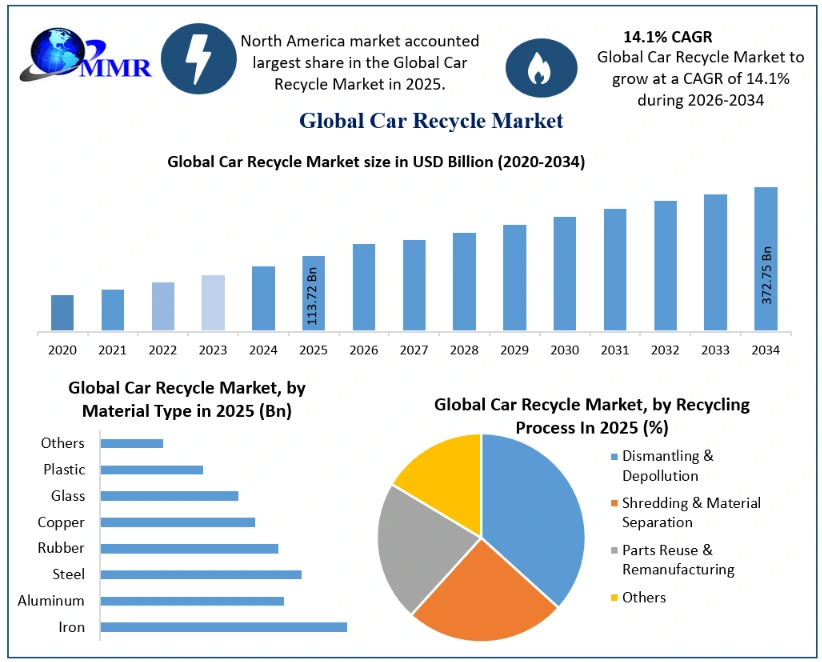
To know about the Research Methodology :- Request Free Sample Report

Car Recycle Market Dynamics:

Governments across the globe, like the U.S., have been dynamic in imposing high duties on the import of virgin steel to keep up with ware costs and to help material recycling. Hence, automakers are constrained to utilize recycled steel. Recycler’s affiliations and governments around the world, like Automotive Recyclers Association (ARA) and the U.S Environmental Protection Agency, are executing feasible practices to lessen the natural effect. Automakers and car parts makers are constrained to utilize restored and recycled parts. Expanded advancements in recycling and the foundation of fresher brands, like Green Recycled Parts (GRP) by ARA, these factors are expected to drive the market through the forecast period.

Presently, around 39 kinds of plastics and polymers are utilized in automobiles. The presence of a huge assortment of plastics and polymers represents a test for a recycler with a high cycle value. In any case, rising natural norms overall and developing accentuation on recycling plastics are assessed to help the recycling pace of plastics utilized in insides, guards, and gas tanks. The car recycling market is expected to observe a fast expansion through the forecast period due to the expansion in the number of cars and end-of-life vehicles. It alludes to the crushing of the vehicles for spare parts. Auto recyclers have been zeroing in on the recyclability of car parts, significantly for the steel and iron parts. Another significant part considered in recycling is getting the polymers, liquids and normal materials for deals or reuse. More than 27 million cars across the world arrive at the finish of their lives yearly. Old vehicles and models engaged in crashes add to the significant portion of cars that are sent for recycling.

A rise in awareness among consumers, energy-saving necessities, and the need to bring down ozone-harming substance outflow levels are a portion of the central point driving the car recycling market. Fast development in industrialization and urbanization in emerging countries and expanding buyer mindfulness drive the metal recycling market. Car recyclers are utilizing modern techniques and systems to work on their inflow of old vehicles. The rising advantages of car recycling, for example, the avoidance of risky fluid from going to landfills consistently and reserve funds worth a great many barrels of oil, which can be utilized for different designs, are further supporting business sector development.

Car Recycle Market Segment Analysis:

By Material, the market is segmented into Iron, Aluminum, Steel, Rubber, Copper, Glass, Plastic, and Others. The metals segment is expected to dominate the market through the forecast period. Moreover, an expansion in the number of junk cars for scrap auto business, exchanging, and recycling are predicted to decidedly impact the metal section's portion in the worldwide car recycling market. Headways in the steel business are predicted to set off the demand for additional treated steel from recyclers. The Rubber portion is expected to observe a huge upswing in the car recycling market development, inferable from its use in the plan and assembling of car vehicles. Rigid unofficial laws and changing buyer ways of behaving are supposed to drive the demand for more reasonable, lightweight, and eco-friendly cars. A rise in awareness among consumers, energy-saving necessities, and the need to bring down ozone-harming substance outflow levels are a portion of the central point driving the car recycling market. Fast development in industrialization and urbanization in emerging countries and expanding buyer mindfulness drive the metal recycling market. Car recyclers are utilizing modern techniques and systems to work on their inflow of old vehicles. The rising advantages of car recycling, for example, the avoidance of risky fluid from going to landfills consistently and reserve funds worth a great many barrels of oil, which can be utilized for different designs, are further supporting business sector development.

By Type, the Market is segmented into Passenger Cars Recycling, Commercial Vehicles Recycling. The Passenger Cars Recycling segment is expected to dominate the market through the forecast period, and it is expected to grow at the highest CAGR through the forecast period. Due to various governmental norms, rules and regulations, the old cars are becoming useless thus, the market is expected to grow through the forecast period.

Car Recycle Market Regional Insights:

The North America Market is expected to dominate the market through the forecast period. Car recycling is a noticeable billion-dollar industry in the U.S utilizing more than 100,000 individuals. The U.S has the most elevated vehicle recycling rate worldwide and thus, holds a main portion of the worldwide car recycling market. The Asia Pacific contributes altogether to the production of vehicles, regarding volume; moreover, the car recycling rate in emerging nations in the area is somewhat low. the rise in awareness and dynamic government drives to advance green plans of action is expected to drive the car recycling market in the region.

The objective of the report is to present a comprehensive analysis of the Car Recycle Market to the stakeholders in the industry. The past and current status of the industry with the forecasted market size and trends are presented in the report with the analysis of complicated data in simple language. The report covers all the aspects of the industry with a dedicated study of key players that include market leaders, followers, and new entrants.

PORTER, PESTEL analysis with the potential impact of micro-economic factors of the market have been presented in the report. External as well as internal factors that are supposed to affect the business positively or negatively have been analyzed, which will give a clear futuristic view of the industry to the decision-makers.

The report also helps in understanding the Car Recycle Market dynamics, structure by analyzing the market segments and project the Car Recycle Market size. Clear representation of competitive analysis of key players By Type, price, financial position, product portfolio, growth strategies, and regional presence in the Car Recycle Market make the report investor’s guide.

Car Recycle Market Recent Developments:

Date Company Development Impact
17 June 2025 Council of the European Union The Council of the European Union formally adopted its position on revised End-of-Life Vehicles (ELV) regulations to mandate strict circularity obligations across member states. The policy framework sets mandatory targets including 25% recycled plastic content in new vehicles by 2035 and expands authorized treatment facility compliance standards.
16 December 2025 Redwood Materials Redwood Materials launched the Redwood Battery Bin to establish a standardized industrial solution for safe collection and transport of end-of-life vehicle batteries. The innovation streamlines logistics for automotive dismantlers and recyclers, accelerating high-yield closed-loop critical mineral recovery.
19 February 2026 Toyota Motor Europe Toyota Motor Europe announced the establishment of an advanced Circular Factory in Wałbrzych, Poland dedicated to processing end-of-life vehicles. Designed to recycle up to 20,000 ELVs annually, the facility expands OEM-led vehicle component dismantling and material recovery in Europe.
06 July 2026 Ashok Leyland Ashok Leyland entered into a strategic partnership with Rosmerta Recycling to build an authorized commercial vehicle scrappage network. The collaboration establishes compliant Registered Vehicle Scrapping Facilities to capture end-of-life commercial fleets and increase secondary metal utilization.

Car Recycle Market Scope: Inquire before buying

Global Car Recycle Market
Report Coverage Details
Base Year: 2025 Forecast Period: 2026-2034
Historical Data: 2020 to 2025 Market Size in 2025: USD 113.72 Bn.
Forecast Period 2026 to 2034 CAGR: 14.1 % Market Size in 2034: USD 372.75 Bn.
Segments Covered: by Type Passenger Cars Recycling

  Hatchback Recycling
  Sedan Recycling
  SUV Recycling
  Multi-Purpose Vehicle (MPV) Recycling
  Coupe & Convertible Recycling

Commercial Vehicles Recycling

   Light Commercial Vehicles (LCVs) Recycling
  Medium Commercial Vehicles (MCVs) Recycling
  Heavy Commercial Vehicles (HCVs) Recycling
  Buses & Coaches Recycling

by Material Iron
Aluminum
Steel
Rubber
Copper
Glass
Plastic
Others
by Recycling Process Dismantling & Depollution
Shredding & Material Separation
Parts Reuse & Remanufacturing
Others
by End-Use Industry Metal Smelters & Foundries
Automotive Parts Manufacturers
Aftermarket & Used Parts Dealers
Battery Recyclers
Others

Car Recycle Market, by Region:

North America (United States, Canada and Mexico)
Europe (UK, France, Germany, Italy, Spain, Sweden, Austria and Rest of Europe)
Asia Pacific (China, South Korea, Japan, India, Australia, Indonesia, Malaysia, Vietnam, Taiwan, Bangladesh, Pakistan and Rest of APAC)
Middle East and Africa (South Africa, GCC, Egypt, Nigeria and Rest of ME&A)
South America (Brazil, Argentina Rest of South America)

Car Recycle Market, Key Players:

North America
1. LKQ Corporation
2. Copart, Inc.
3. SA Recycling LLC
4. Radius Recycling, Inc. (formerly Schnitzer Steel Industries, Inc.)
5. Pull-A-Part, LLC
6. Cox Automotive Inc.
7. Spiers New Technologies, Inc. (Cox Automotive Inc.)
8. IAA, Inc. (Ritchie Bros. Auctioneers Incorporated)
9. Redwood Materials, Inc.
10. Ascend Elements, Inc.
11. Cirba Solutions
12. American Battery Technology Company
13. Call2Recycle, Inc.
14. Li-Cycle Holdings Corp. (Glencore plc — acquired 2025)
15. David J. Joseph Company (Nucor Corporation)
16. OmniSource Corporation (Steel Dynamics, Inc.)
17. American Iron & Metal Company Inc. (AIM Group)
Others

Europe
19. European Metal Recycling Ltd. (EMR Group)
20. Stena Recycling AB (Stena AB)
21. Umicore N.V./S.A.
22. ECOBAT Ltd.
23. ALBA Group plc & Co. KG
24. ASM Auto Recycling Ltd.
25. Hensel Recycling Group
26. Scholz Recycling GmbH
27. INDRA (joint venture of Renault Group and Suez S.A.)
28. Fortum Battery Recycling (Fortum Oyj)
29. Glencore plc
Others

Asia Pacific
30. Sims Limited
31. GEM Co., Ltd. (Green Eco-Manufacture Co., Ltd.)
32. Kaiho Sangyo Co., Ltd.
33. KEIAISHA Co., Ltd.
34. Toyota Metal Co., Ltd. (Toyota Group affiliate)
35. Miracle Automation Engineering Co., Ltd.
36. Changjiu Recycling (Zhejiang Changjiu Auto Parts Co., Ltd.)
37. Mahindra MSTC Recycling Private Limited (joint venture: Mahindra & Mahindra Ltd. / MSTC Limited)
38. SK Tes (SK ecoplant / SK Group)
Others

Middle East & Africa
39. SA Metal Group
Others

South America
40. Ecopeças
Others

Frequently Asked Questions:

1. What is the forecast period considered for the Car Recycle Market report?
Ans. The forecast period for the Car Recycle Market is 2026-2034.

2. Which key factors are hindering the growth of the Car Recycle Market?
Ans. The High Cost of manufacturing expected to hinder the market.

3. What is the compound annual growth rate (CAGR) of the Car Recycle Market for the forecast period?
Ans. The CAGR of Car Recycle Market is 14.1 %

4. What are the key factors driving the growth of the Car Recycle Market?
Ans. Rise in awareness among Consumers driving the market.

5. What was the Global Car Recycle Market size in 2025?
Ans:
The Global Car Recycle Market size was USD 113.72 Billion in 2025.

Table of Contents

1. GLOBAL CAR RECYCLE MARKET INTRODUCTION 1.1. Executive Market Landscape and Industry Overview 1.1.1 Global Car Recycling Market Size (Value USD Million & Volume in 000’ Units), 2025–2034 1.1.2 Historical Market Size Trends and Growth Momentum Analysis Across Car Recycling Industry 1.1.3 Forecast Revenue Projections with Underlying Market Growth Driving Factors 1.1.4 Supply-Demand Balance and Its Influence on Global Recycling Capacity Expansion 1.1.5 Impact of Macroeconomic Indicators on Car Recycling Market Growth Trajectory 1.1.6 End-of-Life Vehicle (ELV) Generation Trends Supporting Market Development 1.1.7 Long-Term Market Outlook Highlighting Circular Economy Growth Opportunities Through 2034 1.1.8 CAGR Analysis of Global Car Recycling Market (2025–2034) 1.2. Car Recycle Market Dynamics 1.2.1 Car Recycle Market Trends 1.2.2 Car Recycle Market Dynamics 1.2.2.1 Drivers 1.2.2.2 Restraints 1.2.2.3 Opportunities 1.2.2.4 Challenges 1.2.3 PORTER’s Five Forces Analysis 1.2.4 PESTLE Analysis 1.3. Pricing Structure and Value Chain Profitability Assessment 1.3.1 Comprehensive Breakdown of Car Recycling Cost Structure Across the Value Chain 1.3.2 Margin Distribution Analysis Among Vehicle Collectors, Dismantlers, Shredders, and Material Recyclers 1.3.3 Impact of Scrap Metal Price Volatility on Recycling Profitability 1.3.4 Revenue Contribution Across Ferrous, Non-Ferrous, Plastic, Glass, and Rubber Recovery 1.3.5 Processing Cost Assessment Across Vehicle Collection, Dismantling, and Material Recovery Stages 1.3.6 Profitability Trends and Revenue Optimization Strategies Across Industry Participants 1.4. End-of-Life Vehicle Collection and Automotive Scrap Supply Dynamics 1.4.1 Global End-of-Life Vehicle (ELV) Generation Trends Across Major Regions 1.4.2 Vehicle Collection Networks Supporting Recycling Supply Chain Efficiency 1.4.3 Automotive Scrap Availability and Regional Supply Assessment 1.4.4 Collection Rate Improvements Through Organized Recycling Ecosystems 1.4.5 Impact of Vehicle Ownership Growth on Future ELV Availability 1.4.6 Informal Versus Organized Vehicle Collection Market Assessment 1.5. Vehicle Dismantling and Material Recovery Trends 1.5.1 Evolution of Vehicle Dismantling Practices Across Global Recycling Facilities 1.5.2 Recovery Trends for Steel, Aluminum, Copper, Plastics, Glass, and Rubber 1.5.3 Increasing Recovery of High-Value Automotive Components 1.5.4 Catalytic Converter Recycling Supporting Precious Metal Recovery 1.5.5 Component Reuse and Refurbishment Supporting Circular Material Utilization 1.5.6 Material Recovery Efficiency Improvements Across Recycling Operations 1.6. Recycling Technologies and Process Innovation Trends 1.6.1 Adoption of Automated Vehicle Dismantling Technologies 1.6.2 Robotics and Artificial Intelligence Enhancing Recycling Efficiency 1.6.3 Advanced Shredding and Material Separation Technologies 1.6.4 Sensor-Based Sorting Improving Material Recovery Accuracy 1.6.5 Digital Monitoring Systems Supporting Recycling Process Optimization 1.6.6 Industry 4.0 Integration Across Modern Automotive Recycling Facilities 1.7. Circular Economy and Closed-Loop Material Recovery 1.7.1 Circular Economy Principles Driving Automotive Recycling Industry Transformation 1.7.2 Closed-Loop Recycling Supporting Sustainable Vehicle Manufacturing 1.7.3 Secondary Raw Material Utilization Across Automotive Supply Chains 1.7.4 Material Circularity Improving Resource Efficiency and Waste Reduction 1.7.5 Automotive Manufacturers Increasing Use of Recycled Materials 1.7.6 Circular Business Models Supporting Long-Term Industry Sustainability 1.8. Electric Vehicle Recycling and Battery Recovery Trends 1.8.1 Rising Electric Vehicle Retirement Supporting Future Recycling Demand 1.8.2 Lithium-Ion Battery Recycling Market Development 1.8.3 Recovery of Critical Minerals Including Lithium, Cobalt, Nickel, and Graphite 1.8.4 Battery Repurposing and Second-Life Energy Storage Applications 1.8.5 High-Voltage Battery Dismantling Safety and Processing Technologies 1.8.6 Battery Recycling Investments Supporting Circular Economy Objectives 1.9. Automotive Parts Reuse and Remanufacturing Trends 1.9.1 Growth of Reusable Automotive Components Across Aftermarket Applications 1.9.2 Engine, Transmission, and Powertrain Remanufacturing Trends 1.9.3 Increasing Demand for Certified Used Automotive Parts 1.9.4 Cost Advantages Supporting Refurbished Component Adoption 1.9.5 Quality Assurance Practices Enhancing Consumer Acceptance 1.9.6 Remanufacturing Supporting Resource Conservation and Waste Reduction 1.10. Sustainability Trends and Environmental Impact Assessment 1.10.1 Carbon Emission Reduction Through Automotive Recycling Activities 1.10.2 Resource Conservation Supporting Sustainable Manufacturing Practices 1.10.3 Waste Diversion from Landfills Through Vehicle Recycling 1.10.4 Environmental Benefits of Secondary Material Utilization 1.10.5 Corporate Sustainability Initiatives Driving Recycling Investments 1.10.6 Circular Economy Strategies Supporting Automotive Decarbonization 1.11. Digital Transformation and Smart Recycling Ecosystem 1.11.1 Digital Platforms Enhancing End-of-Life Vehicle Collection Networks 1.11.2 Artificial Intelligence Supporting Automated Material Identification 1.11.3 IoT-Based Monitoring Across Recycling Operations 1.11.4 Blockchain Supporting Material Traceability and Transparency 1.11.5 Digital Inventory Management for Reusable Automotive Components 1.11.6 Smart Recycling Facilities Improving Operational Efficiency 1.12. Import-Export Trade Analysis (2025) 1.12.1 Global Trade Flow Trends in Automotive Scrap and Recycled Materials 1.12.2 Import-Export Patterns of Ferrous and Non-Ferrous Scrap 1.12.3 Cross-Border Trade of Recycled Automotive Components 1.12.4 Geopolitical Factors Influencing Automotive Scrap Movement 1.12.5 Tariff and Regulatory Impact on International Recycling Trade 1.12.6 Supply Chain Resilience Across Global Recycling Networks 1.13. Recycling Infrastructure and Processing Capacity Analysis 1.13.1 Regional Development of Automotive Recycling Infrastructure 1.13.2 Vehicle Processing Capacity Across Major Recycling Markets 1.13.3 Investments in Advanced Recycling Facilities 1.13.4 Expansion of Automotive Shredding and Material Recovery Plants 1.13.5 Public and Private Investments Supporting Recycling Capacity Growth 1.13.6 Processing Efficiency Improvements Across Recycling Operations 1.14. Regulatory Framework and Compliance Analysis 1.14.1 End-of-Life Vehicle (ELV) Regulations Across Major Markets 1.14.2 Extended Producer Responsibility (EPR) Policies Supporting Vehicle Recycling 1.14.3 Hazardous Waste Handling and Disposal Regulations 1.14.4 Automotive Recycling Certification Standards 1.14.5 Battery Recycling Regulations for Electric Vehicles 1.14.6 Regional Regulatory Comparison Across North America, Europe, Asia Pacific, Middle East & Africa, and South America 1.15. Investment and Capacity Expansion Analysis 1.15.1 Investment Trends Across Global Automotive Recycling Industry 1.15.2 Capacity Expansion Strategies Supporting Future Vehicle Recycling Demand 1.15.3 Public-Private Partnerships Accelerating Recycling Infrastructure Development 1.15.4 Mergers and Acquisitions Supporting Market Consolidation 1.15.5 Strategic Investments in Advanced Recycling Technologies 1.15.6 Capital Allocation Toward Circular Economy Initiatives 1.16. Automotive OEM Circular Economy Initiatives 1.16.1 OEM Vehicle Take-Back Programs Supporting Recycling Ecosystems 1.16.2 Closed-Loop Manufacturing Strategies Across Automotive Companies 1.16.3 Recycled Material Integration into New Vehicle Production 1.16.4 Sustainable Vehicle Design Supporting Easier Material Recovery 1.16.5 OEM Partnerships with Vehicle Recycling Companies 1.16.6 Circular Economy Roadmaps Driving Long-Term Sustainability Goals 1.17. Future Mobility and Vehicle Recycling Outlook 1.17.1 Impact of Electric Mobility on Automotive Recycling Industry 1.17.2 Autonomous Vehicle Recycling Challenges and Opportunities 1.17.3 Future Material Composition Trends Influencing Recycling Technologies 1.17.4 Lightweight Material Recovery Supporting Next-Generation Vehicles 1.17.5 Digital Vehicle Lifecycle Management Supporting Recycling Efficiency 1.17.6 Long-Term Industry Outlook Supporting Circular Automotive Economy 1.18. Emerging Consumer and Industry Trends 1.18.1 Consumer Awareness Supporting Responsible Vehicle Disposal 1.18.2 Rising Adoption of Certified Recycled Automotive Components 1.18.3 Fleet Vehicle Retirement Trends Driving Recycling Volumes 1.18.4 Insurance Industry Influence on Vehicle Recycling Activities 1.18.5 Corporate Fleet Sustainability Initiatives Supporting Recycling Demand 1.18.6 Future Consumer Preferences Supporting Circular Automotive Ecosystem 1.19. Strategic Outlook for Circular Automotive Economy 1.19.1 Global Transition Toward Resource-Efficient Automotive Value Chains 1.19.2 Circular Economy Roadmaps Supporting Sustainable Industry Development 1.19.3 Integration of Recycling into Automotive Manufacturing Strategies 1.19.4 Decarbonization Initiatives Driving Recycling Investments 1.19.5 Collaboration Across OEMs, Recyclers, and Material Suppliers 1.19.6 Long-Term Growth Opportunities Across Circular Automotive Ecosystem 1.20. Car Recycle Market: Market size and Forecast by Segmentation (by Value USD Million and Volume in 000’ Units) (2025-2034) 1.20.1 Car Recycle Market Size and Forecast, By Type 1.20.1.1 Passenger Cars Recycling 1.20.1.1.1 Hatchback Recycling 1.20.1.1.2 Sedan Recycling 1.20.1.1.3 SUV Recycling 1.20.1.1.4 Multi-Purpose Vehicle (MPV) Recycling 1.20.1.1.5 Coupe & Convertible Recycling 1.20.1.2 Commercial Vehicles Recycling 1.20.1.2.1 Light Commercial Vehicles (LCVs) Recycling 1.20.1.2.2 Medium Commercial Vehicles (MCVs) Recycling 1.20.1.2.3 Heavy Commercial Vehicles (HCVs) Recycling 1.20.1.2.4 Buses & Coaches Recycling 1.20.2 Car Recycle Market Size and Forecast, By Material 1.20.2.1 Iron 1.20.2.2 Aluminum 1.20.2.3 Steel 1.20.2.4 Rubber 1.20.2.5 Copper 1.20.2.6 Glass 1.20.2.7 Plastic 1.20.2.8 Others 1.20.3 Car Recycle Market Size and Forecast, By Recycling Process 1.20.3.1 Dismantling & Depollution 1.20.3.2 Shredding & Material Separation 1.20.3.3 Parts Reuse & Remanufacturing 1.20.3.4 Others 1.20.4 Car Recycle Market Size and Forecast, By End-Use Industry 1.20.4.1 Metal Smelters & Foundries 1.20.4.2 Automotive Parts Manufacturers 1.20.4.3 Aftermarket & Used Parts Dealers 1.20.4.4 Battery Recyclers 1.20.4.5 Others 1.20.5 Car Recycle Market Size and Forecast, By Region 1.20.5.1 North America 1.20.5.1.1 United States 1.20.5.1.2 Canada 1.20.5.1.3 Mexico 1.20.5.2 Europe 1.20.5.2.1 United Kingdom 1.20.5.2.2 France 1.20.5.2.3 Germany 1.20.5.2.4 Italy 1.20.5.2.5 Switzerland 1.20.5.2.6 Spain 1.20.5.2.7 Sweden 1.20.5.2.8 Russia 1.20.5.2.9 Netherlands 1.20.5.2.10 Poland 1.20.5.2.11 Rest of Europe 1.20.5.3 Asia Pacific 1.20.5.3.1 China 1.20.5.3.2 South Korea 1.20.5.3.3 Japan 1.20.5.3.4 India 1.20.5.3.5 Australia 1.20.5.3.6 Indonesia 1.20.5.3.7 Philippines 1.20.5.3.8 Malaysia 1.20.5.3.9 Vietnam 1.20.5.3.10 Thailand 1.20.5.3.11 Rest of Asia Pacific 1.20.5.4 Middle East And Africa 1.20.5.4.1 South Africa 1.20.5.4.2 Turkey 1.20.5.4.3 Saudi Arabia 1.20.5.4.4 UAE 1.20.5.4.5 Qatar 1.20.5.4.6 Egypt 1.20.5.4.7 Nigeria 1.20.5.4.8 Rest of ME&A 1.20.5.5 South America 1.20.5.5.1 Brazil 1.20.5.5.2 Argentina 1.20.5.5.3 Chile 1.20.5.5.4 Colombia Rest Of South America 2. COMPETITIVE INTELLIGENCE & INDUSTRIAL ECOSYSTEM 2.1. Competitive Landscape 2.1.1 MMR Competition Matrix 2.1.2 Competitive Positioning of Leading Key Players [Revenue and Market Share(%)] 2.1.3 Key Players Benchmarking 2.1.3.1 Company Name 2.1.3.2 Headquarter 2.1.3.3 End-of-Life Vehicle (ELV) Recycling Services Portfolio 2.1.3.4 Vehicle Dismantling & Depollution Capabilities 2.1.3.5 Material Recovery Portfolio 2.1.3.6 Battery Recycling Capabilities 2.1.3.7 Power Rating Range 2.1.3.8 Processing Capacity 2.1.3.9 Recycling Technology & Automation 2.1.3.10 Circular Economy Initiatives 2.1.3.11 Supply Chain & Collection Network Strength 2.1.3.12 Customer Base 2.1.3.13 Revenue (2025) 2.1.3.14 R&D Investment 2.1.3.15 Profit Margin (%) 2.1.3.16 Growth Rate (Y-o-Y %) 2.1.3.17 Geographic Presence 2.1.4 Market Structure 2.1.4.1 Market Leaders 2.1.4.2 Market Followers 2.1.4.3 Emerging Players 2.1.5 Growth Rate/Y-o-Y (%) of Companies 2.1.6 Profit Margin (%) of Companies 2.1.7 R&D Investments (%) of Companies 2.1.8 Mergers and Acquisitions Details 2.1.9. Recent Key Developments 2.2. Competitive Landscape and Industry Structure Analysis 2.2.1 Market Concentration Levels Across Global Car Recycling Industry 2.2.2 Competitive Positioning Strategies Among Leading Recycling Companies 2.2.3 Entry Barriers and Challenges for New Market Participants 2.2.4 Industry Consolidation Trends Through Mergers and Acquisitions 2.2.5 Market Share Distribution Across Organized and Independent Recyclers 2.2.6 Competitive Benchmarking Based on Processing Capacity, Technology, and Service Portfolio 2.3. Company Market Share and Positioning Analysis (2024–2025) 2.3.1 Revenue-Based Market Share Comparison Across Leading Companies 2.3.2 Competitive Positioning Based on Vehicle Processing Capacity 2.3.3 Regional Market Presence and Expansion Strategies 2.3.4 Growth Performance Analysis of Emerging Market Participants 2.3.5 Technology Adoption as a Competitive Differentiation Factor 2.3.6 Circular Economy Initiatives Supporting Market Leadership 2.4. Strategic Initiatives and Expansion Strategy Analysis 2.4.1 Mergers and Acquisitions Strengthening Market Presence 2.4.2 Capacity Expansion Strategies Across Recycling Facilities 2.4.3 Geographic Expansion into Emerging Automotive Recycling Markets 2.4.4 Strategic Partnerships Across OEMs, Recyclers, and Material Processors 2.4.5 Investments in Advanced Recycling Technologies 2.4.6 Diversification Across Battery Recycling, Parts Reuse, and Material Recovery 2.5. Technology and Service Portfolio Benchmarking 2.5.1 Comparative Assessment of Vehicle Recycling Service Portfolios 2.5.2 Vehicle Dismantling Technology Benchmarking 2.5.3 Automation and Robotics Adoption Across Recycling Facilities 2.5.4 Material Recovery Technology Comparison 2.5.5 Battery Recycling Capability Benchmarking 2.5.6 Digital Transformation and Smart Recycling Solutions 2.6. Financial Performance and Profitability Benchmarking 2.6.1 Revenue Growth Trends Across Leading Market Participants 2.6.2 Profit Margin Analysis Across Automotive Recycling Companies 2.6.3 Investment Trends in Research and Development Activities 2.6.4 Capital Expenditure Supporting Facility Modernization 2.6.5 Operational Efficiency Strategies Improving Profitability 2.6.6 Cost Optimization Through Advanced Recycling Technologies 2.7. Circular Economy and Sustainability Benchmarking 2.7.1 Circular Economy Strategies Across Leading Market Participants 2.7.2 Closed-Loop Material Recovery Initiatives 2.7.3 Carbon Emission Reduction Programs 2.7.4 Secondary Raw Material Utilization Strategies 2.7.5 Waste Reduction and Resource Efficiency Initiatives 2.7.6 Sustainability Reporting and ESG Performance Comparison 2.8. Supply Chain and Material Recovery Benchmarking 2.8.1 Vehicle Collection Network Benchmarking 2.8.2 End-of-Life Vehicle Processing Capacity Comparison 2.8.3 Material Recovery Efficiency Across Major Companies 2.8.4 Automotive Parts Reuse and Remanufacturing Capabilities 2.8.5 Logistics and Supply Chain Optimization Strategies 2.8.6 Traceability Systems Supporting Circular Supply Chains 2.9. Innovation Leadership and R&D Benchmarking 2.9.1 Research and Development Investment Trends 2.9.2 Innovation Leadership in Vehicle Recycling Technologies 2.9.3 Artificial Intelligence and Robotics Integration 2.9.4 Battery Recycling Innovation Strategies 2.9.5 Digitalization Supporting Recycling Process Optimization 2.9.6 Future Technology Roadmaps Across Leading Companies 2.10. ESG Performance and Regulatory Compliance Benchmarking 2.10.1 Environmental Performance Benchmarking 2.10.2 Carbon Footprint Reduction Initiatives 2.10.3 Compliance with End-of-Life Vehicle (ELV) Regulations 2.10.4 Extended Producer Responsibility (EPR) Implementation 2.10.5 Occupational Health and Safety Performance 2.10.6 Governance and Sustainability Reporting Practices 2.11. Company Profile: 40+ Key Players 2.11.1. Detailed Profile considering the parameters: 2.11.1.1 Overview 2.11.1.2 Business Portfolio 2.11.1.3 Financial Overview 2.11.1.4 SWOT Analysis 2.11.1.5 Strategic Analysis 2.11.1.6 Recent Developments 2.11.2. Key Players by Region 2.11.2.1 North America 2.11.2.1.1 LKQ Corporation 2.11.2.1.2 Copart, Inc. 2.11.2.1.3 SA Recycling LLC 2.11.2.1.4 Radius Recycling, Inc. (formerly Schnitzer Steel Industries, Inc.) 2.11.2.1.5 Pull-A-Part, LLC 2.11.2.1.6 Cox Automotive Inc. 2.11.2.1.7 Spiers New Technologies, Inc. (Cox Automotive Inc.) 2.11.2.1.8 IAA, Inc. (Ritchie Bros. Auctioneers Incorporated) 2.11.2.1.9 Redwood Materials, Inc. 2.11.2.1.10 Ascend Elements, Inc. 2.11.2.1.11 Cirba Solutions 2.11.2.1.12 American Battery Technology Company 2.11.2.1.13 Call2Recycle, Inc. 2.11.2.1.14 Li-Cycle Holdings Corp. (Glencore plc — acquired 2025) 2.11.2.1.15 David J. Joseph Company (Nucor Corporation) 2.11.2.1.16 OmniSource Corporation (Steel Dynamics, Inc.) 2.11.2.1.17 American Iron & Metal Company Inc. (AIM Group) 2.11.2.1.18 Others 2.11.2.2 Europe 2.11.2.2.1 European Metal Recycling Ltd. (EMR Group) 2.11.2.2.2 Stena Recycling AB (Stena AB) 2.11.2.2.3 Umicore N.V./S.A. 2.11.2.2.4 ECOBAT Ltd. 2.11.2.2.5 ALBA Group plc & Co. KG 2.11.2.2.6 ASM Auto Recycling Ltd. 2.11.2.2.7 Hensel Recycling Group 2.11.2.2.8 Scholz Recycling GmbH 2.11.2.2.9 INDRA (joint venture of Renault Group and Suez S.A.) 2.11.2.2.10 Fortum Battery Recycling (Fortum Oyj) 2.11.2.2.11 Glencore plc 2.11.2.2.12 Others 2.11.2.3 Asia Pacific 2.11.2.3.1 Sims Limited 2.11.2.3.2 GEM Co., Ltd. (Green Eco-Manufacture Co., Ltd.) 2.11.2.3.3 Kaiho Sangyo Co., Ltd. 2.11.2.3.4 KEIAISHA Co., Ltd. 2.11.2.3.5 Toyota Metal Co., Ltd. (Toyota Group affiliate) 2.11.2.3.6 Miracle Automation Engineering Co., Ltd. 2.11.2.3.7 Changjiu Recycling (Zhejiang Changjiu Auto Parts Co., Ltd.) 2.11.2.3.8 Mahindra MSTC Recycling Private Limited (joint venture: Mahindra & Mahindra Ltd. / MSTC Limited) 2.11.2.3.9 SK Tes (SK ecoplant / SK Group) 2.11.2.3.10 Others 2.11.2.4 Middle East & Africa 2.11.2.4.1 SA Metal Group 2.11.2.4.2 Others 2.11.2.5 South America 2.11.2.5.1 Ecopeças 2.11.2.5.2 Others 3. KEY INSIGHTS, STRATEGIC OUTLOOK & METHODOLOGICAL FRAMEWORK 3.1. Key Findings 3.2. Strategic Moves & Industry Outlook 3.3. Research Methodology

Custom Market Research Services

We Will Customise The Research For You, In Case The Report Listed Above Does Not Meet With Your Requirements