
Off-Highway Vehicles Market - Industry Structure Evaluation, Demand Drivers Analysis, Regional Growth Analysis and Identification, Competitive Positioning / Landscape Review & Global Market Size Forecast to 2032
Overview
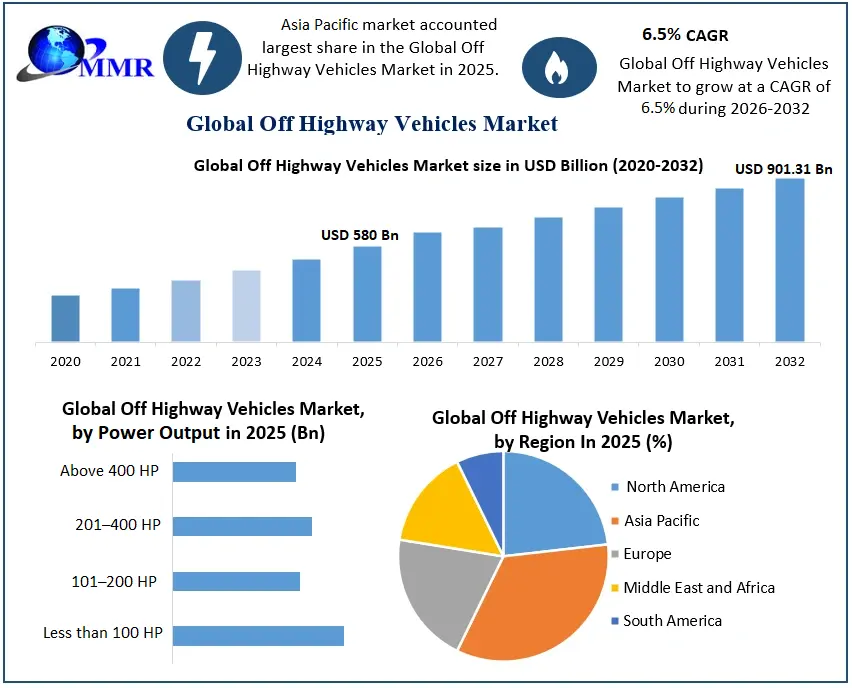
The Off Highway Vehicles Market size was valued at USD 580 Billion in 2025 and the total Off Highway Vehicles revenue is expected to grow at a CAGR of 6.9% from 2026 to 2032, reaching nearly USD 901.31 Billion by 2032.
Global Off Highway Vehicles Market Overview
Off highway vehicles include construction and mining machinery, as well as agricultural implements (such as bulldozers, excavators, harvesters, loaders, and tractors), that are made for off-road operations and off-road heavy-duty tasks. OHVs are an essential part of enabling infrastructure development, resource extraction, and food production in industrialized and developing countries.
The global OHV (Off-Highway Vehicle) market is growing due to increased investment in infrastructure, urban development, and the rising use of machines in agriculture and mining. Government efforts to modernize rural and industrial infrastructure, along with support for energy-efficient machinery, are also creating new opportunities. New technologies like electrification, automation, and GPS-based fleet tracking are improving OHV performance, making them cleaner, more efficient, and adaptable.
This report provides a detailed look at the OHV market, including trends, new technologies, regional performance, and competition. In 2025, North America led the global OHV market, driven by a construction boom in the U.S. and strong tech advancements. Major manufacturers like Caterpillar Inc., Deere & Company, and CNH Industrial are leading the way by developing smart OHVs, expanding globally, and investing in advanced engineering and eco-friendly solutions to meet changing market needs.
To know about the Research Methodology :- Request Free Sample Report
Global Off Highway Vehicles Market Dynamics
Rise in Urbanization and Need for Sustainable Infrastructure to Drive Off Highway Market Growth
Rise in both private and public sector investments in infrastructure development projects, along with growing urbanization, is one of the key factors contributing to the growth of the off-highway vehicle market size. Consistent innovation witnessed in the housing and building industry, the tendency toward nuclear families, and a significant population shift from rural to urban areas boost the demand for sustainable infrastructure. This, in turn, is estimated to drive the demand for off highway vehicles. Moreover, hiring heavy construction equipment is more cost-effective than buying, and therefore, leasing it has become more and more popular. These technologies are essential to maintaining production rates in places where there is a shortage of competent labor.
Increased Importance of Material Handling and Off-road Transportation to Create Off Highway Market Opportunities
Several governments, particularly those of emerging economies, are making significant investments in programs for industrial development along with increased emphasis on the development of smart cities. This has fueled the demand for off-highway vehicles to help with building activities, which in turn propels the market. Another significant growth-inducing aspect is the extensive usage of contemporary off-highway equipment in oil & gas exploration activities.
The market is also fueled by the rise in the use of cutting-edge technologies in the production of hybrid off-road vehicles. Therefore, special-purpose off-highway vehicles that make it easier to remove overburden from tunneling or shaft excavation in hydropower projects were introduced, and they are currently gaining significant traction in the market. Several key players have also released mobile variations that provide accurate, real-time data on the entire operation of the equipment for insightful analysis. Rapid industrialization and rising usage of off-highway vehicles in the power and automotive industries are some of the additional factors driving market expansion.
The increasing automotive sector is anticipated to grow in the forecasted period. The Off-Highway vehicle having all wheel drive helps driver to drive the vehicle in snow, ice, rocks, and other condition due to their better traction. A better grip is offered by Off-Highway Vehicles due to their additional weight. The all-wheel drive provides better torque to the Off-Highway Vehicles, which is very essential while driving on slippery roads.
Rising Electrification Costs, Supply Chain Strains, and Infrastructure Gaps to Create Off-Highway Vehicles Market Challenge
The global off-highway vehicles market has challenges that are hindering its overall growth potential. The cost of electrification and advanced technologies requires heavy R&D investment, making it challenging for small or mid-sized manufacturers to compete. Additionally, the growing number of stricter emission and safety regulations requires constant upgrades to standards, delaying launches. Disruptions in global supply chains, particularly for semiconductors and batteries, continue to impact production schedules and costs. Charging infrastructure in construction sites and rural locations also lacks adequate availability, impeding the adoption of electric OHVs. Lastly, market fragmentation and competition from strong local players only add to the difficulty of producing standardized products and/or scaling globally with diverse regional requirements.
Global Off Highway Vehicles Market Segment Analysis
Based on Fuel Type, the Global Off-Highway Vehicles Market is classified into Gasoline and Diesel. The Gasoline segment dominated the Global Off-Highway Vehicles Market in 2025. and are expected to grow during the forecast period 2025-2032, because of its lower upfront vehicle purchase price, higher availability, and infrastructure for easy refueling. Gasoline is the preferred fuel for lighter-duty OHV applications such as recreation, sports, and utility use. Gasoline engines can provide smoother operations, which are beneficial for non-heavy industrial operations.
Global Off Highway Vehicles Market Regional Insights
Asia Pacific leads in the off-highway vehicles (OHV) market due to significant spending in construction, mining, and precision agriculture, and healthier demand for new technology-rich OHVs in both the United States and Canada. Increased infrastructure and investment funding, state and federal legislative initiatives regarding emissions and other environmental regulation acquisitions, as well as training with fleet management technology, are all generating robust demand for new technology-rich OHVs. Some of the largest manufacturers in the industry, including Caterpillar, Deere & Company, and CNH Industrial, are enabling much stronger electrification, automation, AI-based learning, and data-driven systems that include machine systems and robotics. North America will continue to benefit from its leadership in the off-highway vehicle market, bolstered by federal funding of initiatives that promote research for the sustainability of off-highway technologies and initiate funding for the advancement of new smart and efficient strategies for off-highway vehicle equipment throughout North America.
Government Funding
| Government/Program | Initiative | Funding | Focus Area |
| Bipartisan Infrastructure Law (USA) | Infrastructure Investment and Jobs Act (IIJA) | USD 1,200 Bn | Roads, bridges, smart construction machinery, and mining infrastructure |
| Strategic Innovation Fund (Canada) | Clean Technology Stream | USD 2.1 Bn | Electrification and AI integration in OHVs and heavy-duty industrial vehicles |
| Farm Service Agency (USDA) | Farm Machinery Modernization Program | USD 0.5 Bn | Precision farming and advanced off-road agricultural vehicle adoption |
Global Off Highway Vehicles Market Competitive Landscape
The off-highway vehicles (OHV) market is competitive, consisting of global OEMs and strong regional competitors. Major players like Caterpillar Inc. (USA) and Komatsu Ltd. (Japan) remain through innovation and sustainability, to lead in the market due to their global stature. They are transforming their companies and the market with their investments in electrification, automated systems, and smart fleet technologies that are sustainable, efficient, and produced and operated with compliance today and in the future.
Caterpillar utilizes its dealer network in more than 190 countries, leading in hybrid electric vehicles and autonomous, semi-autonomous, and automated haulage systems. Komatsu offers various sustainability, electrification, AI integration, and smart construction solutions to help support infrastructure advancements in the future. Companies like Volvo Construction Equipment (Sweden), Deere & Company (USA), and CNH Industrial (Italy/USA) are also utilizing aggressive innovation, and sustainable and connected machines in order to remain competitive in the OHV space. While the exact revenue of their OHV segment may not be calculated, their focus on digitalization and eco-efficiency is evident in all segments. We applaud the investments by all, and though not all have a global presence, many are emerging regional manufacturers pushing toward the future of off-highway mobility with precision engineering, sustainability, and automation.
Global Off Highway Vehicles Market Key Recent Development
• In April 2025, Caterpillar Inc. (USA) announced a new generation of autonomous haul trucks with advanced AI navigation and hindrance detection systems proposed for mining operations to advance safety and operational efficiencies.
• In March 2025, Komatsu Ltd. (Japan) introduced an all-electric compact wheel loader with an electrification roadmap and a zero-emissions target for the urban and construction industries.
• In February 2025, Volvo Construction Equipment (Sweden) launched a hybrid hydraulic excavator powered by both battery and diesel to reduce fuel use by as much as 20% built for sustainable infrastructure projects.
• In January 2025, Deere & Company (USA) launched a new generation of JDLink™ telematics with predictive maintenance and remote diagnostic capabilities, providing extraordinary visibility into fleet performance and reduced machine downtime.
• In February 2025, CNH Industrial (Italy/USA) completed the acquisition of Hemisphere GNSS, which expanded precision guidance of off-highway equipment mainly in agriculture and construction and enhanced the agronomic landscape.
Global Off Highway Vehicles Recent Market Trends
| Category | Key Trend | Example Product | Market Impact |
| Electrification | Growing shift toward electric and hybrid OHVs to meet emission norms | Komatsu Electric Mini Excavator | Reduces emissions and operating costs; drives adoption in urban and regulated zones |
| Autonomous Operation | Integration of AI-based autonomous systems for safety and efficiency | Caterpillar Command for Hauling | Enhances productivity, reduces labour costs, and improves operational safety |
| Smart Telematics | Increasing use of IoT and telematics for real-time monitoring and diagnostics | John Deere JDLink™ Telematics System | Optimizes fleet management, reduces downtime, and enables predictive maintenance |
Off-Highway Vehicles Market Scope: Inquire before buying
| Off Highway Vehicle Market | |||
|---|---|---|---|
| Report Coverage | Details | ||
| Base Year: | 2025 | Forecast Period: | 2026-2032 |
| Historical Data: | 2020 to 2025 | Market Size in 2025: | USD 580 Billion |
| Forecast Period 2026-2032 CAGR: | 6.5% | Market Size in 2032: | USD 901.31 Billion |
| Segments Covered: | by Vehicle Type | Construction Equipment Excavators Loaders Backhoe Loaders Bulldozers Motor Graders Others Agricultural Equipment Tractors Harvesters Sprayers Others Mining Equipment Mining Trucks Drilling Equipment Wheel Loaders Others Forestry Equipment Industrial Utility Vehicles Others |
|
| by Propulsion Type | Internal Combustion Engine (ICE) Diesel Gasoline Natural Gas Electric Hydrogen Fuel Cell |
||
| by Power Output | Less than 100 HP 101–200 HP 201–400 HP Above 400 HP |
||
| by Sales Channel | OEM Aftermarket |
||
| by End User | Construction Agriculture Mining Forestry Infrastructure Development Material Handling Oil & Gas Defense Others |
||
Global Off Highway Vehicles Market, by Region
North America (United States, Canada and Mexico)
Europe (United Kingdom, France, Germany, Italy, Spain, Sweden, Russia, Rest of Europe)
Asia Pacific (China, Japan, South Korea, India, Australia, Malaysia, Thailand, Vietnam, Indonesia, Philippines, Rest of APAC)
Middle East and Africa (South Africa, GCC, Nigeria, Egypt, Turkey, Rest of MEA)
South America (Brazil, Argentina, Colombia, Chile, Peru, Rest of South America)
Global Off Highway Vehicles Market, Key Players
North America
1. Caterpillar Inc. (USA)
2. Deere & Company (USA)
3. CNH Industrial (USA)
4. Terex Corporation (USA)
Europe
5. Volvo CE (Sweden)
6. Liebherr Group (Germany/Switzerland)
7. JCB Ltd. (UK)
8. Fendt (AGCO Corporation) (Germany)
9. CNH Industrial (Italy)
Asia-Pacific
10. Komatsu Ltd. (Japan)
11. Hitachi Construction Machinery (Japan)
12. Sany Heavy Industry (China)
13. XCMG Group (China)
14. Doosan Infracore / HD Hyundai CE (South Korea)
Frequently Asked Questions
1. Which region has the largest share in the Global Off Highway Vehicles Market?
Ans: Asia Pacific held the highest share in 2025.
2. What is the growth rate of the Global Off Highway Vehicles Market?
Ans: The Global Off Highway Vehicles Market is expected to grow at a CAGR of 6.5% during the forecast period 2026-2032.
3. What is the scope of the Global Off Highway Vehicles Market report?
Ans: The Global Off Highway Vehicles Market report helps with the PESTEL, Porter's, Recommendations for Investors and leaders, and market estimation for the forecast period.
4. Who are the key players in the Global Off Highway Vehicles Market?
Ans: The important key players in the Global Off Highway Vehicles Market are Caterpillar Inc. (USA), Deere & Company (USA), Komatsu Ltd. (Japan), and Hitachi Construction Machinery (Japan).
5. What is the study period of this market?
Ans: The Global Off Highway Vehicles Market is studied from 2025 to 2032.