
Global Biomass Boiler Market Size by Feedstock Type, Product Type, Application, End User, Region and Forecast 2034
Overview
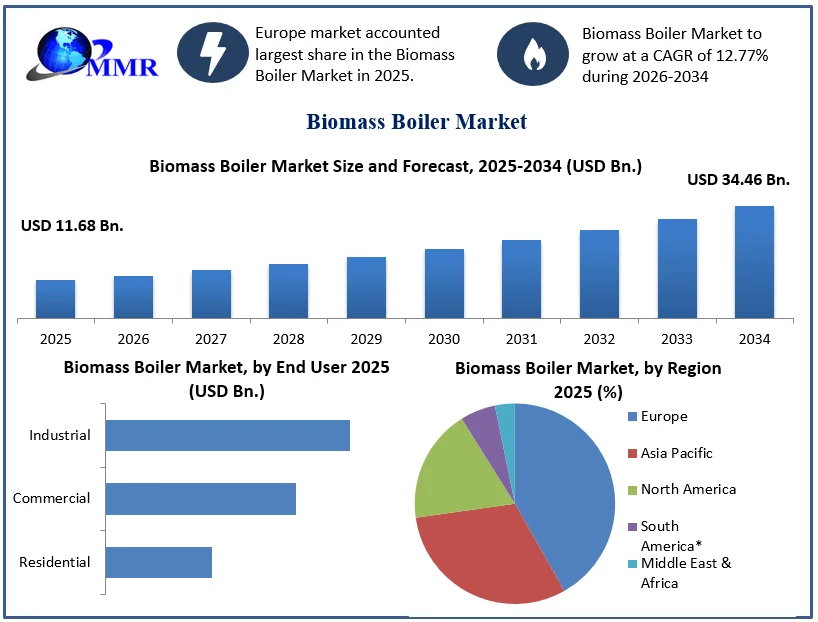
The Global Biomass Boiler Market size was valued at USD 11.68 Billion in 2025 and the total Biomass Boiler revenue is expected to grow at a CAGR of 12.77% from 2026 to 2034, reaching USD 34.46 Billion by 2034.
Biomass Boiler Market Overview
The Biomass Boiler Market covers boilers designed to generate heat, hot water, or steam by using renewable organic fuels such as wood pellets, wood chips, agricultural residues, sawdust, bagasse, and other biomass materials. These systems provide an alternative to conventional fossil-fuel boilers and are used across industrial heating, power generation, commercial buildings, district heating, food processing, paper and pulp, textile, and other energy-intensive applications. The market matters because biomass boilers can make use of locally available residues while supporting renewable heat generation and reducing dependence on conventional fuels.
The Biomass Boiler Market includes the manufacturing, installation, and use of biomass-fired boiler systems for industrial heating, steam generation, power generation, and commercial heating applications. The market is changing as industries shift toward renewable energy, improve energy efficiency, and use wood waste, agricultural residues, bagasse, and other organic materials as fuel. Europe is a leading region, supported by strong industrial activity, biomass availability, and renewable energy programs in countries such as China and India. Companies such as Babcock & Wilcox are contributing to the market through biomass combustion and boiler technologies. Government and energy agencies are also supporting biomass utilization; for example, the International Energy Agency recognizes bioenergy as an important renewable heat source for industrial applications.
MMR's Biomass Boiler Market research provides a detailed view of market trends, fuel types, boiler technologies, capacity ranges, applications, end users, regional demand, competitive developments, and growth opportunities. The research helps businesses identify areas where biomass fuel availability, industrial heating demand, renewable energy policies, and boiler modernization can create new opportunities. It also examines how manufacturers and end users can benefit from efficient combustion, automated biomass handling, emissions-control systems, and the conversion of agricultural and forestry residues into useful heat energy.
Biomass Boiler Market Growth and Share Analysis
To know about the Research Methodology :- Request Free Sample Report
Biomass Boiler Market Dynamics:
Renewable Heat Adoption and Biomass Fuel Availability Support the Biomass Boiler Market
The Biomass Boiler Market is being driven by increasing demand for renewable heat, industrial steam generation, energy efficiency, and better utilization of wood waste and agricultural residues. The market is projected to rise from USD 11.68 billion in 2025 to USD 34.46 billion by 2034, creating stronger demand for biomass-fired heating systems across industrial and commercial applications. Europe held the largest regional share at 41.79% in 2025, supported by renewable energy policies, established biomass supply chains, district heating systems, and demand for lower-carbon heating solutions. Growing use of wood pellets, wood chips, sawdust, bagasse, rice husks, and other biomass fuels is also encouraging industries to consider biomass boilers as an alternative to conventional fuel-based heating systems.
Biomass Fuel Supply Challenges and Operating Requirements Restrain the Biomass Boiler Market
The Biomass Boiler Market faces restraints related to inconsistent fuel quality, seasonal availability of biomass, transportation costs, storage requirements, and the need for regular fuel handling and maintenance. Biomass materials can differ in moisture content, particle size, calorific value, and ash content, which can affect combustion performance and boiler efficiency. The market also requires dedicated fuel storage, feeding equipment, ash removal systems, and emission-control technologies, increasing installation and operating requirements compared with some conventional heating systems. These factors can be particularly important for smaller commercial and residential users where available space, fuel logistics, and maintenance capabilities are limited.
Industrial Process Heating and Biomass Waste Utilization Create Opportunities in the Biomass Boiler Market
The Biomass Boiler Market presents opportunities through the conversion of agricultural, forestry, and industrial residues into useful heat and steam. Industrial users in food processing, paper and pulp, textiles, chemicals, sugar processing, and other heat-intensive sectors can use locally available biomass to support process heating while reducing reliance on conventional fuels. Asia Pacific accounted for 30.99% of market share in 2025, providing significant opportunities due to its large manufacturing base, agricultural activity, and availability of biomass residues. Further opportunities are emerging for high-efficiency combustion systems, automated fuel feeding, smart boiler controls, combined heat and power systems, and boiler modernization projects that can improve fuel utilization and operational performance.
Fuel Quality, Emission Control and Infrastructure Requirements Challenge the Biomass Boiler Market
The Biomass Boiler Market faces challenges related to emission management, biomass fuel standardization, supply-chain reliability, and infrastructure readiness. Burning different biomass materials can produce varying levels of ash, particulate matter, and other emissions, requiring suitable combustion control and emission-reduction equipment. North America represented 18.33% of market share in 2025, while South America and the Middle East and Africa accounted for smaller portions, reflecting differences in biomass availability, industrial demand, energy infrastructure, and policy support across regions. Manufacturers and end users therefore need to balance boiler efficiency, fuel flexibility, emission performance, storage capacity, maintenance requirements, and long-term biomass supply when selecting and operating biomass boiler systems.
Biomass Boiler Market Key Trends
| Market Trend | Description |
| Greater Use of Agricultural and Forestry Residues as Boiler Fuel | Biomass boiler projects are increasingly being designed around locally available materials such as wood chips, sawdust, forestry residues, rice husks, and sugarcane bagasse. This is particularly relevant for food processing, sugar, paper, and other industries that generate usable organic waste within or close to their production facilities. The shift helps businesses turn a disposal material into a usable source of process heat. |
| Automation Is Becoming Standard in Biomass Boiler Operation | New biomass boiler systems are placing greater emphasis on automated fuel feeding, combustion adjustment, temperature monitoring, and boiler controls. Automation reduces the need for continuous manual intervention and helps operators maintain steadier combustion when fuel characteristics change. Smart monitoring and automated control are becoming particularly relevant for industrial facilities where consistent steam and heat output is important. |
| Industrial Process Heat Is Driving Larger Boiler Installations | Biomass boilers are increasingly being considered for continuous process heat requirements in sectors such as food and beverage, pulp and paper, textiles, chemicals, and other manufacturing industries. Larger installations can supply steam and hot water while making use of locally sourced biomass. The International Energy Agency reports that industrial renewable heat growth has been particularly strong in China and India, with biomass residues playing an important role in several industrial sectors. |
| Emission-Control Equipment Is Receiving More Attention | Boiler buyers are paying closer attention to particulate control, combustion optimization, ash management, and flue-gas treatment rather than evaluating a boiler only on heat output. This is encouraging manufacturers to combine biomass combustion systems with improved emission-control equipment and monitoring technologies, particularly in markets where environmental requirements are becoming more demanding. |
| Biomass Boilers Are Being Integrated With Combined Heat and Power Systems | Industrial users are increasingly looking beyond standalone heat generation and considering systems that can produce useful heat together with electricity. Combined heat and power configurations can improve the overall utilization of biomass fuel where a facility has a steady demand for both steam and electricity. Large industrial projects are also being designed with heat recovery and flue-gas condensation to capture more usable energy from the boiler system. |
Biomass Boiler Market Segment Analysis
Biomass Boiler Market by Feedstock Type
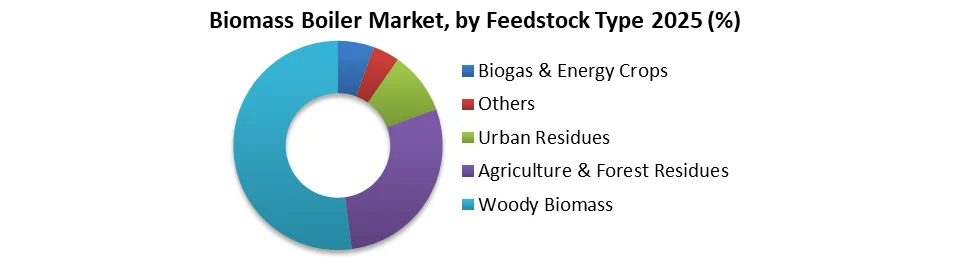
By Feedstock Type, Woody biomass is the leading feedstock type in the Biomass Boiler Market, supported by established supply networks for wood pellets, wood chips, sawmill residues, and other wood-based fuels. Current industry research places woody biomass at 52.1% of feedstock revenue in 2025, making it the clear leading segment, while agriculture and forest residues are gaining attention in regions with strong crop and forestry activity because materials such as rice husks, bagasse, straw, and forestry waste can be sourced close to boiler installations. Urban residues are also receiving greater interest as waste-management systems seek useful applications for organic and combustible waste, while biogas and energy crops remain more application-specific and are often linked to facilities with steady organic feedstock availability.
Biomass Boiler Market by Product Type
By Product Type, Stoker Boilers currently remain the leading product type in the Biomass Boiler Market, supported by their established technology, relatively simple operation, and suitability for a wide range of solid biomass fuels. They continue to be preferred for applications where reliable heat generation and practical fuel feeding are important. Bubbling Fluidized Bed (BFB) Boilers are gaining attention because they provide better fuel flexibility and efficient combustion, making them suitable for biomass with varying moisture and particle characteristics. Circulating Fluidized Bed (CFB) Boilers are also showing strong demand, particularly in larger industrial and power-generation projects, because of their ability to handle mixed and lower-quality biomass fuels while maintaining stable combustion.
Biomass Boiler Market Regional Insights:
Europe is the leading regional market for the Biomass Boiler Market, supported by established biomass heating infrastructure, mature district heating systems, strong use of wood-based fuels, and continued replacement of conventional heating equipment with renewable alternatives. Countries such as Germany, Austria, Sweden, France, and the United Kingdom maintain steady demand across residential, commercial, and industrial applications. The region also benefits from well-developed biomass fuel supply chains and experienced installation and service networks, which support the continued adoption of stoker and fluidized bed boiler technologies.
Asia Pacific is showing the strongest growth momentum, with rising industrial activity, increasing demand for process heat, and wide availability of agricultural and forestry residues supporting biomass boiler adoption. China, India, Japan, South Korea, and Southeast Asian countries are important markets, with demand coming from manufacturing facilities, food processing, power generation, and commercial heating. The availability of locally sourced biomass fuels also improves the economic case for boiler installations, while growing renewable energy programs are encouraging industries to consider biomass-based heating and steam generation.
North America maintains a well-established market, particularly in industrial applications where biomass boilers are used for steam and process heat. The pulp and paper, wood processing, and manufacturing industries benefit from access to forestry residues and established biomass fuel infrastructure. Demand is also supported by renewable energy incentives and efforts to reduce dependence on fossil-fuel-based heating systems. The United States and Canada remain the principal markets, while demand in remote areas is also supported by the use of locally available biomass resources for heating applications.
South America presents attractive opportunities because of its strong agricultural and forestry base and the availability of residues that can be used as boiler fuel. Brazil is particularly important due to the extensive sugar and ethanol processing industry, where bagasse can be utilized for steam and power generation. Food processing, agro-industrial facilities, and other industries with continuous heat requirements are supporting the use of biomass boilers. The region's future demand is closely linked to the availability of agricultural residues, industrial energy requirements, and investment in renewable heat and power systems.
Middle East and Africa remains a developing market, with adoption concentrated around industries that have direct access to agricultural, forestry, or organic waste streams. Food processing, sugar production, agricultural operations, and selected waste-to-energy projects are creating opportunities for biomass boiler installations. Compared with more mature markets, deployment is influenced by fuel collection infrastructure, project financing, technical expertise, and competition from readily available conventional fuels. However, the use of locally available residues for industrial heat generation provides a practical opportunity for biomass boiler adoption in suitable applications.
Biomass Boiler Market Competitive Landscape
The competitive landscape of the Biomass Boiler Market is shaped by established boiler manufacturers, engineering companies, and regional biomass technology specialists competing through combustion efficiency, fuel flexibility, emission control, automation, and project execution capabilities. Key players such as ANDRITZ Group, Valmet, Babcock & Wilcox Enterprises, Thermax Limited, Mitsubishi Heavy Industries, Hurst Boiler & Welding, Sumitomo SHI FW, Schmid Energy Solutions, VYNCKE, and Aalborg Energie Technik are strengthening their positions through advanced stoker boiler, Bubbling Fluidized Bed, and Circulating Fluidized Bed technologies, while also offering fuel handling, steam generation, flue gas treatment, and maintenance services. Competition is increasingly focused on boilers that can operate with different biomass feedstocks, including wood chips, pellets, agricultural residues, and forestry waste, while maintaining stable combustion and lower emissions. Manufacturers are also investing in digital boiler monitoring, automated fuel feeding, heat recovery, and combined heat and power solutions to meet the requirements of industrial, commercial, district heating, and power generation customers. This combination of technology development, customized boiler design, regional service networks, and long-term maintenance support is expected to remain important for gaining market share and strengthening competitive positioning in the Biomass Boiler Market.
Biomass Boiler Market Recent development
| Month/ Year | Company | Recent development |
| February 2026 | Valmet | Valmet joined Veolia’s HeatUp project in Poland to improve the efficiency of a biomass boiler plant. The company is supplying flue gas condensing heat recovery technology and automation for a fluidized bed boiler at the EC4 combined heat and power plant. |
| May 2026 | ANDRITZ | ANDRITZ was selected by National Power Supply in Thailand to supply a recovery boiler and evaporation plant for a new bioenergy power plant. The project strengthens the company’s presence in biomass based power generation and industrial energy solutions. |
| July 2026 | Valmet | Valmet announced a major pressure part replacement for Eneco’s Bio Golden Raand biomass plant in the Netherlands. The work involves replacing the secondary superheater in the circulating fluidized bed boiler to improve reliability and reduce the risk of unplanned downtime. |
| August 2026 | Sumitomo SHI FW | Sumitomo SHI FW signed a contract with QEMETICA to convert a coal fired boiler into a biomass fired boiler at a chemical plant in Poland. The project will use wood chips as the primary fuel and includes new biomass receiving, storage, and fuel handling infrastructure. |
| August 2026 | Sumitomo Heavy Industries | Sumitomo Heavy Industries completed and delivered a 74 megawatt class woody biomass and recycled fuel fired power boiler to Tosoh in Japan. The circulating fluidized bed boiler can use woody biomass together with construction waste derived fuels and other recycled fuels. |
Biomass Boiler Market Scope: Inquire before buying
| Biomass Boiler Market | |||
|---|---|---|---|
| Report Coverage | Details | ||
| Base Year: | 2025 | Forecast Period: | 2026-2034 |
| Historical Data: | 2020 to 2025 | Market Size in 2025: | USD 11.68 Bn. |
| Forecast Period 2026 to 2034 CAGR: | 12.77% | Market Size in 2034: | USD 34.46 Bn. |
| Segments Covered: | by Feedstock Type | Woody Biomass Agriculture & Forest Residues Biogas & Energy Crops Urban Residues Others |
|
| by Product Type | Stoker Boilers Bubbling Fluidized Bed (BFB) Boilers Circulating Fluidized Bed (CFB) Boilers |
||
| by Application | Heating Power Generation |
||
| by End User | Residential Commercial Industrial |
||
Biomass Boiler Market, by Region
Asia Pacific (China, South Korea, Japan, India, Australia, Indonesia, Malaysia, Vietnam, Taiwan, Bangladesh, Pakistan and Rest of APAC)
Europe (UK, France, Germany, Italy, Spain, Sweden, Austria and Rest of Europe)
North America (United States, Canada and Mexico)
Middle East and Africa (South Africa, GCC, Egypt, Nigeria and Rest of ME&A)
South America (Brazil, Argentina Rest of South America)
Biomass Boiler Market, Key Players
1. ETA Heiztechnik GmbH
2. Thermax Limited
3. Energy Innovations UK Limited
4. Schmid Energy Solutions
5. VAS Energy Systems International GmbH
6. Wellons Incorporated
7. Wood Energy Solutions
8. Babcock and Wilcox Enterprises Inc.
9. Nexterra Systems Corp.
10. Leroux and Lotz Technologies
11. Lambion Energy Solutions GmbH
12. Mawera GmbH
13. Kohlbach Group
14. Lin-Ka Maskinfabrik A/S
15. Baxi Group Limited
16. Jernforsen Energi System AB
17. Justsen Energiteknik A/S
18. Ecovision Systems Limited
19. Garioni Naval S.p.A.
20. Hurst Boiler and Welding Co. Inc.
21. Polytechnik Group
22. Rentech Boiler Systems Inc.
23. ANDRITZ AG
24. Valmet Oyj
25. VYNCKE NV
26. Sumitomo SHI FW
27. Mitsubishi Heavy Industries Limited
28. Aalborg Energie Technik A/S
29. Binder Energietechnik GmbH
30. Herz Energietechnik GmbH
31. Fröling Heizkessel und Behälterbau GmbH
32. KWB Energiesysteme GmbH
33. Heizomat Gerätebau Energiesysteme GmbH
34. Windhager Zentralheizung GmbH
35. Hargassner Ges mbH
36. HDG Bavaria GmbH
37. Gilles Energie und Umwelttechnik GmbH
38. Froling UK Limited
39. Herz Armaturen GmbH
40. Compte R.
41. Sugimat S.L.
42. Uniconfort S.r.l.
43. Innergy Heat Exchanger Systems
44. Kohlbach Energieanlagen GmbH
45. Säätötuli Oy
46. Linka Energy A/S
47. Binderholz GmbH
48. KPA Unicon Oy
49. AET Biomass Power Plants
50. Schmid AG Energy Solutions
Frequently Asked Questions:
1. Which region has the largest share in Global Biomass Boiler Market?
Ans: Europe region holds the highest share in 2025.
2. What was the Global Biomass Boiler Market size in 2025?
Ans: The Global Biomass Boiler Market size was USD 11.68 Billion in 2025.
3. What segments are covered in Global Biomass Boiler market?
Ans: Global market is segmented into Component Type, Application and Region.
4. Who are the key players in Global Biomass Boiler market?
Ans: The important key players in the Global market are ETA Heiztechnik GmbH,Thermax Ltd.,Energy Innovations (UK) Ltd,Schmid energy solutions,VAS Energy Systems International GmbH,Wellons, Inc.,Wood Energy,The Babcock & Wilcox Company,Advanced Recycling Equipment, Inc.
5. What is the study period of this market?
Ans: The Global market is studied from 2020 to 2034.