
Automotive Port Fuel Injection (PFI) System Market – Global Market Size, Strategic Growth Drivers, Risk Assessment Framework, Regulatory Landscape Review, Competitive Intensity Mapping & Long-Term Industry Outlook to 2032
Overview
Global Automotive Port Fuel Injection (PFI) System Market is expected to reach US$ 23.08 Bn. by 2032, at a CAGR of 6.12% during the forecast period.
The Global Automotive Port Fuel Injection (PFI) System market report is a comprehensive analysis of the industry, market, and key players. The report has covered the market by demand and supply-side by segments. The Global Automotive Port Fuel Injection (PFI) System report also provides trends by market segments, technology, and investment with a competitive landscape.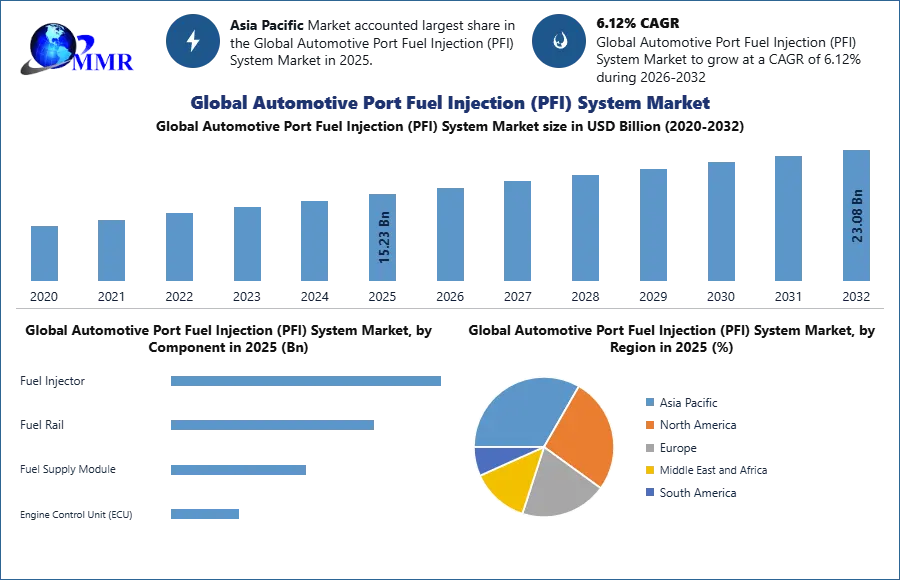 To know about the Research Methodology :- Request Free Sample Report
Global Automotive Port Fuel Injection (PFI) System Market Overview:
Automotive Port Fuel Injection (PFI) System is mainly used in diesel engines, as only diesel engines use compressed air for the fuel ignition system. To work this ignition system out, diesel engines rely on the fuel injection process. In port fuel injection, gasoline or diesel is sprayed into the intake ports of the cylinder where air and fuel are mixed to a proportion and then pulled into the engine cylinder. High air-fuel efficiency ratio and use of manifold injection for metered fuel supply are the factors considered to drive the port fuel injection system market growth. Moreover, the increasing automobile industries across the globe are the key supporting factor driving the growth of the market.
Several key players in the market including Robert Bosch and Continental AG are still using the PFI system for their diesel engine manufacturing owing to the reliability of the system. Furthermore, increasing the inclusion of no. of injectors ensures that each cylinder will get the same amount of fuel.
Global Automotive Port Fuel Injection (PFI) System Market Dynamics:
The increasing requirement of optimum combustion of fuel and the need for low propulsion of exhaust gases are the factors driving the port fuel injection system market growth. Furthermore, innovative policies drafted by the governments of emerging economies across the globe for automobile manufacturing are boosting the automotive PFI system market growth during the forecast period. Trade liberalization of automobile manufacturers and governments is driving the port fuel injection system market growth.
Stringent emission control norms and restrictions imposed by the government is the key factor driving the automotive port fuel injection system market growth to some extent. Furthermore, the need of decreasing the engine size with the increase in performance is the key factor attributing to create higher demand in the market for upcoming years.
Introduction of the new fuel injection system including gasoline direct injection, reverse manifold and others are the factors restraining the automotive port fuel injection system market growth.
Cost effectiveness of Automotive Port Fuel Injection (PFI) System market:
Port fuel injection system needs less space compared to the direct injection system. Also, as the port fuel injection system is used in diesel engines only, light commercial vehicles are the dominating vehicle type in the automotive port fuel injection system market. As the PFI system needs only low pressure and less fuel, the system eliminates the demand for a high torque ratio and high power consumption which are the factors considered to maintain the cost-effectiveness of the system. According to Automotive Manufacturers Association (AMA), the PFI module costs 25% less than the direct injection system used in heavy commercial and passenger cars.
Moreover, the PFI system is more reliable than a multipoint fuel injection system which is considered as a supporting factor driving the market growth. Thus PFI system is more cost-effective owing to less no. of embedded equipment.
Global Automotive Port Fuel Injection (PFI) System Market Segment Analysis:
Engine management system is the dominating segment in Automotive Port Fuel Injection (PFI) System market:
The engine management system consists of electronic and electrical equipment that helps in ensuring the smooth flow of processes within engine mechanism. Sensors, microcontrollers, and ECU’s are the key components of the engine management system. Factors attributing to the growth of the EMS system segment in the automotive port fuel injection system are the increasing need for accurate fuel economy measurement equipment and the increasing use of software systems to tailor the manufacturing of equipment. Sensors are also used to meter the air flow in the valve and also the closing and opening of injectors after the particular time frame.
Direct injection system hampers the automotive port fuel injection system:
The direct injection system is the latest technology in the fuel injection system market. In direct injection system, fuel is directly injected in the cylinders rather than fuel manifold making the system more efficient and uses almost 96% of the latent power of the fuel for sufficient burning. The use of high-pressure pumps and high volume control valves in direct injection systems are the factors hampering the port fuel ignition system. Hence, key players in the market are forced to invest in research and development in the PFI system for more efficient performance while making the engine space smaller as possible. Robert Bosch has announced to invest in an automotive port fuel injection system with approximately 300 million USD in the year 2020 to increase the sales channel and development in the performance of the engine.
Global Automotive Port Fuel Injection (PFI) System Market Regional Insights:
The Asia Pacific is the dominating as well as the fastest-growing region in the market with 38% of total revenue share in the automotive port fuel injection (PFI) system market in 2025. Factors attributing to market growth in the region are the highly developed manufacturing sector and increasing investment in the automotive sector of the region by emerging players in the market including Robert Bosch GmbH, Delphi Automotive PLC and others. Moreover, the increasing buying power of consumers in the region is the key supporting factor attributing the automotive port fuel ignition system market.
Europe is the dominating region in the PFI system market followed by North America with approximately 25% and 17% market share respectively. Factors attributing to market growth in the region are low cost requirements for the production of automobile and thereby increasing profitability and productivity of the PFI system. Furthermore, increasing no. of automobile enthusiasts in the region and high performance and emission control requirement in the region owing to the population of the emerging economies including India, China, ASEAN regions, and others are the factors expected to boost the automotive port fuel injection (PFI) system market growth in the future.
Global Automotive Port Fuel Injection (PFI) System Market Recent Developments:
| Exact Date | Company | Development | Impact |
|---|---|---|---|
| 11 March 2026 | Marelli Holdings | Marelli launched its new generation Port Fuel Injection Engine Control Units (PFI ECUs) for gasoline, flex-fuel, and CNG applications. | Targeting India, Brazil, and EMEA, the units utilize Infineon’s AURIX™ TC3x chips to support localized emissions regulations and multi-fuel versatility. |
| 16 March 2026 | Ucal Limited | Ucal Limited (formerly Ucal Fuel Systems) completed a 90% stake dilution in its US subsidiary, Ucal Holdings Inc., to investor AscentX Inc. | The move signals a strategic restructuring of its global assets, focusing on core operations while reducing direct control over its North American fuel system subsidiaries. |
| 23 February 2026 | Market Analysis | The global automotive fuel injection market was valued at $14.35 billion for 2025, with Gasoline Port Injection (GPI) systems maintaining a 30% market share. | GPI remains dominant in cost-sensitive regions due to its reliability and lower complexity compared to Direct Injection, driving a projected market value of $15.24 billion in 2026. |
| 11 February 2026 | BorgWarner Inc. | BorgWarner reported a 2025 adjusted operating margin of 10.7% and provided 2026 sales guidance of $14.0 billion to $14.3 billion. | Strategic awards for hybrid vehicle turbochargers and drive modules confirm the company’s shift toward supporting extended-range electric vehicles (REEVs) that still utilize ICE components. |
| 30 January 2026 | Robert Bosch GmbH | Bosch announced preliminary 2025 sales of €91 billion, citing a "challenging financial year" with high R&D pressure for powertrain transitions. | The company is focusing on propulsion-agnostic technologies, bridging the gap between traditional fuel injection and hydrogen-based internal combustion engines (H2ICE). |
| 01 April 2025 | Astemo, Ltd. | Hitachi Astemo officially rebranded as Astemo, Ltd. to emphasize its independence as a global mega-supplier for Advanced Sustainable Technologies. | The restructuring, involving Honda and Hitachi as equal shareholders, accelerates investment in software-defined vehicle (SDV) architectures and powertrain integration. |
The objective of the report is to present a comprehensive analysis of the Global Automotive Port Fuel Injection (PFI) System Market to the stakeholders in the industry. The past and current status of the industry with the forecasted market size and trends are presented in the report with the analysis of complicated data in simple language. The report covers all the aspects of the industry with a dedicated study of key players that include market leaders, followers, and new entrants.
PORTER, SVOR, PESTEL analysis with the potential impact of micro-economic factors of the market have been presented in the report. External as well as internal factors that are supposed to affect the business positively or negatively have been analyzed, which will give a clear futuristic view of the industry to the decision-makers.
The report also helps in understanding the Global A Market dynamics, structure by analyzing the market segments and project the Global Market size. Clear representation of competitive analysis of key players by Type, price, financial position, Type portfolio, growth strategies, and regional presence in the Global Market make the report investor’s guide
Global Automotive Port Fuel Injection (PFI) System Market Scope: Inquire before buying
| Global Automotive Port Fuel Injection (PFI) System Market | |||
|---|---|---|---|
| Report Coverage | Details | ||
| Base Year: | 2025 | Forecast Period: | 2026-2032 |
| Historical Data: | 2020 to 2025 | Market Size in 2025: | 15.23 USD Billion |
| Forecast Period 2026-2032 CAGR: | 6.12% | Market Size in 2032: | 23.08 USD Billion |
| Segments Covered: | by Component | Fuel Injector Fuel Rail Fuel Supply Module Engine Control Unit (ECU) |
|
| by Vehicle Type | Passenger Vehicles Light Commercial Vehicles Heavy Commercial Vehicles |
||
| by Distribution Channel | OEM Aftermarket |
||
Global Automotive Port Fuel Injection (PFI) System Market, by Region
North America (United States, Canada and Mexico)
Europe (UK, France, Germany, Italy, Spain, Sweden, Austria and Rest of Europe)
Asia Pacific (China, South Korea, Japan, India, Australia, Indonesia, Malaysia, Vietnam, Taiwan, Bangladesh, Pakistan and Rest of APAC)
Middle East and Africa (South Africa, GCC, Egypt, Nigeria and Rest of ME&A)
South America (Brazil, Argentina Rest of South America)
Global Automotive Port Fuel Injection (PFI) System Market, Key Players are
- Robert Bosch GmbH
- Continental AG
- Denso Corporation
- Hitachi Astemo Ltd.
- Magna International Inc.
- SHW AG
- Delphi Technologies
- BorgWarner Inc.
- Johnson Electric Holdings Limited
- Mikuni Corporation
- Marelli Holdings Co. Ltd.
- Edelbrock Group
- Keihin Corporation
- Woodward Inc.
- Aisin Corporation
- Valeo S.A.
- Siemens AG
- Infineon Technologies AG
- STMicroelectronics N.V.
- NGK Spark Plug Co. Ltd.
- Sensata Technologies Holding plc
- TI Fluid Systems plc
- Ucal Fuel Systems Limited
- Carter Fuel Systems
- Holley Performance Products
- Standard Motor Products Inc.
- Wells Vehicle Electronics
- Bosch Automotive Aftermarket
- SMP Europe
- Lucas TVS Ltd.
Others