
Autoimmune Disease Diagnosis Market by Product, by Test Type, by Disease, by End-User and Regional Insights 2034
Overview
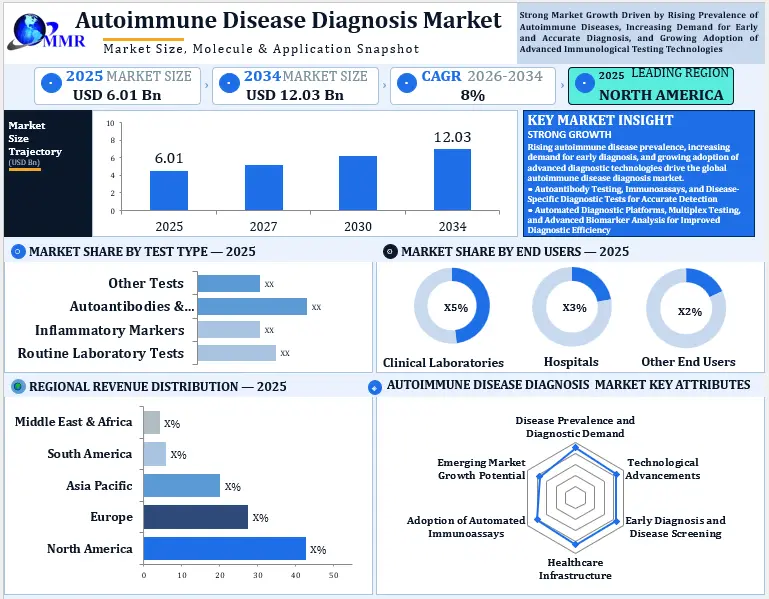
The Global Autoimmune Disease Diagnosis Market is expected to grow at a CAGR of 8% from 2026 to 2034, increasing from US$ 6.01 billion in 2025 to US$ 12.03 billion by 2034.
Autoimmune Disease Diagnosis Market Overview
Most autoimmune diseases require a combination of diagnostic tests, symptom assessment, and physical examinations for accurate diagnosis, as no single test identifies all autoimmune conditions. The antinuclear antibody (ANA) test serves as one of the initial diagnostic tools when patients present with symptoms suggestive of an autoimmune disease.
Autoimmune diseases affect a substantial proportion of the population, with more than 23.5 million people in the United States living with at least one autoimmune condition. These diseases contribute significantly to mortality and disability, increasing the demand for early detection, accurate diagnosis, and effective disease monitoring. This growing need supports the expansion of the global autoimmune disease diagnosis market.
Autoimmune Disease Diagnosis Market Growth Outlook
To know about the Research Methodology :- Request Free Sample Report
Key Highlights of the Global Autoimmune Disease Diagnosis Market
• Market Growth: The global autoimmune disease diagnosis market is expected to grow at a CAGR of 8% from 2025 to 2034, increasing from US$ 6.01 billion in 2025 to US$ 12.03 billion by 2034.
• Increasing Disease Prevalence: More than 23.5 million people in the United States live with at least one autoimmune condition, increasing the demand for early detection, accurate diagnosis, and effective disease monitoring.
• Product Segment: Consumables and assay kits play a key role in autoimmune disease diagnosis because of their recurring use in autoantibody detection, immunological testing, disease screening, and diagnostic confirmation.
• Regional Leadership: North America leads the global autoimmune disease diagnosis market, supported by advanced healthcare infrastructure, established clinical laboratory networks, and the widespread adoption of advanced diagnostic technologies.
• Technological Advancements: Automated immunoassays, multiplex testing platforms, and advanced biomarker analysis improve testing efficiency and support the identification of disease-specific immune responses, creating opportunities for diagnostic innovation.
Autoimmune Disease Diagnosis Market Dynamics:
Global Autoimmune Disease Market Drivers
Increasing Prevalence of Autoimmune Diseases: The increasing prevalence of autoimmune diseases drives demand in the global autoimmune disease diagnosis market. These conditions develop when the immune system mistakenly attacks healthy cells, tissues, and organs, creating a need for timely and accurate diagnostic testing. In the United States, an estimated 23.5 million to 50 million people live with autoimmune diseases, highlighting the substantial burden of these conditions. More than 140 autoimmune diseases affect different organs and body systems, including rheumatoid arthritis, systemic lupus erythematosus, multiple sclerosis, and type 1 diabetes. The overlapping symptoms of these disorders increase the need for comprehensive diagnostic approaches that combine clinical assessments with laboratory testing. Healthcare providers increasingly rely on antinuclear antibody (ANA) tests, disease-specific autoantibody assays, and immunoassays to support disease identification. This growing need for accurate diagnosis and early intervention strengthens demand for autoimmune disease diagnostic solutions.
Global Autoimmune Disease Market Restraints
High Diagnostic Costs and Complex Testing Procedures: High diagnostic costs and complex testing procedures restrain the growth of the global autoimmune disease diagnosis market. Many autoimmune diseases exhibit similar symptoms, including fatigue, joint pain, inflammation, and skin abnormalities, making diagnosis difficult through a single test. Healthcare professionals often require multiple laboratory investigations, clinical examinations, and disease-specific antibody tests to distinguish between autoimmune conditions. These procedures increase the overall cost of diagnosis, particularly for patients who require repeated testing and long-term disease monitoring. Furthermore, limited access to specialized laboratories, trained personnel, and advanced diagnostic equipment restricts the availability of comprehensive autoimmune testing in resource-constrained healthcare settings. These financial and technical barriers delay diagnosis and limit the adoption of advanced diagnostic solutions.
Global Autoimmune Disease Market Opportunities
Advancements in Autoimmune Diagnostic Technologies: Advancements in diagnostic technologies create opportunities for the global autoimmune disease diagnosis market. Automated immunoassays, multiplex testing platforms, and advanced biomarker analysis improve testing efficiency and support the identification of disease-specific immune responses. The presence of more than 140 recognized autoimmune diseases creates a need for diagnostic methods that distinguish between conditions with overlapping symptoms and different treatment requirements. Furthermore, developments in precision medicine and biomarker research support the identification of biological indicators associated with specific autoimmune disorders. These advancements help laboratories improve diagnostic workflows, reduce manual testing requirements, and support more targeted clinical assessments. The increasing adoption of automated laboratory systems and specialized diagnostic assays creates opportunities for manufacturers to expand their product portfolios and address the diagnostic needs of hospitals, clinical laboratories, and specialized healthcare facilities.
Global Autoimmune Disease Market Challenges
Difficulty in Achieving Accurate and Early Diagnosis: Achieving accurate and early diagnosis remains a major challenge for the global autoimmune disease diagnosis market. Autoimmune diseases vary considerably in their symptoms, progression, and effects on different organs, making it difficult to establish a diagnosis based on a single clinical finding. For example, the antinuclear antibody (ANA) test helps identify antibodies associated with autoimmune activity, but a positive result alone does not confirm a specific autoimmune disease. Healthcare professionals often combine ANA results with disease-specific antibody testing, clinical examinations, and other laboratory investigations to establish a diagnosis. Differences in disease presentation and antibody levels also complicate the interpretation of test results. In addition, the absence of definitive biomarkers for certain autoimmune conditions limits diagnostic precision. These challenges increase the need for more specific diagnostic assays, improved biomarker identification, and standardized testing procedures to support reliable disease detection.
Autoimmune Disease Diagnosis Market Segment Analysis
By Product: The market is segmented into consumables and assay kits and instruments. Consumables and assay kits play an essential role in detecting autoantibodies associated with autoimmune conditions, including rheumatoid arthritis, systemic lupus erythematosus, and Sjögren’s syndrome. These products include reagents, antibodies, immunoassay kits, and other testing components that support routine screening, confirmatory testing, and disease monitoring. The recurring need for these consumables across diagnostic procedures supports segment demand. Instruments, including immunoassay analyzers, fluorescence microscopy systems, and automated laboratory platforms, support accurate and efficient testing. The increasing adoption of automated diagnostic technologies improves laboratory workflows, enhances testing consistency, and supports higher sample-processing capacity.
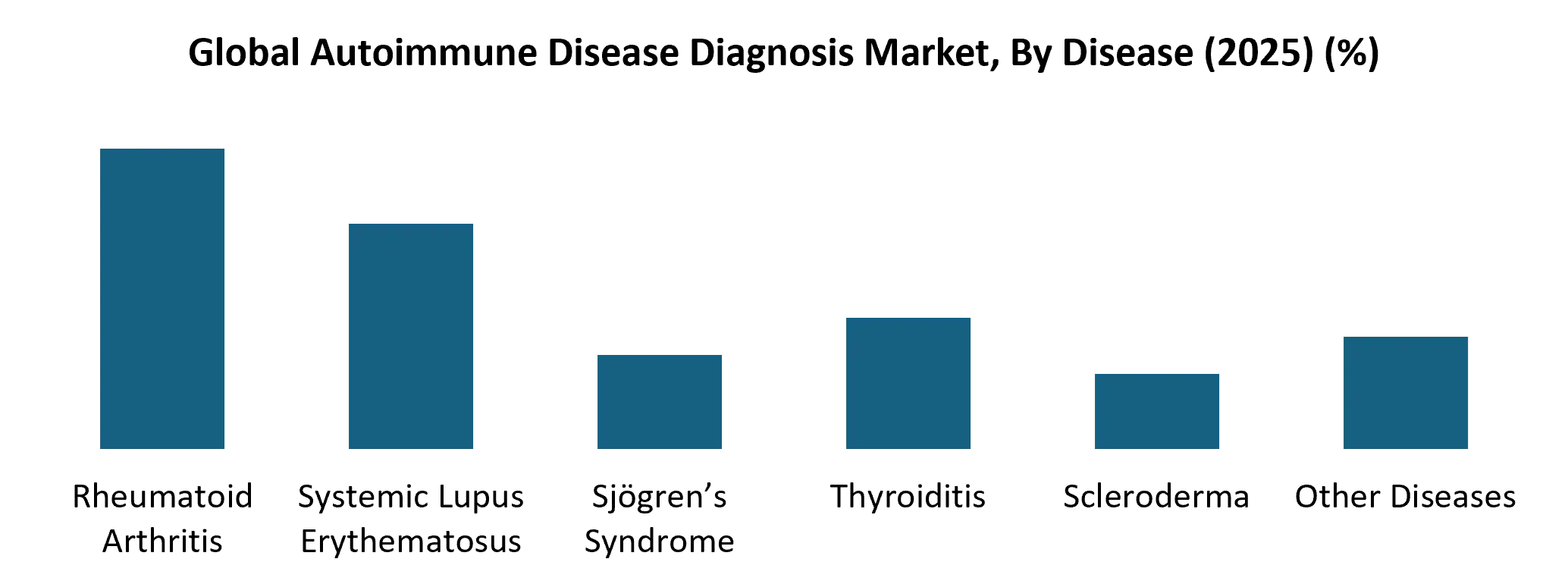
By Disease: The market includes rheumatoid arthritis, systemic lupus erythematosus, Sjögren’s syndrome, thyroiditis, scleroderma, and other autoimmune diseases. Rheumatoid arthritis requires diagnostic tests such as rheumatoid factor and anti-cyclic citrullinated peptide antibody assays to support early identification and clinical assessment. Systemic lupus erythematosus relies on tests such as antinuclear antibodies, anti-double-stranded DNA antibodies, and anti-Smith antibodies to support diagnosis. Sjögren’s syndrome involves the detection of anti-SSA/Ro and anti-SSB/La antibodies alongside clinical evaluation. Thyroiditis requires thyroid function testing and the detection of thyroid-associated antibodies, while scleroderma involves antinuclear antibody testing and disease-associated markers such as anti-centromere and anti-topoisomerase I antibodies. Other diseases, including multiple sclerosis, type 1 diabetes, autoimmune hepatitis, and myasthenia gravis, require condition-specific diagnostic approaches. The diversity of autoimmune disorders and the need to distinguish between conditions with overlapping symptoms support demand for specialized diagnostic assays.
By End-User: The market is categorized into clinical laboratories, hospitals, and other end users. Clinical laboratories perform a broad range of autoimmune diagnostic tests, including autoantibody assays, immunoassays, and specialized immunological investigations. Their access to advanced instruments, trained personnel, and standardized testing procedures supports the processing of samples from different healthcare facilities. Hospitals use autoimmune diagnostic solutions to evaluate suspected conditions, confirm diagnoses, and support treatment decisions for inpatient and outpatient populations. The availability of laboratory services and multidisciplinary medical teams supports the diagnosis of complex autoimmune disorders. Other end users include independent diagnostic centers, specialty clinics, academic medical centers, and research institutions. These facilities use autoimmune diagnostic tests for patient assessment, specialized investigations, biomarker identification, and research into disease mechanisms. The growing need for accurate diagnostic results across different healthcare settings supports demand throughout the end-user segment.
Autoimmune Disease Diagnosis Market Regional Insights:
North America is the leading region in the global autoimmune disease diagnosis market, supported by advanced healthcare infrastructure, a high level of diagnostic awareness, established clinical laboratory networks, and the widespread adoption of advanced diagnostic technologies. The United States and Canada demonstrate strong demand for autoimmune disease diagnostic tests, including antinuclear antibody (ANA) testing, rheumatoid factor testing, autoantibody assays, and automated immunoassay systems. The increasing prevalence of autoimmune conditions, including rheumatoid arthritis, systemic lupus erythematosus, and autoimmune thyroid diseases, strengthens the need for early and accurate diagnosis. In 2025, North America accounts for 42.6% of the global autoimmune disease diagnostics market, reflecting its established diagnostic capabilities and strong healthcare expenditure. The region also benefits from continuous advancements in biomarker identification, precision diagnostics, and laboratory automation, supporting the adoption of innovative autoimmune disease diagnostic solutions.
Europe represents a significant region in the global autoimmune disease diagnosis market, driven by established healthcare systems, widespread access to clinical laboratories, and increasing demand for specialized diagnostic testing. Countries such as Germany, the United Kingdom, France, and Italy contribute to regional demand through their advanced laboratory infrastructure and established healthcare services. The increasing recognition of autoimmune disorders and the need for disease-specific testing support the adoption of immunoassays, autoantibody detection methods, and automated diagnostic instruments. Furthermore, the emphasis on laboratory quality standards, early disease identification, and evidence-based clinical assessment encourages healthcare providers to adopt reliable diagnostic solutions. Continued improvements in laboratory automation and specialized testing capabilities strengthen Europe's position in the global market.
Asia Pacific is an important region in the global autoimmune disease diagnosis market, supported by expanding healthcare infrastructure, increasing healthcare expenditure, and growing awareness of autoimmune disorders. China, India, Japan, and South Korea contribute to regional demand through expanding hospital networks, clinical laboratory services, and the adoption of advanced diagnostic technologies. The increasing need for rheumatoid arthritis testing, autoimmune thyroid disease diagnosis, and systemic lupus erythematosus detection encourages healthcare providers to expand their diagnostic capabilities. Additionally, investments in laboratory automation, improvements in access to specialized healthcare services, and the growing availability of diagnostic testing facilities support market development. The expanding patient population and increasing emphasis on early disease detection create further opportunities for autoimmune disease diagnostic products across the region.
South America demonstrates growing demand in the global autoimmune disease diagnosis market, supported by improvements in healthcare infrastructure, expanding private diagnostic laboratory networks, and increasing awareness of chronic autoimmune conditions. Brazil and Argentina contribute to regional demand through hospitals, specialty clinics, and independent diagnostic centers that provide autoimmune disease testing services. The need for accurate diagnosis of rheumatoid arthritis, systemic lupus erythematosus, and autoimmune thyroid disorders supports the adoption of autoantibody assays and immunological testing methods. Improvements in laboratory capabilities and the expansion of specialized healthcare services strengthen access to diagnostic solutions. However, differences in healthcare expenditure and access to advanced laboratory equipment continue to influence diagnostic availability across countries.
The Middle East and Africa region experiences increasing demand for autoimmune disease diagnostic solutions as healthcare infrastructure develops and access to specialized medical services expands. Countries such as Saudi Arabia, the United Arab Emirates, and South Africa support regional demand through investments in hospital infrastructure, laboratory modernization, and specialized diagnostic services. The growing recognition of autoimmune diseases encourages healthcare providers to improve access to autoantibody testing, immunoassays, and disease-specific diagnostic procedures. The expansion of private healthcare facilities and the adoption of automated laboratory equipment support improvements in diagnostic capabilities. However, limited access to specialized laboratories, variations in healthcare resources, and the cost of advanced diagnostic technologies continue to affect market penetration in some areas.
Global Autoimmune Disease Diagnosis Market Competitive Landscape
The global autoimmune disease diagnosis market features a competitive environment in which companies focus on diagnostic accuracy, product innovation, assay development, and laboratory automation to strengthen their market positions. Key players include F. Hoffmann-La Roche Ltd., Abbott Laboratories, Siemens Healthineers AG, Thermo Fisher Scientific Inc., Bio-Rad Laboratories, Inc., Danaher Corporation, DiaSorin S.p.A., Werfen, bioMérieux SA, and Quest Diagnostics Incorporated. These companies offer diagnostic instruments, immunoassay platforms, reagents, consumables, and specialized testing services that support the detection of autoimmune conditions, including rheumatoid arthritis, systemic lupus erythematosus, Sjögren’s syndrome, and autoimmune thyroid diseases.
Companies strengthen their competitive positions through research and development, expanded disease-specific assay portfolios, and improvements in diagnostic technologies. Automated immunoassay systems, multiplex testing platforms, and advanced autoantibody detection methods support efficient laboratory workflows and help healthcare professionals evaluate complex autoimmune conditions. Specialized companies, including EUROIMMUN Medizinische Labordiagnostika AG and Exagen Inc., focus on immunological testing and disease-specific diagnostic solutions. Strategic collaborations, product development, distribution network expansion, and investments in advanced laboratory technologies remain important strategies for expanding market reach. The competitive landscape emphasizes diagnostic reliability, automation, specialized testing capabilities, and improved access to autoimmune disease diagnosis.
Global Autoimmune Disease Diagnosis Market – Recent Developments
| Date | Company | Development | Impact |
| March 2026 | Virion/Serion | Expanded its autoimmune diagnostic portfolio with recombinant antigens for developing antibody tests targeting autoimmune conditions. | Supports the development of disease-specific diagnostic assays and improves the availability of specialized testing components. |
| June 2026 | Exagen Inc. | Published clinical evidence evaluating the real-world diagnostic performance of its AVISE Lupus testing algorithm. | Strengthens clinical evidence for specialized lupus diagnostics and supports improved patient assessment. |
| July 2026 | Thermo Fisher Scientific | Presented its specialty diagnostics portfolio, including connective tissue disease testing solutions, at a major clinical laboratory diagnostics event. | Supports wider adoption of specialized autoimmune screening panels and improves laboratory diagnostic workflows. |
| August 2026 | AliveDx | Received Health Canada medical device licences for its MosaiQ instrument and MosaiQ AiPlex VAS assay for testing associated with vasculitis and anti-GBM disease. | Expands access to automated multiplex autoimmune testing and supports more streamlined laboratory assessment. |
| August 2026 | Technogenetics | Received US FDA 510(k) clearance for three autoimmune chemiluminescence immunoassays targeting SS-A/Ro, SS-A/Ro 60 kDa, and SS-B/La antibodies. | Strengthens automated antibody testing capabilities for supporting the diagnosis of Sjögren’s syndrome and systemic lupus erythemat |
Autoimmune Disease Diagnosis Market Scope: Inquire before buying
| Autoimmune Disease Diagnosis Market | |||
|---|---|---|---|
| Report Coverage | Details | ||
| Base Year: | 2025 | Forecast Period: | 2026-2034 |
| Historical Data: | 2020 to 2025 | Market Size in 2025: | US $ 6.01 Bn. |
| Forecast Period 2026 to 2034 CAGR: | 8% | Market Size in 2034: | US $ 12.03 Bn. |
| Segments Covered: | by Product | Consumables & Assay Kits Instruments |
|
| by Test Type | Routine Laboratory Tests Inflammatory Markers Autoantibodies & Immunologic Test Other Tests |
||
| by Disease | Rheumatoid Arthritis Systemic Lupus Erythematosus Sjogren’s Syndrome Thyroiditis Scleroderma Other Diseases |
||
| by End-User | Clinical Laboratories Hospitals Other End Users |
||
Autoimmune Disease Diagnosis Market, by Region
North America (United States, Canada and Mexico)
Europe (UK, France, Germany, Italy, Spain, Sweden, Austria and Rest of Europe)
Asia Pacific (China, South Korea, Japan, India, Australia, Indonesia, Malaysia, Vietnam, Taiwan, Bangladesh, Pakistan and Rest of APAC)
Middle East and Africa (South Africa, GCC, Egypt, Nigeria and Rest of ME&A)
South America (Brazil, Argentina Rest of South America)
Autoimmune Disease Diagnosis Market Key Players
1. Thermo Fisher Scientific Inc.
2. Siemens Healthineers AG
3. Abbott Laboratories
4. Danaher Corporation
5. Bio-Rad Laboratories, Inc.
6. Grifols, S.A.
7. Trinity Biotech plc
8. Werfen
9. HYCOR Biomedical
10. EUROIMMUN Medizinische Labordiagnostika AG
11. Oncimmune
12. HTG Molecular Diagnostics
13. Seramun Diagnostica GmbH
14. Exagen Inc.
15. Cambridge Life Sciences Limited
16. A. Menarini Diagnostics S.r.l.
17. ORGENTEC Diagnostika GmbH
18. KRONUS
19. AESKU.Group GmbH
20. Roche Diagnostics
21. Beckman Coulter, Inc.
22. DiaSorin S.p.A.
23. bioMérieux SA
24. Quest Diagnostics Incorporated
25. Laboratory Corporation of America Holdings (Labcorp)
26. INOVA Diagnostics, Inc.
27. Hemagen Diagnostics, Inc.
28. Immco Diagnostics, Inc.
29. R-Biopharm AG
30. Revvity, Inc.
31. Svar Life Science AB
32. SQI Diagnostics Inc.
33. Theradiag
34. Gold Standard Diagnostics
35. HUMAN Gesellschaft für Biochemica und Diagnostica mbH
36. Nova Diagnostics Pte Ltd.
37. Autobio Diagnostics Co., Ltd.
38. Shenzhen YHLO Biotech Co., Ltd.
39. Shenzhen Mindray Bio-Medical Electronics Co., Ltd.
40. Chengdu Maccura Biotechnology Co., Ltd.
41. Shanghai Kehua Bio-Engineering Co., Ltd.
42. Lepu Medical Technology (Beijing) Co., Ltd.
43. Agappe Diagnostics Ltd.
44. Medsource Ozone Biomedicals Pvt. Ltd.
45. BIOSYSTEMS S.A.
46. Sebia S.A.
47. Hologic, Inc.
48. Becton, Dickinson and Company
49. Ortho Clinical Diagnostics
50. Myriad Genetics, Inc.
51. Bio-Techne Corporation
52. Progentec Diagnostics, Inc.
53. Autoimmune Technologies LLC
54. Medical & Biological Laboratories Co., Ltd. (MBL)
55. DIAsource ImmunoAssays S.A.
Frequently Asked Questions:
1. What is the projected growth of the global autoimmune disease diagnosis market?
Ans. The global autoimmune disease diagnosis market is expected to grow at a CAGR of 8% from 2025 to 2034, increasing from US$ 6.01 billion in 2025 to US$ 12.03 billion by 2034.
2. What factors drive the growth of the global autoimmune disease diagnosis market?
Ans. The growth of the global autoimmune disease diagnosis market is driven by the increasing prevalence of autoimmune disorders, rising demand for early and accurate diagnosis, advancements in immunoassay technologies, and the growing adoption of automated laboratory testing systems.
3. Which product segment dominates the global autoimmune disease diagnosis market?
Ans. Consumables and assay kits represent a key product segment in the global autoimmune disease diagnosis market because of their recurring use in autoantibody detection, immunological testing, disease screening, and diagnostic confirmation.
4. Which diseases are covered by the global autoimmune disease diagnosis market?
Ans. The global autoimmune disease diagnosis market covers rheumatoid arthritis, systemic lupus erythematosus, Sjögren’s syndrome, thyroiditis, scleroderma, and other autoimmune disorders that require specialized diagnostic testing.
5. Which region leads the global autoimmune disease diagnosis market?
Ans. North America leads the global autoimmune disease diagnosis market due to its advanced healthcare infrastructure, established clinical laboratory networks, high awareness of autoimmune disorders, and widespread adoption of advanced diagnostic technologies.