
Articulated Robot Market Size by Component, Function, Payload Capacity, End User Industry, Region, Industry-Wide Analysis, Competitive Landscape Assessment & Long-Term Forecast to 2032
Overview
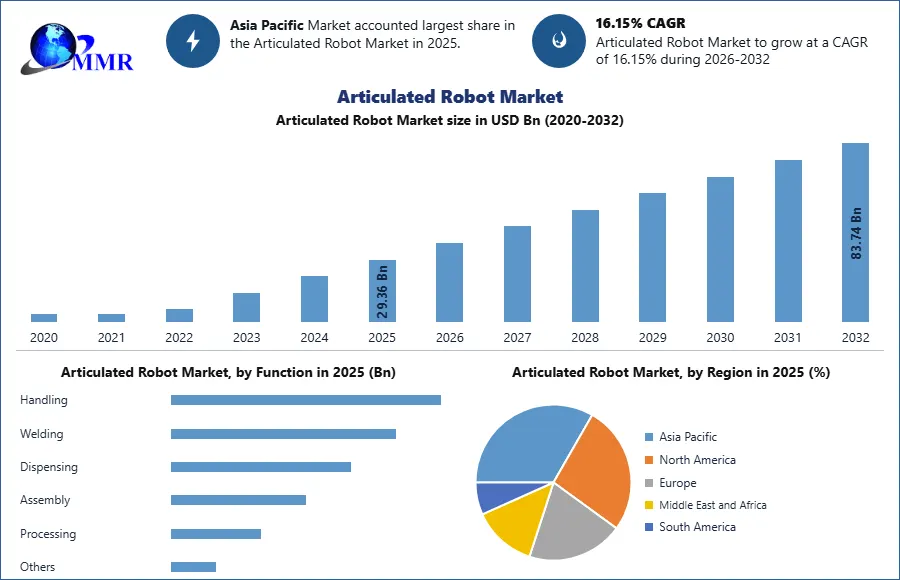
Articulated Robot Market was valued at USD 29.36 Bn in 2025, and total Global Articulated Robot Market revenue is expected to grow at a CAGR of 16.15% and reach nearly USD 83.74 Bn from 2026 to 2032.
Articulated Robot Market Overview
Global Articulated Robot Market is witnessing significant growth, driven by rapid industrial automation and the rising need for precision manufacturing across sectors such as automotive, electronics, and metals. Increasing investments in Industry 4.0 and smart factory initiatives are accelerating the adoption of articulated robots equipped with advanced motion control, AI algorithms, and multi-axis flexibility. These systems enhance production accuracy, operational efficiency, and worker safety, making them vital to modern industrial setups. The growing popularity of collaborative articulated robots (cobots) is enabling safe human–robot interaction, boosting productivity in small and medium-sized enterprises worldwide.
To know about the Research Methodology:-Request Free Sample Report
Technological innovations including IoT integration, machine vision, and predictive maintenance are transforming traditional robotic systems into intelligent, connected, and data-driven solutions. Manufacturers are focusing on developing energy-efficient, modular, and lightweight articulated robots to meet sustainability goals and reduce carbon footprints. The increasing use of six-axis and seven-axis articulated robots for welding, assembly, and material handling applications highlights the industry’s shift toward digital transformation and flexible automation solutions that can adapt to diverse manufacturing needs.
Regionally, Asia Pacific dominated the Articulated Robot Market, led by strong automation growth in China, Japan, South Korea, and India. North America and Europe are adopting advanced robotics for automotive, aerospace, and logistics applications, while emerging economies in South America and the Middle East are modernizing industrial operations. Key players such as ABB Ltd., FANUC Corporation, KUKA AG, and Yaskawa Electric Corporation are investing in AI-powered robotics, cloud-based connectivity, and adaptive learning technologies to enhance productivity and global competitiveness.
Articulated Robot Market Dynamics
Growing Integration of Artificial Intelligence (AI) And Automation Technologies to Boost Articulated Robot Market
A major driver of the Global Articulated Robot Market is the growing integration of artificial intelligence (AI) and automation technologies, transforming industrial robots into intelligent, flexible, and data-driven systems. Advancements in machine vision, IoT connectivity, and predictive maintenance enhance precision, speed, and operational efficiency across manufacturing sectors. The adoption of collaborative articulated robots (cobots) further enables safe human robot interaction and supports small-scale automation. As industries embrace Industry 4.0 and digital transformation, demand for AI-powered, energy efficient, and reconfigurable articulated robots continues to surge, driving significant articulated robot market growth globally.
Increasing Adoption of Collaborative Robots Presents Growth Opportunity for Articulated Robot Market
Global Articulated Robot Market lies in the rising adoption of collaborative articulated robots (cobots) across manufacturing, logistics, and healthcare industries. These robots enable safe human robot collaboration, making automation accessible to small and medium-sized enterprises. Their flexibility, compact design, and easy programmability allow deployment in diverse production environments. With advancements in AI, IoT integration, and adaptive motion control, cobots are becoming more intelligent and cost-effective. The growing shift toward smart factories and human centric automation offers significant potential for articulated robot manufacturers to expand their presence in emerging and high-growth industrial sectors.
Articulated Robot Market Segment Analysis
Based on Payload Capacity, the high payload articulated robot segment is expected to gain a larger market share due to rising demand in automated factories for heavy-load operations. Robots with capacities over 300 kg are widely used in welding, palletizing, material handling, sealing, and assembly, offering high precision, speed, and reliability. Key sectors such as automotive, aerospace, and metal fabrication increasingly adopt these robots for complex, large-component tasks. Advancements in AI motion control, IoT integration, and predictive maintenance further enhance performance, making high-payload articulated robots a critical growth driver in the global articulated robot market.
Based on function, Handling segment dominated the Global Articulated Robot Market and is expected to retain its lead in the coming years. Its ability to efficiently manage material transport, pick and place operations, palletizing, and packaging makes it the preferred choice across automated factories, warehouses, and logistics centers. Welding robots are widely used in automotive and aerospace industries for high-precision joining applications, while Dispensing robots are gaining traction in electronics and packaging for adhesive, sealant, and coating tasks. Assembly robots offer flexibility for component fitting and high-volume production lines, and Processing robots serve niche applications such as cutting, sealing, and polishing. The growing focus on smart factories, Industry 4.0 automation, and workflow optimization ensures that the handling segment continues to drive robust Articulated Robot Market growth globally.
Articulated Robot Market Regional Analysis
Asia Pacific dominated the Global Articulated Robot Market in 2025 and is expected to maintain its leadership throughout the forecast period (2026–2032). The region’s dominance is driven by rapid industrial automation, expanding smart factories, and increased adoption of robotics in automotive, electronics, and metal fabrication industries across China, Japan, South Korea, and India. Strong government support for Industry 4.0 initiatives, high-tech manufacturing, and IoT-integrated robotic solutions is fueling articulated robot market growth. Rising demand for high-payload, six-axis, and collaborative robots in large-scale industrial operations enhances production efficiency, safety, and precision. Furthermore, the shift toward AI-powered, connected, and energy-efficient robotic systems reinforces Asia Pacific’s position as the leading hub for global articulated robot market growth.
Articulated Robot Market Competitive Landscape
Global Articulated Robot Market is highly competitive, led by players such as ABB Ltd., FANUC Corporation, KUKA AG, Yaskawa Electric Corporation, Mitsubishi Electric Corporation, and Kawasaki Heavy Industries. These companies focus on high payload, six-axis, and collaborative robots to meet growing demands in automotive, electronics, aerospace, and logistics industries. Investments in AI-powered control, IoT-enabled robotics, predictive maintenance, and energy-efficient designs are driving intelligent and flexible automation. Strategic partnerships and global expansions across Asia Pacific, North America, and Europe strengthen their market presence. Focus on smart factory integration and real time monitoring positions them at the forefront of the Articulated Robot Market.
Articulated Robot Market Key Trends
• Emergence of AI-Driven and Collaborative Robotics
Global Articulated Robot Market is moving toward AI-driven and collaborative robots (cobots), which can safely interact with humans while performing complex tasks. These robots feature advanced motion control, sensors, and adaptive learning, enhancing efficiency, precision, and safety in automotive, electronics, and logistics industries.
• Integration of Digital Twin and IoT-Based Monitoring
Leading manufacturers are deploying digital twin models and IoT-enabled monitoring systems to simulate robot performance, predict maintenance needs, and optimize production workflows. This ensures real-time operational insights, reduces downtime, and improves process efficiency across smart factories and Industry 4.0-enabled facilities.
• Modular, High-Payload, and Flexible Designs
There is a growing focus on modular, lightweight, and high-payload articulated robots with reconfigurable arms for versatile applications. These innovations allow handling, welding, assembly, and material processing tasks in complex industrial setups, supporting scalable automation and sustainability in next-generation manufacturing.
Articulated Robot Market Recent Development
• On March 11, 2025, ABB expanded its robotic Item Picking family with new AI-powered functional modules designed to transform logistics and fashion industries. These modules offer improved picking accuracy and efficiency, enhancing automation in sorting and fulfillment processes.
• On September 18, 2025, FANUC introduced the M-1000/550F-46A, a high-payload articulated robot with a 550 kg payload capacity and a 4.6-meter reach. This robot is designed for heavy-duty applications such as automotive giga casting and large component handling.
• In December 2024, KUKA launched the KR FORTEC industrial robot, which offers high dynamics and compact form, making it suitable for tasks like handling and spot welding. The KR FORTEC is energy efficient and designed for heavy payload applications up to 500 kg.
Articulated Robot Market Scope: Inquire before buying
| Articulated Robot Market | |||
|---|---|---|---|
| Report Coverage | Details | ||
| Base Year: | 2025 | Forecast Period: | 2026-2032 |
| Historical Data: | 2020 to 2025 | Market Size in 2025: | 29.36 USD Bn |
| Forecast Period 2026-2032 CAGR: | 16.15% | Market Size in 2032: | 83.74 USD Bn |
| Segments Covered: | by Component | Hardware Software Services |
|
| by Function | Handling Welding Dispensing Assembly Processing Others |
||
| by Payload Capacity | Low Medium High |
||
| by End User Industry | Automotive Aerospace EMS Food & Beverages Medical & Pharmaceuticals Others |
||
Articulated Robot Market, by Region
North America (United States, Canada and Mexico)
Europe (UK, France, Germany, Italy, Spain, Sweden, Austria and Rest of Europe)
Asia Pacific (China, South Korea, Japan, India, Australia, Indonesia, Malaysia, Vietnam, Taiwan, and Rest of APAC)
Middle East and Africa (South Africa, GCC, Egypt, Nigeria and Rest of ME&A)
South America (Brazil, Argentina Rest of South America)
Key players/Competitors profiles covered in the Articulated Robot Market report in strategic perspective
North America
1. Rockwell Automation, Inc. (USA)
2. Rethink Robotics (USA)
3. Ellison Technologies, Inc. (USA)
4. American Robot Corporation (USA)
Europe
5. KUKA (Germany)
6. Stäubli International AG (Germany/Switzerland)
7. SCHUNK GmbH & Co. KG (Germany)
8. Robert Bosch GmbH (Germany)
9. ABB Ltd. (Switzerland)
10. Comau (Italy)
Asia Pacific
11. FANUC Corporation (Japan)
12. YASKAWA Electric Corporation (Japan)
13. Kawasaki Heavy Industries, Ltd. (Japan)
14. DENSO Wave Incorporated (Japan)
15. Omron Corporation (Japan)
16. Mitsubishi Electric Corporation (Japan)
17. Epson America, Inc. (Japan)
18. NACHI-FUJIKOSHI Corp. (Japan)
19. Panasonic Corporation (Japan)
20. Toshiba Machine Co., Ltd. (Japan)
21. Adept Technology Pvt. Ltd. (India)
Frequently Asked Questions:
1. Which region dominated the Articulated Robot Market?
Ans: Asia Pacific region dominated the Articulated Robot Market.
2. Who are the leading players in the articulated robot industry?
Ans: Major companies include ABB Ltd., FANUC Corporation, KUKA AG, YASKAWA Electric, Kawasaki Heavy Industries, and Mitsubishi Electric.
3. Why are high-payload articulated robots important?
Ans: They handle heavy loads (>300 kg) in automotive, aerospace, and metal fabrication, improving speed, accuracy, and operational efficiency.
4. What opportunities are driving market growth?
Ans: Rising adoption of cobots, Industry 4.0 automation, AI-enabled systems, and digital twin monitoring offer growth potential.
5. How are AI and machine learning influencing articulated robots?
Ans: AI and machine learning enable predictive maintenance, adaptive motion control, and real-time decision-making, improving efficiency in manufacturing and logistics operations.