
Japan Robotic Vacuum Cleaner Market by Product Type, Operation Mode, Price, Charging Type, Distribution Channel and End User
Overview
The Japan Robotic Vacuum Cleaner Market was valued at USD 520.10 Million in 2025 and is forecast to reach USD 860.54 Million by 2034, growing at a 13.5% CAGR.
Japan Robotic Vacuum Cleaner Market Definition
The Japan Robotic Vacuum Cleaner Market is a market for robotic floor cleaning appliances. It involves researching, designing, manufacturing, distributing, selling, and servicing robots that can clean floors in private and some commercial places. This market’s size depends on Japan’s economic development level, electronics industry characteristics, the level of consumer appliance sophistication, and the number of consumers who prefer such kinds of domestic help. The number of vacuums depends on how often they need to be replaced, their price, technical characteristics, the number of family members, and the overall adoption rate of connected devices. Thus, the robotic vacuum cleaner market in Japan is attractive and gives companies an opportunity to design and sell various floor cleaning products.
| Parameter | Value |
| Market Size (Base Year 2025) | USD 520.10 Million |
| Forecast Market Size (2034) | USD 860.54 Million |
| CAGR (2026-2034) | 13.5% |
| Base Year | 2025 |
| Forecast Period | 2026-2034 |
| Historical Period | 2020-2025 |
Japan Robotic Vacuum Cleaner Market Overview
The Japan Robotic Vacuum Cleaner Market includes automated cleaning devices that vacuum, sweep, and mop floors with minimal human intervention. These products use sensors, LiDAR, AI-based navigation, mapping systems, cameras, and smart connectivity to identify obstacles, plan cleaning routes, operate across rooms, and return automatically to charging stations. The industry uses these solutions to reduce manual cleaning effort, save time, maintain consistent cleaning performance, and support convenient household maintenance, particularly in compact urban homes and aging households.
The market size is valued at USD 520.10 Million in 2025 and is forecast to reach USD 860.54 Million by 2034, creating significant market potential through continued smart-home adoption and demand for automated appliances. Kanto is the highest-dominating region, supported by Tokyo's large urban population, purchasing power, and strong retail and e-commerce infrastructure. Key opportunities include AI-powered navigation, self-emptying systems, vacuum-and-mop products, commercial cleaning applications, and senior-oriented smart-home solutions. Market gaps remain in affordability, compact product design, noise reduction, navigation in complex home layouts, and after-sales support. Consumer expenditure is supported by demand for convenient, premium, and time-saving household appliances. Leading key players include Panasonic, iRobot, ECOVACS, Roborock, Xiaomi, and Sharp, which compete through product innovation, smart-home integration, cleaning performance, pricing, and service networks.
Japan Robotic Vacuum Cleaner Market Growth and Forecast Analysis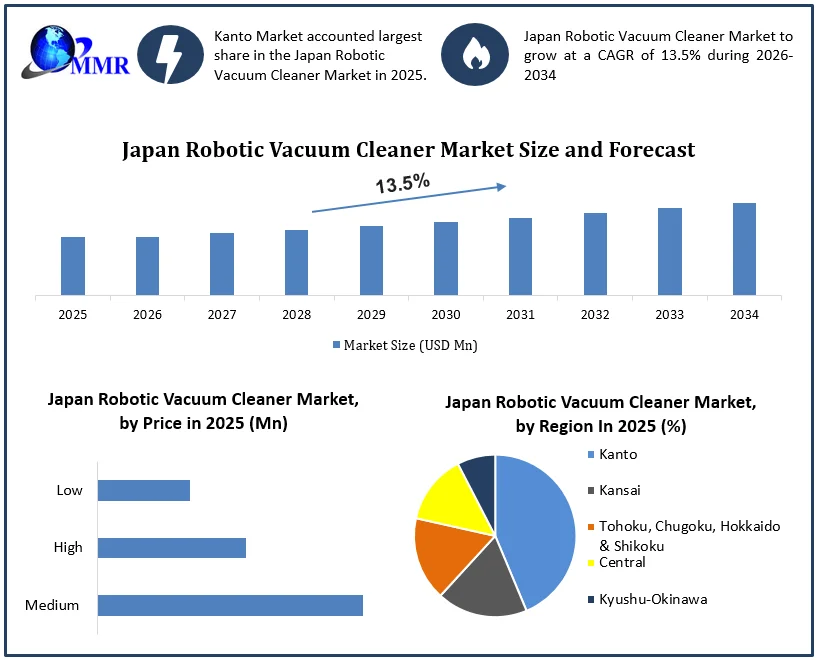
To know about the Research Methodology :- Request Free Sample Report
Japan Robotic Vacuum Cleaner Market Historical Size (2020-2025)
| Year | Market Size (USD Mn) | Growth Rate (YoY) |
| 2020 | 338.4 | 5.45 |
| 2021 | 359.2 | 6.15% |
| 2022 | 385.8 | 7.40% |
| 2023 | 417.3 | 8.17% |
| 2024 | 464.9 | 11.41% |
| 2025 | 520.1 | 11.88% |
Japan Robotic Vacuum Cleaner Market Key Highlights
• Market Growth: USD 520.10 Million in 2025, reaching USD 860.54 Million by 2034.
• Leading Region: Kanto dominates with a 43.70% market share.
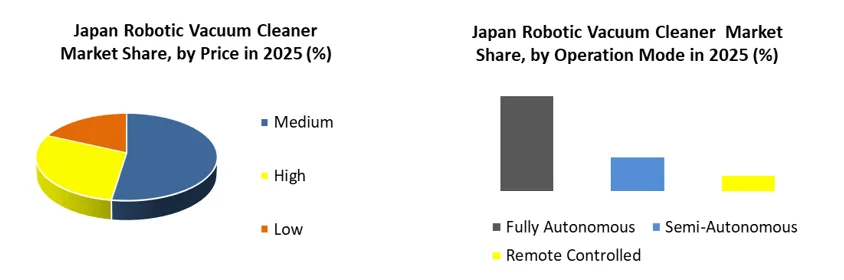
• Price Segment: Medium-price products lead with a 52.45% share.
• Operation Mode: Fully autonomous systems hold the largest share at 64.80%.
• Consumer Demand: Aging households and demand for convenience support adoption.
• Technology Focus: AI navigation, LiDAR, smart connectivity, and self-emptying systems drive innovation.
• Product Trend: Vacuum-and-mop hybrids are gaining consumer interest.
• Key Challenge: High product costs and complex home layouts limit adoption.
Japan Robotic Vacuum Cleaner Market Consumer Insights & Demand Analysis
| Consumer Dimension | Key Insights | Market Implication |
| Aging Population Tailwind | Japan has the world's oldest population; 29% over 65 in 2025. Elderly individuals face physical limitations performing floor cleaning, creating strong eldercare-driven use | Government eldercare grants and social robotics support programs incentivize robotic cleaning use in assisted living and independent elderly households |
| Compact Living Precision | Urban Japanese apartments average 50-65m², requiring robots with millimeter-precision navigation around tatami mats, sliding screens (fusuma), and low furniture clearances | Ultra-slim robot profiles (<8.5cm height) and precision LDS navigation with multi-floor mapping are table-stakes for Japanese market premium acceptance |
| Noise Sensitivity | Japanese residential buildings have thin walls and noise complaint culture; quiet operation (<55dB) is a important purchase factor absent in most global markets | Domestic brands Panasonic and Toshiba specifically engineer whisper-quiet motors; noisy Chinese models face negative online reviews on Kakaku.com |
| Brand Trust Premium | Japanese consumers focus on manufacturer reliability, after-sales service quality, and domestic brand heritage over feature quantity or price competitiveness | Domestic brands command 15-25% price premiums vs. equivalent Chinese models; extended warranty and in-home repair services are decisive purchase factors |
Japan Robotic Vacuum Cleaner Market Dynamics
Japan Robotic Vacuum Cleaner Market Drivers
• Smart-Home Adoption: Growing integration of connected appliances, smartphones, and voice assistants is increasing demand for robotic cleaning solutions.
• Aging Population: Automated cleaning reduces physical effort and supports easier household maintenance for older consumers.
• Demand for Convenience: Consumers increasingly prefer appliances that reduce routine cleaning time and manual intervention.
• Compact Living Spaces: Demand for space-efficient cleaning appliances supports the adoption of compact robotic vacuum cleaners in urban households.
Japan Robotic Vacuum Cleaner Market Restraints
• High Initial Expenditure: Premium robotic vacuum cleaners require higher upfront spending than conventional cleaning appliances, limiting adoption among price-sensitive consumers.
• Replacement Costs: Batteries, filters, brushes, and other consumable components add to long-term ownership expenses.
• Limited Performance on Certain Surfaces: Tatami, thresholds, stairs, and uneven surfaces can reduce cleaning efficiency.
• Limited Consumer Awareness: Some consumers remain uncertain about the practical benefits and performance of advanced robotic cleaning systems.
Japan Robotic Vacuum Cleaner Market Opportunities
• AI-Powered Cleaning: Advanced AI navigation, object recognition, and adaptive cleaning create opportunities for higher-value products.
• Multifunctional Systems: Vacuum-and-mop combinations can expand demand by providing multiple cleaning functions through a single device.
• Commercial Expansion: Hotels, offices, retail facilities, and other commercial locations offer opportunities beyond residential applications.
• Automated Maintenance: Self-emptying, self-cleaning, and automated brush-maintenance systems can increase product convenience and usage frequency.
Japan Robotic Vacuum Cleaner Market Challenges
• Navigation Reliability: Robots must accurately navigate furniture, cables, narrow spaces, and changing room layouts.
• Noise Management: Manufacturers face the challenge of improving suction performance while maintaining low operating noise.
• Data Security: Connected devices require strong protection of household mapping, usage, and other user data.
• Product Reliability: Consistent performance of sensors, batteries, motors, and software is essential for maintaining consumer confidence.
Japan Robotic Vacuum Cleaner Market Segment Analysis
Japan Robotic Vacuum Cleaner Market, by Price
The most dominant segment in the Japan Robotic Vacuum Cleaner Market is expected to be the Medium Price Segment with an anticipated value of 52.45 percent in 2025, which is supported by consumer preference for products featuring an optimal balance of affordability and innovative attributes such as LiDAR navigation, app connectivity, scheduled cleaning functions, and suction capabilities. The High Price Segment is anticipated to constitute an estimated 29.35 percent of the market, which reflects the demand for sophisticated robotic vacuum cleaners equipped with AI-driven obstacle recognition, self-emptying, advanced mopping functionalities, and automated maintenance features, whereas the Low Price Segment is anticipated to comprise an approximate demand of 18.20 percent, which is attributed to the appeal of budget-friendly products to price-sensitive consumers seeking fundamental automated cleaning solutions. Overall, the aforementioned segmentation aligns with general robotic vacuum cleaner market data indicating that the USD 200–499 price band is anticipated to comprise the largest robotic vacuum cleaner market segment in 2025.
Japan Robotic Vacuum Cleaner Market, by Operation Mode
The Fully Autonomous operation mode is projected to account for the largest share of the Japan Robotic Vacuum Cleaner Market in 2025, with an estimated value of 64.80%. This is attributed to the rising demand for robotic vacuum cleaners that offer autonomous operation, advanced navigation, obstacle avoidance, scheduling options, and automatic return to dock features. The Semi-Autonomous segment is estimated to represent 23.70% of the market, as these vacuums provide automation while enabling users to retain control over specific tasks. The Remote-Controlled segment is anticipated to comprise around 11.50% of the market, as it enables direct user interaction with the device. The growing inclination toward fully autonomous vacuums is primarily driven by the rising adoption of smart home technologies in Japan, as well as the industry’s emphasis on autonomous operation as a key differentiator in the robotics sector.
Japan Robotic Vacuum Cleaner Market Regional Analysis
The Kanto Region is expected to be the largest market for Japan Robotic Vacuum Cleaner Market, registering a market share of 43.70% in 2025, led by Tokyo, its vast capital, high household purchasing power, electronics retail infrastructure, and propensity for adopting high-tech domestic appliances. The Kansai Region, concentrated in Osaka and Kyoto, is anticipated to represent the second-largest market share, amounting to 18.10% in 2025, on the back of increased inclination toward automated home appliances. The Central Region is projected to grow at a healthy rate on account of Nagoya’s extensive urban development, registering a market share of 13.90%. Meanwhile, the Kyushu-Okinawa Region is expected to witness gradual adoption of robotic vacuum cleaners, driven by its improving urban infrastructure and electronics retail penetration, at a CAGR of 7.60%. Finally, Tohoku, Chugoku, Hokkaido, and Shikoku will register a market share of 16.70% in 2025, fueled by aging populations and a rise in home appliances retail sales. Overall, the provided market shares are consistent with the aforementioned market analysis, which identified the Kanto region as Japan’s largest robotic vacuum cleaner market.
Japan Robotic Vacuum Cleaner Market Competitive Landscape
The Japan Robotic Vacuum Cleaner Market is moderately competitive, with local electronics manufacturers, major global robotic-cleaning brands, and rising Chinese technology companies fighting for the share of the market. Panasonic has a considerable advantage due to its strong domestic presence, well-established brand image, and extensive retail and service networks for its RULO series. In turn, iRobot strengthens its position on the territory by offering a wide range of Roomba robotic vacuums. Meanwhile, ECOVACS and Roborock provide high-tech solutions such as vacuum-and-mop combo, LiDAR, AI-powered obstacle detection and avoidance, and self-emptying dust bins. Xiaomi, Dreame, and other smart-home appliance producers also participate in the competition with robotic vacuums, targeting the online customer segment and providing high-performance devices at affordable prices.
The competitive environment in the Japanese robotic vacuum cleaner market is intensely shaped by technical advances and the appeal of products to domestic customers. Therefore, the main focus of competition is on artificial intelligence, LiDAR technology, mopping options, self-emptying dust bins, applications, miniaturization, noise reduction, and after-sales service. Local manufacturers hold advantages over foreign competitors due to their strong local dealer networks, well-developed service centers, and overall brand recognition. In turn, global technology companies emphasize the importance of constant innovation and the introduction of new features to stay ahead of the competition. Notably, recent industry reports suggest that Roborock, ECOVACS, and Dreame robotic vacuums have become increasingly popular among Japanese consumers, as they offer cutting-edge navigation and powerful cleaning technologies.
Japan Robotic Vacuum Cleaner Market Technology & Innovation Trends
| Innovation Area | Current Trend | Market Impact |
| Tatami-Safe Soft Mop Technology | Moisture-controlled micro-fiber mop systems specifically validated for Japanese tatami (rush grass mat) flooring without staining or fiber distortion | Critical domestic market differentiator; Panasonic RULO patented tatami detection enables automatic mop retraction |
| Ultra-Quiet Motor Engineering | Brushless DC motor with acoustic dampening achieving sub-52dB operation - comparable to library ambient noise levels | Meets strict Japanese residential noise codes; key purchase driver in multi-family apartment buildings |
| Compact Triangular Navigation Body | Panasonic's triangular robot body geometry reaching 60° corners that circular robots miss - addressing Japan's traditional room corner-cleaning requirement | Patented domestic design responding to Japanese consumer corner-cleaning obsession documented in consumer research |
| Single-Touch Simplicity Interface | One-button physical operation without smartphone app dependency - essential for 65+ user demographic with limited smartphone proficiency | Domestic brands maintain physical button priority while offering optional app as secondary control layer |
| AI-Home Platform Integration (Panasonic Home) | Robotic vacuums integrated into Panasonic's Home smart home ecosystem for unified voice and schedule control with other appliances | Japan-specific ecosystem play creating multi-appliance brand loyalty across refrigerators, air conditioners, and cleaning robots |
Japan Robotic Vacuum Cleaner Market Scope: Inquire before buying
| Japan Robotic Vacuum Cleaner Market | |||
|---|---|---|---|
| Report Coverage | Details | ||
| Base Year: | 2025 | Forecast Period: | 2026-2034 |
| Historical Data: | 2020 to 2025 | Market Size in 2025: | 520.1 USD Million |
| Forecast Period 2026-2034 CAGR: | 13.5% | Market Size in 2034: | 860.54 USD Million |
| Segments Covered: | by Product Type | Floor Robotic Vacuum Cleaner Vacuum & Mop Hybrid Window Robotic Vacuum Cleaner Pool Robotic Vacuum Cleaner Others |
|
| by Operation Mode | Fully Autonomous Semi-Autonomous Remote Controlled |
||
| by Price | High Medium Low |
||
| by Charging Type | Automatic Docking & Self-Charging Manual Charging Battery-Swapping Systems |
||
| by Distribution Channel | Online Company Websites E-Commerce Platforms Online Marketplaces Offline Electronics & Specialty Stores Department Stores Supermarkets & Hypermarkets Other Retail Stores |
||
| by End User | Residential Apartments Single-Family Homes Large Houses Commercial Hotels & Hospitality Offices & Corporate Facilities Retail & Shopping Centers Healthcare Facilities Airports & Transportation Hubs Industrial Warehouses Manufacturing Facilities Other Industrial Sites |
||
Japan Robotic Vacuum Cleaner Market Key Players
1. iRobot Corporation
2. Panasonic Corporation
3. ECOVACS Robotics
4. Roborock Technology
5. Xiaomi Corporation
6. Dreame Technology
7. Anker Innovations
8. Sharp Corporation
9. Hitachi, Ltd.
10.Switch Bot
11.Narwal Robotics
12.Shark Ninja
13.Samsung Electronics
14.LG Electronics
15.IRIS OHYAMA Inc.
Frequently Asked Questions :
1. What is the current size of the Japan Robotic Vacuum Cleaner Market?
The Japan Robotic Vacuum Cleaner Market is valued at USD 520.10 Million in 2025 and, based on the figures provided, is forecast to reach USD 860.54 Million by 2034.
2. What are the key factors driving the Japan Robotic Vacuum Cleaner Market?
Key growth factors include smart-home adoption, Japan’s aging population, demand for convenient and time-saving cleaning solutions, compact urban living spaces, AI-based navigation, and increasing adoption of connected household appliances.
3. Which application segment holds the largest share of the Japan Robotic Vacuum Cleaner Market?
The Residential segment holds the largest share, supported by demand from apartments and households seeking automated, convenient, and low-effort floor cleaning. Residential adoption is particularly relevant in Japan’s compact urban households and aging population.
4. Which region dominates the Japan Robotic Vacuum Cleaner Market?
The Kanto Region dominates the market with a 43.70% share in 2025, supported by Tokyo’s large urban population, high purchasing power, concentrated electronics retail infrastructure, and strong adoption of smart-home appliances.
5. Who are the major players operating in the Japan Robotic Vacuum Cleaner Market?
Major players include iRobot Corporation, Panasonic Corporation, ECOVACS Robotics, Roborock Technology, Xiaomi Corporation, Dreame Technology, Anker Innovations, Sharp Corporation, Hitachi Ltd., Switch Bot, Narwal Robotics, Shark Ninja, Samsung Electronics, LG Electronics, and IRIS OHYAMA Inc. Current market research also identifies Panasonic, iRobot, ECOVACS, and Roborock among the notable competitors in Japan.