
Global Air Blowers Market Size by Type, Application, by Pressure, Region and Forecast 2034
Overview
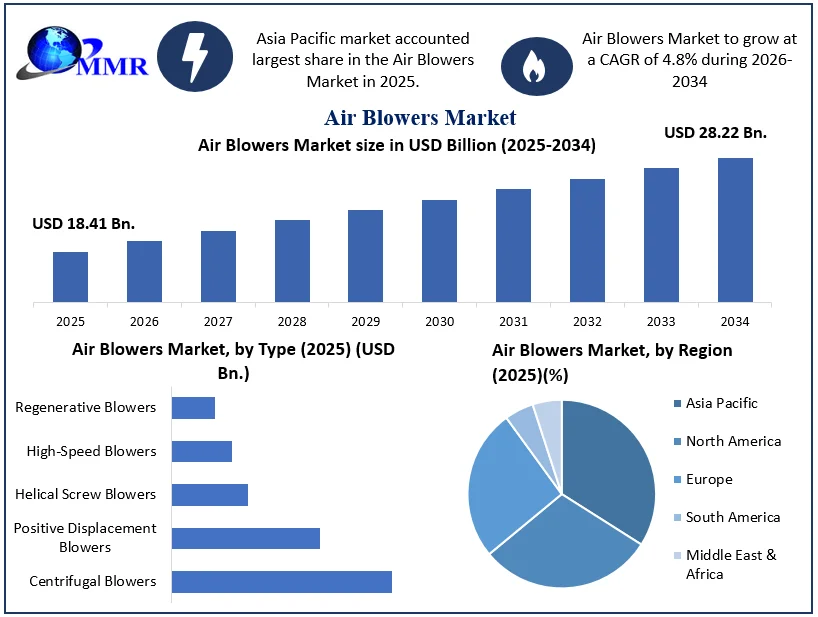
The Global Air Blowers Market size was valued at USD 18.41 Billion in 2025 and the total Air Blowers revenue is expected to grow at a CAGR of 4.8% from 2025 to 2034, reaching USD 28.22 Billion by 2034.
Air Blowers Market Overview:
The global air blowers market is experiencing steady growth as industries increasingly require efficient and reliable solutions for air movement, ventilation, cooling, exhausting, conveying, and material handling. An air blower is a mechanical instrument that creates a high-pressure air or gas flow. Blowers are used to provide air for ventilation and industrial processes. Air blowers are often used to clean electrical parts that are too sensitive to be cleaned with a cloth. During the projected period, increasing demand for air blowers in a wide range of applications is expected to generate profitable prospects for business growth.
Technological advancements are further shaping the global air blower market. Manufacturers are developing advanced blower technologies with improved energy efficiency, compact designs, enhanced durability, variable-speed operation, and automated monitoring capabilities. The integration of smart controls and digital technologies is supporting better performance monitoring and predictive maintenance.
The industrial air blower market is also expanding with increasing demand from heavy industries, where durable and high-performance equipment is required for continuous operations. Growing investments in manufacturing facilities, power infrastructure, mining activities, and wastewater treatment plants are creating additional opportunities for air blower manufacturers.
The research includes a detailed analysis of the Global Air Blowers industry, as well as market classifications by type, application, and region. The study includes an analysis of past market dynamics through 2020 to 2025, which will assist readers in comparing past patterns to current market conditions, as well as the contributions of key players.
Key Highlights
• Market Size: The Global Air Blowers Market is valued at USD 18.41 billion in 2025 and is projected to reach USD 28.22 billion by 2034, registering a 4.8% CAGR during 2025–2034.
• Technological Advancement: Manufacturers are focusing on energy-efficient, compact, durable, variable-speed, and digitally monitored blower systems, with smart controls supporting performance optimization and predictive maintenance.
• Industrial Demand: Growing manufacturing activities are increasing the use of industrial air blowers for ventilation, cooling, drying, dust removal, pneumatic conveying, combustion, and material handling.
• Wastewater Treatment: Expansion of water and wastewater treatment infrastructure is creating significant demand for aeration and wastewater treatment blowers, particularly as urbanization and industrial wastewater generation increase.
• Emerging Opportunities: Growing demand for oil-free and Class 0 air blowers in food processing, pharmaceuticals, healthcare, electronics, and water treatment creates attractive opportunities.
• Application Scope: Major applications include mining, manufacturing, petrochemical, food processing, metal processing, cement production, and other industrial applications.
• Regional Leader: Asia Pacific represents the largest regional market, supported by rapid industrialization, manufacturing expansion, infrastructure development, mining, chemicals, power generation, and wastewater treatment investments.
• Market Outlook: Overall growth is supported by industrial automation, infrastructure investment, wastewater treatment expansion, energy-efficiency requirements, and increasing adoption of smart and oil-free blower technologies.
To Know About The Research Methodology :- Request Free Sample Report
The research profiles thirteen major market participants from various regions. However, when studying the market and calculating its size, the report took into account all leading companies, followers, and new entrants with investors. The manufacturing environment in each region differs, so the study assesses the geographical influence on manufacturing costs, supply chains, raw material availability, cost of labor, advanced technology availability, & main vendors, & makes recommendations for a future hot spot in the APAC region. The research examines major economies' manufacturing policies and their impact on market demand.
Global Air Blowers Market Dynamics
Market Drivers
• Rising Focus on Energy-Efficient Air Blowers: The growing emphasis on energy efficiency is driving the global air blowers market as industries seek to reduce electricity consumption, operating costs, and carbon emissions. Manufacturers are increasingly developing energy-efficient air blowers with variable frequency drives (VFDs), optimized motors, and intelligent controls. Industries such as manufacturing, wastewater treatment, power generation, food processing, and chemicals are increasingly adopting high-efficiency blower systems to improve operational performance and support sustainability objectives.
• Growing Demand from the Manufacturing Sector: The expansion of the manufacturing industry is strengthening demand for industrial air blowers used for ventilation, cooling, drying, dust removal, pneumatic conveying, combustion, and material handling. Increasing automation and production capacity require reliable air-management systems, supporting the growth of the industrial air blower market.
• Expansion of Water and Wastewater Treatment Infrastructure: Increasing investments in water and wastewater treatment are creating significant demand for wastewater treatment blowers. Air blowers provide aeration in biological treatment processes and support efficient oxygen transfer. Growing urbanization, industrial wastewater generation, and government investment in water infrastructure are therefore strengthening the air blowers market growth.
Market Restraints
• High Initial Installation and Capital Costs: High initial investment remains a key restraint for the industrial air blowers market. Large-capacity and customized blower systems require equipment procurement, installation, electrical integration, controls, commissioning, and maintenance infrastructure. These costs can discourage small and medium-sized enterprises from replacing existing equipment, particularly when conventional systems continue to operate.
• High Maintenance Requirements and Air Leakage: Air leakage, inefficient operating conditions, inadequate maintenance, and improper system sizing can increase energy consumption and operating costs. Regular inspection and maintenance are therefore essential for maintaining air blower efficiency. For smaller industrial facilities, the cost and technical requirements associated with air audits, maintenance, and system optimization can restrict adoption.
• Raw Material Price Volatility: Fluctuations in the prices of metals and other components affect the manufacturing costs of industrial air blowers. Changes in the cost of steel, copper, aluminum, motors, and electronic components can increase equipment prices and create uncertainty for manufacturers and industrial buyers.
Market Opportunities
• Rising Demand for Oil-Free and Class 0 Air Blowers: The increasing requirement for contamination-free air in food and beverage, pharmaceutical, healthcare, electronics, and water treatment applications creates opportunities for oil-free air blowers and Class 0-certified blower technologies. These systems help industries maintain product quality and comply with stringent hygiene and air-quality requirements.
• Increasing Adoption of Smart and IoT-Enabled Air Blowers: The integration of IoT sensors, digital monitoring, remote controls, and predictive maintenance is creating new opportunities in the air blower market. Smart blower systems enable users to monitor airflow, pressure, temperature, vibration, and energy consumption in real time. These capabilities support predictive maintenance, reduce downtime, and improve overall equipment efficiency.
• Growing Demand in Food Processing and Pharmaceutical Industries: The expansion of food processing and pharmaceutical manufacturing is increasing demand for reliable and hygienic industrial air blowers. Applications such as pneumatic conveying, drying, cooling, aeration, packaging, and clean-air management require controlled and dependable airflow. This creates opportunities for specialized and oil-free blower solutions.
Market Challenges
• Balancing Energy Efficiency with Performance: Manufacturers face the challenge of improving air blower energy efficiency while maintaining required airflow, pressure, durability, and reliability. Industrial customers increasingly expect lower energy consumption without compromising process performance, encouraging manufacturers to continuously improve motor, impeller, drive, and control technologies.
• Reducing Noise Levels: Reducing noise pollution remains an important challenge for the industrial air blower industry. High-capacity blowers can generate significant noise during continuous operation. Manufacturers are therefore focusing on aerodynamic optimization, improved acoustic designs, variable-speed operation, and noise-reduction technologies.
Air Blowers Market Trends:
• The market is being driven by rising demand for air blowers in the manufacturing industry: During the forecast period, increasing demand for air blowers in a variety of sectors for various applications like cleaning dust or debris, drying the surface, and the others is expected to fuel market expansion. The market is supported by the growing use of centrifugal blowers in the industrial sector. Over the estimated period, the market is expected to develop due to an increase in the use of blowers for residential uses. They are widely used in ventilation systems, which makes them more suitable for use in hotels, restaurants, and shopping malls.
The mining industry's increasing need for blowers is expected to have a favourable impact on the market. When compared to traditional machinery, air blowers are more efficient. Because air blowers can transport air in both a vacuum and a pressurized atmosphere, they can be used in a variety of environments.
• The market's growth is expected to be hindered by the high installation costs of air blowers: The high cost of installing air blowers is a stumbling block for the market. In addition, over the projection period, a lack of technical understanding and awareness about the benefits of air blowers is likely to stymie market growth.
• New opportunities are expected to arise as the food processing business expands: The food processing industry's growing demand for efficient Air Blowers is likely to open up new market opportunities. Furthermore, over the projected period, technical advancements in air blowers, as well as their increasing acceptance in emerging nations, are expected to create new opportunities for the market.
Air Blowers Market Segments
• By Type, The air blowers market, by type, includes centrifugal blowers, positive displacement blowers, helical screw blowers, high-speed blowers, and regenerative blowers. Centrifugal blowers maintain strong demand across manufacturing, wastewater treatment, mining, and power generation, while positive displacement and helical screw blowers support pneumatic conveying and aeration. High-speed and regenerative blowers gain adoption because of their compact designs, energy efficiency, and flexible airflow capabilities.
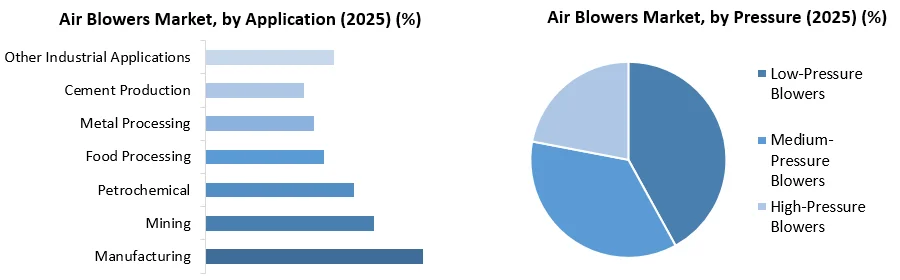
• By Pressure, The air blowers market, by pressure, includes low-pressure, medium-pressure, and high-pressure blowers. Low-pressure blowers dominate due to their extensive use in wastewater aeration, HVAC, cooling, drying, and dust collection, while medium-pressure blowers increasingly serve manufacturing, chemical processing, cement, and pneumatic conveying. High-pressure blowers address specialized applications such as combustion, gas handling, industrial furnaces, and high-pressure material conveying.
By Application,The air blowers market, by application, includes mining, manufacturing, petrochemical, food processing, metal processing, cement production, and other industrial applications. Manufacturing and mining generate significant demand for ventilation, cooling, material handling, and process-air applications, while petrochemical, food processing, metal processing, and cement industries use blowers for combustion, drying, conveying, aeration, and cooling. Wastewater treatment, pharmaceuticals, power generation, chemicals, and industrial HVAC also expand demand for industrial air blower systems.
Air Blowers Market Regional Insights
• North America is the leading region in the global air blowers market, supported by manufacturing, energy, mining, and infrastructure activities.The United States leads regional demand, while Canada contributes through mining, resource processing, and industrial applications.Industries increasingly adopt energy-efficient air blowers to reduce electricity consumption and operating costs. In terms of demand, the United States is estimated to account for more than 60% of the air blower market in North America in the year 2025
• Europe represents a mature market for industrial air blowers, supported by established manufacturing and industrial infrastructure.Germany, the UK, France, Italy, and Spain generate significant demand for advanced blower systems.Strict environmental and energy-efficiency requirements encourage industries to adopt energy-efficient air blowers.Manufacturers increasingly focus on low-noise, variable-speed, and environmentally sustainable blower technologies.
• Asia Pacific represents the largest regional market due to rapid industrialization, manufacturing growth, and infrastructure development.China generates strong demand from manufacturing, mining, chemicals, power generation, and heavy industries.India experiences increasing demand due to industrial expansion, infrastructure investment, and wastewater treatment development.Japan, South Korea, and Australia contribute through advanced manufacturing, mining, cooling, and clean-air applications.
• South America presents growing opportunities in the air blowers market through industrialization and infrastructure development. Brazil represents a major regional market due to its manufacturing, mining, food processing, and energy industries. Chile, Peru, Argentina, and Colombia contribute through mining, mineral processing, manufacturing, and water-treatment activities. Growing wastewater-treatment investments create additional demand for aeration blowers.
• The Middle East & Africa market is expanding through investments in infrastructure, energy, construction, mining, and water treatment. The UAE, Saudi Arabia, and South Africa generate significant demand for industrial air blower systems. Blowers are increasingly used for ventilation, cooling, wastewater treatment, material handling, and industrial processes.
Air Blowers Market Competitive Landscape
The global air blowers market remains competitive, with manufacturers focusing on energy efficiency, oil-free technology, digitalization, reliability, and application-specific solutions. Major players compete across centrifugal, screw, lobe, turbo, and other blower technologies for wastewater treatment, manufacturing, food processing, chemicals, mining, and pneumatic conveying applications.
Atlas Copco strengthens its position through oil-free turbo, screw, lobe, and centrifugal blower technologies, along with variable-speed drives and digital monitoring. Aerzen focuses on positive-displacement and screw blower solutions for wastewater treatment, pneumatic conveying, and industrial gas applications.
Ingersoll Rand competes through engineered air and gas solutions, customized systems, digital controls, and global service capabilities. Energy efficiency remains a key competitive factor as industrial users increasingly focus on reducing electricity consumption and lifecycle operating costs. Manufacturers increasingly integrate IoT sensors, smart controls, variable-speed drives, and remote monitoring to optimize blower performance. Oil-free and Class 0 technologies gain importance in food processing, pharmaceuticals, and other applications requiring clean air. Customized blower systems help manufacturers address different pressure, airflow, temperature, and operating requirements.
Regional suppliers compete through localized manufacturing, competitive pricing, faster delivery, and application-specific technical support. Aftermarket services, including maintenance, spare parts, commissioning, and performance optimization, strengthen customer relationships. Overall, competition increasingly centers on energy efficiency, digitalization, sustainability, customization, reliability, and lifecycle value rather than equipment price alone.
Air Blowers Market Recent Developments
| Date | Company | Recent Development | Market Impact |
| 28 September 2026 | AERZEN | AERZEN expands its Delta Hybrid screw blower portfolio with new D100S and D120S sizes for higher-volume flow applications up to 7,320 m³/h. | Strengthens demand for energy-efficient screw blowers in large-scale industrial and process-air applications. |
| 18 August 2026 | AERZEN | At POWTECH 2026, AERZEN presents new blower and compressor technologies, including the D16S Delta Hybrid screw blower and Aerzen Turbo AT125 Generation 6. | Supports adoption of high-efficiency, oil-free blower systems for pneumatic conveying and bulk-material processing. |
| 3 August 2026 | Ingersoll Rand | Ingersoll Rand announces the acquisition of Lone Star Blower, Inc., expanding its blower technologies, rental capabilities, and service offerings. | Strengthens the company's position in industrial blower equipment and aftermarket services. |
| 4 May 2026 | AERZEN | AERZEN announces new Delta Hybrid D11S and D16S screw blower sizes, targeting improved flexibility and efficiency in lower-volume-flow applications. | Expands the addressable market for energy-efficient screw blowers in wastewater and industrial applications. |
| 3 March 2026 | AERZEN | AERZEN announces new screw and turbo blowers and integrated blower, aeration, and control solutions for IFAT 2026. | Promotes smart, integrated and energy-efficient blower systems, particularly for wastewater treatment. |
| 12 May 2026 | Ingersoll Rand & Garrett Motion | The companies announce a strategic partnership focused on oil-free industrial innovation. | Supports technological development around cleaner, oil-free compressed-air and industrial air solutions. |
Air Blowers Market Scope: Inquire before buying
| Air Blowers Market | |||
|---|---|---|---|
| Report Coverage | Details | ||
| Base Year: | 2025 | Forecast Period: | 2026-2034 |
| Historical Data: | 2020 to 2025 | Market Size in 2025: | 18.41 USD Billion |
| Forecast Period 2026-2034 CAGR: | 4.8% | Market Size in 2034: | 28.22 USD Billion |
| Segments Covered: | by Type | Centrifugal Blowers Positive Displacement Blowers Helical Screw Blowers High Speed Blowers Regenerative Blowers |
|
| by Pressure | Low-Pressure Medium-Pressure High-Pressure |
||
| by Application | Mining Manufacturing Petrochemical Food Processing Industry Metal Processing Cement Production Other Industrial Applications |
||
Air Blowers Market, by Region
North America (United States, Canada and Mexico)
Europe (UK, France, Germany, Italy, Spain, Sweden, Austria and Rest of Europe)
Asia Pacific (China, South Korea, Japan, India, Australia, Indonesia, Malaysia, Vietnam, Taiwan, Bangladesh, Pakistan and Rest of APAC)
Middle East and Africa (South Africa, GCC, Egypt, Nigeria and Rest of ME&A)
South America (Brazil, Argentina Rest of South America)
Air Blowers Market, Key Players:
1.Bosch Limited
2. Mitsubishi Heavy Industries, Ltd.
3. Cheston
4. Makita Corporation
5. SKIL Power Tools
6. Leister AG
7. Everest Blowers Private Limited
8. Airvac Industries Pvt. Ltd.
9. Chicago Blower Corporation
10. Illinois Blower, Inc.
11. Kawasaki Heavy Industries, Ltd.
12. General Electric Company
13. Tuthill Corporation
14. Gardner Denver Inc.
15. Atlas Copco AB
16. AERZEN (Aerzener Maschinenfabrik GmbH)
17. Kaeser Kompressoren SE
18. Howden Group
19. Ingersoll Rand Inc.
20. Sulzer Ltd.
21. Ebara Corporation
22. Xylem Inc.
23. Piller Blowers & Compressors GmbH
24. Continental Blower LLC
25. ANLET Co., Ltd.
26. Shandong Zhangqiu Blower Co., Ltd.
27. The Spencer Turbine Company
28. Busch Vacuum Solutions
29. Elektror airsystems GmbH
30. Taiko Kikai Industries Co., Ltd.
31. Air Control Industries Ltd.
32. Atlantic Blowers
33. New York Blower Company
34. Cincinnati Fan
35. AMETEK Inc.
36. Gast Manufacturing, Inc.
37. Republic Manufacturing, Inc.
38. APG-Neuros
39. Fu Sheng Industrial Co., Ltd.
40. Sullair LLC
Frequently Asked Questions:
1) What is the share of the Global Air Blowers Market in 2025?
Answer: The Global Air Blowers Market was accounted for 18.41 Bn in the year 2025.
2) Which Type segment is dominating the Global Air Blowers Market?
Answer: Centrifugal Blowers segment is the dominating Type segment in the market.
3) What are the key players in the Global Air Blowers Market?
Answer: Bosch Limited, Mitsubishi Hitachi Power Systems, Ltd, Cheston, Makita Corporation, SKIL Power Tools, Leister AG, Everest Blowers Private Limited, Airvac Industries Pvt. Ltd, Chicago Blower Corporation, Illinois blower, Inc. Kawasaki Heavy Industries, Ltd, General Electric Company, Tuthill Corporation, Gardner Denver Inc.
4) Which factor acts as the driving factor for the growth of the Air Blowers Market?
Answer: The major factors for the growth of the Global market includes the Growing demand for air blowers in a wide range of industries for various applications.