Energy Consumption Market By Source Type, Type of Consumption, By Application, By End-User and Regional Insights 2034

4.6%
CAGR (2026-2034)
794.59 USD Mn.
Forecast Market Size
329
Report Pages
164
Market Tables

Overview

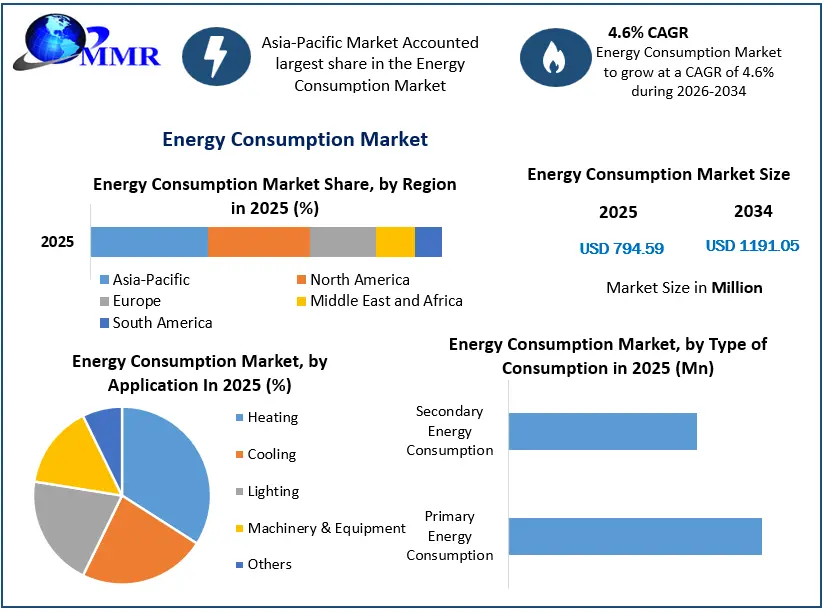
Energy Consumption Market size was valued at USD 794.59 Mn in 2025 and the total revenue is expected to grow at 4.6% through 2026 to 2034, reaching nearly USD 1191.05 Mn.

Energy Consumption Market Overview:

Energy is a critical aspect of any country's economic success. The energy sector is particularly important in emerging countries, given the ever-increasing energy demands that necessitate large stakes to meet. Many forms of energy can be determined such as primary & secondary energy, commercial & non-commercial energy, and renewable & non-renewable energy. In 2022, global energy demand is expected to rise by 4.6%, more than offsetting the 4% decline in 2022 and putting demand 0.5% higher than in 2022. Growth strategies and developing economies are expected to provide for about 70% of the estimated increase in global energy consumption, with demand expected to rise by 3.4 percent above 2022 levels.

Energy Consumption Market Growth Analysis
Energy Consumption Market Growth

To know about the Research Methodology :- Request Free Sample Report

Energy Consumption Market Dynamics:

Over the forecast period, the industrial sector, which contains refining, mining, production, agriculture, and construction, consumes the most energy of any end-use sector, accounting for more than half of total energy consumption. From 2026 and 2032, energy use in the manufacturing sector will increase by far more than 30% as global energy consumption of commodities rises.

Additionally, global energy consumption has increased dramatically during the last century, owing to rising population and income. Demand for practically all energy sources has increased, including coal, oil, natural gas, nuclear power, and biofuels. Such additions to the global energy system reflect a general upward trend in living standards, less global poverty, and longer lifespans.

Increasing fossil fuel usage, on the other hand, is the principal source of global warming and climate change and causes a slew of other serious environmental issues. To meet these difficulties, the global energy system will need to undertake a clean energy transition, in which greenhouse gas-emitting energy sources are gradually replaced by healthier sources.

According to the International Energy Agency (IEA), primary energy consumption in 2022 is expected to fall by 9% for oil, 8% for coal, 5% for natural gas, and 2% for nuclear, while renewable is expected to expand by 1%.

Energy Consumption Market Segment Analysis:

The global energy consumption market is segmented by Energy Source and End User.

Based on the Energy Source, the global energy consumption market is segmented into Fossil Fuels, Electricity, Renewable Energy, and Others. The electricity segment is expected to grow at a higher CAGR of 5.9% in the global energy consumption market during the forecast period. This growth is driven by increasing electrification across industries, transportation, and residential sectors, along with rising adoption of electric vehicles and smart technologies. Additionally, the fossil fuels segment held the largest market share of xx% in 2025, owing to its continued dominance in industrial processes, transportation, and power requirements globally.

Energy Consumption Market Regional Insights:

The Asia Pacific dominates the global energy consumption market during the forecast period 2026-2034. The Asia Pacific held the largest market share of 24% in 2025. More than half of world energy consumption is consumed in the region, with fossil fuels accounting for 85% of that consumption. Even still, one-tenth of the population in this huge area lacks access to electricity, and several rely on traditional biomass cooking and heating methods (such as wood combustion). Energy consumption is rising as a result of rapid urbanization and industrialization, and there are significant changes to prevent long-term reliance on carbon-based energy technology. Together with a lot of renewable energy potential, the region already has a lot of sustainable energy experience and expertise.

Whereas, North America held the second-largest market share of 17% in the global Energy Consumption market in 2025. Rising inhabitants, quick industrialization, and insensitivity on the part of power customers to take required moves to reserve the power are the major operators for the power utilization market. Lowering crude oil depository and reducing power costs are important restraints to the power utilization market. Innovation of new irregular depository of sedimentary gas, tar sands, and sedimentary oil with the potential to satisfy the demand of future power needs are the important changes to the power consumption market. The European Union accounts for 2.5 % depletion in releases in 2025. This was finished by a 14.5% development in sustainable energy creation, with implementation prices lowering down for solar energy and wind. Electric vehicle dealings are also on the rise.

The objective of the report is to present a comprehensive analysis of the global energy consumption market to the stakeholders in the industry. The past and current status of the industry with the forecasted market size and trends are presented in the report with the analysis of complicated data in simple language. The report covers all the aspects of the industry with a dedicated study of key players that include market leaders, followers, and new entrants.

PORTER, PESTEL analysis with the potential impact of micro-economic factors of the market have been presented in the report. External as well as internal factors that are supposed to affect the business positively or negatively have been analyzed, which will give a clear futuristic view of the industry to the decision-makers.

The reports also help in understanding the global energy consumption market dynamic, structure by analyzing the market segments and project the global Energy Consumption Market size. Clear representation of competitive analysis of key players by product, price, financial position, product portfolio, growth strategies, and regional presence in the global energy consumption market make the report investor’s guide.

Energy Consumption Market Recent Industry Developments

Exact Date Company Development Impact
29 January 2026 ABB Announced a strategic collaboration with NVIDIA to support 800 VDC architecture for gigawatt-scale next-generation data centers. Significantly improves energy efficiency in high-demand AI infrastructure, reducing operational power waste.
03 February 2026 Siemens Energy Confirmed an investment of $1 billion in the United States to expand grid technologies and gas service capabilities. Strengthens grid stability and supports the integration of renewable energy to optimize national energy consumption.
23 February 2026 Enel Unveiled a 2026–2028 strategic plan allocating €26 billion to Grids and another €26 billion to integrated renewable businesses. Accelerates decarbonization efforts and enhances digital infrastructure for smarter demand-side energy management.
26 February 2026 Schneider Electric Reported that its Digital Flywheel strategy, focusing on connected software and services, reached €25 billion in revenue for 2025. Demonstrates massive market shift toward software-defined energy management for industrial and building automation.
26 February 2026 Veolia Announced the successful integration of its GreenUp plan, achieving a record 9.4% ROCE driven by energy and water technology demand. Solidifies its position as a leader in environmental security and energy-efficient resource recovery solutions.
06 April 2026 Schneider Electric Hosted the Innovation Summit India 2026, launching new next-generation electrification and automation products for sustainable industries. Drives adoption of AI-powered energy tools in high-growth emerging markets to lower carbon intensity.

Energy Consumption Market Scope: Inquire before buying

Energy Consumption Market
Report Coverage Details
Base Year: 2025 Forecast Period: 2026-2034
Historical Data: 2020 to 2025 Market Size in 2025: 794.59 USD Million
Forecast Period 2026-2034 CAGR: 4.6% Market Size in 2034: 1191.05 USD Million
Segments Covered: by Source Type Fossil Fuels
    Coal
    Oil
    Natural Gas
Renewable Energy
    Solar
    Wind
    Hydropower
    Biomass
    Geothermal
    Others
Nuclear Energy
by Type of Consumption Primary Energy Consumption
Secondary Energy Consumption
by Application Heating
Cooling
Lighting
Machinery & Equipment
Others
by End-User Residential
Commercial
Industrial
Transportation
Agriculture
Others

Energy Consumption Market, by Region

North America (United States, Canada and Mexico)
Europe (UK, France, Germany, Italy, Spain, Sweden, Austria, Turkey, Russia and Rest of Europe)
Asia Pacific (China, India, Japan, South Korea, Australia, ASEAN and Rest of APAC)
Middle East and Africa (South Africa, GCC, Egypt, Nigeria and Rest of ME&A)
South America (Brazil, Argentina, Columbia and Rest of South America)

Energy Consumption Market Key Players

1. Exxon Mobil Corporation
2. evron Corporation.
3. ell plc
4. p.l.c.
5. talEnergies
6. zprom
7. troChina
8. nopec
9. nocoPhillips
10. tate Atomic Energy Corporation Rosatom (Rosatom)
11. estinghouse Electric Company LLC.
12. hina National Nuclear Corporation.
13. extEra Energy
14. berdrola, S.A
15. rsted
16. nel Spa
17. estas
18. irst Solar
19. dani Green Energy
20. TPC Limited
21. eNew Energy
22. hina Huaneng Group
23. EDF
24. Engie SA
25. RWE AG
26. Brookfield Renewable Partners
27. E.ON SE
28. Duke Energy Corporation
29. Southern Company
30. Canadian Solar Inc.
Others

Frequently Asked Questions:

1. Which region has the largest share in Global Energy Consumption Market?
Ans: Asia Pacific region held the highest share in 2025.

2. What is the growth rate of Global Energy Consumption Market?
Ans: The Global Energy Consumption Market is growing at a CAGR of 4.6% during forecasting period 2026-2034.

3. What is scope of the Global Energy Consumption Market report?
Ans: Global Energy Consumption Market report helps with the PESTEL, PORTER, COVID-19 Impact analysis, Recommendations for Investors & Leaders, and market estimation of the forecast period.

4. What is the study period of this Market?
Ans: The Global Energy Consumption Market is studied from 2020 to 2034.

Table of Contents

1. Global Energy Consumption Market: Executive Summary 1.1. Study Assumption and Market Definition 1.2. Scope of the Study 1.3. Executive Summary 1.3.1 Market Size (2025) & Forecast (2026-2032), 1.3.2 Market Size (Value USD) (Volume in TWh) and Market Share (%) - By Segments and Country 2. Global Energy Consumption Market: Competitive Landscapes 2.1. MMR Competition Matrix 2.2. Key Players Benchmarking 2.2.1 Company Name 2.2.2 Headquarters 2.2.3 Product Portfolio 2.2.4 Regulatory & Quality Certifications 2.2.5 Operating Margin (%) 2.2.6 Revenue (USD Billion) – 2025 2.2.7 Market Share (%) – 2025 2.2.8 R&D Investment (%) 2.2.9 Growth Rate (%) 2.2.10 Profit Margin (%) 2.2.11 Technology Integration (%) 2.2.12 Operations Footprint 2.2.13 Sustainability & Compliance Initiatives 2.2.14 Geographic Presence 2.3 Competitive Positioning Of Top Key Players 2.4. Market Structure 2.4.1 Market Leaders 2.4.2 Market Followers 2.4.3 Emerging Players 2.5 Mergers, Acquisitions, and Strategic Deals (2020–2025) 2.5.1 Acquisitions expanding hazardous-area lighting portfolios 2.6.Competitive Landscape of Global Energy Producers 2.6.1 Market Structure and Concentration of Global Energy Production 2.6.2 Major Energy Companies Strategic Portfolio and Resource Ownership 2.6.3 Production Capacity Benchmarking of Global Oil, Gas and Power Producers 2.6.4 Renewable Energy Project Pipelines of Leading Energy Companies 2.6.5 Mergers, Acquisitions and Strategic Alliances in Energy Sector 2.6.6 Company Benchmarking Metrics: Production, Revenue and Market Share 2.7 R&D & Innovation Roadmap 2.7.1 Development of advanced energy storage technologies for grid stability 2.7.2 Research on smart grid and digital energy management systems 2.7.3 Innovation in renewable energy integration including Solar Energy, Wind Energy, and Hydropower 2.7.4 Development of carbon capture and energy efficiency solutions 2.8 Customer Engagement & Long-Term Partnerships 2.8.1 Long-term electricity supply agreements with industrial and commercial users 2.8.2 Strategic partnerships with utilities and independent power producers 2.8.3 Power purchase agreements (PPAs) with corporate renewable energy buyers 2.8.4 Collaboration with governments for clean energy transition programs 2.9 Operational Strategy & Supply Chain Optimization 2.9.1 Expansion of renewable energy generation capacity and infrastructure 2.9.2 Optimization of fuel procurement and energy distribution networks 2.9.3 Digitalization of grid operations and energy monitoring systems 2.9.4 Strengthening supply chains for critical energy components and equipment 2.10 Sustainability & Energy Transition Strategy 2.10.1 Reduction of carbon emissions and implementation of net-zero targets 2.10.2 Investments in clean energy technologies and energy efficiency programs 2.10.3 Adoption of sustainable resource management practices 2.10.4 Integration of energy storage and smart grid technologies 3. Global Energy Consumption Market: Dynamics 3.1. Global Energy Consumption Market Trends 3.2. Global Energy Consumption Market Dynamics 3.2.1 Drivers 3.2.2 Restraints 3.2.3 Opportunities 3.2.4 Challenges 3.3. PORTER’s Five Forces Analysis 3.4. PESTLE Analysis 5. Global Energy System Evolution and Structural Transformation 5.1 Historical Evolution of Global Energy Consumption Systems (2020–2025) 5.2 Industrialization and Rapid Energy Demand Growth in Emerging Economies 5.3 Transition from Coal-Dominant Systems to Diversified Energy Mix 5.4 Growth of Renewable Energy Technologies in Global Energy Systems 5.5 Global Energy Mix Transformation and Decarbonization Trends 5.6 Fossil Fuel Consumption Trends Across Major Global Economies 5.7 Expansion of Renewable Energy Sources in Electricity Generation 5.8 Nuclear Energy’s Role in Low-Carbon Electricity Production Systems 5.9 Electrification Trends Across Industrial, Commercial and Residential Sectors 5.10 Electrification of Transportation Through Electric Vehicle Adoption 5.11 Industrial Electrification Replacing Fossil-Based Heat Generation Processes 5.12 Electrification of Residential Heating Through Heat Pump Systems 5.13 Energy Demand Drivers Including Urbanization and Population Growth 5.14 Decoupling Economic Growth from Energy Consumption Intensity 5. Global Energy Production and Supply Infrastructure Ecosystem 5.1 Energy Production Value Chain from Extraction to Final Consumption 5.2 Global Energy Infrastructure Footprint by Resource and Region 5.3 Oil Production Infrastructure and Strategic Export Corridors 5.4 Major Oil Producing Regions and Offshore Production Systems 5.5 Pipeline Networks and Crude Oil Transportation Infrastructure 5.6 Natural Gas Production Infrastructure and LNG Supply Chains 5.7 Liquefaction Facilities and LNG Export Terminal Development 5.8 Regasification Terminals and International LNG Trade Corridors 5.9 Coal Mining Infrastructure and Thermal Power Plant Distribution 5.10 Global Coal Mining Production Clusters and Export Supply Routes 5.11 Coal Transportation Logistics Including Rail and Port Systems 5.12 Renewable Energy Generation Infrastructure Across Key Regions 5.13 Utility-Scale Solar Farms and Photovoltaic Technology Deployment 5.14 Onshore and Offshore Wind Energy Project Development 5.15 Hydropower Generation Systems and Reservoir Infrastructure 5.16 Electricity Transmission and Distribution Network Infrastructure 5.17 Energy Storage Infrastructure and Grid Balancing Systems 5.18 Supply Chain Risks Including Geopolitical and Resource Constraints 6:Global Energy Consumption by Energy Source 6.1 Fossil Fuel Energy Consumption Across Industrial and Transport Systems 6.2 Oil Consumption Trends in Transportation and Industrial Applications 6.3 Natural Gas Consumption in Electricity Generation and Industry 6.4 Coal Consumption in Power Generation and Heavy Industry 6.5 Electricity Consumption Growth Driven by Electrification and Digitalization 6.6 Renewable Energy Consumption Across Industrial and Residential Sectors 6.7 Nuclear Energy Contribution to Low-Carbon Electricity Consumption 6.8 Hydrogen and Emerging Alternative Energy Carriers Consumption Growth 6.9 Comparative Carbon Intensity and Efficiency of Energy Sources 7 Sectoral Energy Consumption Analysis 7.1 Industrial Energy Consumption Across Manufacturing and Heavy Industries 7.2 Energy Consumption in Steel, Cement and Chemical Production 7.3 High-Temperature Industrial Heat Demand and Energy Sources 7.4 Electrification Potential of Energy-Intensive Industrial Processes 7.5 Energy Demand in Petrochemical and Oil Refining Operations 7.6 Refinery Process Energy Consumption and Optimization Opportunities 7.7 Integration of Renewable Power into Petrochemical Manufacturing 7.8 Residential Energy Consumption and Household Energy Demand Drivers 7.9 Commercial Building Energy Consumption and Urban Infrastructure Systems 7.10 Transportation Energy Demand Across Road, Aviation and Maritime Systems 7.11 Agricultural Energy Consumption and Mechanization Energy Requirements 7.12 Digital Infrastructure Energy Consumption Including Data Centers 8. Regional Energy Consumption Landscape 8.1 North America Energy Consumption Patterns and Infrastructure Capacity 8.2 Europe Energy Consumption Trends and Decarbonization Policy Impact 8.3 Asia Pacific Energy Demand Growth Driven by Industrial Expansion 8.4 Middle East Energy Consumption Dynamics and Resource Dependency 8.5 South America Energy Consumption and Renewable Energy Integration 8.6 Africa Energy Access Expansion and Consumption Growth Opportunities 9.Country-Level Energy Consumption Deep-Dive 9.1 United States Energy Consumption Structure Across Major End-Use Sectors 9.2 China Energy Consumption Expansion Driven by Industrial Growth 9.3 India Energy Consumption Growth and Electrification Initiatives 9.4 Germany Energy Transition and Industrial Energy Demand Shifts 9.5 Japan Energy Consumption Adjustment Following Nuclear Policy Changes 9.6 Emerging Southeast Asian Economies as Future Energy Demand Hubs 10.Energy Consumption Forecast and Scenario Modeling 10.1 Base Case Global Energy Demand Forecast Under Economic Growth 10.2 Accelerated Energy Transition Scenario with Rapid Renewable Adoption 10.3 Delayed Transition Scenario with Continued Fossil Fuel Dominance 10.4 Sectoral Energy Consumption Forecast Across Major Industrial Sectors 10.5 Regional Energy Demand Growth Driven by Urbanization and Electrification 10.6 Energy Efficiency Improvements Impact on Future Energy Demand 11.Energy Pricing, Cost Structures and Market Intelligence 11.1 Global Energy Price Benchmarking Across Major Fuel Types 11.2 Electricity Tariff Structures Across Regulated and Competitive Markets 11.3 Fossil Fuel Price Volatility and Global Supply Dynamics 11.4 Renewable Energy Cost Curve Evolution and Technology Learning Effects 11.5 Industrial Energy Cost Structures and Manufacturing Competitiveness 11.6 Long-Term Energy Price Forecast Under Carbon Pricing Mechanisms 12.Energy Trade and Import–Export Intelligence (2025) 12.1 Global Energy Trade Flow Mapping and Strategic Supply Routes 12.2 Oil and Gas Export Corridors and International Energy Trade Alliances 12.3 LNG Trade Expansion and Regasification Infrastructure Development 12.4 Electricity Cross-Border Trade and Regional Power Pool Systems 12.5 Strategic Energy Import Dependency Across Major Global Economies 12.6 Trade Barriers, Tariffs and Geopolitical Energy Supply Risks 13.Global Energy Infrastructure Investment Landscape 13.1 Capital Investment in Power Generation Infrastructure Worldwide 13.2 Renewable Energy Project Financing and Investment Mechanisms 13.3 Grid Modernization and Smart Grid Infrastructure Development 13.4 Energy Storage Investment Trends and Battery Deployment Growth 13.5 Sovereign Wealth Funds and Private Equity Energy Investments 13.6 Infrastructure Financing Risks and Investment Return Expectations 14.Energy Efficiency and Demand-Side Management Systems 14.1 Industrial Energy Efficiency Technologies in Manufacturing Facilities 14.2 Building Energy Efficiency Technologies and Smart Energy Management 14.3 Demand Response Programs and Grid Load Balancing Mechanisms 14.4 Energy Monitoring Platforms and Digital Consumption Optimization 14.5 Policy Incentives Encouraging Energy Efficiency Adoption 14.6 Industrial Energy Productivity Improvements and Process Optimization 15: Digitalization and Smart Energy Systems 15.1 Smart Grid Infrastructure and Real-Time Energy Monitoring Systems 15.2 Artificial Intelligence Applications in Energy Demand Forecasting 15.3 Internet of Things Integration in Energy Consumption Optimization 15.4 Blockchain-Based Energy Trading and Decentralized Energy Markets 15.5 Digital Twins and Predictive Maintenance for Energy Infrastructure 16.Renewable Energy Integration into Consumption Systems 16.1 Solar Energy Integration into Grid and Distributed Systems 16.2 Wind Energy Contribution to National Electricity Consumption Mix 16.3 Hydropower Role in Long-Term Renewable Energy Stability 16.4 Bioenergy Consumption Growth Across Industrial and Transport Sectors 16.5 Energy Storage Systems Supporting Renewable Integration 16.6 Hybrid Energy Systems Combining Multiple Renewable Technologies 17.Decarbonization and Energy Transition Strategies 17.1 Global Net-Zero Emission Commitments and Policy Targets 17.2 Carbon Capture Utilization and Storage Technology Deployment 17.3 Hydrogen Economy Development and Clean Hydrogen Infrastructure 17.4 Industrial Decarbonization Through Electrification and Fuel Switching 17.5 Carbon Pricing Mechanisms and Emissions Trading Systems 17.6 Energy Transition Roadmaps Across Major Global Economies 18: Environmental Impact and Sustainability Assessment 18.1 Carbon Emissions from Global Energy Consumption Systems 18.2 Environmental Impact of Fossil Fuel Extraction and Combustion 18.3 Water Consumption Footprint of Energy Production Systems 18.4 Life-Cycle Environmental Impact of Renewable Energy Technologies 18.5 Climate Change Risks Affecting Energy Infrastructure and Demand 18.6 ESG Benchmarking of Energy Companies and Sustainability Metrics 19.Emerging Energy Technologies and Innovation Landscape 19.1 Advanced Nuclear Reactor Technologies Including Small Modular Reactors 19.2 Green Hydrogen Production Technologies and Infrastructure Development 19.3 Synthetic Fuels and Alternative Energy Carriers for Hard-to-Abate Sectors 19.4 Advanced Energy Storage Materials and High-Density Battery Systems 19.5 AI and Data Analytics for Energy System Optimization 19.6 Breakthrough Technologies Reshaping Future Energy Consumption Systems 20. Global Power Generation Infrastructure and Capacity Landscape 20.1 Global Installed Power Generation Capacity by Source and Region 20.2 Thermal Power Generation Capacity and Fleet Modernization Trends 20.3 Renewable Power Generation Capacity Expansion and Grid Integration 20.4 Nuclear Power Generation Infrastructure Development 20.5 Utility-Scale Power Plant Development and Capacity Additions 20.6 Distributed Energy Generation and Decentralized Power Systems 20.7 Baseload, Peak Load and Flexible Generation Capacity Analysis 20.8 Global Power Generation Outlook and Future Capacity Pipeline 21. High Voltage (HV) Substation and Transmission Infrastructure Analysis 21.1 Global HV and EHV Substation Infrastructure Landscape 21.2 Transmission Network Expansion and Grid Interconnection Projects 21.3 Air-Insulated vs Gas-Insulated Substation Deployment Analysis 21.4 Digital Substations and Intelligent Grid Infrastructure Development 21.5 HVDC and HVAC Transmission Network Evolution 21.6 Substation Automation and Protection System Technologies 21.7 Renewable Energy Integration Through Transmission Infrastructure 21.8 Substation Modernization, Upgrade and Asset Replacement Programs 21.9 Grid Reliability, Stability and Power Quality Enhancement Systems 22. Artificial Intelligence (AI) in Energy and Power Systems 22.1 AI Adoption Trends Across Global Energy Infrastructure 22.2 AI-Based Power Generation Forecasting and Optimization 22.3 Machine Learning Applications in Renewable Energy Forecasting 22.4 AI-Driven Grid Load Forecasting and Demand Prediction 22.5 Predictive Maintenance for Power Plants and HV Substations 22.6 AI-Based Asset Health Monitoring and Failure Detection 22.7 Digital Twins for Power Generation and Transmission Assets 22.8 Autonomous Grid Management and Self-Healing Network Technologies 22.9 AI Applications in Energy Trading and Dispatch Optimization 22.10 Cybersecurity Enhancement Through AI-Based Monitoring Systems 23. Smart Grid and Intelligent Power Network Transformation 23.1 Smart Grid Infrastructure Development Across Major Economies 23.2 Advanced Metering Infrastructure and Real-Time Energy Monitoring 23.3 Grid Automation and Intelligent Distribution Networks 23.4 Demand Response Systems and Load Management Technologies 23.5 Distributed Energy Resource Management Systems (DERMS) 23.6 Virtual Power Plants and Aggregated Energy Resource Platforms 23.7 Edge Computing and IoT Integration in Smart Energy Networks 23.8 Future Roadmap for Intelligent and Autonomous Power Systems 24. Global Energy Consumption Market: Market Size and Forecast by Segmentation (by Value in USD Billion and Volume in TWh) (2025-2032) 24.1. Global Energy Consumption Market Size and Forecast, By Source Type 24.1.1 (2025-2032) 24.1.2 Fossil Fuels 24.1.3 Coal 24.1.4 Oil 24.1.5 Natural Gas 24.1.6 Renewable Energy 24.1.7 Solar 24.1.8 Wind 24.1.9 Hydropower 24.1.10 Biomass 24.1.11 Geothermal 24.1.12 Others 24.1.13 Nuclear Energy 24.2. Global Energy Consumption Market Size and Forecast, By Type of Consumption (2025-2032) 24.2.1 Primary Energy Consumption 24.2.2 Secondary Energy Consumption 24.3. Global Energy Consumption Market Size and Forecast, By Application (2025-2032) 24.3.1 Heating 24.3.2 Cooling 24.3.3 Lighting 24.3.4 Machinery & Equipment 24.3.5 Others 24.4. Global Energy Consumption Market Size and Forecast, By End-User (2025-2032) 24.4.1 Residential 24.4.2 Commercial 24.4.3 Industrial 24.4.4 Transportation 24.4.5 Agriculture 24.4.6 Others 24.5. Global Energy Consumption Market Size and Forecast, by Region (2025-2032) 24.5.1 North America 24.5.2 United States 24.5.3 Canada 24.5.4 Mexico 24.5.5 Europe 24.5.6 United Kingdom 24.5.7 France 24.5.8 Germany 24.5.9 Italy 24.5.10 Spain 24.5.11 Sweden 24.5.12 Russia 24.5.13 Rest of Europe 24.5.14 Asia Pacific 24.5.15 China 24.5.16 S. Korea 24.5.17 India 24.5.18 Japan 24.5.19 Australia 24.5.20 Indonesia 24.5.21 Philippines 24.5.22 Malaysia 24.5.23 Vietnam 24.5.24 Thailand 24.5.25 Rest of Asia Pacific 24.5.26 Middle East and Africa 24.5.27 South Africa 24.5.28 GCC 24.5.29 Egypt 24.5.30 Nigeria 24.5.31 Rest of ME&A 24.5.32 South America 24.5.33 Brazil 24.5.34 Argentina 24.5.35 Chile 24.5.36 Colombia 24.5.37 Rest Of South America 25 Company Profile: Key Players 25.1 1. Exxon Mobil Corporation 25.1.1 Company Overview 25.1.2 Business Portfolio 25.1.3 Financial Overview 25.1.4 SWOT Analysis 25.1.5 Strategic Analysis 25.1.6 Recent Developments 25.2. Chevron Corporation. 25.3. Shell plc 25.4. BP p.l.c. 25.5. TotalEnergies 25.6. Gazprom 25.7. PetroChina 25.8. Sinopec 25.9. ConocoPhillips 25.10. State Atomic Energy Corporation Rosatom (Rosatom) 25.11. Westinghouse Electric Company LLC. 25.12. China National Nuclear Corporation. 25.13. NextEra Energy 25.14. Iberdrola, S.A 25.15. Ørsted 25.16. Enel Spa 25.17. Vestas 25.18. First Solar 25.19. Adani Green Energy 25.20. NTPC Limited 25.21. ReNew Energy 25.22. China Huaneng Group 25.23.EDF 25.24.Engie SA 25.25.RWE AG 25.26.Brookfield Renewable Partners 25.27.E.ON SE 25.28.Duke Energy Corporation 25.29.Southern Company 25.30.Canadian Solar Inc. 25.30.1 Others 26. Key Findings 27. Analyst Recommendations 28. Global Energy Consumption Market: Research Methodology

Custom Market Research Services

We Will Customise The Research For You, In Case The Report Listed Above Does Not Meet With Your Requirements