
Acrylonitrile Butadiene Styrene Market Size – Industry Structure Evaluation, Demand Drivers Analysis, Regional Growth Analysis and Identification, Competitive Positioning Review & Global Market Size Forecast to 2034
Overview
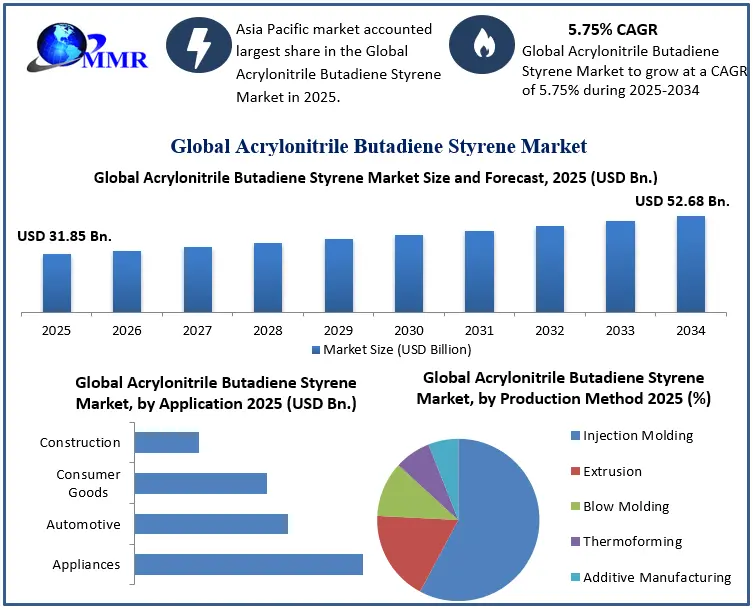
Global Acrylonitrile Butadiene Styrene (ABS) Market was valued USD 31.85 Bn. in 2025 and is expected to reach 52.68 Bn. by 2034, at a CAGR of 5.75% during a forecast period.
Global Acrylonitrile Butadiene Styrene Market Overview:
Acrylonitrile Butadiene Styrene (ABS) is a widely used engineering thermoplastic made from acrylonitrile, butadiene, and styrene. It is valued for its high impact strength, toughness, rigidity, good surface finish, dimensional stability, and easy processing. ABS is used to manufacture automotive parts, electronic housings, appliances, toys, consumer products, electrical components, pipes and fittings, and 3D-printing materials. Its balance of performance and cost makes it an important material for manufacturers looking for durable and lightweight plastic solutions.
The Acrylonitrile Butadiene Styrene market is expanding with increasing demand from the automotive, electronics, electrical, appliances, construction, and consumer goods industries. Automotive manufacturers use Acrylonitrile Butadiene Styrene for interior and trim components, while electronics and appliance manufacturers use it for housings and structural parts. Asia Pacific remains an important production and consumption region because of its strong manufacturing base, particularly in China, Japan, South Korea, and India. Leading companies such as LG Chem, SABIC, INEOS Styrolution, CHIMEI, and Formosa Chemicals & Fibre are active in the ABS and styrenic polymers industry. Government and industry data, including material information published by the U.S. Environmental Protection Agency (EPA), also identifies automotive parts, appliances, electronics, telecommunications equipment, toys, and other molded products as established ABS applications.
MMR's Acrylonitrile Butadiene Styrene (ABS) Market research provides clients with a detailed understanding of ABS market trends, market segmentation, regional demand, competitive landscape, application areas, and growth opportunities. The study evaluates developments such as automotive lightweighting, electric vehicles, electronic devices, smart appliances, specialty ABS grades, flame-retardant ABS, high-heat ABS, recycled ABS, and advanced plastics processing. It also helps identify opportunities in emerging manufacturing markets and higher-performance ABS applications. This research gives businesses useful insights for investment planning, product development, market entry, capacity expansion, competitive analysis, and strategic decision-making.
Global Acrylonitrile Butadiene Styrene Market Growth Outlook
To know about the Research Methodology :- Request Free Sample Report
Global Acrylonitrile Butadiene Styrene Dynamics
Global Acrylonitrile Butadiene Styrene Drivers
The global Acrylonitrile Butadiene Styrene (ABS) market is increasing demand for lightweight, durable, and cost-effective engineering plastics across automotive, appliances, electronics, consumer goods, and industrial applications. Acrylonitrile Butadiene offers a useful combination of impact resistance, rigidity, dimensional stability, attractive surface finish, and processing flexibility, allowing manufacturers to produce complex molded components efficiently. Automotive manufacturers are using Acrylonitrile Butadiene and ABS-based compounds for interior parts, trims, housings, instrument panels, and other components as they focus on reducing component weight while maintaining durability. Growth in consumer electronics, household appliances, electrical equipment, and durable consumer products is also generating steady demand for Acrylonitrile Butadiene housings and structural components. Expanding plastics processing capacity in Asia Pacific and the increasing production of automobiles, appliances, and electronic products in emerging manufacturing economies are further supporting Acrylonitrile Butadiene consumption.
Global Acrylonitrile Butadiene Styrene Restraints
One of the key restraints for the Acrylonitrile Butadiene market is the fluctuating cost and availability of its primary feedstocks, including acrylonitrile, butadiene, and styrene. Changes in crude oil and petrochemical markets can influence raw material costs and create uncertainty for resin producers and downstream manufacturers Acrylonitrile Butadiene also faces increasing environmental scrutiny because conventional grades are primarily derived from fossil-based feedstocks and can be difficult to manage at the end of their useful life when compared with some simpler plastic streams. Manufacturers and brand owners are under growing pressure to reduce virgin plastic consumption, improve recycled content, and meet sustainability targets. In addition, competition from alternative engineering plastics and polymer blends can limit Acrylonitrile Butadiene Styrene adoption when customers require higher heat resistance, chemical resistance, lower density, or other specialized performance characteristics.
Global Acrylonitrile Butadiene Styrene Opportunities
The growth of electric vehicles creates opportunities for Acrylonitrile Butadiene in interior components, electrical housings, charging-related equipment, and other non-structural applications where a balance of weight, appearance, insulation, and durability is required. Another emerging opportunity is the development of recycled Acrylonitrile Butadiene and improved recycling systems that can return post-industrial and post-consumer material to suitable applications. Growing electronics and appliance manufacturing in Asia Pacific, together with increasing demand for customized polymer compounds, can also create opportunities for Acrylonitrile Butadiene producers and compounders to develop application-specific solutions.
Global Acrylonitrile Butadiene Styrene Challenges
The Acrylonitrile Butadiene industry faces increasing competition from polycarbonate, polypropylene, polyamide, PC/ABS blends, and other engineering plastics, with material selection increasingly based on the complete performance and cost requirements of each application. Manufacturers must demonstrate that Acrylonitrile Butadiene can deliver the required combination of strength, appearance, thermal performance, chemical resistance, processing efficiency, and durability while remaining commercially competitive. Sustainability is another major challenge as customers increasingly evaluate recycled content, product recyclability, material efficiency, and environmental impact during procurement decisions. Acrylonitrile Butadiene Styrene producers also need to manage fluctuations in petrochemical feedstock prices, supply-chain disruptions, changing customer specifications, and regional regulatory requirements. Developing new grades that meet both technical performance expectations and sustainability objectives while maintaining consistent quality and competitive pricing will remain an important challenge for market participants.
Global Acrylonitrile Butadiene Market Key Trends:
| Key Trend | Description |
| Rising use of recycled ABS | Manufacturers increasingly use recycled ABS in automotive interiors, electronic housings, appliances, and consumer products. Buyers now look for recycled content without sacrificing impact strength, appearance, and processing performance. This shift supports the growth of higher quality recycled ABS grades. |
| Growing demand from electric vehicles | EV manufacturers continue to use ABS for interior components, housings, trims, and other lightweight parts. Material suppliers are developing grades that combine low weight, impact resistance, dimensional stability, and surface quality for changing automotive requirements. |
| Growth of sustainable material solutions | ABS producers are investing more attention in recycled and partially renewable material and brand owners set sustainability targets. This trend encourages suppliers to improve material traceability, recycling processes, and recycled content consistency. |
| More interest in 3D printing applications | ABS remains an important material for 3D printing because it offers useful strength, durability, and heat resistance. |
Global Acrylonitrile Butadiene Styrene Segment Analysis
Global Acrylonitrile Butadiene Styrene Segment Analysis, by Application
By application, the appliances segment currently shows strong market traction because ABS combines impact resistance, dimensional stability, surface finish, and efficient molding for refrigerators, washing machines, air conditioners, vacuum cleaners, and other household products. Automotive remains an important and increasingly performance driven application, particularly for interior trims, dashboards, panels, and protective housings where manufacturers seek lightweight materials with consistent appearance and durability. Consumer goods maintain steady ABS demand across toys, luggage, sports equipment, furniture components, and personal products because manufacturers value design flexibility and cost effective processing. Construction represents a more specialized application, with ABS supporting pipes, fittings, panels, and protective components where impact resistance and durability matter. Current market research places appliances among the leading ABS applications, while automotive continues to attract demand through lightweight vehicle design and expanding vehicle production.
Global Acrylonitrile Butadiene Styrene Segment Analysis, by Production Method
By production method, injection molding currently represents the leading processing route for ABS because manufacturers use it extensively for high volume components such as automotive parts, appliance housings, electronic enclosures, and consumer products. Extrusion maintains steady demand for ABS sheets, profiles, trims, and continuous components where manufacturers require consistent dimensions and surface quality. Blow molding serves a smaller but specialized market for selected hollow and lightweight components that require impact resistance and structural consistency. Thermoforming supports ABS sheet applications such as equipment covers, interior panels, trays, and protective components, with manufacturers focusing on easy forming and uniform thickness. Additive manufacturing represents a developing application area, particularly for prototypes, customized parts, functional models, and limited production volumes, as improvements in ABS filament quality and printing performance expand its use beyond basic prototyping.
Global Acrylonitrile Butadiene Styrene Regional Analysis
Asia Pacific is the leading Acrylonitrile Butadiene Styrene market in extensive automotive, consumer electronics, electrical equipment, appliance, and plastics manufacturing base. China represents a major demand center, while India and Southeast Asian manufacturing economies are adding demand for Acrylonitrile Butadiene Styrene in consumer products, automotive components and electrical applications. Recent industry research consistently identifies Asia Pacific as the leading ABS-producing or consuming region, although the reported percentage varies according to whether the study measures revenue, volume, Acrylonitrile Butadiene Styrene resin, or Acrylonitrile Butadiene Styrene combined with SAN.
North America represents a substantial portion of Acrylonitrile Butadiene Styrene demand, supported by automotive components, appliances, electronics, industrial equipment and durable consumer products. Demand is also shifting toward specialty Acrylonitrile Butadiene Styrene grades, flame-retardant materials and higher-performance compounds where manufacturers require specific thermal, mechanical and safety properties.
Europe maintains strong Acrylonitrile Butadiene Styrene consumption across automotive, electrical and electronics, appliances, construction and industrial manufacturing. The region's market is increasingly influenced by material efficiency, recycled-content requirements and the development of more sustainable polymer solutions. Acrylonitrile Butadiene Styrene and PC-ABS materials remain relevant for automotive and electrical applications where surface quality and dimensional stability are important.
South America represents a smaller but established Acrylonitrile Butadiene Styrene market, with demand linked mainly to automotive production, household appliances, electronics, consumer goods and plastics processing. Growth opportunities are connected to expanding domestic manufacturing and increasing use of engineered plastics in durable products.
Middle East & Africa is the smaller share of ABS consumption but has opportunities associated with construction, electrical equipment, appliances, automotive components and consumer products. Market development is also influenced by the region's dependence on imported polymer grades and the expansion of downstream plastics-processing industries.
Global Acrylonitrile Butadiene Styrene Competitive Landscape
The ABS market is characterized by competition based on product consistency, grade development, application-specific performance, processing suitability, and supply capabilities rather than on commodity ABS alone. Major producers such as LG Chem, INEOS Styrolution, CHIMEI, SABIC, Formosa Chemicals & Fibre, and other regional suppliers are expanding their ABS portfolios to address different requirements across automotive, appliances, electronics, medical products, and consumer goods. LG Chem offers ABS for automotive, home appliances, and IT applications, while INEOS Styrolution provides multiple ABS grades for injection molding, extrusion, thermoforming, high-heat applications, medical components, and specialty surface requirements. Competition is also shifting toward customized grades that combine impact resistance, heat resistance, surface quality, dimensional stability, and processing performance, while sustainable ABS solutions and application-specific materials are becoming additional areas of product development.
Global Acrylonitrile Butadiene Styrene Recent Development:
| Month | Company | Recent development |
| January 2026 | SABIC | SABIC announced the sale of its Engineering Thermoplastics business in the Americas and Europe to Mutares. The business includes ABS resin and compounds, along with other engineering thermoplastics. |
| February 2026 | CHIMEI | CHIMEI joined a global renewable plastics supply chain connected with Sony and other partners. The initiative includes renewable PC and PC ABS materials for future high performance audio visual products. |
| February 2026 | Formosa Chemicals and Fibre | Formosa Chemicals and Fibre joined the renewable plastics supply chain for Sony products and contributed renewable polystyrene resin to the supply chain. |
| February 2026 | SABIC | SABIC presented advanced material solutions at PlastIndia 2026 and highlighted materials supporting electrification, lightweighting, infrastructure and sustainability. |
| March 2026 | INEOS Styrolution | INEOS Styrolution introduced tighter order controls for styrenics including ABS amid difficult market conditions and supply pressure. |
| April 2026 | Formosa Chemicals and Fibre | Formosa Chemicals and Fibre published technical guidance comparing ABS with ASA ABS and ASA materials, highlighting material selection for different performance requirements. |
| April 2026 | INEOS Styrolution | INEOS Styrolution announced substantial price increases for ABS and other styrene copolymers in response to higher feedstock costs and market conditions. |
| May 2026 | SABIC | SABIC continued its product and portfolio development strategy with a focus on specialty materials and higher value applications. Its 2026 product portfolio includes ABS grades for automotive, electronics, appliances and industrial applications. |
| June 2026 | LG Chem | LG Chem announced a plan to invest KRW 15 trillion in research and development, with mobility and advanced materials among its strategic focus areas. |
| July 2026 | Formosa Chemicals and Fibre | Formosa Chemicals and Fibre announced changes to its ABS product packaging for the Indian market following the removal of the BIS certification requirement for imported ABS products. |
| September 2026 | SABIC | SABIC continued its strategic collaboration activity in advanced materials and signed an MoU with Lenovo to explore opportunities for industrial innovation. |
Acrylonitrile Butadiene Styrene Market Scope: Inquire before buying
| Global Acrylonitrile Butadiene Styrene Market | |||
|---|---|---|---|
| Report Coverage | Details | ||
| Base Year: | 2025 | Forecast Period: | 2026-2034 |
| Historical Data: | 2020 to 2025 | Market Size in 2025: | US $ 31.85 Bn. |
| Forecast Period 2026 to 2034 CAGR: | 5.75% | Market Size in 2034: | US $52.68 Bn. |
| Segments Covered: | by Component Form | Housings & Enclosures Interior Components Structural & Support Parts Profiles & Fittings Customized Components |
|
| by Production Method | Injection Molding Extrusion Blow Molding Thermoforming Additive Manufacturing |
||
| by Application | Appliances Automotive Consumer Goods Construction |
||
Acrylonitrile Butadiene Styrene Market, by Region
North America (United States, Canada and Mexico)
Europe (UK, France, Germany, Italy, Spain, Sweden, Austria and Rest of Europe)
Asia Pacific (China, South Korea, Japan, India, Australia, Indonesia, Malaysia, Vietnam, Taiwan, Bangladesh, Pakistan and Rest of APAC)
Middle East and Africa (South Africa, GCC, Egypt, Nigeria and Rest of ME&A)
South America (Brazil, Argentina Rest of South America)
Global Acrylonitrile Butadiene Styrene Market Key Players
1. LG Chem Ltd. South Korea
2. CHIMEI Corporation Taiwan
3. INEOS Styrolution Group GmbH Germany
4. Formosa Chemicals and Fibre Corporation Taiwan
5. SABIC Saudi Arabia
6. Toray Industries Inc. Japan
7. Kumho Petrochemical Co. Ltd. South Korea
8. Trinseo PLC United States
9. BASF SE Germany
10. Mitsui Chemicals Inc. Japan
11. Lotte Chemical Corporation South Korea
12. PetroChina Company Limited China
13. Techno UMG Co. Ltd. Japan
14. Tianjin Dagu Chemical Co. Ltd. China
15. Shanghai Gaoqiao Petrochemical Company China
16. IRPC Public Company Limited Thailand
17. Versalis SpA Italy
18. Covestro AG Germany
19. Asahi Kasei Corporation Japan
20. Nippon A and L Inc. Japan
21. JSR Corporation Japan
22. Shandong INEOS YPC China
23. Bhansali Engineering Polymers Limited India
24. ELIX Polymers Spain
25. RTP Company United States
26. Ravago Americas United States
27. Avient Corporation United States
28. Grand Pacific Petrochemical Corporation Taiwan
29. Supreme Petrochem Limited India
30. Taita Chemical Company Limited Taiwan
31. Keyuan Holding Group Co. Ltd. China
32. Liaoning Kingfa Advanced Materials Co. Ltd. China
33. Shandong Yulong Petrochemical Co. Ltd. China
34. Sinochem Holdings Corporation Ltd. China
35. Ghaed Basir Petrochemical Products Company Iran
36. Tabriz Petrochemical Company Iran
37. JAM Petrochemical Company Iran
38. The Iran Petrochemical Commercial Company Iran
39. Entec Polymers United States
40. Röchling SE and Co. KG Germany
Global Acrylonitrile Butadiene Styrene - Frequently Asked Questions
1. Which region has the largest share in the Global ABS Market?
Ans: Asia Pacific held the largest share in 2025.
2. What is the growth rate of the Global ABS Market?
Ans: The Global ABS Market is growing at a CAGR of 5.75% during 2025–2034.
3. What is the scope of the Global ABS Market report?
Ans: The report covers market analysis, segmentation, regional analysis, competitive landscape, and forecasts.
4. Who are the key players in the Global ABS Market?
Ans: Key players include LG Chem, CHIMEI, INEOS Styrolution, Formosa Chemicals & Fibre, SABIC, Toray Industries, Kumho Petrochemical, Trinseo, and BASF.
5. What is the study period of the Global ABS Market?
Ans: The Global ABS Market is studied from 2025 to 2034.