Acrylic Adhesives Market by Technology, Type, Application and Region – Global Market Size Estimation, Industry-Wide Analysis, Competitive Landscape Assessment & Long-Term Forecast to 2034

5.81%
CAGR (2026-2034)
13.88 USD Bn.
Forecast Market Size
309
Report Pages
147
Market Tables

Overview

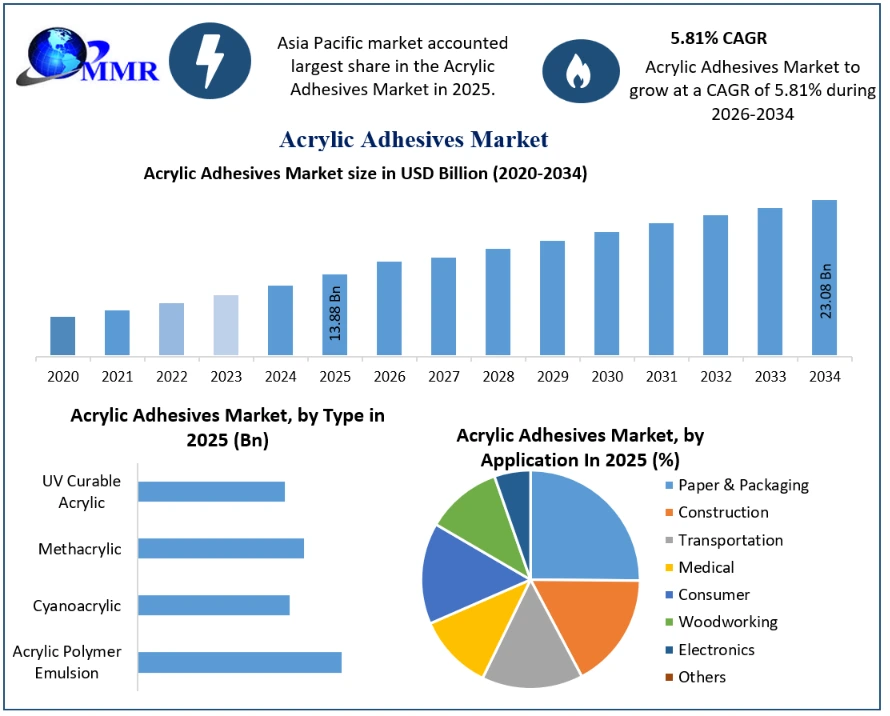
The Acrylic Adhesives Market size was valued at USD 13.88 Billion in 2025 and the total Acrylic Adhesives revenue is expected to grow at a CAGR of 5.81% from 2026 to 2034, reaching nearly USD 23.08 Billion.

Acrylic Adhesives Market Overview:

Acrylic Adhesives Market is expected to reach US$ 23.08 Bn. by 2034. A two-part, resin-based glue made of acrylic or methylacrylic polymers is known as an acrylic adhesive (also known as methyl methacrylate, acrylate, or MMA). They are very resistant to the effects of the environment, exceedingly strong, and effective at joining many items together.

This report focuses on the different segments of the Acrylic Adhesives market (Technology, Type, Application, and Region). In this report, the top industry participants and regions are in-depthly investigated (North America, Asia Pacific, Europe, Middle East & Africa, and South America). It is an in-depth analysis of the several sectors' fast advancements in the modern era. The primary data analysis from 2020 to 2025 is highlighted through numbers, visualisations, and presentations. The market drivers, restraints, opportunities, and challenges for Acrylic Adhesives are examined in this report. The MMR report's investment suggestions are based on a thorough examination of the current competitive environment in the Acrylic Adhesives market.

Acrylic Adhesives Market Growth Outlook
Acrylic Adhesives Market Growth

To know about the Research Methodology :- Request Free Sample Report

Acrylic Adhesives Market Dynamics:

One of the key factors driving market growth is extensive R&D activity and ongoing innovations. Acrylic adhesives have distinguishing qualities including high performance and the capacity to be used in a variety of end-use industries, including the construction, packaging, and pharmaceutical sectors.

Manufacturers of acrylic adhesive are expected to continue to focus heavily on Asia Pacific. It is expected that economic performance will improve in Europe and North America, driving increasing investments in manufacturing and industrial activity. On the other hand, it is expected that the market in China and Japan would experience increased levels of growth during the forecast period.

The U.S. Food and Drug Administration (FDA) developed regulations for the food industry that include functional barriers between food products and the materials used to package them. These regulations help to improve food safety, create a longer shelf life, and maintain the food products' quality. Companies in the industry are increasingly concentrating on creating food-grade packaging materials that abide by regional government rules.

Due to concerns about skin irritation after use, the Centre for Food Safety and Applied Nutrition established the maximum permitted quantity of Alfa Hydroxy Acids components in the cosmetics sector. As a result, it is now required to specify AHA content on packages that are identical, giving accurate information about skin sensitivity from sunburn. As a result, the need for acrylic adhesives in the labelling industry is increasing.

The product is in high demand from emerging economies as a result of technological improvements, growing globalisation, and the use of environmentally friendly adhesives. Operations in the construction, aerospace, and automotive sectors that are technologically sophisticated and economical are expected to boost market growth.

Acrylic adhesives are primarily utilised for hard disc drives and touchscreen displays in the electronics industry, where there is a growing demand for automation and shrinking. Pressure-sensitive adhesives are utilised for hard disc drives' permanent and easily removable labels, filters, and seals, as well as dampening and component assembly needs. They are also utilised in the manufacturing of voice coil motor magnets.

The Acrylic Adhesives market increasing growth is expected to be hampered by fluctuating raw material prices and stringent environmental and safety standards. Aside from them, the market is being prevented from reaching its full potential by tight certifications by OEMs and component manufacturers. R&D costs are much greater than in other sectors.

Acrylic Adhesives Market Segment Analysis:

The Acrylic Adhesives Market is segmented by Technology, Type, and Application.

Based on the Technology, the market is segmented into Water-based, Solvent-based, and Reactive and Others. Water-based technology segment is expected to hold the largest market share of xx% by 2034. The aggressive bond strength, high temperature resistance, and low temperature flexibility of the water-based technology make it appropriate for adhering low-energy substrates. Fastening tapes, which are frequently used in apparel, shoes, furniture, home goods, stationery, autos, and packaging FMCG goods, typically use acrylic adhesives.

Due to their qualities including viscosity, tack, set speed, bond strength, and lay-flat features among others, water-based adhesives find extensive use in the construction, packaging, rigid & non-rigid bonding, tapes, and transportation industries. Global multinationals are working to update their products to meet the needs of a larger market base.

Based on the Application, the market is segmented into Paper & Packaging, Construction, Transportation, Medical, Consumer, Woodworking, Electronics, and Others. Paper & Packaging segment is expected to grow rapidly at a CAGR of xx% during the forecast period 2026-2034. One of the main applications for acrylic adhesives is packaging. Bags, cigarettes, and filters, side seams and closures of cartons, composite containers, and tubes, disposables, envelopes, flexible packaging, labels/signs/decals, speciality packaging, and corrugated boards are only a few examples of the applications.

The packaging market has been growing at the fastest rate in the Asia-Pacific region, with China and India dominating the market. The packaging market in China is expected to grow rapidly, with a CAGR of around 6.8%. The market demand is expected to be driven by this good momentum in the packaging sector. With an annual growth rate of 15% to 20%, packaging is one of the fastest-growing businesses in India. It is starting to take centre stage in the world's packaging business. Packaging is presently the fifth-largest economic sector in the nation. The industry has shown consistent growth over the past few years, and it is expected to increase, especially in the export market.

Acrylic Adhesives Market Regional Insights:

Asia Pacific region is expected to dominate the Acrylic Adhesives Market during the forecast period 2026-2034. Asia Pacific region is expected to hold the largest market share of xx% by 2034. The need for acrylic adhesives in the region is expected to driven by factors including the region's significant increase in building activities, rising packaging demand from the growing e-commerce business platform, and rising production in the food and beverage industry. Due to strict packaging regulations, nations like China and India dominate the market for acrylic adhesives.

Due of the rapid growth of internet access in China and India, the e-commerce packaging market in these nations has the potential to grow more quickly. The demand for food and drink products is also sustaining the continuous growth of the paper packaging and rigid packaging industries in these nations. In addition, these countries' construction industries are expected to grow significantly over the forecast period as a result of a number of planned projects.

In China, there are numerous airport construction projects that are either in the planned or development stages. Airports like Chengdu Shuangliu International Airport, Beijing Capital International Airport, Guangzhou Baiyun International Airport, etc. are among them. In addition, the government unveiled ambitious development plans, which included provisions for the relocation of 250 million people to its new megacities during the forecast period.

The objective of the report is to present a comprehensive analysis of the Global Acrylic Adhesives Market to the stakeholders in the industry. The past and current status of the industry with the forecasted market size and trends are presented in the report with the analysis of complicated data in simple language. The report covers all the aspects of the industry with a dedicated study of key players that include market leaders, followers, and new entrants.

PORTER, PESTEL analysis with the potential impact of micro-economic factors of the market has been presented in the report. External as well as internal factors that are supposed to affect the business positively or negatively have been analyzed, which will give a clear futuristic view of the industry to the decision-makers.

The reports also help in understanding the Global Acrylic Adhesives Market dynamic and structure by analyzing the market segments and projecting the Global Acrylic Adhesives Market size. Clear representation of competitive analysis of key players by Distribution Channel, price, financial position, product portfolio, growth strategies, and regional presence in the Acrylic Adhesives Market make the report investor’s guide.

Acrylic Adhesives Market Recent Industry Development

Date Company Development Impact
15 January 2025 Henkel AG & Co. KGaA Henkel launched its new LOCTITE AA 3922 low-odor acrylic adhesive designed specifically for medical device bonding applications. This enhances production workplace safety and speeds up processing time for precision medical component assembly.
18 September 2025 3M Company 3M introduced a next-generation bio-based acrylic pressure-sensitive adhesive tape containing over 50% renewable plant-based carbon material. The product advances industrial packaging sustainability targets without sacrificing high-tack structural performance.
12 November 2025 H.B. Fuller Company H.B. Fuller completed the acquisition of a European specialty adhesives formulator to broaden its portfolio of fast-curing structural acrylic adhesives. The acquisition expands H.B. Fuller’s market footprint in European automotive lightweighting and electric vehicle battery bonding applications.
10 February 2026 Sika AG Sika unveiled its SikaFast-5500 high-strength acrylic adhesive range customized for bonding dissimilar substrates including composites and metals. It offers superior impact resistance and reduces processing cure times by 25% for commercial transportation assembly.

Acrylic Adhesives Market Scope: Inquire before buying

Acrylic Adhesives Market
Report Coverage Details
Base Year: 2025 Forecast Period: 2026-2034
Historical Data: 2020 to 2025 Market Size in 2025: USD 13.88 Bn.
Forecast Period 2026 to 2034 CAGR: 5.81% Market Size in 2034: USD 23.08 Bn.
Segments Covered: by Technology Water-based
Solvent-based
Reactive and Others
by Type Acrylic Polymer Emulsion
Cyanoacrylic
Methacrylic
UV Curable Acrylic
by Application Paper & Packaging
Construction
Transportation
Medical
Consumer
Woodworking
Electronics
Others

Acrylic Adhesives Market, by Region

North America (United States, Canada and Mexico)
Europe (UK, France, Germany, Italy, Spain, Sweden, Austria and Rest of Europe)
Asia Pacific (China, South Korea, Japan, India, Australia, Indonesia, Malaysia, Vietnam, Taiwan, Bangladesh, Pakistan and Rest of APAC)
Middle East and Africa (South Africa, GCC, Egypt, Nigeria and Rest)

Acrylic Adhesives Market, Key Players are :

1. Bayer Corporation
2. Henkel AG & Company
3. 3M Company
4. Bostik SA
5. H.B. Fuller
6. Illinois Tool Works Inc.
7. Covestro LLC
8. Avery Dennison
9. Sika AG
10.Pidilite Industries Limited
11.Royal Adhesives & Sealants, LLC
12.ITW
13.MAPEI Inc.
14.BASF
15.Eastman Chemical Company
16.RPM International Inc.
17.TONSAN Adhesive, Inc.
18.TOAGOSEI CO., LTD

Frequently Asked Questions:

1] Which region is expected to hold the highest share in the Acrylic Adhesives Market?
Ans. Asia Pacific region is expected to hold the highest share in the Acrylic Adhesives Market.

2] Who are the top key players in the Acrylic Adhesives Market?
Ans. Bayer Corporation, Henkel AG & Company, 3M Company, Bostik SA, H.B. Fuller, and Illinois Tool Works Inc. are the top key players in the Acrylic Adhesives Market.

3] Which segment is expected to hold the largest market share in the Acrylic Adhesives Market by 2034?
Ans. Water-based technology segment is expected to hold the largest market share in the Acrylic Adhesives Market by 2034.

4] What is the market size of the Acrylic Adhesives Market by 2034?
Ans. The market size of the Acrylic Adhesives Market is expected to reach USD 23.08 Bn. by 2034.

5] What was the Global Acrylic Adhesives Market size in 2025?
Ans: The Global Acrylic Adhesives Market size was USD 13.88 Billion in 2025.

Table of Contents

1. Acrylic Adhesives Market Introduction 1.1. Study Assumption and Market Definition 1.2. Scope of the Study 1.3. Executive Summary 2. Global Acrylic Adhesives Market: Competitive Landscape 2.1. MMR Competition Matrix 2.2. Competitive Landscape 2.3. Key Players Benchmarking 2.3.1. Company Name 2.3.2. Business Segment 2.3.3. End-user Segment 2.3.4. Revenue (2025) 2.3.5. Company Locations 2.4. Leading Acrylic Adhesives Market Companies, by market capitalization 2.5. Market Structure 2.5.1. Market Leaders 2.5.2. Market Followers 2.5.3. Emerging Players 2.6. Mergers and Acquisitions Details 3. Acrylic Adhesives Market: Dynamics 3.1. Acrylic Adhesives Market Trends by Region 3.1.1. North America Acrylic Adhesives Market Trends 3.1.2. Europe Acrylic Adhesives Market Trends 3.1.3. Asia Pacific Acrylic Adhesives Market Trends 3.1.4. Middle East and Africa Acrylic Adhesives Market Trends 3.1.5. South America Acrylic Adhesives Market Trends 3.2. Acrylic Adhesives Market Dynamics by Region 3.2.1. North America 3.2.1.1. North America Acrylic Adhesives Market Drivers 3.2.1.2. North America Acrylic Adhesives Market Restraints 3.2.1.3. North America Acrylic Adhesives Market Opportunities 3.2.1.4. North America Acrylic Adhesives Market Challenges 3.2.2. Europe 3.2.2.1. Europe Acrylic Adhesives Market Drivers 3.2.2.2. Europe Acrylic Adhesives Market Restraints 3.2.2.3. Europe Acrylic Adhesives Market Opportunities 3.2.2.4. Europe Acrylic Adhesives Market Challenges 3.2.3. Asia Pacific 3.2.3.1. Asia Pacific Acrylic Adhesives Market Drivers 3.2.3.2. Asia Pacific Acrylic Adhesives Market Restraints 3.2.3.3. Asia Pacific Acrylic Adhesives Market Opportunities 3.2.3.4. Asia Pacific Acrylic Adhesives Market Challenges 3.2.4. Middle East and Africa 3.2.4.1. Middle East and Africa Acrylic Adhesives Market Drivers 3.2.4.2. Middle East and Africa Acrylic Adhesives Market Restraints 3.2.4.3. Middle East and Africa Acrylic Adhesives Market Opportunities 3.2.4.4. Middle East and Africa Acrylic Adhesives Market Challenges 3.2.5. South America 3.2.5.1. South America Acrylic Adhesives Market Drivers 3.2.5.2. South America Acrylic Adhesives Market Restraints 3.2.5.3. South America Acrylic Adhesives Market Opportunities 3.2.5.4. South America Acrylic Adhesives Market Challenges 3.3. PORTER's Five Forces Analysis 3.4. PESTLE Analysis 3.5. Technology Roadmap 3.6. Regulatory Landscape by Region 3.6.1. North America 3.6.2. Europe 3.6.3. Asia Pacific 3.6.4. Middle East and Africa 3.6.5. South America 3.7. Key Opinion Leader Analysis For Acrylic Adhesives Industry 3.8. Analysis of Government Schemes and Initiatives For Acrylic Adhesives Industry 3.9. Acrylic Adhesives Market Trade Analysis 3.10. The Global Pandemic Impact on Acrylic Adhesives Market 4. Acrylic Adhesives Market: Global Market Size and Forecast by Segmentation (in USD Billion) 2025-2034 4.1. Acrylic Adhesives Market Size and Forecast, by Technology (2025-2034) 4.1.1. Water-based 4.1.2. Solvent-based 4.1.3. Reactive and Others 4.2. Acrylic Adhesives Market Size and Forecast, by Type (2025-2034) 4.2.1. Acrylic Polymer Emulsion 4.2.2. Cyanoacrylic 4.2.3. Methacrylic 4.2.4. UV Curable Acrylic 4.3. Acrylic Adhesives Market Size and Forecast, by Application (2025-2034) 4.3.1. Paper & Packaging 4.3.2. Construction 4.3.3. Transportation 4.3.4. Medical 4.3.5. Consumer 4.3.6. Woodworking 4.3.7. Electronics 4.3.8. Others 4.4. Acrylic Adhesives Market Size and Forecast, by Region (2025-2034) 4.4.1. North America 4.4.2. Europe 4.4.3. Asia Pacific 4.4.4. Middle East and Africa 4.4.5. South America 5. North America Acrylic Adhesives Market Size and Forecast by Segmentation (in USD Billion) 2025-2034 5.1. North America Acrylic Adhesives Market Size and Forecast, by Technology (2025-2034) 5.1.1. Water-based 5.1.2. Solvent-based 5.1.3. Reactive and Others 5.2. North America Acrylic Adhesives Market Size and Forecast, by Type (2025-2034) 5.2.1. Acrylic Polymer Emulsion 5.2.2. Cyanoacrylic 5.2.3. Methacrylic 5.2.4. UV Curable Acrylic 5.3. North America Acrylic Adhesives Market Size and Forecast, by Application (2025-2034) 5.3.1. Paper & Packaging 5.3.2. Construction 5.3.3. Transportation 5.3.4. Medical 5.3.5. Consumer 5.3.6. Woodworking 5.3.7. Electronics 5.3.8. Others 5.4. North America Acrylic Adhesives Market Size and Forecast, by Country (2025-2034) 5.4.1. United States 5.4.1.1. United States Acrylic Adhesives Market Size and Forecast, by Technology (2025-2034) 5.4.1.1.1. Water-based 5.4.1.1.2. Solvent-based 5.4.1.1.3. Reactive and Others 5.4.1.2. United States Acrylic Adhesives Market Size and Forecast, by Type (2025-2034) 5.4.1.2.1. Acrylic Polymer Emulsion 5.4.1.2.2. Cyanoacrylic 5.4.1.2.3. Methacrylic 5.4.1.2.4. UV Curable Acrylic 5.4.1.3. United States Acrylic Adhesives Market Size and Forecast, by Application (2025-2034) 5.4.1.3.1. Paper & Packaging 5.4.1.3.2. Construction 5.4.1.3.3. Transportation 5.4.1.3.4. Medical 5.4.1.3.5. Consumer 5.4.1.3.6. Woodworking 5.4.1.3.7. Electronics 5.4.1.3.8. Others 5.4.2. Canada 5.4.2.1. Canada Acrylic Adhesives Market Size and Forecast, by Technology (2025-2034) 5.4.2.1.1. Water-based 5.4.2.1.2. Solvent-based 5.4.2.1.3. Reactive and Others 5.4.2.2. Canada Acrylic Adhesives Market Size and Forecast, by Type (2025-2034) 5.4.2.2.1. Acrylic Polymer Emulsion 5.4.2.2.2. Cyanoacrylic 5.4.2.2.3. Methacrylic 5.4.2.2.4. UV Curable Acrylic 5.4.2.3. Canada Acrylic Adhesives Market Size and Forecast, by Application (2025-2034) 5.4.2.3.1. Paper & Packaging 5.4.2.3.2. Construction 5.4.2.3.3. Transportation 5.4.2.3.4. Medical 5.4.2.3.5. Consumer 5.4.2.3.6. Woodworking 5.4.2.3.7. Electronics 5.4.2.3.8. Others 5.4.3. Mexico 5.4.3.1. Mexico Acrylic Adhesives Market Size and Forecast, by Technology (2025-2034) 5.4.3.1.1. Water-based 5.4.3.1.2. Solvent-based 5.4.3.1.3. Reactive and Others 5.4.3.2. Mexico Acrylic Adhesives Market Size and Forecast, by Type (2025-2034) 5.4.3.2.1. Acrylic Polymer Emulsion 5.4.3.2.2. Cyanoacrylic 5.4.3.2.3. Methacrylic 5.4.3.2.4. UV Curable Acrylic 5.4.3.3. Mexico Acrylic Adhesives Market Size and Forecast, by Application (2025-2034) 5.4.3.3.1. Paper & Packaging 5.4.3.3.2. Construction 5.4.3.3.3. Transportation 5.4.3.3.4. Medical 5.4.3.3.5. Consumer 5.4.3.3.6. Woodworking 5.4.3.3.7. Electronics 5.4.3.3.8. Others 6. Europe Acrylic Adhesives Market Size and Forecast by Segmentation (in USD Billion) 2025-2034 6.1. Europe Acrylic Adhesives Market Size and Forecast, by Technology (2025-2034) 6.2. Europe Acrylic Adhesives Market Size and Forecast, by Type (2025-2034) 6.3. Europe Acrylic Adhesives Market Size and Forecast, by Application (2025-2034) 6.4. Europe Acrylic Adhesives Market Size and Forecast, by Country (2025-2034) 6.4.1. United Kingdom 6.4.1.1. United Kingdom Acrylic Adhesives Market Size and Forecast, by Technology (2025-2034) 6.4.1.2. United Kingdom Acrylic Adhesives Market Size and Forecast, by Type (2025-2034) 6.4.1.3. United Kingdom Acrylic Adhesives Market Size and Forecast, by Application (2025-2034) 6.4.2. France 6.4.2.1. France Acrylic Adhesives Market Size and Forecast, by Technology (2025-2034) 6.4.2.2. France Acrylic Adhesives Market Size and Forecast, by Type (2025-2034) 6.4.2.3. France Acrylic Adhesives Market Size and Forecast, by Application (2025-2034) 6.4.3. Germany 6.4.3.1. Germany Acrylic Adhesives Market Size and Forecast, by Technology (2025-2034) 6.4.3.2. Germany Acrylic Adhesives Market Size and Forecast, by Type (2025-2034) 6.4.3.3. Germany Acrylic Adhesives Market Size and Forecast, by Application (2025-2034) 6.4.4. Italy 6.4.4.1. Italy Acrylic Adhesives Market Size and Forecast, by Technology (2025-2034) 6.4.4.2. Italy Acrylic Adhesives Market Size and Forecast, by Type (2025-2034) 6.4.4.3. Italy Acrylic Adhesives Market Size and Forecast, by Application (2025-2034) 6.4.5. Spain 6.4.5.1. Spain Acrylic Adhesives Market Size and Forecast, by Technology (2025-2034) 6.4.5.2. Spain Acrylic Adhesives Market Size and Forecast, by Type (2025-2034) 6.4.5.3. Spain Acrylic Adhesives Market Size and Forecast, by Application (2025-2034) 6.4.6. Sweden 6.4.6.1. Sweden Acrylic Adhesives Market Size and Forecast, by Technology (2025-2034) 6.4.6.2. Sweden Acrylic Adhesives Market Size and Forecast, by Type (2025-2034) 6.4.6.3. Sweden Acrylic Adhesives Market Size and Forecast, by Application (2025-2034) 6.4.7. Austria 6.4.7.1. Austria Acrylic Adhesives Market Size and Forecast, by Technology (2025-2034) 6.4.7.2. Austria Acrylic Adhesives Market Size and Forecast, by Type (2025-2034) 6.4.7.3. Austria Acrylic Adhesives Market Size and Forecast, by Application (2025-2034) 6.4.8. Rest of Europe 6.4.8.1. Rest of Europe Acrylic Adhesives Market Size and Forecast, by Technology (2025-2034) 6.4.8.2. Rest of Europe Acrylic Adhesives Market Size and Forecast, by Type (2025-2034) 6.4.8.3. Rest of Europe Acrylic Adhesives Market Size and Forecast, by Application (2025-2034) 7. Asia Pacific Acrylic Adhesives Market Size and Forecast by Segmentation (in USD Billion) 2025-2034 7.1. Asia Pacific Acrylic Adhesives Market Size and Forecast, by Technology (2025-2034) 7.2. Asia Pacific Acrylic Adhesives Market Size and Forecast, by Type (2025-2034) 7.3. Asia Pacific Acrylic Adhesives Market Size and Forecast, by Application (2025-2034) 7.4. Asia Pacific Acrylic Adhesives Market Size and Forecast, by Country (2025-2034) 7.4.1. China 7.4.1.1. China Acrylic Adhesives Market Size and Forecast, by Technology (2025-2034) 7.4.1.2. China Acrylic Adhesives Market Size and Forecast, by Type (2025-2034) 7.4.1.3. China Acrylic Adhesives Market Size and Forecast, by Application (2025-2034) 7.4.2. S Korea 7.4.2.1. S Korea Acrylic Adhesives Market Size and Forecast, by Technology (2025-2034) 7.4.2.2. S Korea Acrylic Adhesives Market Size and Forecast, by Type (2025-2034) 7.4.2.3. S Korea Acrylic Adhesives Market Size and Forecast, by Application (2025-2034) 7.4.3. Japan 7.4.3.1. Japan Acrylic Adhesives Market Size and Forecast, by Technology (2025-2034) 7.4.3.2. Japan Acrylic Adhesives Market Size and Forecast, by Type (2025-2034) 7.4.3.3. Japan Acrylic Adhesives Market Size and Forecast, by Application (2025-2034) 7.4.4. India 7.4.4.1. India Acrylic Adhesives Market Size and Forecast, by Technology (2025-2034) 7.4.4.2. India Acrylic Adhesives Market Size and Forecast, by Type (2025-2034) 7.4.4.3. India Acrylic Adhesives Market Size and Forecast, by Application (2025-2034) 7.4.5. Australia 7.4.5.1. Australia Acrylic Adhesives Market Size and Forecast, by Technology (2025-2034) 7.4.5.2. Australia Acrylic Adhesives Market Size and Forecast, by Type (2025-2034) 7.4.5.3. Australia Acrylic Adhesives Market Size and Forecast, by Application (2025-2034) 7.4.6. Indonesia 7.4.6.1. Indonesia Acrylic Adhesives Market Size and Forecast, by Technology (2025-2034) 7.4.6.2. Indonesia Acrylic Adhesives Market Size and Forecast, by Type (2025-2034) 7.4.6.3. Indonesia Acrylic Adhesives Market Size and Forecast, by Application (2025-2034) 7.4.7. Malaysia 7.4.7.1. Malaysia Acrylic Adhesives Market Size and Forecast, by Technology (2025-2034) 7.4.7.2. Malaysia Acrylic Adhesives Market Size and Forecast, by Type (2025-2034) 7.4.7.3. Malaysia Acrylic Adhesives Market Size and Forecast, by Application (2025-2034) 7.4.8. Vietnam 7.4.8.1. Vietnam Acrylic Adhesives Market Size and Forecast, by Technology (2025-2034) 7.4.8.2. Vietnam Acrylic Adhesives Market Size and Forecast, by Type (2025-2034) 7.4.8.3. Vietnam Acrylic Adhesives Market Size and Forecast, by Application (2025-2034) 7.4.9. Taiwan 7.4.9.1. Taiwan Acrylic Adhesives Market Size and Forecast, by Technology (2025-2034) 7.4.9.2. Taiwan Acrylic Adhesives Market Size and Forecast, by Type (2025-2034) 7.4.9.3. Taiwan Acrylic Adhesives Market Size and Forecast, by Application (2025-2034) 7.4.10. Rest of Asia Pacific 7.4.10.1. Rest of Asia Pacific Acrylic Adhesives Market Size and Forecast, by Technology (2025-2034) 7.4.10.2. Rest of Asia Pacific Acrylic Adhesives Market Size and Forecast, by Type (2025-2034) 7.4.10.3. Rest of Asia Pacific Acrylic Adhesives Market Size and Forecast, by Application (2025-2034) 8. Middle East and Africa Acrylic Adhesives Market Size and Forecast by Segmentation (in USD Billion) 2025-2034 8.1. Middle East and Africa Acrylic Adhesives Market Size and Forecast, by Technology (2025-2034) 8.2. Middle East and Africa Acrylic Adhesives Market Size and Forecast, by Type (2025-2034) 8.3. Middle East and Africa Acrylic Adhesives Market Size and Forecast, by Application (2025-2034) 8.4. Middle East and Africa Acrylic Adhesives Market Size and Forecast, by Country (2025-2034) 8.4.1. South Africa 8.4.1.1. South Africa Acrylic Adhesives Market Size and Forecast, by Technology (2025-2034) 8.4.1.2. South Africa Acrylic Adhesives Market Size and Forecast, by Type (2025-2034) 8.4.1.3. South Africa Acrylic Adhesives Market Size and Forecast, by Application (2025-2034) 8.4.2. GCC 8.4.2.1. GCC Acrylic Adhesives Market Size and Forecast, by Technology (2025-2034) 8.4.2.2. GCC Acrylic Adhesives Market Size and Forecast, by Type (2025-2034) 8.4.2.3. GCC Acrylic Adhesives Market Size and Forecast, by Application (2025-2034) 8.4.3. Nigeria 8.4.3.1. Nigeria Acrylic Adhesives Market Size and Forecast, by Technology (2025-2034) 8.4.3.2. Nigeria Acrylic Adhesives Market Size and Forecast, by Type (2025-2034) 8.4.3.3. Nigeria Acrylic Adhesives Market Size and Forecast, by Application (2025-2034) 8.4.4. Rest of ME&A 8.4.4.1. Rest of ME&A Acrylic Adhesives Market Size and Forecast, by Technology (2025-2034) 8.4.4.2. Rest of ME&A Acrylic Adhesives Market Size and Forecast, by Type (2025-2034) 8.4.4.3. Rest of ME&A Acrylic Adhesives Market Size and Forecast, by Application (2025-2034) 9. South America Acrylic Adhesives Market Size and Forecast by Segmentation (in USD Billion) 2025-2034 9.1. South America Acrylic Adhesives Market Size and Forecast, by Technology (2025-2034) 9.2. South America Acrylic Adhesives Market Size and Forecast, by Type (2025-2034) 9.3. South America Acrylic Adhesives Market Size and Forecast, by Application (2025-2034) 9.4. South America Acrylic Adhesives Market Size and Forecast, by Country (2025-2034) 9.4.1. Brazil 9.4.1.1. Brazil Acrylic Adhesives Market Size and Forecast, by Technology (2025-2034) 9.4.1.2. Brazil Acrylic Adhesives Market Size and Forecast, by Type (2025-2034) 9.4.1.3. Brazil Acrylic Adhesives Market Size and Forecast, by Application (2025-2034) 9.4.2. Argentina 9.4.2.1. Argentina Acrylic Adhesives Market Size and Forecast, by Technology (2025-2034) 9.4.2.2. Argentina Acrylic Adhesives Market Size and Forecast, by Type (2025-2034) 9.4.2.3. Argentina Acrylic Adhesives Market Size and Forecast, by Application (2025-2034) 9.4.3. Rest Of South America 9.4.3.1. Rest Of South America Acrylic Adhesives Market Size and Forecast, by Technology (2025-2034) 9.4.3.2. Rest Of South America Acrylic Adhesives Market Size and Forecast, by Type (2025-2034) 9.4.3.3. Rest Of South America Acrylic Adhesives Market Size and Forecast, by Application (2025-2034) 10. Company Profile: Key Players 10.1. Bayer Corporation 10.1.1. Company Overview 10.1.2. Business Portfolio 10.1.3. Financial Overview 10.1.4. SWOT Analysis 10.1.5. Strategic Analysis 10.1.6. Scale of Operation (small, medium, and large) 10.1.7. Details on Partnership 10.1.8. Regulatory Accreditations and Certifications Received by Them 10.1.9. Awards Received by the Firm 10.1.10. Recent Developments 10.2. Henkel AG & Company 10.3. 3M Company 10.4. Bostik SA 10.5. H.B. Fuller 10.6. Illinois Tool Works Inc. 10.7. Covestro LLC 10.8. Avery Dennison 10.9. Sika AG 10.10. Pidilite Industries Limited 10.11. Royal Adhesives & Sealants, LLC 10.12. ITW 10.13. MAPEI Inc. 10.14. BASF 10.15. Eastman Chemical Company 10.16. RPM International Inc. 10.17. TONSAN Adhesive, Inc. 10.18. TOAGOSEI CO., LTD 11. Key Findings 12. Industry Recommendations 13. Acrylic Adhesives Market: Research Methodology 14. Terms and Glossary

Custom Market Research Services

We Will Customise The Research For You, In Case The Report Listed Above Does Not Meet With Your Requirements