
Global 3D Bioprinting Market - Industry Structure Evaluation, Demand Drivers Analysis, Regional Growth Analysis and Identification, Competitive Positioning / Landscape Review & Global Market Size Forecast to 2032
Overview
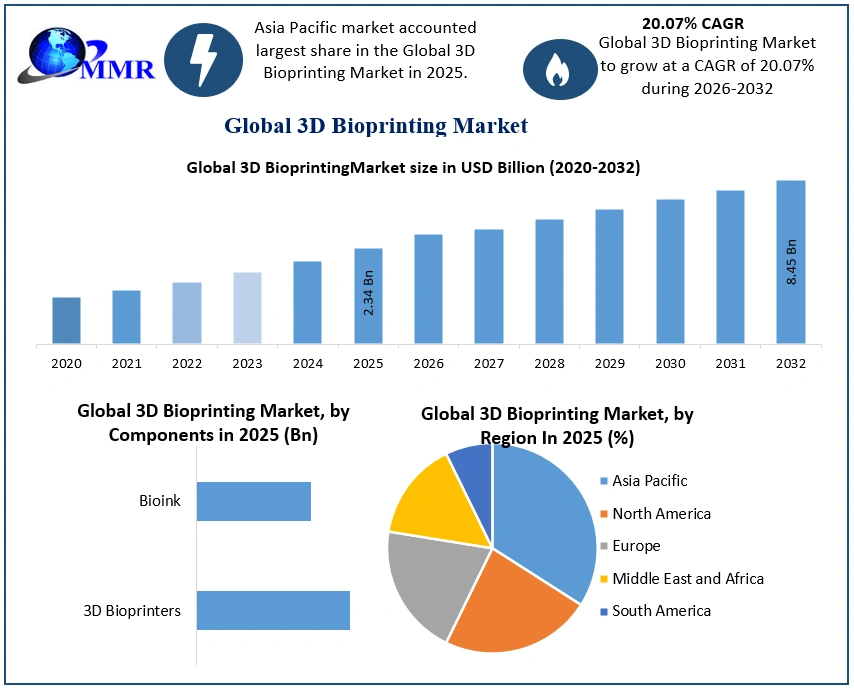
The 3D Bioprinting Market size was valued at USD 2.34 Billion in 2025 and the total 3D Bioprinting revenue is expected to grow at a CAGR of 20.07% from 2026 to 2032, reaching nearly USD 8.45 Billion by 2032.
Innovative drug screening as well as drug development platforms have led to the advancement in the 3D bioprinting technology to develop multiple all-inclusive high throughtputs and customized organ-on-chip like platforms along with printed 3D cell structures. Recently, several 3D-bioprinting technologies are implemented to derive and improve 3D-cell culture. The 3D bioprinters enable automated production of reproducible, fast and customized 3D structures. Several companies are buiidling systems, which are capable of creating realistic 3D human tissues for drug and therapy research applications.
Living human tissues and organs 3D bioprinting is expected to reach a market value of USD 2854.3 million by 2027, up from USD 645.6 million in 2019. Depending on how the final product will be used, the 3D bioprinting market is divided into research and clinical segments. Printing of skin, bone, cartilage, and blood vessels is one of the clinical uses available today. In particular, the use of the 3D bioprinting method for skin regeneration and wound healing began in 2009, with multiple published research reaching about 19 and 70 in 2019 and 2020, respectively. According to MMR analysis skin bioprinting is anticipated to develop at a compound annual growth rate (CAGR) of 19.8% from 2019 to 2024.
Scope of the 3D bioprinting market Report:
The 3D bioprinting market report provides a comprehensive analysis of the global 3D Bioprinting Market. The report estimates the 3D Bioprinting Market, in terms of USD value from 2024 to 2030. In order to identify potential investment pockets, the report gives an analytical representation of the 3D Bioprinting industry together with current trends and future forecasts. The report includes a thorough analysis of the market share for 3D Bioprinting as well as data on important drivers, restraints, and opportunities. A quantitative analysis of the existing market is done from 2024 to 2030 to show the potential for market growth across the globe. In addition, Porter's five forces study demonstrates the market power of both buyers and providers. The research offers a thorough analysis of the worldwide 3D Bioprinting market based on the level of competition and how it will grow over the forecast period.
To know about the Research Methodology:-Request Free Sample Report
3D Bioprinting Market Dynamics:
The emergence of new pathogen has caused unexpected diseases and epidemics in humans. The COVID-19 pandemic has demonstrated the urgent need for a platform to implement the rapid and agile development of treatments and vaccines to get rid off from new pathogens like SARS-CoV-2. As traditional drug development process typically takes 10-15 yeqars to develop safe and effective drugs. Therefore modifying the drug discovery pipeline via emerging sophisticated technologies like 3D bioprinting are gaining interest for the acceleration of drug discovery. As the current success rate of the drug enteing clinical trials is roughly 10%. The research conducted by various scientist of Nanoengineering and Bioengineering Departments, stated that 3D bioprinting of human tissues helps in serving a potential model that represents human physiology to provide more precise results.
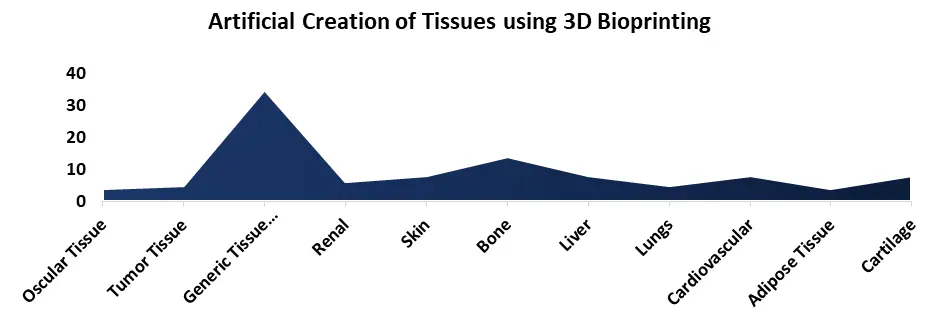
The artificial creation of tissues, human skin and internal organs might sound futuristic dream but,incredibly much of it is happening right now. Advances in 3D printing, and more specifically, bioprinting, are giving researchers and medical professionals new choices for therapy and scientific investigation. Bioprinting could, in fact, be the future of individualized medicine and health care.
The biomaterial including the bio-link and the supporting gel, used for 3D bioprinting is critical for developing each cell type specifically for obtaining better products. To overcome the aforementioned challenes several biotech companies have devoted themselves to develop bioprinted human tissues to study different kind of diseases. For Instance, the medical laboratory and research company Organovo designed 3D bioprinted human tissues for medical research and therapeutic applications.
More than 1,13,000 patients all over the world are on the waiting list of organ transplant each year. The number of recipients on the waiting list is increasing at a rate of one every ten minutes, which is faster than the number of eligible donors and transplants. Twenty people each day who cannot access available organs for transplant die as a result of this difference. 3D bioprinters are capable of printing out human organ so that patients can receive their needed organ transplant in a timely fashion creating a growth opportunity for the 3D bioprinter market. For Instance, the Chicago based start-up BIOLIFE4D successfully created a mini human heart that helps in replicating the features of functional human heart. Various innovation in bioinks has further increased the usage of the 3D bioprinter market. Due to the innovation of the bioinks which are derived from the patients own cells and the ability to construct 3D bioprints exactly in the same dimensions measured from the patients MRI scans there is an increase demand of 3D bioprinters.
With the COVID-19 infection's rapid spread, 3D bioprinting is experiencing high demand. As a result, a lot of pharmaceutical and biopharmaceutical companies are stepping up to support medical professionals, doctors, and researchers. For instance, Stratasys, one of the top 3D printer manufacturers in America, has used a 3D bioprinter to create face shields. They transported 100,000 face shields into the United States up until March 2020.
3D bioprinters are even used for medical training purpose. For instance, the medical researchers and orthopedic surgeons at Taiwan announced a collaboration with Industrial Technology Institute to establish a diagnostic platform using 3D bioprinted medical implants. This collaboration of 3D bioprinting patient specific implants were found to be beneficial to facilate oral cancer patients reconstructive surgeries to restore soft tissues or bones that were removed during surgeries.
As for any medical application, safety comes first, hence strict regulations are imposed on 3D Bioprinting. In addition, the cost of 3D bioprinting organs is difficult to estimate. Several companies need to be focused on improving current 3D bioprinters to increase the resolution of the detailed tissue. Despite all these concerns, 3D bioprinting has a promising future given broader industry trends toward more individualized medical treatments. 3D bioprinting is well adapted to provide specialized tissues and organs that meet a range of specific needs as more patients demand personalized therapies. Due of its potential uses in a variety of medical fields, 3D bioprinting is also ideally suited to help researchers and medical professionals at various phases of drug development and patient care. Several businesses are focusing on entering the 3D bioprinting sector in an effort to advance the technology and gain profit from these developments.
3D Bioprinting Market Segment Analysis:
By Technology Insights, With the aid of biomaterials used as bio-inks, the inkjet-based category, had the greatest revenue share of 36.0% in 2025, allowed for the printing of intricate living organs or tissues on culture substrates. The widespread use of inkjet printing in the medical industry is a factor in the expansion of this market. In particular, the subjects of tissue engineering and drug delivery systems and inkjet printing as a bio-applicable technology are covered in this study. Because of its increased reliability and growing demand, this market sector is expected to experience substantial expansion during the forecast period.
The magnetic levitation market is anticipated to grow at the quickest CAGR of 14.2% during the forecast period. The technology's cost-effectiveness is responsible for the lucrative expansion. With its sophisticated features, increased speed, and increased accuracy, magnetic levitation technology is anticipated to eliminate more than 80.0% of the mistakes in 3D bioprinting. Additionally, toxicity testing, printing of vascular muscles, and human cell regeneration all use these bioprinters. For instance, using magnetic levitation-based devices, BioAssay has created a structure that resembles tissue. Due to the quick uptake of newer technologies, the magnetic levitation-based devices are most likely to have sluggish growth during the projection period.

By Material, the 3D Bioprinting Market is segmented into hydrogels, living cells and extracellular matrices. In terms of the greatest revenue share in the global market in 2025, the live cells segment dominated over other material type segments. The main drivers influencing this segment's revenue growth are the expansion of research and development efforts in the area of regenerative medicine, the rise in public and private funding in stem cell research, and the quick uptake of next-generation 3D bioprinting technology. The Hydrogel segment is further found to be the dominating segmentin the forecated peiod. Recently developed hydrogel have evoked as an ideal candidate for the bio-ink formulations of 3D bioprinting due to their aqueous and 3D networked environment.
By Application, With a 36.8% market share in 2025, the medical application category led the 3D bioprinting market overall. During the forecast period, it is expected to rise at a CAGR of 15.5%. The market for 3D bioprinting is expanding due to the widespread use of pharmaceutical pills to treat a variety of chronic conditions. The segment is also being driven by the expanding demand for pharmaceuticals and the efficient use of bio-drugs in this technology. The demand for pharmaceutical products is rising along with the number of players in the sector. Consequently, this market segment is anticipated to grow profitably throughout the forecast period.
The tissue and organ generation sub-segment is anticipated to grow at the fastest rate of CAGR of 15.8% during the forecast period. The most common application of 3D bioprinting in medicine is to regenerate organs and tissue suitable for transplantation. The need for tissue and organ creation is growing as the COVID-19 disease is becoming more common. The tissue and organ generation segment is anticipated to experience exponential expansion over the course of the projected period as a result. The main market participants anticipate that the rising number of COVID-19 cases in the world will open up new growth opportunities. Different 3D bioprinting market participants are working to create fresh methods that can counteract this pandemic effect and provide a vaccine.
3D Bioprinting Market Regional Insights:
Asia Pacific region has dominated the 3D bioprinting market with a revune share of 23.7% in 2025, the region is anticipated to maintain its leadership throughout the forecast period. Due to the increased number of COVID-19 cases and increased government R&D spending, Japan and China accounted for the greatest revenue share in the area. According to the Worldometer Report 2021, up until January 13th, 20211, China has around 87,706 active COVID-19 cases registered. Additionally, it is projected that a lack of organ donors and the rising death rate brought on by COVID-19 will further propel the 3D bioprinting industry in this area.
In 2022, the North American market had a revenue share of 31.8%, and it is anticipated that it will continue to dominate for the entire forecast period. Over the course of the projection period, it is anticipated that the market would rise due to the growing adoption of IT in the healthcare sector. Around 23,369,732 active COVID-19 cases were registered in the United States alone up until January 13th, 2022, according to the Worldometer Report 2022. Over 50 vaccine candidates are now being testing. To produce a vaccination for this illness, the government is investing more in research and development. Because this technology has been recognised for use in drug testing and organ donation, there is a rising demand for 3D bioprinting.
3D Bioprinting Market Competative Landscape:
3D bioprinting is rife with unique approaches, as is the case in many developing sectors the 3D Bioprinting has shown potential profit, and sevral companies are increasingly attempting to patent their work in order to prevent it from being marketed elsewhere. The fabrication of functional kidney tissues is reported to be possible thanks to a Harvard-developed bioprinting technique that Trestle Biotherapeutics just licenced.
Israeli business Matricelf and Tel Aviv University's tech transfer company Ramot agreed to an exclusive licencing agreement in January 2022 for the use of a revolutionary, patent-pending 3D bioprinting method. The technique, which involves using extracellular matrices and patient stem cells to bioprint implants for repairing damaged tissues, is reportedly undergoing patent approval in the US and Europe.
3D Bioprinting Market Recent Industry Developments (2025–2026)
| Date | Company | Development | Impact |
|---|---|---|---|
| 04 February 2026 | SNS Insider | Released a comprehensive analysis confirming the market reached USD 2.15 Billion in 2025 with an accelerated growth trajectory for 2026. | Provides critical market validation for investors and stakeholders focusing on high-growth segments like bioinks and living cells. |
| 15 June 2025 | BICO (CELLINK) | Launched the BIO Xⱽ Bioprinter, featuring optimized multi-material capabilities and automatic calibration. | Significantly speeds up tissue engineering workflows in pharmaceutical and regenerative medicine applications. |
| 01 June 2025 | TissueLabs | Introduced TissuePro, a new high-performance extrusion-based bioprinter designed for advanced regenerative medicine. | Expands the accessibility of precision biofabrication for clinical-stage research and drug development. |
| 20 May 2025 | 3D Systems | Released its NextGen Bioprinting Platform, specifically engineered for enhanced cell viability and organ-on-chip resolution. | Aims to shorten drug development timelines by providing more accurate disease modeling environments. |
| 12 May 2025 | Bio Inx & Readily3D | Collaboratively launched READYPCL INX, a polyester-based resin for high-speed volumetric printing. | Enables single-step fabrication of complex 3D structures with 100 µm resolution, bypassing traditional layer-by-layer constraints. |
| 15 February 2025 | Eli Lilly & Organovo | Eli Lilly acquired Organovo's FXR program, including the lead asset FXR314, for USD 10 Million upfront. | Integrates 3D-bioprinted human tissue models directly into big pharma pipelines to generate predictive preclinical data. |
3D Bioprinting Market Scope: Inquire before buying
| 3D Bioprinting Market | |||
|---|---|---|---|
| Report Coverage | Details | ||
| Base Year: | 2025 | Forecast Period: | 2026-2032 |
| Historical Data: | 2020 to 2025 | Market Size in 2025: | USD 2.34 Bn. |
| Forecast Period 2026 to 2032 CAGR: | 20.7% | Market Size in 2032: | USD 8.45 Bn. |
| Segments Covered: | by Technology Insights | Magnetic 3D Laser-Assisted Inkjet 3D Microextrision |
|
| by Deployment Mode | Hydrogels Extracellular Matrices Living cells Other Biomaterials |
||
| by Application Area | Medical Tissue and organ generation Medical pills Prosthetics and implants Others Dental Biosensors Consumer/Personal Product Testing Bioinks Food and Animal Product Others |
||
| by Components | 3D Bioprinters Bioink |
||
| by End Users | Research Organizations Academic Institutes Biopharmaceuticals Companies Hospitals |
||
3D Bioprinting Market, by Region
North America (United States, Canada and Mexico)
Europe (UK, France, Germany, Italy, Spain, Sweden, Austria, Turkey, Russia and Rest of Europe)
Asia Pacific (China, India, Japan, South Korea, Australia, ASEAN and Rest of APAC)
Middle East and Africa (South Africa, GCC, Egypt, Nigeria and Rest of ME&A)
South America (Brazil, Argentina, Columbia and Rest of South America)
3D Bioprinting Market, Key Players are:
The scrubber system industry is characterized by intense competition among key players, including Alfa Laval, Wärtsilä, and Mitsubishi Heavy Industries. These companies leverage advanced technologies and innovation to enhance efficiency and compliance with stringent environmental regulations. The market is witnessing a shift towards hybrid scrubber systems, driven by rising demand for flexibility and sustainability. Strategic partnerships and mergers are prevalent, allowing firms to expand their product portfolios and market reach. Additionally, geographic growth, particularly in Asia-Pacific, is vital as countries increasingly adopt stricter emissions standards. This dynamic landscape underscores the importance of continuous innovation and strategic positioning in the market.
- EnvisionTEC Inc.
- Organovo Holdings, Inc.(US)
- Vivax Bio LLC
- BICO Group AB (CELLINK)
- Advanced Solutions Life Sciences LLC
- Allevi Inc. (3D Systems)
- Revotek Co. Ltd.
- Precise Bio(US)
- 3D Systems Corporation
- Stratasys Ltd.
- Aspect Biosystems Ltd.
- Cyfuse Biomedical K.K.
- RegenHU
- Poietis
- CollPlant Biotechnologies Ltd.
- Rokit Healthcare Inc.
- 3D Bioprinting Solutions
- Regemat 3D S.L.
- Materialise NV
- Inventia Life Science
- Prellis Biologics
- FluidForm
- Viscient Biosciences
- Xylyx Bio Inc.
- Bio Inx
FAQs:
1. Which are the leading companies in 3D Bioprinting Market?
Ans. EnvisionTEC, Inc., Organovo Holdings, Inc., Inventia Life Science PTY LTD, Poietis, Vivax Bio, LLC, Allevi, Cyfuse Biomedical, K.K.3D Bioprinting Solutions, Cellink GlobalRegemat 3D, S.L.Bico group ab, Collplant Biotechnologies Ltd., Regenhu, Advanced Solutions Life Sciences, LLCRokit Healthcare, inc.Pandorum Technologies pvt. ltd.,Foldink Life Science Technologies, Revotek co., ltd.,Precise Bio
2. What are the essentials of 3D Bioprinting?
Ans. The 3D Bioprinting produces living tissues, blood vessels and potentially whole organs for use in training,medical procedures and testing.The cellular complexity of the living body has resulted in 3D bioprinting development.
3. What is the market size of the 3D Bioprinting Market by 2032?
Ans. The market size of the Information Technology Market by 2032 is expected to reach at USD 8.45 Bn.
4. What are the driving factors of 3D Bioprinting Market?
Ans. Acceleration in Drug Development Process, and use of 3D Bioprinting in Organ Transplantation has driven the 3D Bioprinting Market.
5. Who are the target audience in 3D Bioprinting?
Ans. 3D Bioprinting retailers, Medical devices companies, 3D bioprinting vendors, Hospitals are the target audience in 3D Bioprinting market.