
Financial Guarantee Market Size by Product, Enterprise Size, End User and Region – Segment-Level Market Assessment, Growth Opportunity Analysis, Competitive Mapping & Forecast to 2034
Overview
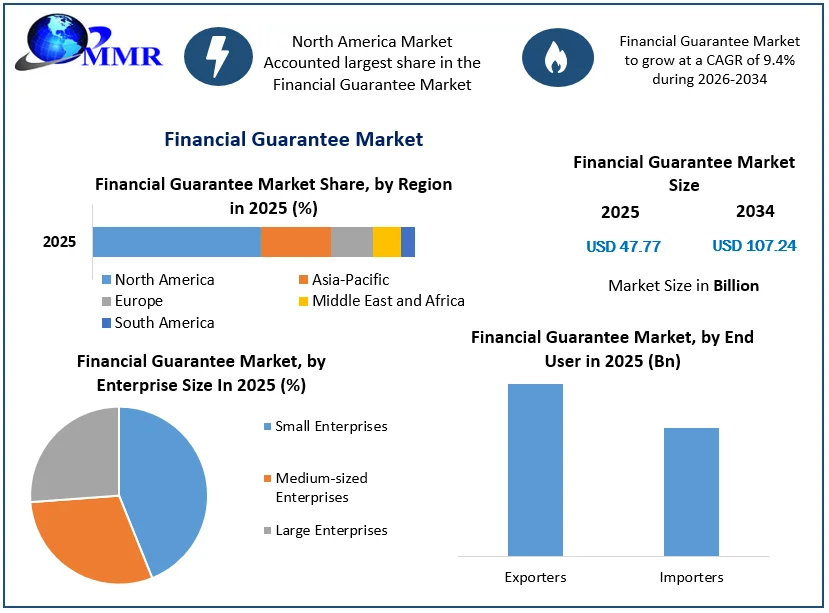
The Financial Guarantee Market size was valued at USD 47.77 billion in 2025 and the total Financial Guarantee Market revenue is expected to grow at a CAGR of 9.4 % from 2026 to 2034, reaching nearly USD 107.24 billion.
The Financial Guarantee operates on the foundation of ensuring debt repayment in case of default by a borrower, backed by a third-party guarantor. This agreement is pivotal in various financial transactions, providing assurance to creditors, and facilitating high-risk ventures that might otherwise be deemed too risky. Financial guarantees come in multiple forms, including corporate and personal guarantees, security deposits, or collateral, significantly impacting lending, credit terms, and interest rates for borrowers. The Financial Guarantee market demonstrates promising growth, propelled by factors such as increased demand for credit facilities, the need for risk mitigation in uncertain economic climates, and the role of guarantees in enabling otherwise restricted financial transactions.
Drivers include the integration of guarantees into complex financial contracts, enhancing access to credit, and fostering lending activities. Key trends include the adaptation of guarantees in diverse sectors, driving innovation, and growing market reach. Opportunities lie in the growing emphasis on financial security, prompting investments in guarantee-related services and products. Recent developments show significant initiatives by Financial Guarantee market players, such as USAID and the U.S. International Development Finance Corporation's joint $41 million loan guarantee program in India to promote renewable energy investments by SMEs. These trends underscore a dynamic market driven by evolving demands, innovative solutions, and strategic initiatives aimed at bolstering economic resilience, financial inclusivity, and sustainable development.
Financial Guarantee Market Size, Growth and Share Analysis
To know about the Research Methodology :- Request Free Sample Report
The Financial Guarantee market's upward trajectory is fueled by numerous factors such as increased demand for credit facilities, risk mitigation requirements during economic uncertainties, and facilitating transactions that might be considered too risky otherwise. Guarantees play a critical role in enabling otherwise restricted financial transactions, mitigating the risk associated with lending to high-risk borrowers, and supporting credit access during financial uncertainties. Recent market insights also indicate a considerable increase in the Financial Guarantee market size, attributing this growth to factors like improved access to finance, driving innovation, and strategic market initiatives. The financial guarantee market's growth is indicative of its vital role in fostering economic resilience, encouraging financial inclusivity, and promoting sustainable development on a global scale.
Financial Guarantee Market Dynamics:
Regulatory Compliance Mandates Fuel Demand for Financial Guarantees:
The rise in financial activities, such as loans, bonds, and complex derivatives, fuels the demand for financial guarantees. For instance, in emerging markets like India, the surge in housing loans and infrastructure projects necessitates financial guarantees, boosting market growth. Growing international trade activities lead to heightened cross-border transactions, necessitating financial guarantees for mitigating risks. As companies engage in global commerce, trade finance and payment guarantees become pivotal, stimulating the financial guarantee market. Infrastructure projects often require financial guarantees to secure funding and ensure project completion. For instance, large-scale government initiatives like China's Belt and Road Initiative demand financial guarantees, attracting investments and spurring market growth. Sectors with inherent risks, such as energy and construction, seek financial guarantees to mitigate uncertainties. Projects like renewable energy installations or large-scale construction projects utilize guarantees to alleviate investor concerns, fostering market growth. Stringent regulatory requirements mandate financial institutions to seek guarantees for risk management. Compliance with regulations like Basel III and Solvency II necessitate financial guarantees, driving Financial Guarantee market growth as institutions seek to meet regulatory standards.
Digitalization and technological innovations in finance require guarantees to secure digital transactions. As fintech expands, securing digital payments and transactions through guarantees becomes essential, propelling market growth. Supportive government policies and initiatives in developing economies for small and medium-sized enterprises (SMEs) and infrastructure projects stimulate the demand for financial guarantees. Policies encouraging entrepreneurship and infrastructure development drive Financial Guarantee market growth by facilitating access to credit and loans. Increasing focus on risk mitigation and credit enhancement strategies prompts businesses to opt for financial guarantees. In volatile economic environments, guarantees aid in risk reduction, enhancing creditworthiness and encouraging lending. Collaboration between the private and public sectors on large-scale projects necessitates financial guarantees, driving Financial Guarantee growth. For instance, public-private partnerships for infrastructure projects often involve financial guarantees to attract private investment. Post-pandemic, there's a heightened emphasis on risk aversion, leading to the increased adoption of financial guarantees. Businesses prioritize risk management tools like guarantees to navigate uncertainties, fostering Financial Guarantee growth.
Boosting Investor Confidence in Infrastructure Projects via Financial Guarantees:
Financial guarantees enable small businesses to access loans that are considered risky by lenders due to uncertain Financial Guarantee market conditions. For instance, small enterprises often secure business loans with the backing of financial guarantees, encouraging business growth and entrepreneurship. In the realm of global commerce, financial guarantees facilitate trade finance and payment assurances, reducing risks in cross-border transactions. These guarantees assure payment between buyers and sellers in international trade, fostering smoother trade operations and mitigating financial uncertainties. Major infrastructure projects, such as those involved in government initiatives like China's Belt and Road Initiative, often necessitate financial guarantees to attract investment. These guarantees assure funders of project completion and repayments, boosting investor confidence and enhancing Financial Guarantee market growth. Stringent regulatory requirements like Basel III and Solvency II mandate financial institutions to utilize guarantees for effective risk management. This compliance drives market growth as financial entities seek to adhere to regulatory standards, contributing to increased demand for guarantees.
As financial technology expands, the need for guarantees to secure digital transactions becomes crucial. Financial guarantees play a pivotal role in securing digital payments and transactions, providing essential security measures that support the growth of the fintech sector. Supportive government policies in developing economies, aimed at fostering small and medium-sized enterprises, drive the demand for financial guarantees. These policies encourage entrepreneurship and infrastructure development, facilitating better access to credit and loans, and fostering Financial Guarantee market growth. Businesses increasingly focus on risk mitigation strategies and credit enhancement. Financial guarantees aid in risk reduction, thereby enhancing creditworthiness and encouraging lending activities, fostering market growth in volatile economic environments. Collaborations between the private and public sectors, especially on large-scale projects, often necessitate financial guarantees to attract private investments. These guarantees assure investors, thereby driving Financial Guarantee market growth through increased private sector participation in such projects. Following the pandemic, there's a heightened emphasis on risk aversion, leading to increased adoption of financial guarantees by businesses. Companies prioritize risk management tools, including guarantees, to navigate uncertainties, thereby fostering market growth. Financial guarantees facilitate various financial transactions, providing security and assurance, ultimately supporting the efficient functioning of the financial ecosystem.
Impact of Economic Recessions on Default Risks affecting the financial guarantee market.
Economic recessions amplify default risks, impacting financial guarantee providers. For instance, during the 2008 financial crisis, increased defaults on mortgage-backed securities affected the financial guarantee market negatively. Evolving regulatory landscapes pose challenges for financial guarantee issuers. Compliance with stringent regulations such as Dodd-Frank and EMIR (European Market Infrastructure Regulation) increases operational complexity and costs, impacting market adaptability. Higher-than-anticipated default rates adversely impact the financial guarantee sector. Notable instances include the Ambac and MBIA cases, where higher default rates on insured mortgage-backed securities led to downgrades and financial turmoil in the Financial Guarantee market. Market volatility and uncertainty, especially during geopolitical crises, affect financial guarantee demand. For instance, Brexit-induced market uncertainties led to concerns about credit and increased volatility in financial markets. Evaluating and pricing risks accurately in complex financial instruments poses challenges. The intricate nature of derivatives and structured finance products like CDOs (Collateralized Debt Obligations) leads to difficulties in assessing and mitigating risks.
Securing adequate funding to cover potential liabilities becomes challenging during market stress. Limited access to liquidity leads to increased strain on financial guarantee providers during crises, affecting their ability to meet obligations. Overreliance on specific counterparties poses risks. Instances like the Lehman Brothers collapse in 2008 highlighted the vulnerabilities associated with heavy dependence on certain institutions, impacting the financial guarantee market. In environments with negative interest rates, financial guarantee providers face challenges generating returns on reserves, impacting profitability and sustainability. Legal challenges and litigation related to contract disputes or failed obligations pose financial risks and reputational damage. Notable cases like ACA Financial Guaranty Corporation v. Goldman Sachs in 2010 highlight the legal complexities and risks in the market. Increased digitization exposes financial guarantee providers to cyber threats and data breaches. Instances of cyber-attacks compromise sensitive information, leading to financial and reputational damage.
Financial Guarantee Market Segment Analysis:
Based on Product Type, The Financial Guarantee Market includes various segments based on product types, each serving distinct purposes. Among these segments, bank guarantees represent a pivotal category, divided into specific types like financial bank guarantees, performance-based guarantees, and foreign bank guarantees. Bank guarantees, especially financial and performance-based guarantees, dominate due to their broad applicability across industries, offering risk mitigation and ensuring contractual obligations. They play a vital role in enabling businesses to engage in otherwise risky transactions, thereby bolstering trade and commerce. Financial bank guarantees assure repayment on behalf of the buyer if they fail to honor their debts to the seller, mitigating financial risk. Conversely, performance-based guarantees enable beneficiaries to claim losses in cases of non-compliance with contractual obligations by the counterparty. Foreign bank guarantees, prevalent in international trade, often involve a correspondent bank in the beneficiary's domicile country, providing assurances for cross-border transactions.
The Documentary Letter of Credit (DLC) and Standby Letter of Credit (SBLC) segment forecast suggests an increasing prominence primarily driven by growing international trade volumes and the need for secure payment mechanisms in global transactions. For instance, in recent years, a surge in cross-border trade in emerging Financial Guarantee markets like Southeast Asia and Africa has led to a growing reliance on DLCs and SBLCs, indicating their potential dominance in the forecast period as international trade continues to expand and evolve. DLC constitutes another essential segment, facilitating secure payments in global trade by the buyer’s bank, ensuring payment to the seller upon compliance with specified terms. SBLC acts as a backup payment method, assuring the seller of payment if the buyer fails to meet obligations. Receivables Financing involves leveraging accounts receivable as collateral for obtaining financing and enhancing liquidity. While Bank Guarantees currently dominate the Financial Guarantee Market due to their versatility, the forecast indicates a potential shift towards increased reliance on Documentary and Standby Letters of Credit in response to evolving global trade dynamics, thereby shaping the Financial Guarantee market landscape.
| Types | Explanation |
| Individual financial Guarantee | Here an individual provides a financial guarantee. |
| This type of guarantee is visual in the case of family guarantees, wherein the parent usually provides a financial guarantee for debt taken by the son. | |
| The banker allows this since it is assured about the repaying capacity of the parents through its tax returns, bank statements, and study of the source of income. But, on the other hand, the son may not have established his credit profile. | |
| Bond Guarantee | This refers to the guarantee issued for bonds of a Company. |
| The insurance company becomes a guarantor for the bonds issued by a Company. Such a guarantee increases the bond rating, and the investors are assured about the recovery of their money. | |
| Guarantees by parent Companies | A parent company with good financial standing provides a financial guarantee for any subsidiary company. |
| The Parent company is flooded with financial resources and hence can repay. | |
| The lender may also ask the parent company to pledge its assets as collateral against the guarantee. | |
| Bank guarantee for customers | A customer has a bank account with a banker & the banker is aware of the customer’s creditworthiness. |
| When the customer enters a transaction with a first-time vendor for a large order, the vendor often asks for a bank guarantee to check creditworthiness. |
Financial Guarantee Market Regional Insights:
North America holds a significant share in the global Financial Guarantee Market due to its well-established financial infrastructure and innovative financial products. The region's dominance is evident in its robust market size, significant investments, and technological advancements, particularly in the United States and Canada. The North American market benefits from the presence of major financial institutions, fostering an environment conducive to financial guarantees. For instance, in the U.S., the financial guarantee market has witnessed growth attributed to the recovery from the financial crisis, with increased demand for guarantees in mortgage-backed securities and infrastructure projects.
Europe represents another key region in the Financial Guarantee Market, characterized by the presence of well-established financial hubs such as London, Frankfurt, and Paris. The European market's dominance is attributed to its diverse financial services industry, including banks, insurance companies, and investment firms. Despite facing challenges from regulatory changes such as Brexit and stringent compliance requirements like EMIR, Europe continues to command a significant share of the financial guarantee space. The market's stability and depth enable the provision of various guarantee products, facilitating trade finance and investment activities across the continent.
The Asia Pacific region has emerged as a dynamic force in the Financial Guarantee Market. With rapid economic growth, increasing cross-border trade, and burgeoning financial markets, countries like China, Japan, India, and Singapore are pivotal players. Asia Pacific's dominance stems from robust growth in trade finance, infrastructure projects, and technological advancements in financial services. For instance, China's Belt and Road Initiative has spurred the demand for financial guarantees, attracting substantial investments in infrastructure development. Furthermore, initiatives in India to bolster SMEs and infrastructure projects have contributed to the rising demand for financial guarantees. These regional variations in dominance reflect the diverse landscapes and opportunities shaping the Financial Guarantee Market globally.
Table 1 Parameters of Value of a Financial Guarantee:
| Parameter | Effect on Value of Guarantee | Reason |
| Increase in the bond issuer’s assets available to the creditor. | Reduces | The creditor gains less by exchanging the actual bond for the promised payment. |
| Increase in the volatility of the bond issuer’s assets. | Increases | More circumstances arise where the guarantee is worth exercising. |
| Increase in the amount due from the bond issuer. | Increases | Raises the amount due from the guarantor. |
| Increase in the time before the bond issuer must repay. | Increases or decreases | Increase: more opportunity for the bond issuer’s assets to move, i.e., more volatility. Decrease: reduces the present value of receipt from the guarantor. |
| Increase in the risk of the guarantor. | Decreases | Reduces the risk-adjusted value of the guarantee. |
| Increase in interest rates. | Decreases | Reduces the present value of the receipt from the guarantor. |
Financial Guarantee Market Competitive Landscape
The competitive landscape of the Financial Guarantee Market shows a dynamic interplay between various entities and initiatives aiming to bolster economic development, enhance access to finance, and promote sustainable energy solutions across diverse geographies.
The joint $41 million loan guarantee program in India emphasizes support for Small and Medium Enterprises (SMEs) investing in renewable energy, specifically rooftop solar installations. This initiative aids SMEs in obtaining affordable and reliable power, promoting sustainable practices, and contributing to India's clean energy transition.
The World Bank's approval of a $300 million credit for the Mozambique Access to Finance and Economic Opportunities Project aims to address economic shocks and market constraints. Focusing on enhancing access to financial services for micro, small, and medium enterprises (MSMEs) and informal workers, this project aims to unlock economic potential by improving financial inclusion and fostering economic resilience.
The U.S. International Development Finance Corporation's partnership with commercial banks in Serbia demonstrates a concerted effort to catalyze up to $272 million for small and medium-sized enterprises. By supporting businesses, including women-owned enterprises and those in rural areas, this initiative aims to facilitate growth opportunities, technological advancements, and market adaptability, fostering economic development in Serbia.
Financial Guarantee Market Recent Development
| Date | Company | Development | Impact |
|---|---|---|---|
| 21 January 2026 | Assured Guaranty | Assured Guaranty completed the acquisition of Bermuda-based life and annuity reinsurer Warwick Re Limited for approximately $158 million. | This transaction marks the firm's entry into the annuity reinsurance sector, leveraging its core financial guarantor expertise to diversify long-term earnings streams. |
| 15 February 2026 | Brookfield US Company LLC | Brookfield US Company LLC submitted a regulatory Form A filing for the acquisition of control over financial guarantor Ambac Assurance Corporation for approximately $3 billion. | The acquisition shifts ownership of the prominent bond insurer to Brookfield, providing massive capital backing to scale its specialty insurance and structured finance operations. |
| 30 December 2025 | Assured Guaranty (Europe) SA | Assured Guaranty (Europe) SA officially issued a five-year, €175 million debt service reserve (DSR) guarantee for the benefit of telecom operator XpFibre Groupe. | The strategic instrument replaces a portion of traditional bank credit lines, serving as a cost-effective alternative to support large-scale European infrastructure and fiber network buildouts. |
| 03 November 2025 | Ambac Financial Group, Inc. | Ambac Financial Group, Inc. finalized the strategic acquisition of supplemental health insurance program manager ArmadaCare from SiriusPoint Ltd. for $250 million. | The combination materially accelerates the growth, scale, and diversification of Ambac's specialty distribution platform outside of its legacy financial guarantee portfolio. |
| 21 January 2025 | Assured Guaranty Ltd. | Assured Guaranty Ltd. partnered with Arizent's The Bond Buyer to sponsor and publish the comprehensive Investing in Infrastructure 2025 research report. | The publication highlights the growing necessity of financial guarantees and bond insurance to protect public finance stakeholders against macro inflation and political polarizations. |
Financial Guarantee Market Scope: Inquire Before Buying
| Financial Guarantee Market | |||
|---|---|---|---|
| Report Coverage | Details | ||
| Base Year: | 2025 | Forecast Period: | 2026-2034 |
| Historical Data: | 2020 to 2025 | Market Size in 2025: | USD 47.77 Bn. |
| Forecast Period 2026 to 2034 CAGR: | 9.4% | Market Size in 2034: | USD 107.24 Bn. |
| Segments Covered: | by Product | Bank Guarantees Financial Bank Guarantee Performance-Based Guarantee Foreign Bank Guarantees Documentary Letter of Credit Standby Letter of Credit (SBLC) Receivables Financing Others |
|
| by Enterprise Size | Small Enterprises Medium-sized Enterprises Large Enterprises |
||
| by End User | Exporters Importers |
||
Financial Guarantee Market, by Region
North America (United States, Canada and Mexico)
Europe (UK, France, Germany, Italy, Spain, Sweden, Austria, Turkey, Russia and Rest of Europe)
Asia Pacific (China, India, Japan, South Korea, Australia, ASEAN and Rest of APAC)
Middle East and Africa (South Africa, GCC, Egypt, Nigeria and Rest of ME&A)
South America (Brazil, Argentina, Columbia and Rest of South America)
Financial Guarantee Market Key Players:
1. Asian Development Bank
2. Bank of Montreal
3. Barclays
4. BNP Paribas
5. Citibank
6. HSBC
7. ICBC
8. National Bank of Canada
9. Scotia Bank
10. SINOSURE
Frequently Asked Questions:
1. What are the growth drivers for the Financial Guarantee Market?
Ans. Regulatory Compliance Mandates Fuel Demand for Financial Guarantees and is expected to be the major driver for the Financial Guarantee Market.
2. What is the major Opportunity for the Financial Guarantee Market growth?
Ans. Boosting Investor Confidence in Infrastructure Projects via Financial Guarantees is expected to be the major Opportunity in the Financial Guarantee Market.
3. Which country is expected to lead the global Financial Guarantee Market during the forecast period?
Ans. North America is expected to lead the Financial Guarantee Market during the forecast period.
4. What is the projected market size and growth rate of the Financial Guarantee Market?
Ans. The Financial Guarantee Market size was valued at USD 47.77 billion in 2025 and the total Financial Guarantee Market revenue is expected to grow at a CAGR of 9.4 % from 2026 to 2034, reaching nearly USD 107.24 billion.
5. What segments are covered in the Financial Guarantee Market report?
Ans. The segments covered in the Financial Guarantee Market report are by Product Type, Enterprise Size, End User, and Region.