Fertigation And Chemigation Market - Industry Analysis Market Dynamics, segmented by Input Type, By Irrigation Type, Region and Forecast 2032

6.5%
CAGR (2026-2032)
51.04 USD Bn.
Market Size
302
Report Pages
120
Market Tables

Overview

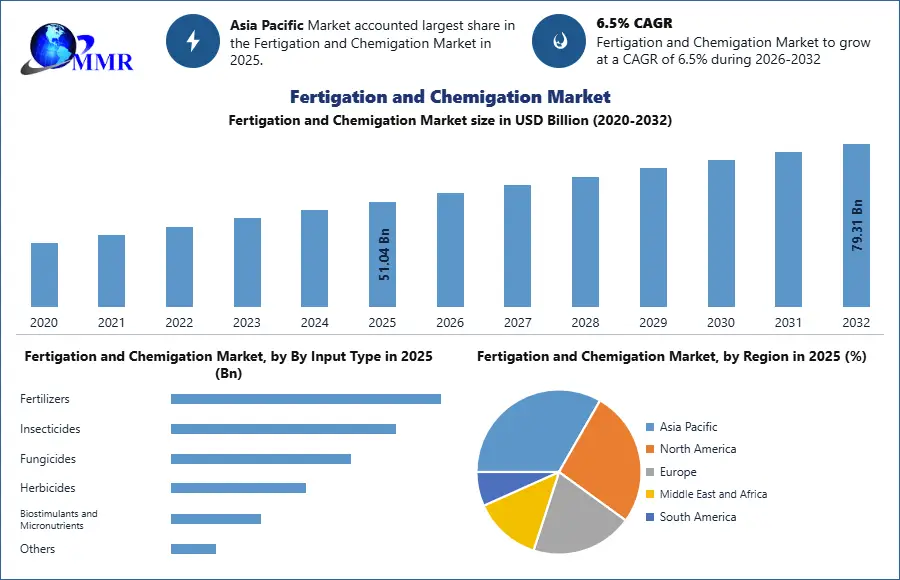
Fertigation And Chemigation Market size was valued at US$ 51.04  Bn. in 2025, and the total revenue is expected to grow by 6.5% from 2025 to 2032, reaching nearly US$ 79.31 Bn.

Fertigation And Chemigation Market Overview:

Fertigation and chemigation refer to the slow application of nutrients and water to the soil via surface drip, subsurface drip, bubbler, and micro-sprinkler systems. Fertigation and chemigation have several advantages like minimal water waste, low labor requirements, and the ability to provide drought protection, which is expected to drive market growth.

The market have been experiencing significant growth in response to global water scarcity and the significant progress and initiatives made by emerging economies through water replenishment and programs. Government initiatives to maximize the use of water resources in agriculture, as well as additional support for adopting the fertigation and chemigation in the form of subsidies are expected to put the market on a strong growth trajectory in the forecasted years. Additionally, growth in population and increased demand for higher-quality crops are expected to boost the  market's growth during the forecast period.Fertigation and Chemigation MarketTo know about the Research Methodology:-Request Free Sample Report
Fertigation And Chemigation Market Dynamics:

• The global market is gaining traction as a result of the growing popularity of irrigation techniques as a result of the constant quest for high crop productivity accompanied by water scarcity spread across continents as the global population grows.

• Furthermore, strong progress in new and emerging markets will create more lucrative and remunerative growth opportunities for the market. Furthermore, government policies promoting the most efficient use of water resources in agriculture, as well as additional subsidies to encourage the adoption of the markets, will propel new growth opportunities in the forecasted period.

• Fertigation and chemigation offer several advantages, such as minimum wastage of water and minimal labor requirement. This provides the ability to guard against drought conditions.

• Fertigation is practiced extensively in commercial agriculture and horticulture. Fertigation is also increasingly being used for landscaping as dispenser units become more reliable and easier to use. Fertigation is used to add additional nutrients or to correct nutrient deficiencies detected in plant tissue analysis. It is usually practiced on high-value crops such as vegetables, turf, fruit trees, and ornamentals.

• However, high initial investments and the lack of awareness about Fertigation and chemigation will slow the market's growth rate. Improving efficiency and critical nutrient application doses will also pose significant challenges to market growth. The negative impact of COVID-19 on the supply chain will act as a major market restraint, slowing the rate of growth in the market.

Fertigation And Chemigation Market Segment Analysis:

In 2025, fertilizers dominate the input type segment due to their essential role in enhancing crop productivity and nutrient delivery efficiency through irrigation systems. The adoption of biostimulants and micronutrients is increasing steadily, driven by the shift toward sustainable agriculture and soil health improvement. Insecticides, fungicides, and herbicides also hold significant demand, particularly in integrated pest management practices, enabling precise chemical application and reducing input wastage.

Based on crop type, cereals and grains account for the largest share in 2025, supported by extensive cultivation areas and the need for efficient nutrient management. Fruits and vegetables represent a high-growth segment due to increasing demand for high-quality produce and the adoption of precision irrigation techniques. Oilseeds and pulses are witnessing moderate growth, while plantation crops and turf and ornamentals benefit from controlled fertigation practices to maintain yield consistency and quality.

Fertigation And Chemigation Market Regional Insights:

Based on region, Asia Pacific leads the global fertigation and chemigation market in 2025, driven by large agricultural land areas, increasing adoption of micro-irrigation systems, and strong government support for efficient farming practices in countries such as India and China. The growing need to enhance crop yield and optimize water usage further supports regional dominance.

North America holds a significant market share due to advanced agricultural technologies, high adoption of precision farming, and well-established irrigation infrastructure. The region benefits from strong awareness regarding water conservation and efficient nutrient management practices.

Europe represents a mature market, supported by strict environmental regulations and a strong focus on sustainable agriculture. Countries in Western Europe are increasingly adopting fertigation techniques to reduce chemical runoff and improve soil health.

Latin America shows steady growth, particularly in countries with large-scale commercial farming such as Brazil and Argentina, where fertigation is used to improve productivity in crops like soybeans, sugarcane, and fruits.

Middle East & Africa (MEA) is witnessing gradual growth due to water scarcity and increasing adoption of efficient irrigation systems. The region is focusing on maximizing agricultural output with limited water resources, supporting the adoption of fertigation and chemigation technologies.

The report's goal is to provide industry stakeholders with a comprehensive analysis of the Fertigation And Chemigation market. The report analyses complicated data in simple language and presents the past and current state of the industry, as well as forecasted market size and trends. The report examines all aspects of the industry, including a detailed examination of key players such as market leaders, followers, and new entrants.

The report includes a PORTER and PESTEL analysis, as well as the potential impact of market microeconomic factors. External and internal factors that are expected to positively or negatively affect the business have been analysed, providing a clear future view of the industry.

The report also assists in understanding the Fertigation and Chemigation market dynamics, structure, and size projections by analysing market segments. A clear representation of competitive analysis of key players in the Fertigation And Chemigation market by product, price, financial position, product portfolio, growth strategies, and regional presence makes the report an investor's guide.

Fertigation And Chemigation Market Scope: Inquire before buying

Fertigation and Chemigation Market
Report Coverage Details
Base Year: 2025 Forecast Period: 2026-2032
Historical Data: 2020 to 2025 Market Size in 2025: 51.04 USD Billion
Forecast Period 2026-2032 CAGR: 6.5% Market Size in 2032: 79.31 USD Billion
Segments Covered: By Input Type Fertilizers
Insecticides
Fungicides
Herbicides
Biostimulants and Micronutrients
Others
By Crop Type Cereals and Grains
Oilseeds and Pulses
Fruits and Vegetables
Plantation Crops
Turf and Ornamentals
Others
By Irrigation Type Drip Irrigation
Sprinkler Irrigation
Others
By Application Open-Field Agriculture
Greenhouse and Hydroponics
Nursery and Landscaping
Urban Vertical Farming
Others

Fertigation And Chemigation Market, by Region

North America (United States, Canada and Mexico)
Europe (UK, France, Germany, Italy, Spain, Sweden, Austria and Rest of Europe)
Asia Pacific (China, South Korea, Japan, India, Australia, Indonesia, Malaysia, Vietnam, Taiwan, Bangladesh, Pakistan and Rest of APAC)
Middle East and Africa (South Africa, GCC, Egypt, Nigeria and Rest of ME&A)
South America (Brazil, Argentina Rest of South America)

Fertigation And Chemigation Market Key Players

  1. Valmont Industries Inc.
  2. The Toro Company
  3. Jain Irrigation Systems Limited
  4. Lindsay Corporation
  5. Rivulis Irrigation
  6. Netafim Limited
  7. Rain Bird Corporation
  8. T-L Irrigation Co.
  9. Nelson Irrigation Corporation
  10. EPC Industrie Limited
  11. Eurodrip S.A.
  12. Irritec S.p.A.
  13. Amiad Water Systems Ltd.
  14. Galcon Ltd.
  15. Dosatron International
  16. Irrigation Components International
  17. Jacto Inc.
  18. Finolex Plasson Industries Ltd.
  19. Hunter Industries
  20. Autogrow Systems Ltd.
  21. CALSENSE
  22. Agri-Inject Inc.
  23. GreenTech India
  24. Irrigation and Water Technologies (IWT)
  25. Hortau Inc.
  26. CropX Technologies
  27. Ag Leader Technology
  28. Nelson Irrigation
  29. Netafim Irrigation India Pvt. Ltd.
  30. Others

Table of Contents

1. Fertigation and Chemigation Market: Research Methodology 2. Fertigation and Chemigation Market: Executive Summary 2.1. Study Assumption and Market Definition 2.2. Scope of the Study 2.3. Market Summary 2.3.1 Market Size (2025) & Forecast (2026-2032) 2.3.2 Market Size (Value USD Billion) and Market Share (%) - By Segments, Regions and Country 3. Fertigation and Chemigation Market: Competitive Landscape 3.1. SMR Competition Matrix 3.2. Competitive positioning 3.3. Key Players Benchmarking 3.3.1 Company Name 3.3.2 Headquarter 3.3.3 Product Portfolio 3.3.4 Market Share(%) 3.3.5 Growth Rate (%) 3.3.6 Revenue 2024 3.3.7 Profit Margin (%) 3.3.8 Y-O-Y(%) 3.3.9 R&D Investments 3.3.10 Technology Adoption 3.3.11 Certification & Compliance 3.3.12 ESG / Sustainability Policies 3.3.13 Geographical Presence 3.4. Market Structure 3.4.1 Market Leaders 3.4.2 Market Followers 3.4.3 Emerging Players 4. Fertigation and Chemigation Market: Dynamics 4.1. Market Trends 4.2. Market Dynamics 4.2.1 Drivers 4.2.2 Restraints 4.2.3 Opportunities 4.2.4 Challenges 4.3. PORTER’s Five Forces Analysis 4.4. PESTLE Analysis 4.6. Key Opinion Leader Analysis For the Fertigation and Chemigation Market Industry 5. Agricultural Land, Irrigated Area, And Crop Coverage Analysis (2025) 5.1 Total Agricultural Land By Region And Country 5.2 Irrigated Area Suitable For Fertigation And Chemigation 5.3 Crop-Wise Irrigated Land Distribution 5.4 Untapped Land Potential For System Adoption 5.5 Long-Term Land Use Trend Impact On Demand 6. Fertigation And Chemigation Adoption Penetration Analysis 6.1 Adoption Rates By Country And Crop Type 6.2 Comparison With Conventional Fertilizer Application Methods 6.3 Adoption Barriers Among Smallholder Farmers 6.4 Penetration In Greenhouse Versus Open-Field Farming 6.5 Long-Term Adoption Curve Assessment 7. Input Consumption And Efficiency Impact Analysis 7.1 Fertilizer Consumption Reduction Through Fertigation 7.2 Pesticide And Chemical Usage Efficiency Improvements 7.3 Yield Improvement Versus Input Reduction Trade-Offs 7.4 Water–Nutrient Use Efficiency Metrics 7.5 Economic And Environmental Impact Assessment 8. Fertigation And Chemigation Vs. Conventional Application Comparison 8.1 Cost Comparison With Broadcast Fertilizer Application 8.2 Yield And Uniformity Performance Comparison 8.3 Labor Requirement And Mechanization Differences 8.4 Environmental Runoff And Leaching Comparison 8.5 Strategic Implications For Sustainable Agriculture 9. Cost Structure, ROI, And Farm-Level Economics (2025) 9.1 Input Cost Optimization And Wastage Reduction Analysis 9.2 Yield Improvement Versus Payback Period Benchmarking 9.3 Farm Size–Wise Return On Investment Sensitivity 9.4 Labor Savings And Operational Efficiency Gains 9.5 Cost Volatility Exposure For Fertilizers And Crop Protection Chemicals 9.6 Profitability Comparison With Broadcast And Foliar Methods 10. Adoption Drivers, Barriers, And Farmer Behavior Analysis 10.1 Awareness Levels And Technical Know-How Gaps Among Farmers 10.2 Role Of Agronomists, Dealers, And Extension Services In Adoption 10.3 Barriers Related To Cost, Complexity, And System Maintenance 10.4 Trust And Risk Perception Toward Chemical Injection Methods 10.5 Influence Of Government Subsidies And Incentive Programs 10.6 Adoption Differences Between Smallholders And Commercial Farms 10.7 Regional Maturity And Adoption Curve Assessment 11. Long-Term Soil Health And Crop Rotation Impact Analysis 11.1 Impact On Soil Salinity And Nutrient Stratification 11.2 Compatibility With Crop Rotation And Intercropping Systems 11.3 Reduction In Soil Compaction Due To Fewer Field Operations 11.4 Microbial Activity And Root-Zone Health Implications 11.5 Long-Term Nutrient Balance And Soil Fertility Outcomes 11.6 Risk Of Over-Dependence On Soluble Nutrients 11.7 Soil Monitoring And Corrective Management Practices 12. Crop Productivity, Yield Stability, And Risk Mitigation Analysis 12.1 Yield Consistency Under Variable Rainfall And Climate Stress 12.2 Role In Reducing Crop Nutrient Deficiency Risks 12.3 Impact On Crop Uniformity And Harvest Predictability 12.4 Disease And Pest Pressure Control Effectiveness Via Chemigation 12.5 Seasonal Yield Risk Mitigation Versus Conventional Spraying 12.6 Performance Under High-Value And Sensitive Crop Systems 12.7 Influence On Quality Grading And Marketable Output 13. Technology Evolution And Precision Agriculture Alignment 13.1 Integration With Precision Farming And Digital Agronomy Platforms 13.2 Role Of IoT, Sensors, And Variable Rate Application Technologies 13.3 Advancements In Soluble Formulations And Stabilized Nutrients 13.4 Automation And AI-Based Fertigation Scheduling Potential 13.5 Data-Driven Decision-Making And Yield Prediction Enablement 13.6 Interoperability With Farm Management Systems 13.7 Future Readiness For Smart And Autonomous Irrigation Ecosystems 14. Supply Chain Resilience And Input Availability Analysis 14.1 Dependence On Fertilizer And Agrochemical Supply Chains 14.2 Impact Of Global Raw Material Price Volatility 14.3 Regional Sourcing Versus Import Dependency Risks 14.4 Inventory Management Challenges During Peak Seasons 14.5 Transportation And Storage Constraints For Liquid Inputs 14.6 Risk Of Shortages During Climate Or Geopolitical Disruptions 14.7 Strategic Stockholding And Procurement Practices 15. Investment, Financing, And Institutional Support Analysis 15.1 Role Of Government Subsidies And Irrigation Schemes 15.2 Bank, NBFC, And Agri-Fintech Financing Availability 15.3 Pay-Per-Use And Service-Based Fertigation Models 15.4 Public–Private Partnerships Supporting Adoption 15.5 Role Of NGOs And Development Agencies 15.6 Institutional Procurement And Large-Farm Investments 15.7 Investment Attractiveness For Agri-Input Manufacturers 16. Environmental Impact And Resource Efficiency Assessment 16.1 Water Use Efficiency Improvements And Conservation Impact 16.2 Reduction In Chemical Runoff And Groundwater Contamination 16.3 Contribution To Sustainable Nutrient Management Practices 16.4 Carbon Footprint Implications From Reduced Field Operations 16.5 Compliance With Environmental Protection Norms 16.6 Role In Climate-Resilient And Precision Agriculture Systems 16.7 Comparative Sustainability Scoring Versus Traditional Application 17. Regulatory, Safety, And Compliance Framework Analysis By Region 17.1 Regulations Governing Chemical Injection Into Irrigation Systems 17.2 Fertilizer And Agrochemical Labeling And Compatibility Standards 17.3 Worker Safety, Handling, And Exposure Risk Considerations 17.4 Environmental Compliance And Discharge Restrictions 17.5 Certification And Approval Requirements By Region 17.6 Policy Support For Precision Nutrient Application 17.7 Risk Of Regulatory Tightening And Compliance Cost Impact 18. Fertigation and Chemigation Market: Global Market Size and Forecast by Segmentation (by Value in USD Billion) (2025-2032) 18.1. Fertigation and Chemigation Market Size and Forecast, By Input Type (2025-2032) 18.1.1 Fertilizers 18.1.2 Insecticides 18.1.3 Fungicides 18.1.4 Herbicides 18.1.5 Biostimulants and Micronutrients 18.1.6 Others 18.2. Fertigation and Chemigation Market Size and Forecast, By Crop Type(2025-2032) 18.2.1 Cereals and Grains 18.2.2 Oilseeds and Pulses 18.2.3 Fruits and Vegetables 18.2.4 Plantation Crops 18.2.5 Turf and Ornamentals 18.2.6 Others 18.3. Fertigation and Chemigation Market Size and Forecast, By Irrigation Type(2025-2032) 18.3.1 Drip irrigation 18.3.2 Sprinkler irrigation 18.3.3 Others 18.4. Fertigation and Chemigation Market Size and Forecast, By Application(2025-2032) 18.4.1 Open-Field Agriculture 18.4.2 Greenhouse and Hydroponics 18.4.3 Nursery and Landscaping 18.4.4 Urban Vertical Farming 18.4.5 Others 18.5. Fertigation and Chemigation Market Size and Forecast, by Region (2025-2032) 18.5.1 North America 18.5.2 Europe 18.5.3 Asia Pacific 18.5.4 Middle East and Africa 18.5.5 South America 19. North America Fertigation and Chemigation Market Size and Forecast by Segmentation (by Value in USD Billion) (2025-2032) 19.1. North America Market Size and Forecast, By Input Type 19.2. North America Market Size and Forecast, By Crop Type 19.3. North America Market Size and Forecast, By Irrigation Type 19.4. North America Market Size and Forecast, By Application 19.5. North America Market Size and Forecast, By Country 19.5.1 United States 19.5.2 United States Market Size and Forecast, By Input Type 19.5.3 United States Market Size and Forecast, By Crop Type 19.5.4 United States Market Size and Forecast, By Irrigation Type 19.5.5 United States Market Size and Forecast, By Application 19.5.6 Canada 19.5.7 Mexico 20. Europe Fertigation and Chemigation Market Size and Forecast by Segmentation (by Value in USD Billion) (2025-2032) 20.1. Europe Market Size and Forecast, By Input Type 20.2. Europe Market Size and Forecast, By Crop Type 20.3 Europe Market Size and Forecast, By Irrigation Type 20.4 Europe Market Size and Forecast, By Application 20.5. Europe Market Size and Forecast, By Country 20.5.1 United Kingdom 20.5.2 France 20.5.3 Germany 20.5.4 Italy 20.5.5 Spain 20.5.6 Sweden 20.5.7 Russia 20.5.8 Rest of Europe 21. Asia Pacific Fertigation and Chemigation Market Size and Forecast by Segmentation (by Value in USD Billion) (2025-2032) 21.1. Asia Pacific Market Size and Forecast, By Input Type 21.2. Asia Pacific Market Size and Forecast, By Crop Type 21.3. Asia Pacific Market Size and Forecast, By Irrigation Type 21.4. Asia Pacific Market Size and Forecast, By Application 21.5. Asia Pacific Market Size and Forecast, By Country 21.5.1 China 21.5.2 South Korea 21.5.3 Japan 21.5.4 India 21.5.5 Australia 21.5.6 Indonesia 21.5.7 Philippines 21.5.8 Malaysia 21.5.9 Vietnam 21.5.10 Thailand 21.5.11 Rest of Asia Pacific 22. Middle East and Africa Fertigation and Chemigation Market Size and Forecast by Segmentation (by Value in USD Billion) (2025-2032) 22.1. Middle East and Africa Market Size and Forecast, By Input Type 22.2. Middle East and Africa Market Size and Forecast, By Crop Type 22.3. Middle East and Africa Market Size and Forecast, By Irrigation Type 22.4. Middle East and Africa Market Size and Forecast, By Application 22.5. Middle East and Africa Market Size and Forecast, By Country 22.5.1 South Africa 22.5.2 GCC 22.5.3 Egypt 22.5.4 Nigeria 22.5.5 Rest of MEA 23 South America Fertigation and Chemigation Market Size and Forecast by Segmentation (by Value in USD Billion) (2025-2032) 23.1. South America Market Size and Forecast, By Input Type 23.2. South America Market Size and Forecast, By Crop Type 23.3. South America Market Size and Forecast, By Irrigation Type 23.4. South America Market Size and Forecast, By Application 23.5. South America Market Size and Forecast, By Country 23.5.1 Brazil 23.5.2 Argentina 23.5.3 Colombia 23.5.4 Chile 23.5.5 Rest of South America 24. Company Profile: Key Players 24.01.Valmont Industries, Inc. 24.01.1 Company Overview 24.01.2 Business Portfolio 24.01.3 Financial Overview 24.01.4 SWOT Analysis 24.01.5 Strategic Analysis 24.01.6 Recent Developments 24.02.The Toro Company 24.03.Jain Irrigation Systems Limited 24.04.Lindsay Corporation 24.05.Rivulis Irrigation 24.06.Netafim Limited 24.07.Rain Bird Corporation 24.08.T-L Irrigation Co. 24.09.Nelson Irrigation Corporation 24.10.EPC Industrie Limited 24.11.Eurodrip S.A. 24.12.Irritec S.p.A. 24.13.Amiad Water Systems Ltd. 24.14.Galcon Ltd. 24.15.Dosatron International 24.16.Irrigation Components International 24.17.Jacto Inc. 24.18.Finolex Plasson Industries Ltd. 24.19.Hunter Industries 24.20.Autogrow Systems Ltd. 24.21.CALSENSE 24.22.Agri-Inject, Inc. 24.23.GreenTech India 24.24.DIrrigation and Water Technologies (IWT) 24.25.Hortau Inc. 24.26.CropX Technologies 24.27.Ag Leader Technology 24.28.Nelson Irrigation 24.29.Netafim Irrigation India Pvt. Ltd. 24.29.1 Others 25. Key Findings 26. Analyst Recommendations

Custom Market Research Services

We Will Customise The Research For You, In Case The Report Listed Above Does Not Meet With Your Requirements