
Global Dulse Palmaria Market Size by Form, by End Use, by Distribution Channel, by Region and Forecast 2034
Overview
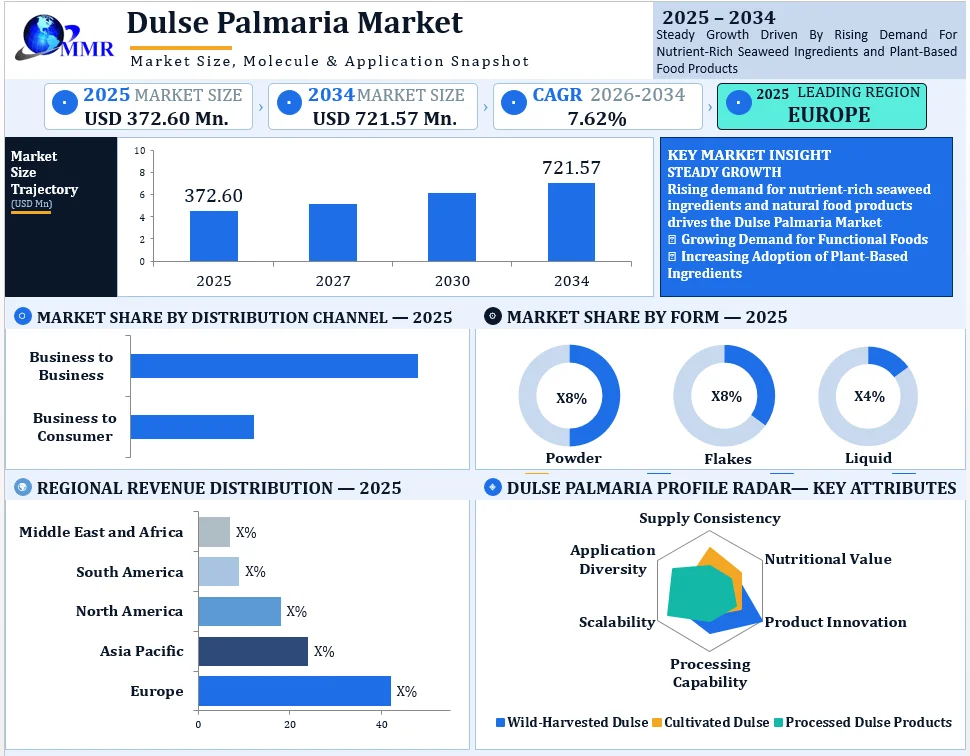
The Global Dulse Palmaria Market size was valued at USD 372.60 Million in 2025 and the total Dulse Palmaria revenue is expected to grow at a CAGR of 7.62% from 2026 to 2034, reaching USD 721.57 Million by 2034.
Global Dulse Palmaria Market Overview
The Dulse Palmaria Market focuses on the harvesting, cultivation, processing, and commercialization of Palmaria palmata, a nutrient-rich red marine seaweed commonly known as dulse. Valued for its distinctive salty, umami flavour and nutritional properties, dulse is available in dried leaves, flakes, powders, seasonings, and ready-to-eat snacks. Its growing relevance in natural food ingredients and sustainable nutrition is creating opportunities across the edible seaweed industry.
The Dulse Palmaria Market is growing as health-conscious consumers, plant-based food manufacturers, gourmet food brands, and ingredient suppliers increasingly adopt seaweed as a versatile food ingredient. Europe is a leading region in the Dulse Palmaria Market, supported by established harvesting traditions in Ireland, Scotland, and other Atlantic coastal areas, along with growing demand for natural food ingredients and sustainable seafood alternatives. Dulse is increasingly used in snacks, soups, sauces, bakery products, and seasonings, while commercial cultivation and improved processing methods are creating opportunities to strengthen supply. Companies such as Maine Coast Sea Vegetables and Acadian Seaplants Limited represent the broader edible seaweed industry, while food research supported by organizations such as the Food and Agriculture Organization highlights the importance of seaweed in food systems and sustainable marine resource utilization.
The Dulse Palmaria Market report by Maximize Market Research examines industry trends, growth drivers, restraints, competitive positioning, regional developments, and emerging opportunities. It highlights potential growth areas in sustainable cultivation, premium seaweed snacks, plant-based food innovation, functional ingredients, and value-added dulse processing for food and personal care applications.
Global Dulse Palmaria Market Size, Growth and Share Analysis
To know about the Research Methodology :- Request Free Sample Report
Global Dulse Palmaria Market Key Highlights
| Key Highlights | Analytical Insights |
|---|---|
| Market Growth | The Dulse Palmaria Market is projected to grow at a CAGR of 7.62% during 2026–2034, driven by demand for sustainable seaweed ingredients and nutrient-rich foods. |
| Leading Region | Europe leads the market, supported by established dulse harvesting traditions, Atlantic coastal resources, and demand for natural food ingredients. |
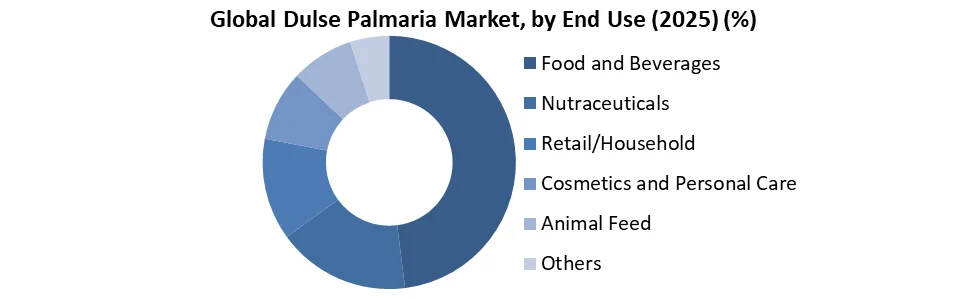
| Leading End Use | Food and Beverages represents the leading end-use segment, with applications in snacks, bakery products, sauces, seasonings, and plant-based meals. |
| Key Growth Opportunity | Commercial cultivation, dulse protein extraction, functional foods, and improved processing technologies offer opportunities to strengthen supply and expand applications. |
| Competitive Landscape | Maine Coast Sea Vegetables, Acadian Seaplants Limited, Mara Seaweed, and other seaweed suppliers compete through product innovation, sustainable sourcing, and expanded distribution. |
Global Dulse Palmaria Market: Commercial Opportunity Assessment
| Application Area | Market Potential | Commercialization Status | Key Opportunity |
|---|---|---|---|
| Functional Foods | High | Established and developing |
Fortified snacks, soups, sauces, and seasonings |
| Dulse Protein Ingredients | High | Emerging | Plant-based protein blends and protein-rich food formulations |
| Nutraceuticals | Medium–High | Emerging | Mineral-rich powders and seaweed-derived bioactive ingredients |
| Animal Feed | Medium | Research and early development | Alternative protein and mineral ingredients for feed |
| Cosmetics and Personal Care |
Medium | Developing | Seaweed extracts for skin-conditioning formulations |
Global Dulse Palmaria Market Dynamics:
Rising Demand for Nutrient-Rich Seaweed Ingredients Drive Dulse Palmaria Market Growth
The growing preference for nutrient-rich foods, plant-based protein, natural seasonings and sustainable marine ingredients is driving demand in the Dulse Palmaria Market. Palmaria palmata, commonly known as dulse, offers protein, dietary fibre, minerals and a distinctive umami flavour, making it suitable for snacks, soups, bakery products, sauces and functional food formulations. Research indicates that its protein content can range from 8% to 35% of dry weight, creating opportunities for food manufacturers seeking alternative protein ingredients and clean-label product formulations. Increasing interest in vegetarian diets, premium seaweed snacks and marine-derived nutritional ingredients is also creating commercial opportunities for dulse across food processing, nutraceuticals and specialty ingredient applications.
Seasonal Seaweed Supply and High Raw Material Costs Restrict Dulse Palmaria Market Development
The Dulse Palmaria Market faces supply constraints because commercial production depends substantially on seasonal wild harvesting, limited coastal resources and the availability of suitable cultivation systems. Harvesting conditions, seasonal variations in natural populations, limited mechanisation and inconsistent raw material availability can increase procurement costs for food manufacturers. In addition, fresh dulse can contain up to 88% moisture, making drying, storage, transportation and processing important cost considerations. These factors can restrict large-scale adoption in price-sensitive food applications and make consistent year-round supply difficult for commercial buyers.
Sustainable Dulse Cultivation and Alternative Protein Innovation Create New Market Opportunities
Investment in controlled seaweed cultivation, improved hatchery systems and advanced ingredient processing offers significant opportunities for the Dulse Palmaria Market. Developing reliable cultivation methods could reduce dependence on wild harvesting while improving biomass availability, product consistency and supply-chain planning. With reported protein levels reaching 35% of dry weight in some samples, dulse also presents opportunities for protein extraction, plant-based foods, nutritional powders, animal feed and bioactive ingredient development. Food manufacturers can explore dulse-based seasonings, fortified bakery products, meat alternatives and natural flavour ingredients, while research into seaweed-derived compounds may support future applications in food packaging and personal care products. Improvements in spore germination, cultivation survival and biomass processing could help commercial producers improve production efficiency and serve a wider range of industrial customers.
Iodine Variability, Contaminant Monitoring and Cultivation Efficiency Challenge Dulse Palmaria Market Expansion
Maintaining consistent food safety, nutritional quality and commercial production remains a key challenge for the Dulse Palmaria Market. The iodine content of dulse varies according to environmental conditions, harvest timing and processing, requiring manufacturers to establish suitable testing and quality-control procedures for food products. Research published in 2025 also identified seasonal differences in protein, sugar and mineral composition, highlighting the importance of controlling raw material specifications across harvest periods. Cultivation presents additional technical difficulties, including low spore release and germination rates, high early-stage mortality and contamination by other organisms. Producers must also monitor potentially harmful elements and microbial hazards to meet applicable food safety requirements. Addressing these issues through improved cultivation protocols, standardised processing, traceability and routine laboratory testing will be essential for building consumer confidence and supporting dependable commercial supply.
The protein content of some algae compared with Palmaria palmata:

Global Dulse Palmaria Market Key Trends
| Market trend | Description |
|---|---|
| Rising Demand for Dulse-Based Functional Foods and Natural Seasonings |
Food manufacturers are exploring dulse as a savoury ingredient in soups, sauces, snacks, breads and plant-based meals. Its distinctive umami flavour and mineral content create opportunities for premium seaweed seasonings and nutritious food formulations. |
| Advancement in Land-Based Dulse Cultivation Technology |
Research institutions are developing controlled tank-based cultivation methods to improve dulse production and reduce reliance on naturally harvested seaweed. In February 2026, researchers at the Scottish Association for Marine Science reported reducing early-stage spore mortality from approximately 60–70% to around 10% through improved cultivation and biological management techniques. |
| Growing Interest in Dulse Protein Extraction and Alternative Protein Ingredients |
Food research is examining dulse protein extraction, amino acid composition, digestibility and potential use in plant-based foods and beverages. Reported protein content ranges from 8% to 35% of dry weight, depending on growing and processing conditions, supporting interest in seaweed-derived protein ingredients. |
| Adoption of Circular Economy Practices in Seaweed Production |
Seaweed producers are investigating ways to reuse nutrients from seafood processing rather than relying entirely on conventional cultivation inputs. Research published in December 2025 demonstrated improved dulse growth and nutritional composition using diluted process water from herring production, highlighting a potential route towards resource-efficient seaweed farming. |
| Development of Fresh Dulse Products for Retail and Food Service |
Product developers are working to make dulse more accessible beyond dried flakes and specialty ingredients. A Belgian initiative launched in October 2025 is developing locally cultivated fresh seaweed products, including soups, tapenades and hybrid or vegan burgers, while assessing consumer preferences and distribution opportunities. |
| Greater Focus on Nutritional Standardisation and Seaweed Food Safety |
Food processors are paying closer attention to seasonal changes in dulse composition, iodine levels and potentially harmful elements. Research published in July 2025 documented seasonal differences in protein, sugars and mineral content, increasing the importance of harvest timing, laboratory testing and consistent ingredient specifications for commercial food applications. |
Global Dulse Palmaria Market Segment Analysis:
Based on the form, the Powder segment followed by the Flakes segment is expected to generate the highest revenue share in the global dulse/palmaria market during the forecast period. Dulse Flakes and Dulse Powder are wonderful food ingredients full of superfood properties. Thus, increasing adoption of flakes and powder in dietary supplements supports the segment growth during the forecast period. Demand for healthy and tasty aquatic food has been the primary driving force behind the kelp boom in Eastern Asia, primarily China and the Republic of Korea.
The boom has been sustained or reinforced along the way by other market forces, such as the demand for brown seaweed extracts (iodine, alginate, mannitol, fucoidan, etc.) and the demand for fresh seaweeds to feed abalone. Nutritious, eco-friendly, and versatile algae have great potential in a variety of food and non-food applications, yet the potential may not turn into immediate market demand because of a variety of constraints, such as low consumer exposure or preference, high production costs, market competition, and stringent regulations.
Based on End Use, Food and Beverages is the leading end-use segment in the Dulse Palmaria Market, supported by established applications in seaweed snacks, seasonings, bakery products, sauces and plant-based meals. Dulse (Palmaria palmata) is valued for its savoury umami flavour and nutritional composition, making it suitable for both direct consumption and use as a specialty food ingredient. Nutraceuticals represent a promising application for seaweed-derived protein, minerals and bioactive compounds, while retail and household demand benefits from the availability of dried flakes and powdered dulse. Animal feed is attracting research interest as a potential source of protein and minerals, although commercial adoption still faces challenges related to ingredient consistency, safety and production scale. Cosmetics and personal care offer additional opportunities for dulse extracts in skin-conditioning and antioxidant formulations. Overall, food and beverages is the most established commercial application, while nutraceuticals and animal feed offer opportunities for future product diversification.
Global Dulse Palmaria Market Regional Insights:
Europe is the leading region in Dulse Palmaria Market, benefits from established seaweed harvesting traditions, strong coastal food cultures, and increasing demand for natural and sustainably sourced food ingredients. Ireland, Scotland, and other Atlantic coastal areas provide favourable conditions for dulse harvesting and product development. Growing consumer interest in plant-based nutrition, gourmet seaweed products, and alternative seasonings is supporting the use of dulse in snacks, soups, sauces, bakery products, and specialty foods. Improvements in seaweed processing, product preservation, and commercial cultivation are also creating opportunities for European producers to improve supply consistency and expand distribution.
Asia Pacific offers growth opportunities in the Dulse Palmaria Market through its established seaweed cultivation infrastructure, extensive processing capabilities, and widespread acceptance of edible seaweeds. China, Indonesia, the Republic of Korea, and the Philippines maintain important positions in seaweed production and processing. Although dulse is less familiar than several locally consumed seaweed varieties, rising interest in premium food ingredients, plant-based diets, and nutritional products could encourage its adoption. Food manufacturers and ingredient suppliers can explore opportunities to introduce dulse-based seasonings, snacks, powders, and specialty food formulations to consumers seeking new marine ingredients.
North America is developing opportunities in the Dulse Palmaria Market through demand for plant-based foods, natural ingredients, and innovative seaweed-based products. Atlantic Canada has established seaweed harvesting and processing activities, while the United States provides a market for specialty foods, gourmet ingredients, and health-oriented products. Dulse flakes, dried leaves, powders, and seasonings can appeal to consumers looking for distinctive flavours and alternatives to conventional food ingredients. Investment in seaweed farming, improved harvesting practices, and partnerships between producers and food manufacturers could support greater product availability and market expansion.
South America presents emerging opportunities for the Dulse Palmaria Market as food manufacturers and consumers show increasing interest in sustainable ingredients, marine resources, and plant-based nutrition. The region's coastal resources offer potential for broader seaweed industry development, although dulse-specific production and distribution remain less established than in traditional Atlantic harvesting areas. Food processors and specialty ingredient distributors could explore dulse applications in seasonings, sauces, snacks, and premium nutritional products. Greater consumer awareness, product education, and reliable distribution channels will be important for developing regional demand.
The Middle East and Africa region offers potential for the Dulse Palmaria Market through expanding specialty food distribution, interest in alternative protein sources, and demand for premium natural ingredients. Seaweed cultivation in parts of Africa, particularly Tanzania, provides a foundation for marine resource development, although established production mainly involves seaweed varieties other than dulse. In the Middle East, imported dulse products may find opportunities in gourmet retail, health food stores, hospitality, and specialty food manufacturing. Market development will depend on consumer awareness, dependable import and distribution networks, and product positioning that highlights dulse's culinary versatility and nutritional appeal.
Dulse Market: Regional Performance Analysis
| Region | Key Countries | Production and Market Landscape |
|---|---|---|
| Europe | France, Ireland, Iceland, Norway, United Kingdom, Faroe Islands |
Established tradition of wild dulse harvesting in selected coastal areas, alongside research into cultivation and commercial processing. France, particularly Brittany, is a documented harvesting area. |
| North America | Canada, United States |
Native North Atlantic seaweed resources and opportunities for food applications, specialty ingredients and controlled cultivation. |
| Asia-Pacific | Japan, South Korea, China, Australia |
Seaweed processing and consumption infrastructure offer potential market opportunities, although regional seaweed activity should not be confused with verified dulse production. |
| Middle East & Africa | South Africa and selected coastal markets |
Potential for niche seaweed products and emerging cultivation initiatives; species-specific commercial production requires further verification. |
| South America | Chile and other coastal markets |
Existing seaweed-sector capabilities in some countries may support future development, but dulse-specific production volumes are not established by the sources reviewed. |
Global Dulse Palmaria Market Competitive Landscape
The Dulse Palmaria Market competitive landscape is shaped by established seaweed suppliers, specialty dulse producers, natural food brands, and marine ingredient companies competing through product innovation, sustainable seaweed sourcing, processing capabilities, and distribution expansion. Key players such as Bernard Jensen Products, Eden Foods, Inc., Mendocino Sea Vegetable Company, Maine Coast Sea Vegetables, VitaminSea Seaweed, Z-Company BV, Celtic Sea Spice Company, Atlantic Holdfast Seaweed Company, Cascadia Seaweed, and Acadian Seaplants Limited are recognized participants in the dulse and Palmaria palmata industry. Competition in the Dulse Palmaria Market is increasingly influenced by rising demand for nutrient-rich seaweed products, plant-based food ingredients, natural flavor enhancers, functional foods, and marine-derived nutritional supplements. Market participants are focusing on expanding their product portfolios across dried dulse, seaweed flakes, powders, extracts, and ready-to-use food ingredients while improving product quality, traceability, and supply chain reliability. Companies that strengthen sustainable seaweed harvesting, commercial cultivation, value-added processing, and online and specialty retail distribution are well positioned to capture emerging Dulse Palmaria Market opportunities.
Global Dulse Palmaria Market Recent Development
| Month and Year | Company | Recent development |
|---|---|---|
| February 2026 | Scottish Association for Marine Science | Scottish Association for Marine Science reported progress in tank based cultivation of Palmaria palmata, reducing early stage mortality and supporting the potential for more reliable year round dulse production. |
| March 2026 | Pure Ocean Algae |
Pure Ocean Algae launched a range of three red seaweed based nutritional supplements in Ireland and the United Kingdom, expanding the commercial use of cultivated Palmaria palmata in wellness and nutraceutical applications. |
| March 2026 | PalmariaPlus research project led by Nofima | Nofima and its research partners continued work on improving red seaweed reproduction, cultivation methods and product quality, supporting the long term development of commercial Palmaria palmata farming in Europe. |
| June 2026 |
Maine Coast Sea Vegetables |
Maine Coast Sea Vegetables introduced new packaging for its dulse whole leaf product, maintaining its existing product while refreshing its retail presentation. |
| July 2026 |
Seaweed Enterprises | Seaweed Enterprises acquired the assets of Mara Seaweed in Scotland, preserving jobs and outlining plans to develop a seaweed processing hub to serve growers and ingredient markets across the United Kingdom. |
| August 2026 | OceanBites | OceanBites reported progress in developing a controlled indoor cultivation system for fresh dulse, with plans to scale production and improve year round supply for food distributors and processors. |
Global Dulse Palmaria Market Scope: Inquire before buying
| Dulse Palmaria Market | |||
|---|---|---|---|
| Report Coverage | Details | ||
| Base Year: | 2025 | Forecast Period: | 2026-2034 |
| Historical Data: | 2020 to 2025 | Market Size in 2025: | USD 372.60 Million |
| Forecast Period 2026 to 2034 CAGR: | 7.62 % | Market Size in 2034: | USD 721.57 Million |
| Segments Covered: | by Form | Powder Flakes Liquid |
|
| by End Use | Food & Beverages Bakery & Confectionary Snacks & Savory Meat & Seafood Salads, Sauces, & Dressings Processed Meal Others Nutraceuticals Retail/Household Animal Feed Cosmetics & Personal Care Others |
||
| by Distribution Channel | Business to Business Business to Consumer Hypermarkets/Supermarkets Convenience Stores Specialty Stores Online Retail |
||
Global Dulse Palmaria Market by Region:
North America (United States, Canada and Mexico)
Europe (UK, France, Germany, Italy, Spain, Sweden, Austria and Rest of Europe)
Asia Pacific (China, South Korea, Japan, India, Australia, Indonesia, Malaysia, Vietnam, Taiwan, Bangladesh, Pakistan and Rest of APAC)
Middle East and Africa (South Africa, GCC, Egypt, Nigeria and Rest of ME&A)
South America (Brazil, Argentina Rest of South America)
Global Dulse Palmaria Market Key Players:
1. Bernard Jensen Products
2. Eden Foods, Inc.
3. Mendocino Sea Vegetable Company
4. Z-Company
5. VitaminSea Seaweed
6. Celtic Sea Spice Company
7. Atlantic Holdfast Seaweed Company
8. Cascadia Seaweed
9. Maine Fresh Sea Farm
10. Acadian Seaplants Limited
11. Maine Coast Sea Vegetables
12. Ocean Harvest Technology
13. Mara Seaweed
14. Seagreens
15. AlgAran Seaweed Products
16. Wild Irish Seaweeds
17. Seaflora Skincare
18. Atlantic Sea Farms
19. The Cornish Seaweed Company
20. Cenalga
21. Pacific Harvest
22. Seaweed Kings
23. Clear Ocean Seaweed
24. Dulse and Rugosa
25. Maine Seaweed Company
26. Ocean’s Balance
27. Seaweed and Co.
28. Seaweed Energy Solutions
29. Bio-Oregon
30. Coastal Seafoods
31. Ebb and Flow Seaweeds
32. Maritime Industries
33. Ocean Organics
34. Seaweed for Life
35. Irish Seaweeds
36. Canadian Kelp Resources
37. Algaia
38. Seamore
39. Shore Seaweed
40. Seaweed Market
41. GimMe Health Foods
42. Seakura
43. Clearspring
44. Springtide
45. OceanWide Seaweed
46. Ocean Rainforest
47. ALGAplus
48. The Seaweed Company
49. Seaweed Solutions
50. Sea6 Energy
Global Dulse Palmaria Market – Frequently Asked Questions
1. Which region has the largest share in the Dulse Palmaria Market?
Ans: Europe is the leading region in the Dulse Palmaria Market, supported by traditional dulse harvesting and demand for seaweed-based foods.
2. What is the growth rate of the Dulse Palmaria Market?
Ans: The market is expected to grow 7.62% during the forecast period of 2026 to 2034, driven by rising demand for sustainable and plant-based food ingredients.
3. What is the scope of the Dulse Palmaria Market report?
Ans: The report covers market trends, growth drivers, restraints, segmentation, regional analysis, competitive landscape, and future growth opportunities.
4. Who are the key players in the Dulse Palmaria Market?
Ans: Key industry participants include Maine Coast Sea Vegetables, Acadian Seaplants Limited, Mara Seaweed, Maine Fresh Sea Farm, and Atlantic Sea Farms.
5. What is the study period of the Dulse Palmaria Market?
Ans: The Dulse Palmaria Market is studied from 2020 to 2034.