Chocolate Market Size by Type, Product Form, Nature, Price Range, Packaging Type, Distribution Channel, End User and Region - Segment-Level Market Assessment, Growth Opportunity Analysis, Competitive Mapping & Forecast to 2034

4.65%
CAGR (2026-2034)
128.1 USD Bn.
Forecast Market Size
312
Report Pages
147
Market Tables

Overview

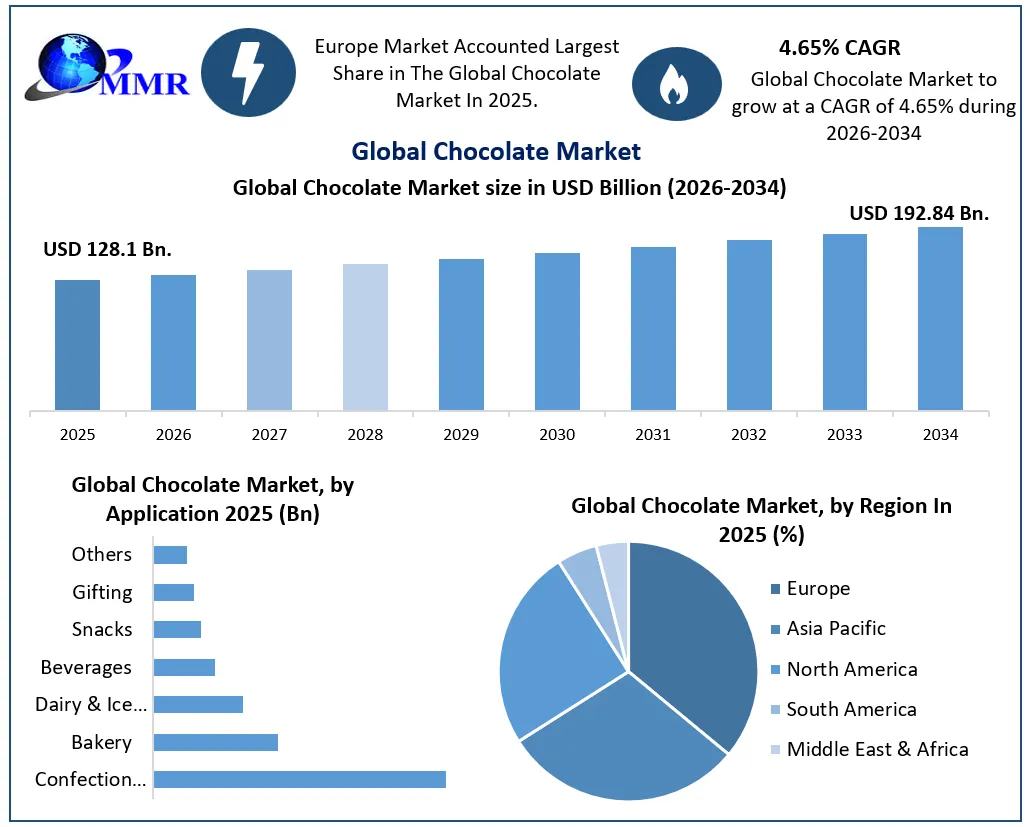
The Global Chocolate Market is expected to grow at a CAGR of 4.65%, rising from USD 128.1 billion in 2025 to USD 192.84 billion by 2034. Market growth is driven by increasing consumer demand for premium, dark, and artisanal chocolates, as well as sugar-free and organic options, alongside urbanization and changing global lifestyles.

Global Chocolate Market Overview:

Chocolate, one of the most widely consumed confectioneries globally, is increasingly shifting toward premium, dark, and artisanal varieties as health-conscious and indulgent consumer preferences rise. In 2024–2025, global cocoa consumption reached approximately 4.8 million tonnes, with premium segments capturing notable value despite a smaller share of total volume. Europe continues to lead consumption, with over 950,000 metric tons of premium chocolate sold, and overall chocolate intake exceeding 2 million metric tons across major markets. Countries such as India, China, and Japan are expecting the fastest growth in chocolate consumption, driven by urbanization, rising disposable incomes, and evolving taste preferences. Opportunities exist in sugar-free, organic, and clean-label chocolate segments, though cocoa price volatility and supply challenges continue to pressure margins and influence product volumes and pricing strategies.

Global Chocolate Market Size Growth Outlook (2025–2034)
Chocolate Market Growth Outlook

To know about the Research Methodology :- Request Free Sample Report

Key Highlights:

• Strong Cocoa Trade Supports Chocolate Supply: cocoa bean and semi-finished product exports rose nearly 6% year-on-year in early 2025, ensuring steady raw material flows for global chocolate manufacturers despite earlier supply disruptions.
• Input Tightness Continues to Shape Production: Lower cocoa output in the 2023/24 season continues to impact chocolate production planning in 2025, encouraging manufacturers to optimize formulations, pricing strategies, and inventory management.
• Cost Pressures Ease but Remain Elevated: Cocoa prices corrected by over 30% in 2025 from late-2024 record highs, providing partial cost relief for chocolate producers, though prices remain well above historical averages.
• Volatile Raw Material Environment: Ongoing price sensitivity to weather conditions, stock levels, and supply forecasts keeps procurement risks high for chocolate makers in 2025.
• Moderate Supply Improvement Outlook: A small projected cocoa surplus for 2024/25 signals gradual supply stabilization, but limited availability continues to support firm cocoa prices, influencing chocolate pricing and margins.
• Market Adaptation Accelerates: Chocolate manufacturers in 2025 increasingly focus on premiumization, portion control, and reformulation to manage input volatility while sustaining demand.

Trends – Premiumization and Increasing Demand for Dark and Artisanal Chocolates.

The global chocolate industry is undergoing a structural shift toward premiumization, as consumers increasingly prefer dark, single-origin, and artisanal chocolates with higher cocoa content and perceived health benefits. These products appeal due to higher cocoa content, superior quality, and perceived health benefits, especially among affluent and health-conscious consumers. Sustained industrial activity, coupled with robust cocoa supply and growing per-capita availability, supports innovation in premium and artisanal chocolates, creating opportunities for differentiated product offerings and niche market growth .

• High-quality fine flavor cocoa is increasingly central to artisanal chocolate market growth, supporting innovation in premium and dark chocolate segments.
• Sustained cocoa per-capita availability was more than 0.710 kg/person in 2025 underpin stable global chocolate market size and forecast, enabling broader consumption of premium, dark, and artisanal chocolates.

Drivers – Growing Consumer Preference for Premium and Dark Chocolate Variants

The Global Chocolate Industry is experiencing steady growth, driven by a structural shift toward premium and dark chocolate variants as consumer lifestyles evolve and health awareness rises. Rising discretionary spending, supported by global GDP per capita of nearly more than USD 12,647 in 2025, enables higher demand for quality chocolate products. Urbanization, reaching 57.7% globally, improves market access through organized and specialty retail channels. While the 15–29 age cohort, representing around 17% of the global population, shows strong preference for indulgent, artisanal, and dark chocolates.

Opportunities – Expansion of Sugar-Free, Vegan, Organic, and Clean-Label Chocolate Segments

The Global Chocolate Market offers substantial growth potential in specialty segments, driven by evolving consumer preferences, health awareness, and sustainability trends. Premium, artisanal, sugar-free, vegan, organic, and clean-label chocolates represent key areas for strategic market differentiation.
• Certified Organic Agriculture: By 2023, 98.9 million hectares globally were managed under certified organic systems, providing a robust supply foundation for premium, health-oriented, and sustainable chocolate production.
• Organic Producer Base: With 4.3 million certified organic producers worldwide as of 2022, chocolate manufacturers can scale sourcing for artisanal, vegan, and functional product innovation.
• Sugar Reduction Policies: Increasing emphasis on limiting free sugar to below 10% of daily energy intake drives innovation in sugar-free and low-sugar chocolate variants.

Restraints – Volatility in Cocoa Prices Impacting Costs and Margins

The Global Chocolate Market faces constraints from high volatility in cocoa prices, which significantly affects production costs, profit margins, and financial planning. Cocoa prices surged to USD 4,452.60 per tonne in 2024, with short-term spikes exceeding USD 6,000 per tonne in October 2024. The cocoa price index increased by Nearly 60% from 2020 to 2024, while futures averaged USD 4,980 per tonne in January 2025, reflecting ongoing market sensitivity. Rising freight and import costs intensify financial pressure, challenging manufacturers to maintain cost efficiency and risk mitigation.

• Cocoa import costs rose nearly 28% in 2023, while bulk cocoa transport and freight rates increased by 19% in 2024, significantly raising production and logistics expenses.
• Manufacturers are mitigating margin pressure through forward contracts, futures trading, diversified sourcing, and improved energy efficiency, packaging optimization, and supply chain resilience.

Global Chocolate Market Segment Analysis

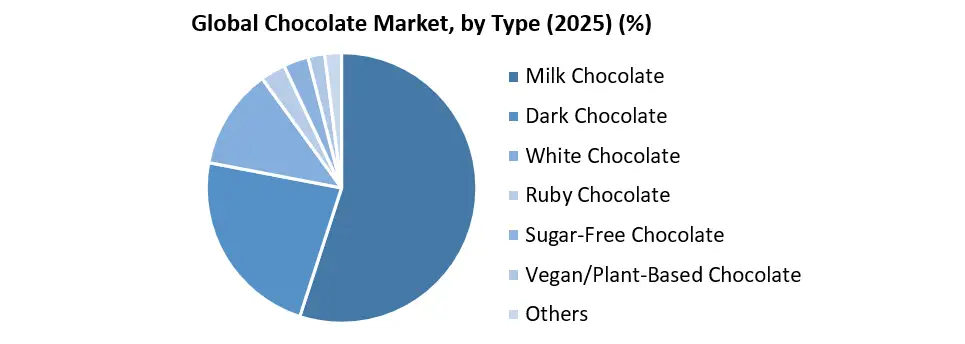
by Type, The type segment of the global chocolate market includes milk chocolate, dark chocolate, white chocolate, ruby chocolate, sugar-free chocolate, vegan/plant-based chocolate, and others. The market offers diverse chocolate varieties to meet changing consumer preferences for taste, cocoa content, nutritional value, and dietary requirements. Growing demand for premium chocolate, clean-label ingredients, reduced-sugar products, and plant-based alternatives supports product innovation and expands the consumer base across different age groups and income categories.
Chocolate Market, by Type

by Product Form, The product form segment of the global chocolate market includes molded chocolate, countline, chocolate bars/tablets, filled chocolate, chocolate chips and drops, seasonal/gifting chocolate, and others. Manufacturers offer chocolate in diverse formats to cater to everyday consumption, impulse purchases, premium indulgence, baking requirements, and gifting occasions. Product innovation, attractive packaging, portion-controlled formats, and the expansion of premium chocolate collections strengthen demand across retail, foodservice, and commercial applications.

by Application, The application segment of the global chocolate market includes confectionery, bakery, dairy and ice cream, beverages, snacks, gifting, and others. Chocolate serves as a key ingredient and flavor component across multiple food and beverage categories, supporting its widespread use in both direct consumption and processed products. Increasing demand for chocolate-based desserts, bakery products, ice creams, flavored beverages, and indulgent snacks drives market expansion, while seasonal celebrations and gifting traditions further strengthen chocolate consumption worldwide.

Regional Insights of Global Chocolate Market.

Europe dominated the Global Chocolate Market in 2025, driven by retail networks and strong seasonal demand, with holiday demand rising 10–15% annually, boosting premium and dark chocolate adoption. While it has high-consumption, mature market, with more than 6.2 kg per-capita intake in 2025 and growing preference for premium, organic, and ethically sourced chocolates. Asia-Pacific leads as the fastest-growing region, with India USD 2.9B (2024) and China more than 0.7 kg per capita in 2025, accelerating premium, dark, and sugar-free chocolate adoption globally.
• Europe experiences 10–15% seasonal sales growth during holidays, while Brazil imported 150,000 MT of chocolate/cocoa products in 2025, reflecting expanding market activity.
• UAE imported more than 45,000 MT in 2025, highlighting premium chocolate demand, and e-commerce with urban retail channels drive chocolate accessibility across Asia-Pacific.

Europe Chocolate Market – Penetration by Country 2025 (%)

Global Chocolate Market – Competitive Landscape

• The global chocolate market is dominated by major players such as Mars, Ferrero, Mondelēz International, Nestlé, and Hershey, which strengthen their positions through extensive product portfolios, global distribution networks, and continuous product innovation. Premium brands such as Lindt, Godiva, Valrhona, and Ghirardelli focus on premiumization and specialty chocolate offerings.

• In 2026, competition intensifies through sustainable cocoa sourcing, product launches, and premium flavor innovation. Mars expands responsible cocoa sourcing, Ferrero introduces new Wonka products through its Netflix partnership, and Mondelēz strengthens its Cocoa Life initiatives, supporting brand differentiation and long-term market competitiveness.

Global Chocolate Market- Recent Developments:

Company Year Recent Development Impact / Business Implication
Mars, Inc. 2026 Released its Cocoa for Generations 2025 Progress Report, achieving 98% of its 2025 cocoa volume through its Responsibly Sourced Cocoa Program, with deforestation- and conversion-free sourcing milestones. Strengthens sustainable cocoa sourcing, improves supply chain traceability, supports farmer communities, and enhances long-term raw material security.
Ferrero Group 2026 Unveiled a new Wonka product range featuring ten seasonal and limited-edition launches across chocolate, sugar confectionery, ice cream, and cereals, alongside a global partnership with Netflix. Expands product innovation, strengthens brand visibility, and increases consumer engagement through entertainment-led marketing and seasonal confectionery offerings. PR Newswire
Mondelēz International 2026 Introduced a limited-edition Cadbury Dairy Milk Silk Dubai Chocolate in India, bringing the popular Dubai-inspired dessert concept to the premium chocolate segment. Strengthens premium chocolate positioning, attracts consumers seeking innovative flavors, and expands demand for indulgent chocolate products.
Nestlé S.A. 2026 Expanded cocoa sourcing in Brazil by establishing relationships with hundreds of cocoa farms and promoting regenerative agricultural practices to improve yields, cocoa quality, and fertilizer efficiency. Diversifies cocoa procurement, improves supply chain resilience, reduces dependence on traditional sourcing regions, and supports sustainable cocoa production.
The Hershey Company 2026 Launched Hershey's Creme Bars in Salted Caramel and Affogato flavors, supported by a promotional partnership with global girl group KATSEYE. Broadens the chocolate product portfolio, encourages flavor experimentation, attracts younger consumers, and strengthens brand engagement through innovative marketing.

Chocolate Market Scope: Inquire before buying

Global Chocolate Market
Report Coverage Details
Base Year: 2025 Forecast Period: 2026-2034
Historical Data: 2020 to 2025 Market Size in 2025: USD 128.1 Bn.
Forecast Period 2026 to 2034 CAGR: 4.65% Market Size in 2034: USD 192.84 Bn.
Segments Covered: by Type Milk Chocolate
Dark Chocolate
White Chocolate
Ruby Chocolate
Sugar-Free Chocolate
Vegan/Plant-Based Chocolate
Others
by Product Form Molded Chocolate
Countline
Chocolate Bars/Tablets
Filled Chocolate
Chocolate Chips & Drops
Seasonal/Gifting Chocolate
Others
by Cocoa Content Low Cocoa Content
Medium Cocoa Content
High Cocoa Content
Extra Dark Chocolate
by Nature Organic
Conventional
by Ingredient Type Standard Chocolate
Functional Chocolate
Protein-Enriched Chocolate
Probiotic Chocolate
Cocoa-Free Chocolate Alternatives
by Price Range Economy
Mid-Range
Premium
Luxury/Artisanal
by Packaging Type Pouches & Bags
Boxed Chocolate
Single Packs
Gift Packs
Sustainable Packaging
Others
by Distribution Channel Supermarkets/Hypermarkets
Convenience Stores
Online Retail Stores
Specialty Stores
Duty-Free & Travel Retail
Others
by End User Retail & Consumer
Foodservice & HoReCa
Bakery & Confectionery Industry
Ice Cream & Dessert Industry
Industrial Chocolate Processing
Others
by Application Confectionery
Bakery
Dairy & Ice Cream
Beverages
Snacks
Gifting
Others

Chocolate Market, by Region

North America (United States, Canada and Mexico)
Europe (UK, France, Germany, Italy, Spain, Sweden, Austria and Rest of Europe)
Asia Pacific (China, South Korea, Japan, India, Australia, Indonesia, Malaysia, Vietnam, Taiwan, Bangladesh, Pakistan and Rest of APAC)
Middle East and Africa (South Africa, GCC, Egypt, Nigeria and Rest of ME&A)
South America (Brazil, Argentina Rest of South America)

Global Chocolate Market, Key Players:

North America
1. The Hershey Company
2. Mars, Incorporated
3. Mondelez International
4. Ghirardelli Chocolate Company
5. Russell Stover Chocolates
6. Theo Chocolate
7. TCHO Chocolate
8. Dandelion Chocolate
9. Vosges Haut-Chocolat
10. Compartés
11. L.A. Burdick
12. Endangered Species Chocolate

Europe
1. Ferrero Group
2. Chocoladefabriken Lindt & Sprüngli AG
3. Nestlé S.A.
4. Godiva Chocolatier
5. Chocolaterie Guylian
6. Neuhaus
7. Leonidas
8. Läderach
9. Venchi
10. Valrhona
11. Michel Cluizel
12. La Maison du Chocolat
13. Pierre Marcolini
14. Amedei
15. Domori
16. Debauve & Gallais
17. Tony's Chocolonely
18. Hotel Chocolat
19. Loacker
20. Pladis Global
21. Roshen Confectionery Corporation

Asia-Pacific
1. Meiji Holdings Co., Ltd.
2. Morinaga & Co., Ltd.
3. Ezaki Glico Co., Ltd.
4. Lotte Confectionery Co., Ltd.
5. Orion Corporation
6. Royce' Chocolate
7. Fu Wan Chocolate
8. Smoor
9. Theobroma
10. Paul and Mike
11. Mason & Co

Middle East
1. Patchi

South America
1. Pacari

FAQs Of Global Chocolate Market:

Q1: What is the global chocolate market size and forecast for 2025–2034?
A: The global chocolate market size was valued at USD 128.1 billion in 2025 and is forecast to reach USD 192.84 billion by 2034, growing at a CAGR of 4.65%.

Q2: Which region dominates the global chocolate market share?
A: Europe dominates the global chocolate market share due to the highest per-capita consumption and strong demand for premium and dark chocolates.

Q3: What are the key trends driving global chocolate market growth?
A: Premiumization, rising demand for dark and artisanal chocolates, and growing adoption of sugar-free, organic, and clean-label products are the key growth trends.

Q4: Why is dark chocolate gaining popularity worldwide?
A: Dark chocolate is gaining popularity globally due to its higher cocoa content, perceived health benefits, and increasing consumer health awareness.

Q5: How does cocoa price volatility affect the global chocolate industry?
A: Cocoa price volatility increases production costs and margin pressure, pushing manufacturers to adopt hedging strategies, sustainable sourcing, and cost optimization.

Table of Contents

1. SECTION – GLOBAL CHOCOLATE MARKET INTRODUCTION 1.1. Global Chocolate Market Landscape and Industry Overview 1.1.1 Global Chocolate Market Size (Value USD Mn & Volume Metric Tons), 2025–2034 1.1.2 Historical Market Size Trends and Growth Momentum Analysis 1.1.3 Forecast Revenue Projections and Key Growth Drivers 1.1.4 Demand-Supply Balance and Market Expansion Potential 1.1.5 Impact of Macroeconomic Indicators on Chocolate Market Growth 1.1.6 Seasonal Consumption Patterns Affecting Revenue Generation 1.1.7 Long-Term Market Outlook and Structural Growth Opportunities 1.2. Global Chocolate Market Dynamics 1.2.1 Market Trends 1.2.2 Market Dynamics 1.2.3 Market Drivers 1.2.4 Market Restraints 1.2.5 Opportunities 1.2.6 Challenges 1.2.7 PORTER’s Five Forces Analysis 1.2.8 PESTLE Analysis 1.3. Chocolate Value Chain and Ecosystem Analysis 1.3.1 Raw material suppliers including cocoa beans, sugar, dairy ingredients, and flavoring agents 1.3.2 Cocoa processing and chocolate manufacturing ecosystem 1.3.3 Role of contract manufacturers and private-label production 1.3.4 Distribution network including wholesalers, supermarkets, specialty stores, and e-commerce channels 1.3.5 End-use applications across confectionery, bakery, frozen desserts, beverages, and foodservice 1.3.6 Value addition across sourcing, processing, branding, and retail stages 1.3.7 Margin analysis across farmers, processors, manufacturers, distributors, and retailers 1.3.8 Digital traceability systems and transparency initiatives within cocoa supply chain 1.4. Cocoa & Chocolate Production, Processing & Capacity Analysis(2025) 1.4.1 Cocoa Bean Processing and Chocolate Manufacturing Capacity in Belgium 1.4.2 Cocoa Grinding, Refining, Conching, Tempering and Molding Infrastructure 1.4.3 Processing Technology Adoption and Manufacturing Efficiency in Belgium 1.4.4 Global chocolate production volume by product category 1.4.5 Regional manufacturing capacity distribution 1.4.6 Capacity utilization trends among major chocolate-producing countries 1.4.7 Chocolate manufacturing workflow including roasting, refining, conching, tempering, and molding 1.4.8 Automation and robotics adoption in chocolate processing facilities 1.4.9 Production efficiency improvement strategies adopted by manufacturers 1.4.10 Operational challenges related to raw material availability and energy costs 1.4.11 Impact of seasonal demand fluctuations on production planning 1.4.12 Expansion of premium and artisanal chocolate manufacturing facilities 1.4.13 Waste reduction and manufacturing sustainability initiatives 1.5. Cocoa Tonnage and Physical Supply Analysis 1.5.1 Global cocoa bean production volume and tonnage trends, 2020–2025 1.5.2 Cocoa grinding, processing, and utilization volumes across major markets 1.5.3 Cocoa consumption volumes associated with global chocolate manufacturing 1.5.4 Cocoa bean import and export volumes by major countries 1.5.5 Production and utilization trends across leading cocoa-producing countries 1.5.6 Regional cocoa tonnage distribution and supply concentration analysis 1.5.7 Global cocoa inventory, stocks, and supply availability assessment 1.5.8 Cocoa supply-demand balance and production-consumption gap in MT 1.6. Cocoa Source and Origin Analysis 1.6.1 Major cocoa-producing countries and principal sourcing regions 1.6.2 Cocoa sourcing distribution across West Africa, Latin America, and Asia-Pacific 1.6.3 Country-level cocoa production, exports, and sourcing tonnage 1.6.4 Major cocoa origins supplying global chocolate manufacturers and processors 1.6.5 Direct, cooperative, trader, and intermediary-based cocoa sourcing structures 1.6.6 Single-origin versus multi-origin cocoa sourcing strategies 1.6.7 Premium, specialty, organic, and certified cocoa sourcing trends 1.6.8 Traceability, sustainability, and responsible sourcing requirements by origin 1.7. Cocoa Bean Variety and Quality Analysis 1.7.1 Forastero cocoa characteristics, availability, and chocolate applications 1.7.2 Criollo cocoa characteristics, availability, and premium positioning 1.7.3 Trinitario cocoa characteristics, production regions, and applications 1.7.4 Fine-flavor cocoa characteristics and specialty chocolate applications 1.7.5 Cocoa bean variety availability across major producing countries 1.7.6 Bulk versus premium cocoa varieties across global supply chains 1.7.7 Influence of bean variety on flavor, quality, processing, and pricing 1.7.8 Emerging demand for differentiated, specialty, and origin-specific cocoa varieties 1.8. Industry Supply Chain Analysis 1.8.1 Global sourcing patterns for cocoa, sugar, milk powder, and cocoa butter 1.8.2 Supply chain mapping from cocoa farms to finished chocolate products 1.8.3 Distribution flow from manufacturers to retailers and end consumers 1.8.4 Role of logistics providers and cold-chain infrastructure in chocolate transportation 1.8.5 Regional supply-demand imbalance analysis 1.8.6 Impact of geopolitical tensions and trade disruptions on cocoa sourcing 1.8.7 Supplier diversification and procurement risk management strategies 1.8.8 Inventory optimization and warehousing practices 1.8.9 Role of export-import networks in global chocolate trade 1.8.10 Supply chain dependencies on major cocoa-producing countries 1.8.11 Traceability and transparency trends in cocoa procurement 1.9. Cost Structure Analysis (2025) 1.9.1 Raw material cost contribution by cocoa, sugar, dairy ingredients, and packaging materials 1.9.2 Manufacturing and processing cost analysis 1.9.3 Energy consumption and utility cost structure 1.9.4 Labor, administration, and operational overhead analysis 1.9.5 Transportation, warehousing, and distribution cost breakdown 1.9.6 Profit margin comparison by chocolate category 1.9.7 Cost impact of sustainable packaging and ethical sourcing initiatives 1.9.8 Effect of commodity price fluctuations on manufacturing profitability 1.9.9 Regional production cost comparison across key manufacturing hubs 1.9.10 Cost optimization through automation and operational efficiency improvements 1.10. Pricing Analysis & Regional Benchmarking (2025) 1.10.1 Average selling price analysis by chocolate type and product category 1.10.2 Regional pricing comparison across developed and emerging markets 1.10.3 Impact of cocoa price movements on retail and industrial chocolate pricing 1.10.4 Historical pricing trend assessment (2020–2025) 1.10.5 Forecast pricing outlook (2025–2034) 1.10.6 Premium pricing strategies adopted by luxury chocolate brands 1.10.7 Price sensitivity analysis across consumer segments 1.10.8 Online versus offline retail pricing comparison 1.10.9 Impact of inflation and exchange rate fluctuations on product pricing 1.10.10 Competitive pricing strategies among multinational and regional brands 1.11. Sustainability & Regulatory Landscape 1.11.1 Ethical cocoa sourcing programs and certification frameworks 1.11.2 Adoption of recyclable, compostable, and biodegradable packaging materials 1.11.3 Carbon footprint reduction initiatives across manufacturing operations 1.11.4 Circular economy practices in chocolate packaging and waste management 1.11.5 Government regulations on food safety, labeling, and ingredient disclosure 1.11.6 Organic certification and sustainability compliance requirements 1.11.7 Impact of environmental regulations on manufacturing and packaging costs 1.11.8 Sustainable farming practices and regenerative agriculture initiatives 1.11.9 Corporate ESG commitments and sustainability benchmarking among leading brands 1.12. Demand Analysis by End-Use Industry (2025) 1.12.1 Retail and household chocolate consumption analysis 1.12.2 Chocolate demand from bakery and confectionery manufacturers 1.12.3 Application of chocolate in dairy products and frozen desserts 1.12.4 Consumption trends within the foodservice and HoReCa sector 1.12.5 Industrial chocolate demand from processed food manufacturers 1.12.6 Demand for functional and wellness-oriented chocolate products 1.12.7 Seasonal and festive chocolate demand trends 1.12.8 Commercial demand from cafes, restaurants, and quick-service chains 1.12.9 Regional consumption analysis by application industry 1.12.10 Influence of premiumization on end-use demand patterns 1.13. Chocolate Product Landscape & Category Insights 1.13.1 Milk chocolate market performance and consumption trends 1.13.2 Dark chocolate demand analysis by cocoa percentage 1.13.3 White chocolate market trends and innovation analysis 1.13.4 Functional chocolate product development and market outlook 1.13.5 Plant-based and vegan chocolate segment analysis 1.13.6 Sugar-free chocolate adoption trends among health-conscious consumers 1.13.7 Cocoa-free chocolate alternative product landscape 1.13.8 Premium and artisanal chocolate market positioning 1.13.9 Organic and preservative-free chocolate category analysis 1.13.10 Emerging flavor and ingredient trends across chocolate categories 1.13.11 Regional milk chocolate versus dark chocolate preference analysis 1.13.12 White chocolate and compound chocolate consumption trends by geography 1.13.13 Demand for nut-based, fruit-filled, caramel, wafer, and biscuit chocolate variants 1.13.14 Flavor localization strategies across regional markets 1.13.15 Adoption of local flavors including matcha, saffron, chili, cardamom, coconut, sesame, sea salt, and berries 1.13.16 Sweetness preference variation across developed and emerging markets 1.13.17 Texture preference analysis including filled, molded, coated, crunchy, aerated, and wafer-based chocolates 1.14. Capacity Expansion & Investment Landscape 1.14.1 Regional manufacturing capacity expansion analysis 1.14.2 Investment trends in premium and specialty chocolate production 1.14.3 Greenfield and brownfield project assessment 1.14.4 Capital expenditure trends across manufacturing facilities 1.14.5 Feasibility analysis for new chocolate processing plants 1.14.6 Entry barriers related to sourcing, branding, and distribution 1.14.7 Strategic partnerships, mergers, and acquisition activity 1.14.8 Expansion strategies adopted by leading global manufacturers 1.14.9 Automation-related investments in production efficiency 1.14.10 Expansion of private-label chocolate manufacturing capabilities 1.14.11 Co-manufacturing and contract manufacturing opportunities in premium chocolate 1.14.12 Investment by retailers in in-house chocolate production facilities 1.14.13 Strategic partnerships between branded companies and private-label manufacturers 1.15. Technology & Innovation Outlook 1.15.1 Advanced chocolate processing and automated production technologies 1.15.2 AI-enabled quality inspection and defect detection systems 1.15.3 Precision tempering, molding, and enrobing innovations 1.15.4 Sustainable cocoa processing and energy-efficient manufacturing solutions 1.15.5 Innovation in sugar reduction and alternative sweetener formulations 1.15.6 Plant-based and dairy-free chocolate ingredient advancements 1.15.7 Functional ingredient integration including protein, probiotics, and adaptogens 1.15.8 Clean-label formulation and preservative-free product innovation 1.15.9 Shelf-life enhancement and freshness preservation technologies 1.15.10 Premium packaging customization and digital printing advancements 1.15.11 Automation in chocolate packaging and sorting operations 1.15.12 R&D investments in sustainable cocoa alternatives and cocoa-free chocolate 1.15.13 Innovation in bean-to-bar and artisanal chocolate manufacturing processes 1.15.14 Belgium Cocoa & Chocolate R&D and Innovation Ecosystem 1.15.15 Industry–Research Institute Collaboration and Technology Transfer 1.15.16 Pilot-Scale Processing and Product Development Capabilities 1.15.17 Patent and Innovation Activity in Cocoa Processing and Chocolate Manufacturing 1.16. Belgium Cocoa & Chocolate Industry Skills, Training & Workforce Development 1.16.1 Cocoa & Chocolate Processing Workforce Landscape 1.16.2 Technical and Vocational Training Programs for Cocoa & Chocolate Processing 1.16.3 Chocolate Manufacturing, Confectionery and Craftsmanship Training 1.16.4 Food Safety, Quality Control and Processing Skills Development 1.16.5 Advanced Manufacturing, Automation and Digital Skills Training 1.16.6 R&D, Product Development and Innovation Skills Requirements 1.16.7 Industry–Academia Collaboration and Knowledge Transfer Programs 1.16.8 Workforce Skill-Gap and Talent Availability Assessment 1.16.9 Employee Upskilling and Continuous Professional Development 1.16.10 Future Workforce and Emerging Skill Requirements, 2025–2034 1.17. Trade & Import-Export Analysis (2025) 1.17.1 Global chocolate trade flow analysis by value and volume 1.17.2 Key exporting and importing countries for cocoa and chocolate products 1.17.3 Impact of tariffs and trade regulations on international market access 1.17.4 Import dependency analysis across major consuming countries 1.17.5 Export competitiveness of key manufacturing regions 1.17.6 Influence of geopolitical and economic conditions on trade patterns 1.18. Marketing & Branding Trends 1.18.1 Brand positioning strategies across premium and mass-market categories 1.18.2 Growth of personalized and gifting-oriented chocolate campaigns 1.18.3 Luxury branding and artisanal storytelling approaches 1.18.4 Digital advertising and influencer-driven marketing trends 1.18.5 Private-label chocolate branding developments 1.18.6 Seasonal and festival-based promotional campaigns 1.18.7 Consumer engagement through experiential and limited-edition launches 1.18.8 Social media-driven product discovery and purchasing behavior 1.18.9 Competitive benchmarking between branded and private-label chocolate products 1.18.10 Retailer-owned premium chocolate branding strategies 1.18.11 Consumer perception shift toward premium private-label chocolates 1.18.12 Packaging differentiation strategies between branded and retailer-owned products 1.19. Investment & Financial Analysis 1.19.1 Profitability analysis by chocolate category and pricing segment 1.19.2 Capital allocation trends across production and distribution operations 1.19.3 Payback period assessment for manufacturing investments 1.19.4 Financial benchmarking of leading chocolate manufacturers 1.19.5 Risk analysis associated with cocoa sourcing and commodity volatility 1.19.6 Sensitivity analysis for raw material and logistics cost fluctuations 1.19.7 Long-term investment opportunities in sustainable chocolate production 1.19.8 Return on investment for automation and digital transformation initiatives 1.19.9 Regional investment attractiveness analysis 1.19.10 Funding trends for premium and innovative chocolate startups 1.20. Consumer Purchasing Behavior Analysis 1.20.1 Consumer purchasing behavior by product category and demographic group 1.20.2 Preference analysis for premium versus economy chocolate products 1.20.3 Influence of sustainability claims on consumer purchasing patterns 1.20.4 Online shopping behavior and digital purchase trends 1.20.5 Procurement criteria adopted by industrial chocolate buyers 1.20.6 Bulk purchasing trends within foodservice and manufacturing sectors 1.20.7 Brand loyalty and repeat purchase analysis 1.20.8 Impulse purchase behavior across premium and mass-market categories 1.20.9 Consumer response to chocolate price increases 1.20.10 Pack-size sensitivity analysis across income groups 1.20.11 Gifting versus self-consumption purchasing behavior 1.20.12 Urban versus rural chocolate consumption trends 1.20.13 Willingness to pay for ethical, organic, and premium chocolate products 1.20.14 Promotional buying versus brand loyalty analysis 1.20.15 Consumer preference trends among millennials, Gen Z, children, and older demographics 1.20.16 Health-conscious consumer behavior influencing low-sugar and functional chocolate demand 1.21. Digitalization & Industry 4.0 Adoption 1.21.1 Automation in chocolate processing and packaging operations 1.21.2 IoT-enabled monitoring for temperature, quality, and production efficiency 1.21.3 AI-based quality inspection and predictive maintenance systems 1.21.4 Digital inventory, warehouse, and supply chain management solutions 1.21.5 Blockchain and data analytics integration for cocoa traceability and demand forecasting 1.22. Chocolate Packaging & Performance Analysis 1.22.1 Packaging durability and protection performance analysis 1.22.2 Shelf-life extension technologies for chocolate products 1.22.3 Premium packaging formats enhancing visual appeal and gifting value 1.22.4 Lightweight and sustainable packaging material innovations 1.22.5 Barrier packaging technologies for freshness and temperature protection 1.22.6 Convenience-focused packaging solutions for on-the-go consumption 1.22.7 Transportation efficiency and packaging optimization strategies 1.22.8 Customization and limited-edition packaging trends 1.22.9 Smart packaging applications for traceability and engagement 1.23. Sustainability Impact & Lifecycle Analysis – Chocolate Market 1.23.1 Sustainable cocoa sourcing and farming practices 1.23.2 Carbon emission reduction in manufacturing 1.23.3 Resource efficiency and waste management 1.23.4 ESG compliance and sustainability benchmarking 1.24. Regulatory Landscape and Compliance Framework 1.24.1 Overview of global chocolate industry regulations and compliance requirements 1.24.2 Food safety regulations and ingredient disclosure requirements 1.24.3 Sugar reduction policies and nutritional labeling mandates 1.24.4 Organic, Fair Trade, and sustainability certification standards 1.24.5 Regulations governing cocoa sourcing and traceability systems 1.24.6 Carbon emission norms and environmental sustainability mandates 1.24.7 Import-export regulations, tariffs, and cross-border compliance standards 1.24.8 Allergen labeling, transportation, and storage compliance requirements 1.24.9 Impact of regulatory changes on production costs and innovation strategies 1.24.10 Regional regulatory comparison across North America, Europe, and Asia-Pacific 1.24.11 Future regulatory outlook related to sustainability and food transparency standards 1.25. Chocolate Retail Experience and Store Innovation 1.25.1 Experiential retail concepts enhancing chocolate brand engagement 1.25.2 Store layout and design influence on purchasing behavior 1.25.3 In-store sampling strategies increasing product trial and conversion 1.25.4 Luxury retail ambience impact on brand perception 2. SECTION – COMPETITIVE INTELLIGENCE & INDUSTRIAL ECOSYSTEM 2.1. Chocolate Market: Competitive Landscape 2.1.1 MMR Competition Matrix 2.1.2 Competitive Positioning of Key Players 2.1.3 Company Profiles: Key Players 2.1.4 Overview 2.1.5 Business Portfolio 2.1.6 Financial Overview 2.1.7 SWOT Analysis 2.1.8 Strategic Analysis 2.1.9 Recent Developments 2.1.10 North America 2.1.11 The Hershey Company 2.1.12 Mars, Incorporated 2.1.13 Mondelez International 2.1.14 Ghirardelli Chocolate Company 2.1.15 Russell Stover Chocolates 2.1.16 Theo Chocolate 2.1.17 TCHO Chocolate 2.1.18 Dandelion Chocolate 2.1.19 Vosges Haut-Chocolat 2.1.20 Compartés 2.1.21 L.A. Burdick 2.1.22 Endangered Species Chocolate 2.1.23 Europe 2.1.24 Ferrero Group 2.1.25 Chocoladefabriken Lindt & Sprüngli AG 2.1.26 Nestlé S.A. 2.1.27 Godiva Chocolatier 2.1.28 Chocolaterie Guylian 2.1.29 Neuhaus 2.1.30 Leonidas Läderach 2.1.31 Venchi 2.1.32 Valrhona 2.1.33 Michel Cluizel 2.1.34 La Maison du Chocolat 2.1.35 Pierre Marcolini 2.1.36 Amedei 2.1.37 Domori 2.1.38 Debauve & Gallais 2.1.39 Tony's Chocolonely 2.1.40 Hotel Chocolat 2.1.41 Loacker 2.1.42 Pladis Global 2.1.43 Roshen Confectionery Corporation 2.1.44 Asia-Pacific 2.1.45 Meiji Holdings Co., Ltd. 2.1.46 Morinaga & Co., Ltd. 2.1.47 Ezaki Glico Co., Ltd. 2.1.48 Lotte Confectionery Co., Ltd. 2.1.49 Orion Corporation 2.1.50 Royce' Chocolate 2.1.51 Fu Wan Chocolate 2.1.52 Smoor 2.1.53 Theobroma 2.1.54 Paul and Mike 2.1.55 Mason & Co 2.1.56 Middle East 2.1.57 Patchi 2.1.58 South America 2.1.59 Pacari 2.1.60 Patchi 2.1.61 Others 2.2. Competitive Landscape and Market Structure Analysis 2.2.1 Market concentration and competitive intensity across the global chocolate industry 2.2.2 Tier-wise classification (global giants, regional brands, artisanal players) 2.2.3 Benchmarking across product quality, pricing, and innovation 2.2.4 Market fragmentation in premium vs mass-market segments 2.2.5 Entry barriers (branding, cocoa sourcing, distribution control) 2.3. Market Share Analysis and Strategic Positioning (2025) 2.3.1 Revenue-based market share analysis of leading chocolate companies 2.3.2 Positioning matrix (premium vs mass-market, global vs regional reach) 2.3.3 Competitive ranking of key global chocolate brands 2.3.4 Emergence of niche players (organic, vegan, bean-to-bar brands) 2.3.5 Market share evolution trends (2020–2025) 2.4. Product Portfolio and Technology Benchmarking 2.4.1 Product segmentation (milk, dark, white, filled, functional chocolate) 2.4.2 Cocoa percentage and quality benchmarking 2.4.3 Innovation in flavors, fillings, and formulations 2.4.4 Differentiation in packaging, branding, and premium positioning 2.4.5 R&D-driven product diversification strategies 2.5. Strategic Initiatives and Expansion Strategies 2.5.1 Mergers, acquisitions, and strategic alliances in chocolate sector 2.5.2 Expansion into emerging markets (Asia-Pacific, LATAM, MEA) 2.5.3 Investment in premium, organic, and sustainable chocolate segments 2.5.4 Partnerships with retail, e-commerce, and foodservice channels 2.5.5 Capacity expansion and global manufacturing investments 2.6. Pricing Strategy and Revenue Model Analysis 2.6.1 Pricing strategies across mass, premium, and luxury chocolate segments 2.6.2 Revenue models (retail sales, bulk supply, D2C, seasonal gifting) 2.6.3 Regional price variation and affordability analysis 2.6.4 Impact of cocoa price volatility on retail pricing 2.6.5 Margin structure across product categories 2.7. Innovation Pipeline and Patent Activity Analysis 2.7.1 Patent trends in chocolate formulations and processing technologies 2.7.2 Innovation in sugar reduction and functional chocolate products 2.7.3 Sustainable cocoa sourcing and traceability innovations 2.7.4 Smart packaging (QR codes, freshness tracking, anti-counterfeit tech) 2.7.5 Future R&D pipeline including cocoa alternatives and plant-based chocolate 2.8. Manufacturing Capabilities and Production Footprint 2.8.1 Global chocolate manufacturing footprint of major players 2.8.2 Production capacity and scalability across regions 2.8.3 Automation in chocolate production lines 2.8.4 Vertical integration from cocoa sourcing to finished product 2.8.5 Energy-efficient and sustainable manufacturing practices 3. SECTION – STRATEGIC OUTLOOK 3.1. Key Findings 3.2. Analyst Recommendation 3.3. Research Methodology

Custom Market Research Services

We Will Customise The Research For You, In Case The Report Listed Above Does Not Meet With Your Requirements