
Compressed Air Treatment Equipment Market Size by Product, Technology, End-use Industry and Distribution Channel
Overview
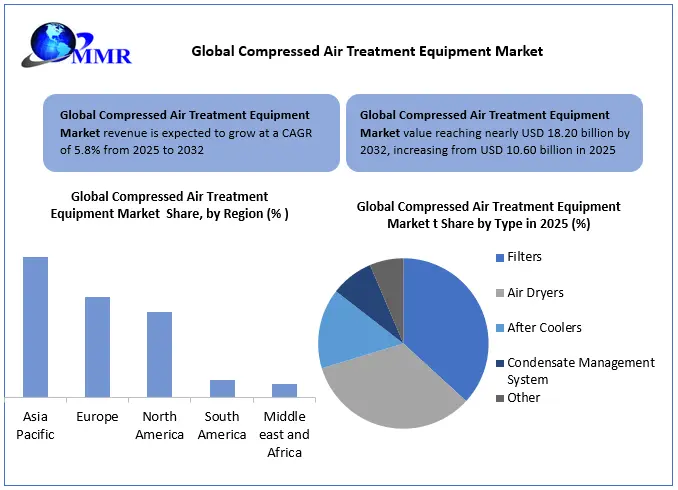
The Global Compressed Air Treatment Equipment Market was valued at USD 10.60 billion in 2025 and is estimated to reach USD 18.20 billion by 2032, expanding at a CAGR of 5.8% during the forecast period (2025–2032). The industry has been registering constant growth because many sectors have focused on high air quality, energy efficiency, high reliability of machinery, and high adherence to the tough industrial standards. Compressed air treatment equipment has been highly instrumental in the removal of moisture, oil, particles, and other forms of contaminants which may pose great risk to the pneumatic system.
The fast-growing manufacturing industries, especially in the developing countries of Asia-Pacific, is one of the major factors behind market growth. The automotive industry, food and beverage industry, pharmaceutical industry, electronics, chemical, and oil & gas industry need high-purity air compressors to ensure optimal performance and adhere to quality standards. Investments in automation and intelligent manufacturing technologies are expected to further drive the demand for filtration and condensate management solutions.
Stringent international standards governing compressed air purity, particularly in critical industries such as pharmaceuticals, food processing, healthcare, and electronics manufacturing, continue to strengthen market demand. Standards such as ISO 8573 encourage manufacturers to invest in high-performance air dryers, coalescing filters, activated carbon filters, and condensate management systems to ensure consistent air quality and minimize contamination risks.
Overall, increasing industrialization, rising awareness regarding compressed air quality, stringent regulatory compliance, and the growing need for energy-efficient manufacturing processes are expected to sustain long-term demand for compressed air treatment equipment across both developed and emerging markets.
For, instance:
• Asia-Pacific – 39.2%: Led the market due to rapid industrialization, manufacturing growth, and increasing adoption of automation technologies.
• Europe – 28.1%: Maintained a strong position with stringent air quality regulations and high demand from automotive and pharmaceutical industries.
• North America – 23.9%: Driven by advanced manufacturing, energy-efficient technologies, and modernization of industrial facilities.
• South America – 5.0%: Growth supported by expanding food & beverage, mining, and industrial manufacturing sectors across Brazil, Argentina, and Chile.
• Middle East & Africa – 3.8%: Witnessed steady demand from oil & gas, petrochemicals, and infrastructure development projects.
To know about the Research Methodology :- Request Free Sample Report
Global Compressed Air Treatment Equipment Market Dynamics
Rising Industrial Automation and Manufacturing Expansion
The increasing adoption of industrial automation and smart manufacturing is a major driver of the compressed air treatment equipment market. Industries including automotive, food & beverage, pharmaceuticals, electronics, and chemicals require high-quality compressed air to improve operational efficiency, protect equipment, and maintain product quality. Growing investments in manufacturing facilities and Industry 4.0 technologies are further accelerating market demand.
High Installation and Maintenance Costs
The high initial investment required for advanced compressed air treatment systems, along with ongoing maintenance and replacement of components such as filters and dryers, can discourage adoption among small and medium-sized enterprises. Budget constraints in developing economies also pose a challenge to market growth.
Global Compressed Air Treatment Equipment Market Opportunity:
Increasing Demand for Energy-Efficient Air Treatment Systems
Rising energy costs and sustainability initiatives are encouraging industries to adopt energy-efficient compressed air treatment equipment. The integration of IoT-enabled monitoring, predictive maintenance, and low-energy air dryers presents significant growth opportunities for manufacturers seeking to improve system performance and reduce operational costs.
Global Compressed Air Treatment Equipment Market Challenge:
Meeting Stringent Air Quality and Regulatory Standards
Manufacturers face the challenge of complying with increasingly stringent compressed air quality standards and environmental regulations across industries such as pharmaceuticals, food processing, and electronics. Ensuring consistent air purity while maintaining cost-effective operations requires continuous technological innovation and investment in advanced treatment solutions.
Global Compressed Air Treatment Equipment Market Trends
The Global Compressed Air Treatment Equipment Market is experiencing a very strong transition towards more efficient and intelligent air treatments due to the need for cutting operational costs and minimizing carbon footprint among various industries. More and more air dryers, high efficiency filters, and condensate management systems that consume less energy yet keep the compressed air at a good level are used by manufacturers. Internet of Things sensors are being used now in order to enable real-time monitoring of system performance, maintenance optimization, and improvement of equipment performance and reliability.
Yet another important development is the increased need for oil-free and contamination-free compressed air in vital sectors like pharma, food and beverages, electronic products, and healthcare. The growing stringent regulations and requirements with respect to air purity levels are prompting more and more manufacturers to make use of advanced filtration and drying technologies in order to maintain their product consistency and safety. Furthermore, with the advent of fast-paced industrial growth in developing nations, along with the growing investments in manufacturing facilities, there is increasing usage of advanced compressed air treatment machinery by the industry.
Global Compressed Air Treatment Equipment Regional Insight:
Asia-Pacific dominates the global compressed air treatment equipment market, driven by rapid industrialization, expanding manufacturing activities, and increasing investments in automotive, electronics, food & beverage, and pharmaceutical industries. China, Japan, India, and South Korea remain the major contributors to regional growth.
Europe holds a significant market share owing to stringent industrial air quality regulations, widespread adoption of energy-efficient technologies, and a strong manufacturing base. Germany, France, Italy, and the United Kingdom are the leading markets in the region.
North America is witnessing steady growth due to advanced industrial infrastructure, increasing automation, and rising demand for high-performance compressed air systems across automotive, aerospace, healthcare, and food processing industries. The United States remains the largest contributor.
South America is experiencing moderate growth, supported by expanding manufacturing, mining, and food & beverage industries. Brazil, Argentina, and Chile are the primary markets driving regional demand for compressed air treatment equipment.
The Middle East & Africa market is growing steadily due to increasing investments in oil & gas, petrochemicals, power generation, and industrial infrastructure. Saudi Arabia, the UAE, and South Africa are leading countries contributing to regional market expansion.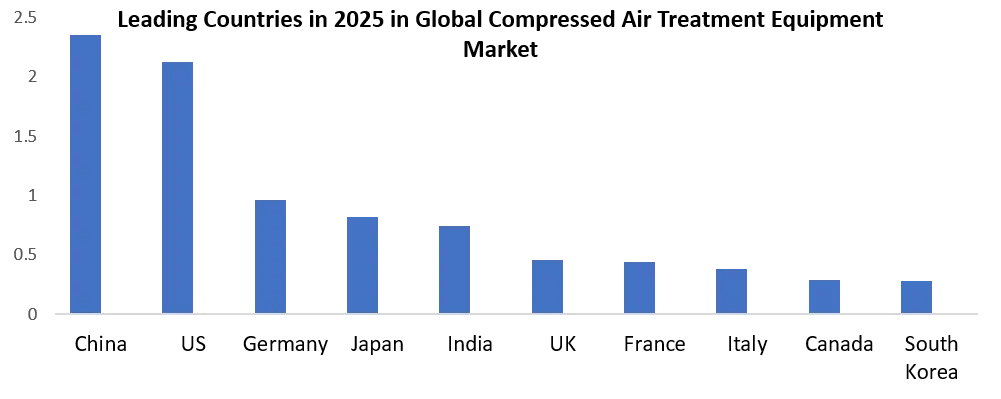
Global Compressed Air Treatment Equipment Competitive Landscape:
The Global Compressed Air Treatment Equipment Market is moderately consolidated, with a mix of established multinational companies and regional manufacturers competing through product innovation, energy-efficient technologies, and extensive distribution networks. Leading players are investing in advanced filtration systems, high-efficiency air dryers, IoT-enabled monitoring solutions, and sustainable compressed air treatment technologies to strengthen their market position. Strategic initiatives such as mergers and acquisitions, product launches, capacity expansions, and partnerships with industrial OEMs are common strategies adopted to expand global presence and enhance competitive advantage.
Competition is further intensified by the growing demand for customized compressed air treatment solutions across industries such as automotive, pharmaceuticals, food & beverage, electronics, chemicals, and oil & gas. Manufacturers are focusing on improving product reliability, reducing energy consumption, and offering comprehensive after-sales services to differentiate themselves. Additionally, increasing investments in smart manufacturing, digital monitoring, and predictive maintenance technologies are enabling key market participants to deliver integrated compressed air treatment solutions that improve operational efficiency and ensure compliance with stringent air quality standards.
Compressed Air Treatment Equipment Market Scope: Inquire before buying
| Compressed Air Treatment Equipment Market | |||
|---|---|---|---|
| Report Coverage | Details | ||
| Base Year: | 2025 | Forecast Period: | 2026-2032 |
| Historical Data: | 2020 to 2025 | Market Size in 2025: | USD 10.6 Bn. |
| Forecast Period 2026 to 2032 CAGR: | 5.8% | Market Size in 2032: | USD 18.2 Bn. |
| Segments Covered: | by Product | Filters Air Dryers Aftercoolers Condensate Management Systems Others |
|
| by Technology | Refrigerated Dryers Desiccant Dryers Membrane Dryers Coalescing Filters Activated Carbon Filters |
||
| by End-use Industry | Food & Beverage Pharmaceuticals & Healthcare Automotive, Electronics & Semiconductors Chemical & Petrochemical Oil & Gas General Manufacturing Power Generation Others |
||
| by Distribution Channel | Direct Sales Distributors OEMs Online Sales |
||
Compressed Air Treatment Equipment Market, by Region
North America (United States, Canada, and Mexico)
Europe (UK, France, Germany, Italy, Spain, Sweden, Austria, and the Rest of Europe)
Asia Pacific (China, South Korea, Japan, India, Australia, ASEAN, Indonesia, Philippines, Malaysia, Vietnam, Thailand, ASEAN, Rest of Asia Pacific)
Middle East & Africa (South Africa, GCC, Nigeria, Rest of ME&A)
South America (Brazil, Argentina, Rest of South America)
Global Compressed Air Treatment Equipment Key Players:
| Company Name | Region | Core Competencies |
| Atlas Copco AB | Sweden | Compressed air systems, air dryers, filtration solutions, industrial compressors |
| Ingersoll Rand Inc. | United States | Compressed air treatment equipment, industrial air systems, energy-efficient solutions |
| Parker Hannifin Corporation | United States | Compressed air filtration, gas separation, industrial filtration technologies |
| Donaldson Company, Inc. | United States | Industrial air filtration, compressed air purification, dust collection systems |
| KAESER KOMPRESSOREN SE | Germany | Air dryers, filters, compressed air management systems |
| Sullair, LLC | United States | Compressed air systems, air treatment packages, industrial compressors |
| BOGE Kompressoren Otto Boge GmbH & Co. KG | Germany | Compressed air treatment, oil-free compressors, filtration solutions |
| SPX FLOW, Inc. | United States | Industrial drying, filtration, compressed air processing technologies |
| MANN+HUMMEL Group | Germany | Industrial filtration, compressed air filters, separation technologies |
| BEKO TECHNOLOGIES GmbH | Germany | Compressed air dryers, condensate management, filtration systems |
| Pneumatech | Belgium | Air purification, adsorption dryers, nitrogen generators |
| Mikropor Makina A.Ş. | Türkiye | Compressed air filters, dryers, condensate treatment systems |
| AIRPRESS | Netherlands | Air compressors, dryers, filtration and accessories |
| Hankison International (SPX FLOW) | United States | Refrigerated and desiccant air dryers, filtration technologies |
| SMC Corporation | Japan | Pneumatic equipment, air preparation units, filtration systems |
| Festo SE & Co. KG | Germany | Pneumatic automation, compressed air preparation, smart air management |
| Hitachi Global Air Power | United States | Industrial compressors, air treatment systems, digital monitoring |
| Gardner Denver (Ingersoll Rand) | United States | Industrial compressors, air treatment equipment, aftermarket services |
| CompAir (Ingersoll Rand) | Germany | Compressed air systems, dryers, filtration technologies |
| Airtac International Group | Taiwan | Pneumatic components, FRL units, compressed air treatment |
| Camfil AB | Sweden | High-efficiency industrial air filtration, clean air solutions |
| Airfilter Engineering | India | Compressed air filters, industrial filtration systems |
| Ultrafilter GmbH | Germany | Compressed air purification, sterile filtration, gas filtration |
| Nano-Purification Solutions | United Kingdom | Air dryers, compressed air filtration, gas purification |
| Omega Air d.o.o. Ljubljana | Slovenia | Air dryers, filters, condensate management equipment |
| Walker Filtration Ltd. | United Kingdom | Compressed air filtration, gas purification, filtration media |
| Zeks Compressed Air Solutions | United States | Refrigerated dryers, desiccant dryers, filtration equipment |
| FS-Curtis | United States | Air compressors, compressed air dryers, filtration systems |
| Chicago Pneumatic | Belgium | Compressed air equipment, air treatment products, industrial compressors |
Frequently Asked Questions:
1. What is the projected market size of the Global Compressed Air Treatment Equipment Market by 2032?
The Global Compressed Air Treatment Equipment Market is projected to reach USD 18.20 billion by 2032, growing from USD 10.60 billion in 2025.
2. What is the expected CAGR of the Global Compressed Air Treatment Equipment Market during 2025–2032?
The market is expected to grow at a CAGR of approximately 5.8% during the forecast period.
3. Which region dominates the Global Compressed Air Treatment Equipment Market?
Asia-Pacific holds the largest market share, driven by rapid industrialization, manufacturing expansion, and increasing adoption of automation technologies.
4. Which product type holds the largest market share?
Filters account for the largest market share due to their essential role in removing contaminants and ensuring high-quality compressed air across industrial applications.
5. What are the key factors driving market growth?
Major growth drivers include rising industrial automation, increasing demand for energy-efficient compressed air systems, stringent air quality regulations, and expanding manufacturing activities worldwide.