
Cockpit Electronics Market– Industry Structure Evaluation, Demand Drivers Analysis, Regional Growth Analysis and Identification, Competitive Positioning Review & Global Market Size Forecast to 2034
Overview
The Cockpit Electronics Market for Automotive size was valued at USD 58.67 Bn. in 2025, and the total Cockpit Electronics Market for Automotive revenue is expected to grow at a CAGR of 4.5 % from 2026 to 2034, reaching nearly USD 87.19 Bn.
Cockpit Electronics Market for Automotive Overview
Cockpit Electronics for Automotive refers to advanced in-vehicle systems such as digital instrument clusters, infotainment displays, heads-up displays (HUDs), and driver monitoring systems. These integrated technologies enhance safety, connectivity, and user experience through intuitive interfaces and smart connectivity solutions.
Growing adoption of digital dashboards, infotainment, and ADAS fuels demand, while supply chain challenges, chip shortages, and production scalability impact the availability of automotive cockpit electronics.
Asia-Pacific leads the cockpit electronics market, driven by high automotive production in China, Japan, and India. Top players include Bosch, Continental, Visteon, Harman (Samsung), and Panasonic, dominating with advanced HMI and infotainment solutions.
The report cockpit electronics market is segmented into product, type, fuel type, Level of autonomous driving, end market, and region. In terms of product, the cockpit electronics market is categorized into a head-up display, infotainment display, infotainment & navigation, instrument cluster, telematics, and others. On the basis of type, the cockpit electronics market is classified into basic cockpit electronics and advanced cockpit electronics.
Based on fuel type, the cockpit electronics market is segmented into battery electric vehicles, internal combustion engines, and others. In terms of a level of autonomous driving, the cockpit electronics market is classified into conventional and semi-autonomous. Based on the end market, the cockpit electronics market is classified into the economic passenger car, mid-priced passenger car, and luxury passenger car. Region-wise, into North America, Europe, Asia Pacific, the Middle East & Africa, and Latin America.
Cockpit Electronics Market for Automotive Growth Share and Analysis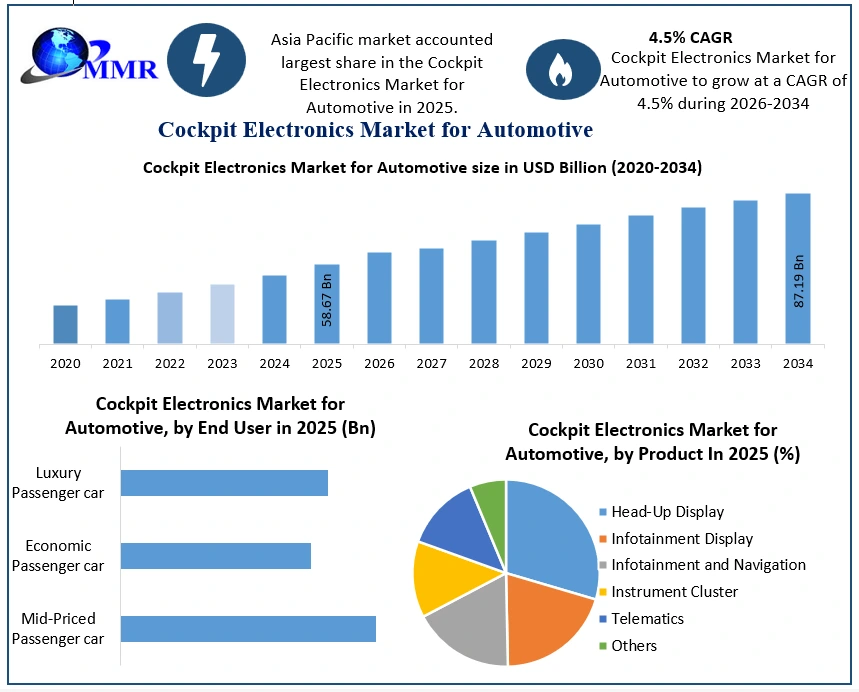
To know about the Research Methodology:- Request Free Sample Report
Electronics in the automotive industry has increased ease of driving, safety and also vies to provide quality infotainment. Cockpit electronics is a large market and have seen a high growth rate in recent times. This trend in growth for automotive cockpit electronics market is anticipated to continue over the upcoming years. Rising demand for enhanced user experience and convenience features are trending the overall Cockpit Electronics Market for automotive. However, a high cost of advanced cockpit electronic systems will restrain the market growth.
In terms of product, head-up display sub-segment is expected to gain the largest market share in the forecast period. Increasing awareness about safety features among consumers is expected to fuel the Head-up Display sub-segment growth. Based on the Fuel type segment is estimated to experience significant growth of the BEV sub-segment. This growth is attributed to the increased production of electric vehicles.
In terms of region, Asia-Pacific is going to emerge as one of the higher growth regions in forecast period followed by North America and Europe. Japan and South Korea’s presence, with their technological advancement, tremendous vehicle production, and cost-effective manufacturing in developing economies like China and India, will fuel the Cockpit Electronics Market for Automotive in the Asia-Pacific region.
Some of the key players in the cockpit electronics market are Bosch, Continental AG, Harman (Samsung), Visteon and Tesla.
Cockpit Electronics Market for Automotive Dynamics
Surging Demand for Connected Car Technologies to Boost the Cockpit Electronics Market for Automotive Growth
The rapid adoption of connected car features, such as real-time navigation, over-the-air (OTA) updates, and vehicle-to-everything (V2X) communication, is propelling the cockpit electronics market. Consumers increasingly expect seamless connectivity, infotainment, and advanced driver-assistance systems (ADAS) in modern vehicles. Automakers are integrating sophisticated cockpit systems to meet these demands, with a 5G-able platform and cloud-based services becoming standard in premium and mid-range vehicles. This trend is accelerated by the government mandates for carried out vehicle safety and telematics, the OEM is pushed to invest heavily in the next generation of cockpit electronics.
Semiconductor Supply Chain Disruptions to Create Restraint for the Cockpit Electronics Market for Automotive
The cockpit electronics market faces significant challenges due to semiconductor shortages and supply chain bottlenecks. Modern cockpit systems rely on advanced chips for displays, processors, and sensors, but geopolitical tensions, production delays, and uneven raw material availability have constrained supply. This has led to increased component costs, longer lead times, and delayed vehicle launches. Automakers are struggling to secure stable chip supplies, forcing some to simplify cockpit features or prioritize high-margin models, ultimately slowing market growth.
Expansion in the Electric Vehicle (EV) Segment to Create Opportunities for the Cockpit Electronics Market for Automotive
The global shift toward electric vehicles presents a lucrative opportunity for cockpit electronics providers. EVs inherently require advanced digital dashboards, energy-efficient displays, and integrated infotainment systems to differentiate their offerings. As EV adoption grows, automakers are investing in customizable, user-friendly cockpit interfaces with features like battery management visualization and enhanced connectivity. This trend is particularly strong in emerging markets, where governments are incentivizing EV production, creating a new revenue stream for cockpit electronics suppliers.
Cockpit Electronics Market for Automotive Segment Analysis
Based on the Level of Autonomous Driving, the Cockpit Electronics Market for Automotive is segmented into Semi-Autonomous and Conventional. The semi-autonomous segment dominated the Cockpit Electronics Market for Automotive in 2025 and is expected to hold the largest market share over the forecast period. Dominance due to the automotive market, outpacing conventional (non-autonomous) and fully autonomous (Level 4-5) vehicles. This dominance is inspired by consumer demand for advanced driver-assistance systems (ADAS) such as adaptive cruise control, lane-keeping assist, and automated parking-now the standard in mid-to-high model now. While traditional vehicles (level 0–1) still lead in cost-sensitive markets, their stake is shrinking as rules and safety ratings, which is in favor semi-late technology.
Based on Fuel Type, the Cockpit Electronics Market for Automotive is segmented into Battery Electric Vehicle, Internal Combustion Engine, and Others. The Battery Electric Vehicle segment dominated the Cockpit Electronics Market for Automotive in 2024 and is expected to hold the largest market share over the forecast period.
Dominance due to the global motor vehicle market is the largest share despite the rapid growth of battery electric vehicles (BEVs). While BEV adoption is accelerating, strict emission rules and government incentives, ICE vehicles are prevalent due to their ability, broad fuel-filling infrastructure, and consumer familiarity, especially in emerging markets. Hybrid and plug-in hybrid vehicles (classified under "Others") are receiving traction as transitional solutions, but net ICE models still lead to sales volumes, especially in cost-sensitive segments. However, the change towards electrification is undisputed, with the BEVs occupying a significant market share in developed areas like Europe and China, indicating a gradual transition from snow dominance in the coming decade.
Based on End User, the Cockpit Electronics Market for Automotive is segmented into Mid-Priced Passenger car, Economic Passenger car, and Luxury Passenger car. The Mid-Priced Passenger car segment dominated the Cockpit Electronics Market for Automotive in 2024 and is expected to hold the largest market share over the forecast period. Dominance due to the automotive cockpit electronics market, capturing the largest share due to their optimal balance of affordability and advanced features.
Consumers increasingly demand connected infotainment, digital clusters, and basic ADAS technologies once reserved for luxury segments but now mainstream in mid-tier models (e.g., Toyota, Hyundai, VW). While luxury cars (e.g., Mercedes, BMW) pioneer cutting-edge innovations like AR-HUDs and AI interfaces, their high costs limit volume. Economy cars, though high in sales, lag in cockpit tech adoption due to cost constraints, often featuring basic displays. The mid-priced segment thrives as OEMs integrate premium-like tech (e.g., 10-inch touchscreens, voice controls) at competitive prices, supported by rising disposable incomes and financing options in emerging markets.
Cockpit Electronics Market for Automotive Regional Analysis
Asia-Pacific (APAC) dominates the automotive cockpit electronics market.
Dominance due to its massive vehicle production (led by China, Japan, and India), rapid EV adoption driven by government policies, and a robust local supply chain for semiconductors and displays. The region benefits from cost-competitive manufacturing, strong demand for connected car features in mid-priced vehicles, and investments by domestic automakers (BYD, Hyundai, Tata) in advanced digital cockpits. While Europe and North America focus on premium cockpit technologies, APAC scale and expanding middle-class consumer base solidify its leadership, with emerging markets like Southeast Asia further accelerating growth through affordable tech integration.
Cockpit Electronics Market for Automotive: Competitive Landscape
In 2024, Bosch and Continental AG lead the global automotive cockpit electronics market, leveraging their technological expertise and extensive OEM partnerships. Bosch, with an estimated USD 12.5 billion in cockpit electronics revenue, dominates with its integrated solutions like the Digital Instrument Cluster and AI-powered infotainment systems, particularly in EVs and premium segments. Close behind, Continental AG (revenue: USD 10.8 billion) excels in high-resolution displays, augmented reality HUDs, and cybersecurity-enabled cockpit platforms, supplying major automakers like Volkswagen and BMW. Both companies invest heavily in R&D—Bosch in AI-driven personalization and Continental in scalable modular systems—while competing with Asian players (e.g., Denso, Harman) in cost-sensitive markets.
Cockpit Electronics Market for Automotive: Recent Trends
1. AI-Powered Adaptive Cockpits
Biometric sensors and machine learning personalize cabin settings (climate/seats/music) in real-time.
Ex: Mercedes MBUX with gaze/voice recognition.
2. Micro-LED/OLED Displays
Energy-efficient, ultra-thin screens with 200,000:1 contrast ratio.
Ex: BMW’s 12.3 curved OLED cluster in iX.
3. Haptic-Touch Hybrid Controls
Physical buttons with touch-sensitive feedback (reduces driver distraction).
Ex: Audi’s MMI Touch Response with vibration feedback.
Cockpit Electronics Market for Automotive: Recent Developments
| Date | Company Headquarters |
Recent Development |
| 12 February 2024 | Bosch Stuttgart, Germany |
Unveiled neural network-based voice control for next-gen Mercedes MB.OS. |
| 15 April 2024 | Continental Hanover, Germany |
Launched ShyTech displays (invisible until activated) for Volvo’s 2025 EVs. |
| 30 June 2024 | Harman Stamford, USA |
Partnered with Netflix for in-car streaming with Dolby Atmos in the BMW i7. |
| 15 January 2025 | Visteon Michigan, USA |
Debuted dual-rotating 17-inch screens for BYD’s luxury sedan. |
| 10 March 2025 | Denso Kariya, Japan |
Revealed holographic AR-HUD with 20° FOV for Lexus’ 2026 models. |
Cockpit Electronics Market Scope: Inquire before buying
| Cockpit Electronics Market for Automotive | |||
|---|---|---|---|
| Report Coverage | Details | ||
| Base Year: | 2025 | Forecast Period: | 2026-2034 |
| Historical Data: | 2020 to 2025 | Market Size in 2025: | USD 58.67 Bn. |
| Forecast Period 2026 to 2034 CAGR: | 4.5% | Market Size in 2034: | USD 87.19 Bn. |
| Segments Covered: | by Product | Head-Up Display Infotainment Display Infotainment and Navigation Instrument Cluster Telematics Others |
|
| by Type | Basic Cockpit Electronics Advanced Cockpit Electronics |
||
| by Level of Autonomous Driving | Semi-Autonomous Conventional |
||
| by Fuel Type | Battery Electric Vehicle Internal Combustion Engine Others |
||
| by End Market | Mid-Priced Passenger car Economic Passenger car Luxury Passenger car |
||
Cockpit Electronics Market for Automotive Key Region
North America (United States, Canada and Mexico)
Europe (United Kingdom, France, Germany, Italy, Spain, Sweden, Russia, Rest of Europe)
Asia Pacific (China, Japan, South Korea, India, Australia, Malaysia, Thailand, Vietnam, Indonesia, Philippines, Rest of APAC)
Middle East and Africa (South Africa, GCC, Nigeria, Egypt, Turkey, Rest of MEA)
South America (Brazil, Argentina, Colombia, Chile, Peru, Rest of South America)
Cockpit Electronics Market for Automotive Key Players
North America
1. Harman (Samsung), Connecticut
2. Visteon, USA
3. Tesla, USA
4. Panasonic Automotive, USA
5. LG Electronics, USA
Europe
1. Bosch, Germany
2. Continental AG, Germany
3. Valeo, France
4. Aptiv, Ireland
5. Marelli, Italy
Asia Pacific
1. Denso, Japan
2. Panasonic Automotive, Japan
3. LG Electronics, South Korea
4. Hyundai Mobis, South Korea
5. Desay SV, China
Middle East and Africa
1. Tawazun Technology, UAE
2. Garmin Middle East, UAE
3. SAS Automotive, South Africa
South America
1. Ficosa, Spain
2. Movile, Brazil
3. Punto Movil, Colombia
Frequently Asked Questions:
1. Which region has the largest share in the Global Cockpit Electronics Market for the Automotive Market?
Ans: The Asia-Pacific region held the highest share in 2025.
2. What is the growth rate of the Global Cockpit Electronics Market for the Automotive Market?
Ans: The Global Cockpit Electronics Market for Automotive Market is growing at a CAGR of 4.5% during the forecasting period 2026-2034.
3. What is the scope of the Global Cockpit Electronics Market for Automotive Market report?
Ans: Global Cockpit Electronics Market for Automotive Market report helps with the PESTEL, PORTER, COVID-19 Impact analysis, Recommendations for Investors & Leaders, and market estimation of the forecast period.
4. Who are the key players in the Global Cockpit Electronics Market for Automotive?
Ans: The important key players in the Global Cockpit Electronics Market for Automotive Market are – Bosch, Continental AG, Harman (Samsung), Visteon and Tesla.
5. What is the study period of this Market?
Ans: The Global Cockpit Electronics Market for Automotive Market is studied from 2025 to 2034.