Coal to Liquid Fuel (CTL) Market by Product, Technology and Region – Global Market Size Estimation, Industry-Wide Analysis, Competitive Landscape Assessment & Long-Term Forecast to 2032

3.25%
CAGR (2026-2032)
4.02 USD Bn.
Market Size
323
Report Pages
124
Market Tables

Overview

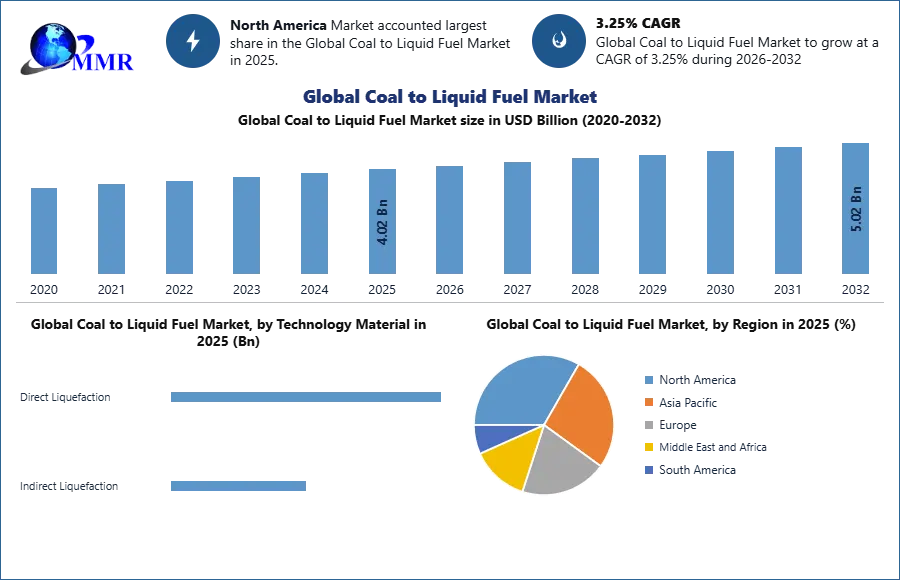
Coal to Liquid Fuel Market size is expected to reach USD 5.02 Bn. by 2032, at a CAGR of 3.25% during the forecast period.
The Coal-to-Liquid (CTL) Fuel Market refers to the industry that converts coal into liquid hydrocarbons such as diesel, gasoline, and jet fuel through chemical processes like gasification and liquefaction. The most widely used technology is the Fischer–Tropsch process, where coal is first converted into synthesis gas (a mixture of hydrogen and carbon monoxide) and then transformed into synthetic fuels. This technology enables countries with abundant coal reserves but limited crude oil resources to produce transportation fuels domestically.

The market is gaining strategic importance due to energy security concerns, fluctuating crude oil prices, and increasing demand for alternative fuel sources. Countries such as China and South Africa have become global leaders in CTL production because of their large coal reserves and strong government support. For instance, Sasol operates the world’s largest CTL facility, the Secunda CTL Plant, which produces around 160,000 barrels of synthetic fuel per day and supplies a significant portion of South Africa’s liquid fuel demand.

Similarly, China is expanding CTL production through projects such as the Erdos CTL developed by China Energy Investment Corporation. The plant converts about 10,000 tons of coal daily into synthetic oil products, demonstrating the commercial viability of the technology.The coal-to-liquid fuel market is expected to grow steadily, particularly in coal-rich economies in Asia-Pacific, as governments invest in synthetic fuel technologies and carbon-capture integration to balance energy security with environmental concerns.

Global Coal to Liquid Fuel MarketTo know about the Research Methodology :- Request Free Sample Report

Coal to Liquid Fuel Market Dynamics:

Rising reliability on natural gas and fossil fuel for the manufacturing of conveying powers along with stationary or steadily decreasing depository according to the present industry framework is the major factor accountable for the CTL automation execution. The increase in the prices of fossil fuel or crude oil gas refinement is additionally estimated to operate the need for the CTL procedure.

Various CTL activities will be money-oriented in the coming year with the expectation of inducement for an extended attempt to transform coal to low sulfur, ash-free conveying powers, and ultimately gaseous powers for domestic utilization. Technological development combined with encouraging the development of the liquid power needs for conveying is the major factor operating the worldwide CTL market. In the recent industry outline, there are twenty energetic CTL amenities around the world. With an increase in gas costs, the exchanges of natural gas from dry carbon, to be utilized in natural gas discharged energy creation provision, seems to be remarkably reasonable. Technologically promoted power cell and incorporated Cycle energy creations will also need the transformation of carbon to cleansed gaseous or fluid powers. Fluid products obtained from syngas are estimated to captivate a larger market portion in the upcoming years. Simple accessibility of developed and operation specified catalysts has authorized the manufacturing of larger hydrocarbons such as methanol. Combination gas obtained from power products are estimated to acquire higher significance in the coming year. These products are utilized for product chemicals and also observe execution as conveying powers. Furthermore, they can be utilized in the manufacturing of reserved additional powers for IGCC power plants. The Fischer Tropsch procedure is the highest utilized coal mixture procedure in the companies. Its responses and polymerization of syngas planning’s examined to be larger and modifiable according to the determined needs to manufacture a broad arrangement of products, like paraffin lubricates, hydrocarbon gasoline, and oxygenates.

Coal to Liquid Fuel Market Segment Analysis:

Based On Product : The diesel segment dominated the Coal-to-Liquid (CTL) fuel market in 2025, accounting for approximately 66.6% of the total market share. This dominance is primarily driven by the extensive use of diesel fuel across transportation, industrial, and commercial sectors. Diesel remains the preferred fuel for heavy-duty vehicles, including trucks, buses, mining equipment, and construction machinery, due to its higher energy efficiency and durability compared with other fuels. As global logistics, infrastructure development, and freight transportation activities expand, the demand for diesel continues to increase, supporting the growth of this segment.

In addition, the rapid expansion of the manufacturing and industrial sectors, particularly in emerging economies such as China and India, has significantly contributed to the consumption of diesel-based fuels. Diesel is widely used to power industrial generators, heavy machinery, and backup power systems, making it a critical fuel for continuous industrial operations.Technological advancements in indirect coal liquefaction processes, especially Fischer–Tropsch synthesis, have also improved the efficiency and yield of synthetic diesel production. These advancements enable companies to produce high-quality, low-sulfur diesel from coal resources. As a result, strong industrial demand, cost efficiency, and technological progress continue to drive the growth of the diesel segment in the CTL fuel market.

Coal to Liquid Fuel Market Regional Analysis:

North America emerged as a lucrative region in the coal-to-liquid (CTL) fuel market, accounting for nearly 18.0% of the global market share in 2025. The growth of the regional market is primarily driven by increasing fuel demand from the transportation and industrial sectors. The steady rise in the number of passenger vehicles, commercial trucks, and logistics fleets across the United States and Canada has significantly increased the need for reliable liquid fuels, creating opportunities for synthetic fuel technologies such as CTL.

In addition, the expansion of manufacturing facilities and heavy industries in North America has contributed to higher fuel consumption. Many industrial operations rely on diesel and other liquid fuels to power machinery, equipment, and backup generators, which indirectly supports demand for alternative fuel production technologies.

Another key factor supporting market growth is the growing awareness of energy security and alternative fuel sources. Governments and energy companies in the region are increasingly focusing on reducing dependence on imported crude oil by promoting domestic fuel production. Supportive regulatory frameworks, research funding, and pilot projects related to advanced fuel technologies are encouraging investments in CTL and other synthetic fuel solutions.

Together, rising fuel demand, industrial expansion, and supportive energy policies are strengthening the growth prospects of the coal-to-liquid fuel market in North America.

Coal to Liquid Fuel Market Recent Development:

  • Expansion of CTL capacity in China (2024–2026): China has significantly expanded its coal-to-liquid and coal-to-chemicals industries to enhance energy security and reduce dependence on imported oil and gas. Several new projects and plant expansions are being developed in coal-rich regions such as Inner Mongolia and Xinjiang, strengthening the country’s synthetic fuel production capacity.

  • China Shenhua Energy CTL expansion (2024): China Shenhua Energy expanded its CTL operations to increase the production of cleaner synthetic fuels. The company is investing in advanced liquefaction technologies to improve efficiency and meet rising transportation fuel demand in China.

  • Technological advancements in CTL production: In 2024, Linc Energy announced improvements in coal-to-liquid technologies aimed at increasing conversion efficiency and lowering environmental impact. The company is focusing on advanced gasification and liquefaction processes to produce cleaner diesel and jet fuel from coal resources.

  • Integration of hydrogen and cleaner fuel technologies (2025): China Datang Corporation launched a coal-to-chemicals project integrating green hydrogen, marking an important step toward lowering carbon emissions in coal-based fuel production systems.

  • New coal gasification and synthetic fuel initiatives in India (2026): New projects in Maharashtra aim to convert coal-derived syngas into alternative fuels such as dimethyl ether (DME), supporting India’s goal of reducing LPG and petroleum imports.

Coal to Liquid Fuel Market Scope: Inquiry Before Buying

Global Coal to Liquid Fuel Market
Report Coverage Details
Base Year: 2025 Forecast Period: 2026-2032
Historical Data: 2020 to 2025 Market Size in 2025: 4.02 USD Billion
Forecast Period 2026-2032 CAGR: 3.25% Market Size in 2032: 5.02 USD Billion
Segments Covered: by Technology Material Direct Liquefaction
Indirect Liquefaction
by Product Material Diesel
Gasoline
Other Fuels
by Application Transportation Fuel
Cooking Fuel
Others

Coal to Liquid Fuel Market, by Region

North America (United States, Canada and Mexico)
Europe (UK, France, Germany, Italy, Spain, Sweden, Austria and Rest of Europe)
Asia Pacific (China, South Korea, Japan, India, Australia, Indonesia, Malaysia, Vietnam, Taiwan, Bangladesh, Pakistan and Rest of APAC)
Middle East and Africa (South Africa, GCC, Egypt, Nigeria and Rest of ME&A)
South America (Brazil, Argentina Rest of South America)

Coal to Liquid Fuel Market, Key Players:

  1. Sasol Limited
  2. China Shenhua Energy Company
  3. Yankuang Energy Group Company Limited
  4. Inner Mongolia Yitai Coal Co., Ltd.
  5. Linc Energy Ltd.
  6. DKRW Energy LLC
  7. Monash Energy
  8. Envidity Energy Inc.
  9. Altona Energy Plc
  10. Bumi plc
  11. TransGas Development Systems LLC
  12. Celanese Corporation
  13. Syntroleum Corporation
  14. Rentech Inc.
  15. Baard Energy LLC
  16. GreatPoint Energy Inc.
  17. Headwaters Incorporated
  18. Eastman Chemical Company
  19. Siemens Energy
  20. Shell plc
  21. Exxon Mobil Corporation
  22. Chevron Corporation
  23. Peabody Energy Corporation
  24. China National Petroleum Corporation
  25. Honeywell International Inc.
  26. Worley Limited

Table of Contents

Coal to Liquid Fuel Market 1. Preface 1.1. Report Scope and Market Segmentation 1.2. Research Highlights 1.3. Research Objectives 2. Assumptions and Research Methodology 2.1. Report Assumptions 2.2. Abbreviations 2.3. Research Methodology 2.3.1. Secondary Research 2.3.1.1. Secondary data 2.3.1.2. Secondary Sources 2.3.2. Primary Research 2.3.2.1. Data from Primary Sources 2.3.2.2. Breakdown of Primary Sources 3. Executive Summary: Coal to Liquid Fuel Market 4. Market Overview 4.1. Introduction 4.2. Market Indicator 4.2.1. Drivers 4.2.2. Restraints 4.2.3. Opportunities 4.2.4. Challenges 4.3. Porter’s Analysis 4.4. Value Chain Analysis 4.5. Market Risk Analysis 4.6. SWOT Analysis 4.7. Industry Trends and Emerging Technologies 5. Supply Side and Demand Side Indicators 6. Coal to Liquid Fuel Market Analysis and Forecast 6.1. Coal to Liquid Fuel Market Size & Y-o-Y Growth Analysis 6.1.1. North America 6.1.2. Europe 6.1.3. Asia Pacific 6.1.4. Middle East & Africa 6.1.5. South America 7. Coal to Liquid Fuel Market Analysis and Forecast, By Product 7.1. Introduction and Definition 7.2. Key Findings 7.3. Coal to Liquid Fuel Market Value Share Analysis, By Product 7.4. Coal to Liquid Fuel Market Size (US$ Bn) Forecast, By Product 7.5. Coal to Liquid Fuel Market Analysis, By Product 7.6. Coal to Liquid Fuel Market Attractiveness Analysis, By Product 8. Coal to Liquid Fuel Market Analysis and Forecast, By Technology 8.1. Introduction and Definition 8.2. Key Findings 8.3. Coal to Liquid Fuel Market Value Share Analysis, By Technology 8.4. Coal to Liquid Fuel Market Size (US$ Bn) Forecast, By Technology 8.5. Coal to Liquid Fuel Market Analysis, By Technology 8.6. Coal to Liquid Fuel Market Attractiveness Analysis, By Technology 9. Coal to Liquid Fuel Market Analysis, by Region 9.1. Coal to Liquid Fuel Market Value Share Analysis, by Region 9.2. Coal to Liquid Fuel Market Size (US$ Bn) Forecast, by Region 9.3. Coal to Liquid Fuel Market Attractiveness Analysis, by Region 10. North America Coal to Liquid Fuel Market Analysis 10.1. Key Findings 10.2. North America Coal to Liquid Fuel Market Overview 10.3. North America Coal to Liquid Fuel Market Value Share Analysis, By Product 10.4. North America Coal to Liquid Fuel Market Forecast, By Product 10.4.1. Diesel 10.4.2. Gasoline 10.4.3. Others 10.5. North America Coal to Liquid Fuel Market Value Share Analysis, By Technology 10.6. North America Coal to Liquid Fuel Market Forecast, By Technology 10.6.1. DCL 10.6.2. ICL 10.7. North America Coal to Liquid Fuel Market Value Share Analysis, by Country 10.8. North America Coal to Liquid Fuel Market Forecast, by Country 10.8.1. U.S. 10.8.2. Canada 10.9. North America Coal to Liquid Fuel Market Analysis, by Country 10.10. U.S. Coal to Liquid Fuel Market Forecast, By Product 10.10.1. Diesel 10.10.2. Gasoline 10.10.3. Others 10.11. U.S. Coal to Liquid Fuel Market Forecast, By Technology 10.11.1. DCL 10.11.2. ICL 10.12. Canada Coal to Liquid Fuel Market Forecast, By Product 10.12.1. Diesel 10.12.2. Gasoline 10.12.3. Others 10.13. Canada Coal to Liquid Fuel Market Forecast, By Technology 10.13.1. DCL 10.13.2. ICL 10.14. North America Coal to Liquid Fuel Market Attractiveness Analysis 10.14.1. By Product 10.14.2. By Technology 10.15. PEST Analysis 10.16. Key Trends 10.17. Key Developments 11. Europe Coal to Liquid Fuel Market Analysis 11.1. Key Findings 11.2. Europe Coal to Liquid Fuel Market Overview 11.3. Europe Coal to Liquid Fuel Market Value Share Analysis, By Product 11.4. Europe Coal to Liquid Fuel Market Forecast, By Product 11.4.1. Diesel 11.4.2. Gasoline 11.4.3. Others 11.5. Europe Coal to Liquid Fuel Market Value Share Analysis, By Technology 11.6. Europe Coal to Liquid Fuel Market Forecast, By Technology 11.6.1. DCL 11.6.2. ICL 11.7. Europe Coal to Liquid Fuel Market Value Share Analysis, by Country 11.8. Europe Coal to Liquid Fuel Market Forecast, by Country 11.8.1. Germany 11.8.2. U.K. 11.8.3. France 11.8.4. Italy 11.8.5. Spain 11.8.6. Russia 11.8.7. Norway 11.8.8. Rest of Europe 11.9. Europe Coal to Liquid Fuel Market Analysis, by Country 11.10. Germany Coal to Liquid Fuel Market Forecast, By Product 11.10.1. Diesel 11.10.2. Gasoline 11.10.3. Others 11.11. Germany Coal to Liquid Fuel Market Forecast, By Technology 11.11.1. DCL 11.11.2. ICL 11.12. U.K. Coal to Liquid Fuel Market Forecast, By Product 11.12.1. Diesel 11.12.2. Gasoline 11.12.3. Others 11.13. U.K. Coal to Liquid Fuel Market Forecast, By Technology 11.13.1. DCL 11.13.2. ICL 11.14. France Coal to Liquid Fuel Market Forecast, By Product 11.14.1. Diesel 11.14.2. Gasoline 11.14.3. Other 11.15. France Coal to Liquid Fuel Market Forecast, By Technology 11.15.1. DCL 11.15.2. ICL 11.16. Italy Coal to Liquid Fuel Market Forecast, By Product 11.16.1. Diesel 11.16.2. Gasoline 11.16.3. Others 11.17. Italy Coal to Liquid Fuel Market Forecast, By Technology 11.17.1. DCL 11.17.2. ICL 11.18. Spain Coal to Liquid Fuel Market Forecast, By Product 11.18.1. Diesel 11.18.2. Gasoline 11.18.3. Others 11.19. Spain Coal to Liquid Fuel Market Forecast, By Technology 11.19.1. DCL 11.19.2. ICL 11.20. Russia Coal to Liquid Fuel Market Forecast, By Product 11.20.1. Diesel 11.20.2. Gasoline 11.20.3. Others 11.21. Russia Coal to Liquid Fuel Market Forecast, By Technology 11.21.1. DCL 11.21.2. ICL 11.22. Norway Coal to Liquid Fuel Market Forecast, By Product 11.22.1. Diesel 11.22.2. Gasoline 11.22.3. Others 11.23. Norway Coal to Liquid Fuel Market Forecast, By Technology 11.23.1. DCL 11.23.2. ICL 11.24. Rest of Europe Coal to Liquid Fuel Market Forecast, By Product 11.24.1. Diesel 11.24.2. Gasoline 11.24.3. Others 11.25. Rest of Europe Coal to Liquid Fuel Market Forecast, By Technology 11.25.1. DCL 11.25.2. ICL 11.26. Europe Coal to Liquid Fuel Market Attractiveness Analysis 11.26.1. By Product 11.26.2. By Technology 11.27. PEST Analysis 11.28. Key Trends 11.29. Key Developments 12. Asia Pacific Coal to Liquid Fuel Market Analysis 12.1. Key Findings 12.2. Asia Pacific Coal to Liquid Fuel Market Overview 12.3. Asia Pacific Coal to Liquid Fuel Market Value Share Analysis, By Product 12.4. Asia Pacific Coal to Liquid Fuel Market Forecast, By Product 12.4.1. Diesel 12.4.2. Gasoline 12.4.3. Others 12.5. Asia Pacific Coal to Liquid Fuel Market Value Share Analysis, By Technology 12.6. Asia Pacific Coal to Liquid Fuel Market Forecast, By Technology 12.6.1. DCL 12.6.2. ICL 12.7. Asia Pacific Coal to Liquid Fuel Market Value Share Analysis, by Country 12.8. Asia Pacific Coal to Liquid Fuel Market Forecast, by Country 12.8.1. China 12.8.2. India 12.8.3. Japan 12.8.4. South Korea 12.8.5. Australia 12.8.6. Indonesia 12.8.7. Malaysia 12.8.8. Vietnam 12.8.9. Rest of Asia Pacific 12.9. Asia Pacific Coal to Liquid Fuel Market Analysis, by Country 12.10. China Coal to Liquid Fuel Market Forecast, By Product 12.10.1. Diesel 12.10.2. Gasoline 12.10.3. Others 12.11. China Coal to Liquid Fuel Market Forecast, By Technology 12.11.1. DCL 12.11.2. ICL 12.12. India Coal to Liquid Fuel Market Forecast, By Product 12.12.1. Diesel 12.12.2. Gasoline 12.12.3. Others 12.13. India Coal to Liquid Fuel Market Forecast, By Technology 12.13.1. DCL 12.13.2. ICL 12.14. Japan Coal to Liquid Fuel Market Forecast, By Product 12.14.1. Diesel 12.14.2. Gasoline 12.14.3. Others 12.15. Japan Coal to Liquid Fuel Market Forecast, By Technology 12.15.1. DCL 12.15.2. ICL 12.16. South Korea Coal to Liquid Fuel Market Forecast, By Product 12.16.1. Diesel 12.16.2. Gasoline 12.16.3. Others 12.17. South Korea Coal to Liquid Fuel Market Forecast, By Technology 12.17.1. DCL 12.17.2. ICL 12.18. Australia Coal to Liquid Fuel Market Forecast, By Product 12.18.1. Diesel 12.18.2. Gasoline 12.18.3. Others 12.19. Australia Coal to Liquid Fuel Market Forecast, By Technology 12.19.1. DCL 12.19.2. ICL 12.20. Indonesia Coal to Liquid Fuel Market Forecast, By Product 12.20.1. Diesel 12.20.2. Gasoline 12.20.3. Others 12.21. Indonesia Coal to Liquid Fuel Market Forecast, By Technology 12.21.1. DCL 12.21.2. ICL 12.22. Malaysia Coal to Liquid Fuel Market Forecast, By Product 12.22.1. Diesel 12.22.2. Gasoline 12.22.3. Others 12.23. Malaysia Coal to Liquid Fuel Market Forecast, By Technology 12.23.1. DCL 12.23.2. ICL 12.24. Vietnam Coal to Liquid Fuel Market Forecast, By Product 12.24.1. Diesel 12.24.2. Gasoline 12.24.3. Others 12.25. Vietnam Coal to Liquid Fuel Market Forecast, By Technology 12.25.1. DCL 12.25.2. ICL 12.26. Rest of Asia Pacific Coal to Liquid Fuel Market Forecast, By Product 12.26.1. Diesel 12.26.2. Gasoline 12.26.3. Others 12.27. Rest of Asia Pacific Coal to Liquid Fuel Market Forecast, By Technology 12.27.1. DCL 12.27.2. ICL 12.28. Asia Pacific Coal to Liquid Fuel Market Attractiveness Analysis 12.28.1. By Product 12.28.2. By Technology 12.29. PEST Analysis 12.30. Key Trends 12.31. Key Developments 13. Middle East & Africa Coal to Liquid Fuel Market Analysis 13.1. Key Findings 13.2. Middle East & Africa Coal to Liquid Fuel Market Overview 13.3. Middle East & Africa Coal to Liquid Fuel Market Value Share Analysis, By Product 13.4. Middle East & Africa Coal to Liquid Fuel Market Forecast, By Product 13.4.1. Diesel 13.4.2. Gasoline 13.4.3. Others 13.5. Middle East & Africa Coal to Liquid Fuel Market Value Share Analysis, By Technology 13.6. Middle East & Africa Coal to Liquid Fuel Market Forecast, By Technology 13.6.1. DCL 13.6.2. ICL 13.7. Middle East & Africa Coal to Liquid Fuel Market Value Share Analysis, by Country 13.8. Middle East & Africa Coal to Liquid Fuel Market Forecast, by Country 13.8.1. GCC 13.8.2. South Africa 13.8.3. Rest of Middle East & Africa 13.9. Middle East & Africa Coal to Liquid Fuel Market Analysis, by Country 13.10. GCC Coal to Liquid Fuel Market Forecast, By Product 13.10.1. Diesel 13.10.2. Gasoline 13.10.3. Others 13.11. GCC Coal to Liquid Fuel Market Forecast, By Technology 13.11.1. DCL 13.11.2. ICL 13.12. South Africa Coal to Liquid Fuel Market Forecast, By Product 13.12.1. Diesel 13.12.2. Gasoline 13.12.3. Others 13.13. South Africa Coal to Liquid Fuel Market Forecast, By Technology 13.13.1. DCL 13.13.2. ICL 13.14. Rest of Middle East & Africa Coal to Liquid Fuel Market Forecast, By Product 13.14.1. Diesel 13.14.2. Gasoline 13.14.3. Others 13.15. Rest of Middle East & Africa Coal to Liquid Fuel Market Forecast, By Technology 13.15.1. DCL 13.15.2. ICL 13.16. Middle East & Africa Coal to Liquid Fuel Market Attractiveness Analysis 13.16.1. By Product 13.16.2. By Technology 13.17. PEST Analysis 13.18. Key Trends 13.19. Key Developments 14. South America Coal to Liquid Fuel Market Analysis 14.1. Key Findings 14.2. South America Coal to Liquid Fuel Market Overview 14.3. South America Coal to Liquid Fuel Market Value Share Analysis, By Product 14.4. South America Coal to Liquid Fuel Market Forecast, By Product 14.4.1. Diesel 14.4.2. Gasoline 14.4.3. Others 14.5. South America Coal to Liquid Fuel Market Value Share Analysis, By Technology 14.6. South America Coal to Liquid Fuel Market Forecast, By Technology 14.6.1. DCL 14.6.2. ICL 14.7. South America Coal to Liquid Fuel Market Value Share Analysis, By Technology 14.8. South America Coal to Liquid Fuel Market Value Share Analysis, by Country 14.9. South America Coal to Liquid Fuel Market Forecast, by Country 14.9.1. Brazil 14.9.2. Mexico 14.9.3. Argentina 14.9.4. Rest of South America 14.10. South America Coal to Liquid Fuel Market Analysis, by Country 14.11. Brazil Coal to Liquid Fuel Market Forecast, By Product 14.11.1. Diesel 14.11.2. Gasoline 14.11.3. Others 14.12. Brazil Coal to Liquid Fuel Market Forecast, By Technology 14.12.1. DCL 14.12.2. ICL 14.13. Mexico Coal to Liquid Fuel Market Forecast, By Product 14.13.1. Diesel 14.13.2. Gasoline 14.13.3. Others 14.14. Mexico Coal to Liquid Fuel Market Forecast, By Technology 14.14.1. DCL 14.14.2. ICL 14.15. Argentina Coal to Liquid Fuel Market Forecast, By Product 14.15.1. Diesel 14.15.2. Gasoline 14.15.3. Others 14.16. Argentina Coal to Liquid Fuel Market Forecast, By Technology 14.16.1. DCL 14.16.2. ICL 14.17. Rest of South America Coal to Liquid Fuel Market Forecast, By Product 14.17.1. Diesel 14.17.2. Gasoline 14.17.3. Others 14.18. Rest of South America Coal to Liquid Fuel Market Forecast, By Technology 14.18.1. DCL 14.18.2. ICL 14.19. South America Coal to Liquid Fuel Market Attractiveness Analysis 14.19.1. By Product 14.19.2. By Technology 14.20. PEST Analysis 14.21. Key Trends 14.22. Key Developments 15. Company Profiles 15.1. Market Share Analysis, by Company 15.2. Competition Matrix 15.2.1. Competitive Benchmarking of key players by price, presence, market share, Applications and R&D investment 15.2.2. New Product Launches and Product Enhancements 15.2.3. Market Consolidation 15.2.3.1. M&A by Regions, Investment and Applications 15.2.3.2. M&A Key Players, Forward Integration and Backward Integration 15.3. Company Profiles: Key Players 15.3.1. Pall 15.3.1.1. Company Overview 15.3.1.2. Financial Overview 15.3.1.3. Product Portfolio 15.3.1.4. Business Strategy 15.3.1.5. Recent Developments 15.3.1.6. Development Footprint 15.3.2. Shenhau 15.3.3. Yankuang 15.3.4. DKRW Energy 15.3.5. Bumi 15.3.6. Monash Energy 15.3.7. Linc Energy 15.3.8. China Shenhua Energy Co. Ltd. 15.3.9. Sasol Ltd. 15.3.10. Transgas Development Systems , LLC 15.3.11. Altona Energy Plc. 15.3.12. Envidity Energy , Inc. Primary key Insights

Custom Market Research Services

We Will Customise The Research For You, In Case The Report Listed Above Does Not Meet With Your Requirements