
Co-Polymer Sealant Market Size – Industry Structure Evaluation, Demand Drivers Analysis, Regional Growth Analysis and Identification, Competitive Positioning Review & Global Market Size Forecast to 2030
Overview
The Co-Polymer Sealant Market size was valued at USD 512.40 Million in 2023 and the total Co-Polymer Sealant revenue is expected to grow at a CAGR of 7.5% from 2024 to 2030, reaching nearly USD 850.09 Million.
Co-Polymer Sealant Market Overview:
Co-polymer sealant (also known as a clear sealant) can be applied to any non-porous surface such as metal, glass, or tile. The sealant appears completely clear, preserving the aesthetic of the surface it is resting on. Co-polymer sealants, unlike silicone sealants, are especially useful on flat surfaces. Copolymer sealants adhere well to a wide range of surfaces, including some that have traditionally been difficult to adhere to, such as PVC. Silicones have excellent adhesion, particularly to glass and metals. Co-polymer rubber sealants have the capacity to relax when stretched. The increased use of acrylic co-polymer-based sealants is driving the growth of the co-polymer sealant market. Acrylic copolymers, also known as emulsion polymers, are versatile products that can be used to create co-polymer sealants. Acrylic co-polymer-based sealants are low-cost, eco- friendly, and long-lasting sealants in the market. Another versatile polymer used in the production of sealants is modified styrene acrylic co-polymer. This co-polymer sealant has a high adhesion property various substrate products. To know about the Research Methodology :- Request Free Sample Report
Co-Polymer Sealant Market Dynamics:
Bolstering demand for hybrid resins in manufacturing adhesives & sealants
Compared to other assembly techniques for structural design, adhesives & sealants have grown in popularity. Modern product designs and manufacturing techniques are in high demand, so new adhesives and sealants are constantly being developed to satisfy this demand in the Co-Polymer sealant market. Recent developments in adhesive and sealant technologies have made it possible for manufacturers to surpass imitations by speeding up manufacturing and increasing durability. By combining the most important characteristics of each resin, the Co-Polymer Sealant based adhesives can overcome the limitations of individual resins to create high-performance and enhanced adhesives & sealants. As next-generation adhesives & sealants, a variety of options are being introduced with some degree of customization to meet the needs of the customers. The manufacturers are spending a lot of money on research and development to combine different adhesive bonding technologies. These combinations will result in hybrid adhesives that have the characteristics of the resins used to make them. As a result, the Co-Polymer sealant market is significantly influenced by the development of hybrid resins for the production of high-performance hybrid adhesives & sealants.
Consistent demand for packaging products from the food & beverage industry
Alterations in the way materials are consumed, with highly durable materials taking the place of materials like aluminum, metal, and paper. In the recent eight years, it is expected that this will have a positive impact on product demand for packaging applications. The U.S. market's primary driver is expected to continue to be the steady demand for packaging products from the food and beverage sector. Further driving the demand for packaging adhesives is likely to be the growing presence of discount retailers in the United States and the high potential of grocery retail. The Co-Polymer sealant market’s long-term growth is thus probably to be aided by this.
Co-Polymer Sealant Market Restraints
Lack of end-user acceptance
The rate of acceptance of Co-Polymer Sealant among end-users remains low. This lower acceptance rate could be attributed to a lack of awareness about the availability of hybrid adhesives or a preference for traditional adhesives. The results obtained from conventional adhesives are satisfactory to the End- use Industrys. Neglecting the additional benefits of hybrid adhesives, such as improved flexibility/elongation, impact/thermal cycling resistance, peel strength, and long-term durability. These aspects are hampering the Co-Polymer sealant market.
Co-Polymer Sealant Market Opportunity
Manufacturers are concentrating on creating high-performing, high-quality co-polymer sealants
Multi-purpose co-polymer sealants with next-generation technology are being introduced to grow the range of applications. This is expected to create significant growth opportunities in the co-polymer sealant market. With the need for long-term adhesion, manufacturers are focusing on major innovations to develop high-performance and high-quality sealants for future building and construction sector requirements. Despite its numerous advantages, the technological advancements required for the production of co-polymer sealants may be a stumbling block for the co-polymer sealant market.
Growing demand for non-hazardous, eco-friendly, and long-lasting adhesives and sealants
Stringent regulations imposed by the United States Environmental Protection Agency (US EPA), Registration, Evaluation, Authorization, and Restriction of Chemicals (REACH), Leadership in Energy and Environmental Design (LEED), and other regional regulatory bodies have compelled manufacturers to create eco-friendly adhesives with low VOC levels. Demand for green adhesives or those with low VOC is increasing due to an increasing trend of using eco-friendly or green products in various industries. Moving toward a more sustainable product portfolio has provided the Co-Polymer sealant market with significant growth opportunities.
Green buildings are becoming increasingly popular in the global construction market. This appears to be encouraging for the development of greener, more sustainable adhesive solutions. These eco-friendly adhesives are made from renewable, recycled, remanufactured, or biodegradable materials. The use of such eco-friendly products is also beneficial to human health. The European and US markets are heavily regulated by REACH and GHS. More emphasis is being placed on eliminating the use of banned or hazardous substances in the production of adhesives and sealants, such as organotins, mercury, monomeric isocyanates, pyrrolidones, phthalates, and nonylphenols. This helps to drive the Co-Polymer sealant market to grow. This, in turn, is expected to increase the use of environmentally friendly products and improve the company's reputation for promoting environmentally friendly products, thereby increasing goodwill.
Competitive Landscape:
Allfasteners USA LLC, Ashland Global Holdings Inc., BASF SE, Bostik, Chemtron Inc., Dow, Evonik, and others are key market players in the co-polymer sealants market.
Major market contributors are seen focusing on developing new and improved products that can be used in a variety of end-use industries. Because of the small number of players involved in the production of co-polymer sealants, the market for co-polymer sealants is an integrated market. Major players are concentrating their efforts on providing co-polymer sealants in key regions recognized around the world through effective strategies and improved solutions.
Evonik is going beyond chemistry in its quest to become the best specialty chemicals company in the world for Co-Polymer Sealants. As a partner to their customers, they connect disciplines, skills, and perspectives to create value-generating and sustainable solutions. As a result, they are at the forefront of their markets and industry advancement. The answer to the question of why they exist is found in the passion with which they add special features to their customers' products: to improve people's lives day after day.
Co-Polymer Sealant Market Segment Analysis:
Based on Type, The silicon-polyether block co-polymer sealants segment generated the most revenue in the Co-Polymer sealant market in 2023 and is expected to grow at a CAGR of 7.7% during the forecast period. Silicone-polyether block-based co-polymer sealants with high adhesion and performance are an excellent choice for the adhesion of roofing substrates, concrete, clay, tile, slate, and pre-painted metals. Co-polymer sealants based on silicone polyether are long-lasting sealants that are ideal for high-wind applications because they can withstand wear and tear and crack formation. Additionally, silicone-polyether-based co-polymer sealants cure quickly and provide a smooth, paintable surface.
All of these factors have increased the demand for silicone-polyether block co-polymer sealants in the Co-Polymer sealant market. Because of its versatility and formulation chemistry, silicone-polyether block co-polymer sealants are widely used for the adhesion of damp, non-porous surfaces such as glass, metals, and glazed tiles. The demand for silicone-polyether-based co-polymer sealants is increasing in the building and construction industry because they reduce tile chattering and shifting and provide better adhesion than other types of co-polymer sealants. Based on the Application, The chemical application generated the most revenue in 2023 and is expected to grow at a CAGR of 6.6% during the forecast period. Co-polymer sealants are essential in the chemical industry because they fill gaps, cracks, joints, and other openings in machinery and reaction tanks, and vessels. The presence of cracks and joints in industrial equipment may increase the risk of liquid, gas, or another unwanted matter seepage.
Larger diameter vessels and tanks are typically built in sections and then joined together with mechanical equipment like nuts and industrial bolts. However, dealing with the risk of cracks at equipment joints is unavoidable. Furthermore, vibrational effects and other mechanical factors cause invisible cracks to form near equipment joints, increasing the risk of equipment failure and product degradation. When compared to other industrial sealants, co-polymer sealants are regarded as critical adhesive products. Polyester, polyamide, polysulfide, vinyl, and polyurethane sealants are the most common co-polymer sealants used in the chemical industry.
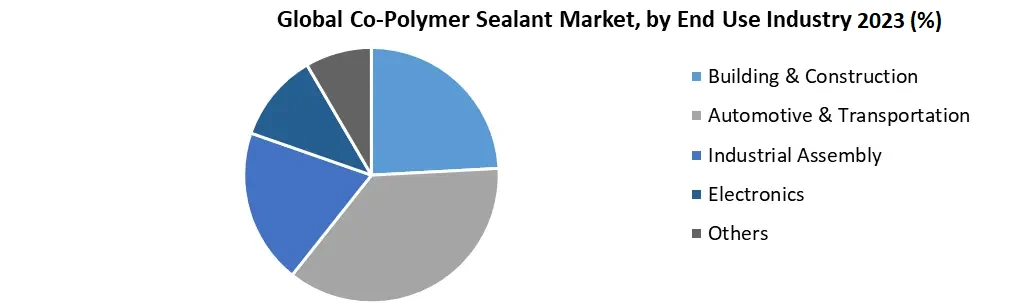
 Based on the End-use Industry, Building & Construction is the Co-Polymer Sealant market's largest end-use industry segment. Co-Polymer sealants are used in a variety of building and construction applications such as flooring, tiling, waterproofing, carpet laying, wall coverings, insulation, roofing, civil operations, and so on. Facades, parquet, and other materials are becoming more popular in the construction industry because they are used in bonding, renovation, maintenance, and repair of residential and commercial buildings, as well as civil engineering applications.
 Co-Polymer Sealant Market Regional Insights:
In 2023, Asia Pacific dominated the Co-Polymer sealant market, accounting for nearly 40.0% of global volume. In 2020, the COVID-19 pandemic had a significant impact on various industries such as textiles and garments, construction, and automotive, as well as export trade. According to government data, the textile trade between China and India fell 12.4% year on year in the first two months of 2020 compared to the previous year. Since the third quarter of 2020, the Co-Polymer sealant market has shown a positive recovery and gained momentum in 2023. The GCC is a key growth engine for the Middle East and Africa. Growing construction activity in the GCC region is expected to drive demand for adhesives and sealants during the forecast period. In recent years, the housing sector in GCC countries has underperformed. This was primarily due to the drop in oil prices and the slowing of the economy. However, the construction industry is expected to perform well in the forecast years as a result of investments in residential construction, energy, and transportation infrastructure. Government economic recovery initiatives are expected to fuel infrastructure development in Central and South America. Argentina, Colombia, and Peru are expected to see growth in the construction industry during the forecast period. This is expected to fuel demand for adhesives and sealants in Central and South America. For example, Peru's economic growth can be attributed largely to an increase in construction and related business activities in the country.
Co-Polymer Sealant Market Scope: Inquiry Before Buying
| Co-Polymer Sealant Market | |||
|---|---|---|---|
| Report Coverage | Details | ||
| Base Year: | 2023 | Forecast Period: | 2024-2030 |
| Historical Data: | 2018 to 2023 | Market Size in 2023: | USD 512.40 Mn. |
| Forecast Period 2024 to 2030 CAGR: | 7.5% | Market Size in 2030: | USD 850.09 Mn. |
| Segments Covered: | by Product Type | Silicone-Polyether Block Copolymer Sealants Ethylene Acrylic Sealants Others |
|
| by Application | Chemical Energy and Power Medical Others |
||
| by End-use Industry | Building & Construction Automotive & Transportation Industrial Assembly Electronics Others |
||
Co-Polymer Sealant Market by Region
North America (United States, Canada and Mexico)
Europe (UK, France, Germany, Italy, Spain, Sweden, Austria, Turkey, Russia and Rest of Europe)
Asia Pacific (China, India, Japan, South Korea, Australia, ASEAN and Rest of APAC)
Middle East and Africa (South Africa, GCC, Egypt, Nigeria and Rest of ME&A)
South America (Brazil, Argentina, Columbia and Rest of South America)
Co-Polymer Sealant Market Key Players are:
1.Allfasteners USA LLC
2. Ashland Global Holdings Inc.
3.BASF SE
4. Bostik
5.Chemtron Inc.
6.Dow
7.Evonik
8. Industries AG.
9.Henkel AG and Co. KgaA
10. Kraton Corporation
11.3M Company
12.MAPEI
13.Momentive
14. Premier Building Solutions
15.SEKISUI FULLER
16. Selleys
17.Henkel AG & Company
18. Wacker Chemie AG
19. Sika AG
Frequently Asked Questions:
1] What segments are covered in the Global Co-Polymer Sealant Market report?
Ans. The segments covered in the Co-Polymer Sealant Market report are based on Product Type, Application, and, End User.
2] Which region is expected to hold the highest share in the Global Co-Polymer Sealant Market?
Ans. The Asia Pacific region is expected to hold the highest share in the Co-Polymer Sealant Market.
3] What is the market size of the Global Co-Polymer Sealant Market by 2030?
Ans. The market size of the Co-Polymer Sealant Market by 2030 is expected to reach USD 850.09 Mn.
4] What is the forecast period for the Global Co-Polymer Sealant Market?
Ans. The forecast period for the Co-Polymer Sealant Market is 2024-2030.
5] What was the Global Co-Polymer Sealant Market size in 2023?
Ans: The Global Co-Polymer Sealant Market size was USD 512.40 Million in 2023.