
Cleanroom Supplies Market Size by product type, cleanroom class, Material, Application and End Use Industry
Overview
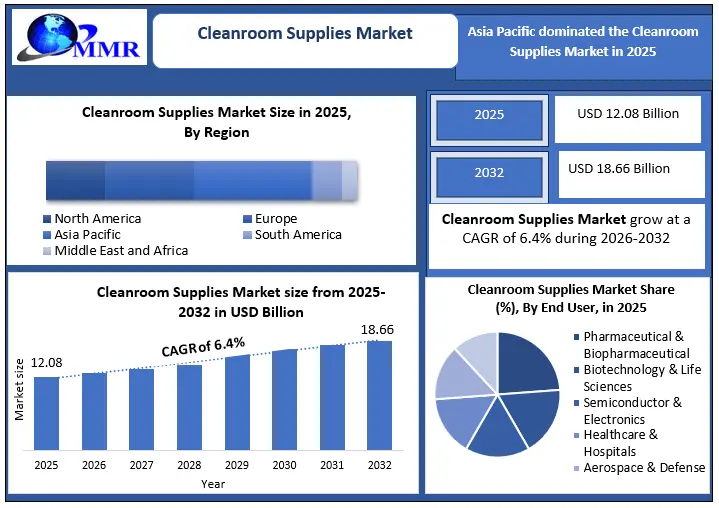
Global Cleanroom Supplies Market Size Was USD 12.08 Billion in 2025 and is Expected to Reach USD 18.66 Billion by 2032, Growing at a CAGR of 6.4% During 2026–2032. As contamination control becomes increasingly critical across pharmaceutical manufacturing, semiconductor fabrication, biotechnology laboratories, and healthcare environments, demand for high-performance cleanroom consumables continues to accelerate globally.
Manufacturers are increasingly prioritizing sterile production environments, particle-free operations, and regulatory-compliant contamination control systems to improve product quality and operational reliability. Against this backdrop, the global Cleanroom Supplies Market reached USD 12.08 billion in 2025 and is projected to grow to USD 18.66 billion by 2032, expanding at a CAGR of 6.4% during the forecast period from 2026 to 2032.
Facilities consume 15,000–30,000 cleanroom wipes per month, while each worker uses 3,000–6,000 glove pairs annually. Stricter regulations and expanding cleanroom infrastructure actively fuel strong global demand and rising consumption volumes worldwide.
Cleanroom Supplies Market - Key Highlights
- Pharmaceutical & biopharmaceutical industries remain the largest end users, supported by rising biologics, biosimilars, and sterile injectable production globally.
- The semiconductor & electronics sector represents the fastest-growing end-user segment, with strong demand from Taiwan, South Korea, China, Japan, and the United States.
- Asia-Pacific is the fastest-growing regional market, while North America leads in market share due to strong regulatory compliance and high cleanroom density.
- Alcohol-based disinfectants and hydrogen peroxide-based solutions are witnessing accelerated adoption due to stringent aseptic and contamination-control requirements.
- The Cleanroom Supplies Market is highly compliance-driven, with organized players dominating due to GMP validation, lot traceability, and audit-ready documentation.
- Long-term contract supply agreements are increasingly preferred by large pharmaceutical plants and semiconductor fabs to ensure supply continuity and price stability.
- Key players such as Kimberly-Clark, DuPont, Ansell, Texwipe, and ITW are focusing on portfolio expansion, Asia-Pacific penetration, and sustainable cleanroom consumables over the next five years.
To know about the Research Methodology :- Request Free Sample Report
Cleanroom Supplies Market Dynamics:
Expansion of Semiconductor Manufacturing and Advanced Electronics
The Cleanroom Supplies Market is strongly driven by rapid growth in semiconductor manufacturing, where ultra-clean environments are mandatory to prevent particle contamination. Semiconductor fabrication facilities operate under ISO Class 1–5 cleanroom standards, requiring extensive use of cleanroom consumables, cleanroom wipes, cleanroom gloves, cleanroom masks, and cleanroom cleaning supplies.
In 2024, global semiconductor capital expenditure exceeded USD 185 billion, led by the U.S., Taiwan, South Korea, Japan, and China. Even a 0.3-micron particle can reduce wafer yields by 30–50% in sub-7 nm nodes, directly increasing reliance on cleanroom contamination control products. As a result, demand for semiconductor cleanroom supplies continues to rise across Asia-Pacific and North America.
Rising Pharmaceutical and Biotechnology Manufacturing
The pharmaceutical and biotechnology sectors are major drivers of the Cleanroom Consumables Market, particularly for pharmaceutical cleanroom supplies, GMP compliant cleanroom consumables, and ISO certified cleanroom supplies. In 2024, global pharmaceutical R&D spending reached USD 252 billion, with Europe alone accounting for USD 59.9 billion.
Sterile drug production, biologics, vaccines, and gene therapies require validated cleanroom environments. Regulatory authorities reported a 35% increase in sterile production inspections between 2019 and 2023, accelerating adoption of cleanroom disinfectants and chemicals, cleanroom wipes and cleaning products, and medical cleanroom consumables.
Increasing enforcement of ISO 14644 cleanroom standards, EU GMP Annex 1 guidelines, and FDA aseptic manufacturing regulations is significantly accelerating adoption of validated cleanroom consumables across pharmaceutical, biotechnology, semiconductor, and medical device manufacturing facilities worldwide.
Healthcare-Associated Infection (HAI) Prevention
Healthcare facilities are increasingly investing in cleanroom cleaning supplies, cleanroom gloves and masks, and cleanroom contamination control solutions to reduce infection risks. 1 in 31 hospital patients in the U.S. is affected by HAIs annually, contributing to approximately 99,000 deaths per year.
Sterile cleanroom supplies reduce airborne and surface contamination by over 99%, driving adoption across hospitals, diagnostic labs, and medical device manufacturing units.
Cleanroom Supplies Market Restraints
High Cost of Compliance and Operational Burden
The Cleanroom Supplies Market faces restraints from high operational and compliance costs. Cleanroom facilities consume 3–10 times more energy than conventional manufacturing spaces, with HVAC systems accounting for 40–60% of total operating costs.
Frequent replacement of cleanroom consumables further increases expenses. On average, a single cleanroom worker uses 3,000–6,000 glove pairs and 300–800 masks annually, creating cost pressure for buyers.
Regulatory non-compliance can cost manufacturers USD 2.2–3.3 million per incident and delay product launches by 4–6 months, discouraging adoption among small and mid-sized enterprises.

Fragmentation Between Organized and Unorganized Markets
The organized players dominate high-quality cleanroom products, the unorganized segment remains active in developing regions. Unorganized suppliers often lack ISO certification, GMP validation, and material traceability, creating risks for contamination-sensitive industries. This fragmentation creates pricing pressure and quality inconsistency in the Cleanroom Materials Market, particularly in parts of Asia, South America, and the Middle East.
Cleanroom Supplies Market Opportunities
Growth in Biotechnology, Nanotechnology & MEMS
Nanotechnology and MEMS manufacturing present high-growth opportunities for the Cleanroom Supplies Market. MEMS devices experience up to 45% higher failure rates when produced outside controlled cleanroom environments. Cleanroom manufacturing improves MEMS reliability to >99.9%.
In 2024, over 90% of nanotechnology R&D laboratories globally operated within ISO Class 3–6 cleanrooms, creating strong demand for cleanroom wipes, cleanroom consumables, and cleanroom contamination control products.
Sustainability and Reusable in Cleanroom Supplies Market
Sustainability initiatives are opening opportunities for disposable vs reusable cleanroom supplies. Reusable cleanroom garments and wipes can reduce waste generation by 40–60% and lower long-term operating costs by 20–30%.
Manufacturers offering eco-friendly cleanroom cleaning supplies and low-VOC disinfectants are gaining preference, particularly in Europe, where environmental compliance standards are stringent.
Sustainability-focused procurement strategies are increasingly reshaping purchasing decisions across pharmaceutical and semiconductor cleanroom facilities. Manufacturers offering reusable cleanroom garments, recyclable contamination-control consumables, and low-VOC disinfectants are expected to gain competitive advantage as companies prioritize ESG compliance, waste reduction, and long-term operational cost optimization.
Cleanroom Supplies Market Segment Analysis
Cleanroom apparel accounted for a significant share of the Cleanroom Supplies Market in 2025, driven by its critical role in minimising human-borne contamination, which historically contributed to up to 80% of particulate contamination inside controlled environments. Cleanroom coveralls, gowns, hoods, booties, and ESD-safe apparel were widely adopted across pharmaceutical manufacturing, semiconductor fabs, biotechnology laboratories, and medical device cleanrooms.
In value terms, cleanroom apparel remained one of the highest-revenue-generating segments, owing to frequent replacement cycles, regulatory mandates under ISO Class 5–7 and EU GMP Grade A–C, and increasing demand for sterile and ESD-compliant garments. Asia-Pacific dominated volume consumption due to high labor intensity in electronics and pharma manufacturing, while North America and Europe led in premium reusable and validated apparel demand. The segment benefited from rising healthcare-associated infection concerns and stricter regulatory inspections between 2019 and 2023, which increased adoption across healthcare and laboratory environments.
Cleanroom Supplies Market Regional Analysis
North America dominated the Cleanroom Supplies Market in 2025 due to strong pharmaceutical manufacturing capabilities, high cleanroom density across semiconductor fabs, and strict regulatory compliance requirements under FDA and ISO standards. The United States remains the largest contributor owing to rising sterile injectable production, biologics manufacturing expansion, and growing investments in semiconductor fabrication facilities supported by the CHIPS Act.
Asia-Pacific is projected to witness the fastest growth during the forecast period due to rapid expansion of electronics manufacturing, increasing pharmaceutical exports, and rising cleanroom infrastructure investments across China, Taiwan, South Korea, Japan, and India. The region benefits from strong semiconductor fabrication growth, cost-efficient manufacturing ecosystems, and government-backed industrial expansion initiatives supporting long-term demand for contamination-control consumables and cleanroom apparel.
Europe continues to represent a significant market driven by stringent environmental and sterility compliance standards, increasing biologics production, and rising adoption of sustainable and reusable cleanroom consumables. Germany, France, and the United Kingdom remain key markets due to strong pharmaceutical R&D activities and advanced medical device manufacturing infrastructure.
Asia-Pacific offers the strongest growth opportunity due to electronics manufacturing, pharmaceutical exports, and government-backed industrial expansion. China, India, South Korea, Japan, and Taiwan are major consumers of cleanroom supplies market by region.
India’s pharmaceutical exports crossed USD 25 billion in 2023, while China hosts over 30% of global electronics manufacturing, creating long-term demand for cleanroom consumables suppliers
Cleanroom Supplies Market Recent Developments:
In 2024, DuPont expanded its Tyvek IsoClean cleanroom apparel portfolio and extended its recycling program for disposable cleanroom garments, supporting sustainability and contamination control. These initiatives strengthened DuPont’s position in pharmaceutical, biotechnology, and semiconductor cleanroom applications.
In 2024, Ansell Limited strengthened its cleanroom presence through the acquisition of Kimberly-Clark’s PPE business, including Kimtech and KleenGuard brands, expanding its sterile PPE and cleanroom apparel offerings while advancing sustainability initiatives and regulatory-compliant solutions.
Cleanroom Supplies Market Scope: Inquire before buying
| Cleanroom Supplies Market | |||
|---|---|---|---|
| Report Coverage | Details | ||
| Base Year: | 2025 | Forecast Period: | 2026-2032 |
| Historical Data: | 2020 to 2025 | Market Size in 2025: | USD 12.08 Bn. |
| Forecast Period 2026 to 2032 CAGR: | 6.4% | Market Size in 2032: | USD 18.66 Bn. |
| Segments Covered: | by Product Type | Cleanroom Supplies Cleanroom Wipes Cleanroom Gloves Cleanroom Masks & Face Covers Cleaning & Disinfection Products Sticky Mats Others |
|
| by Cleanroom Class | ISO Class 1–3 ISO Class 4–6 ISO Class 7–8 |
||
| by Material | Polyester-based Consumables Cellulose-based Consumables Alcohol-based Disinfectants Hydrogen Peroxide & Quaternary Compounds Others |
||
| by Application | Contamination Control Surface Cleaning & Disinfection Aseptic Manufacturing Equipment Cleaning Validation & Quality Control |
||
| by End-User Industry | Pharmaceutical & Biopharmaceutical Biotechnology & Life Sciences Semiconductor & Electronics Healthcare & Hospitals Aerospace & Defense Food & Beverage |
||
Cleanroom Supplies Market Key Players
1. DuPont
2. Kimberly-Clark Professional
3. Contec Inc.
4. Avantor (VWR International)
5. Thermo Fisher Scientific
6. 3M
7. Valutek
8. Texwipe (ITW)
9. Ansell
10. Ecolab
11. Berkshire Corporation
12. Micronova Manufacturing
13. Nitritex (Ansell Healthcare)
14. KM Purely Creative
15. Cleanroom World
16. Alpha Pro Tech
17. Prudential Overall Supply
18. UniFirst (UniClean)
19. Dastex Group
20. Micronclean
21. ITW Contamination Control
22. Riverstone Resources
23. CT International
24. Valutek Asia
25. Aramark Cleanroom Services
26. High-Tech Conversions
27. Foamtec International
28. Presco Cleanroom Products
29. KleanLabs
30. Blue Thunder Technologies
31. Others
Frequently Asked Questions in the Cleanroom Supplies Market
1. Which product segment dominates the Cleanroom Supplies Market?
Answer: Cleanroom coveralls dominate the Cleanroom Supplies Market due to their ability to provide full-body contamination control. Their widespread adoption across ISO Class 5–7 and EU GMP Grade A–C cleanrooms, particularly in pharmaceutical manufacturing and semiconductor fabrication facilities, drives consistent demand. High replacement frequency and strict compliance requirements further strengthen this segment’s market leadership.
2. What industries drive demand for Cleanroom Supplies Market?
Answer: Demand for Cleanroom Supplies is primarily driven by pharmaceuticals, biotechnology, healthcare, semiconductors, aerospace, and food processing industries. These sectors operate under stringent hygiene, sterility, and contamination-control regulations, necessitating continuous use of certified cleanroom garments to ensure product integrity and regulatory compliance.
3. Why is Asia-Pacific the fastest-growing region in the Cleanroom Supplies Market?
Answer: Asia-Pacific is the fastest-growing region due to rapid capacity expansion in semiconductor fabs, pharmaceutical manufacturing, and biotechnology facilities across China, South Korea, Japan, Taiwan, and India. Increasing foreign direct investment, favorable manufacturing policies, and rising exports of electronics and pharmaceuticals have significantly increased demand for cleanroom coveralls, hoods, masks, and booties in the region.
4. What is the future outlook of the Cleanroom Supplies Market?
Answer: The Cleanroom Supplies Market is expected to witness long-term growth driven by increasing semiconductor capital expenditure, rising sterile pharmaceutical production, expanding biotechnology research activities, and stricter contamination-control regulations worldwide. Adoption of sustainable cleanroom consumables, reusable garments, and automated contamination-control systems is also expected to reshape future procurement strategies across regulated industries.
5. What is the Cleanroom Supplies Market?
Answer: The Cleanroom Supplies Market comprises specialized protective garments, including coveralls, hoods, booties, gowns, gloves, and face masks, designed to minimize particle contamination and protect personnel in controlled environments.