
Cell Surface Markers Market Size, Share, Growth Trends, Industry Analysis, Competitive Landscape, and Forecast by Product Type, Application, Technology, Cell Type, End User and Region, 2026–2034
Overview
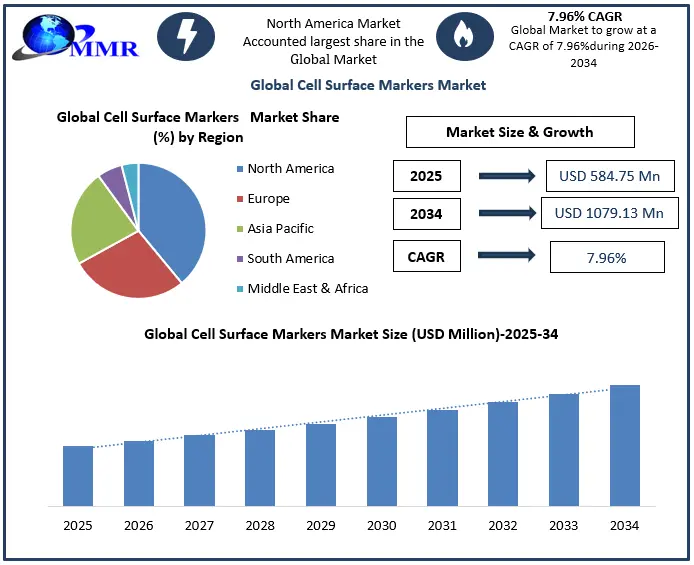
The Global Cell Surface Markers Market was valued at USD 584.75 million in 2025 and is estimated to reach USD 1079.13 Million by 2034, growing at a 7.96% CAGR during 2026–2034.
Global Cell Surface Markers Market Key Highlights
| Market Growth: The market grows at a 7.96% CAGR during 2026–2034. Leading Product: Antibodies dominate due to broad use in immunophenotyping and cellular analysis. Leading Application: Research applications lead through demand from oncology, immunology, stem cell research, and drug discovery. Leading Region: North America holds the leading position, supported by advanced research and diagnostic infrastructure. Fast-Growing Region: Asia Pacific gains momentum through expanding biotechnology, diagnostics, and cell therapy research. Key Trend: Multiparameter and spectral flow cytometry strengthen high-dimensional cell profiling and marker analysis. Major Opportunity: Growing cell and gene therapy development creates new demand for cellular characterization and marker-based analysis. |
Global Cell Surface Markers Market Overview
Cell surface markers are proteins, glycoproteins, and other molecules expressed on the outer membrane of cells that provide identifiable characteristics for distinguishing cell populations, evaluating cellular states, and understanding biological functions. These markers form the basis of immunophenotyping, in which specific antibodies identify cells according to the antigens present on their surface. The National Cancer Institute recognizes immunophenotyping as an important approach for identifying and separating cell populations and for diagnosing diseases such as leukemia and lymphoma. Therefore, Cell surface marker analysis supports a broad range of research and clinical activities, including immune-cell characterization, cancer diagnosis, stem cell research, biomarker discovery, and drug development.
Rising cancer incidence represents a major demand factor for cell surface markers because marker-based immunophenotyping helps laboratories classify abnormal cells, establish disease lineage, and monitor hematological malignancies. There were 20.6 million new cancer cases globally in 2024, and projected annual cases are to approach 35 million by 2050. This increasing disease burden creates the need for reliable cellular characterization and diagnostic workflows, particularly in oncology and hematology.
During the forecast period, market growth is supported by the increasing use of multiparametric flow cytometry, expansion of biomarker-driven research, and growing investment in precision medicine and cell-based therapies. Modern immunophenotyping can simultaneously evaluate multiple cell-surface markers, enabling researchers and clinicians to distinguish closely related cell populations and identify disease-associated phenotypes. For example, combinations of markers can differentiate immune-cell subsets or characterize abnormal populations in leukemia and lymphoma rather than relying on a single biological characteristic. As pharmaceutical companies, biotechnology firms, hospitals, and research institutions require detailed cellular profiling for discovery, diagnosis, and treatment monitoring, demand for cell surface marker antibodies, reagents, and analytical solutions continues to expand.
Why This Report?
This report provides a concise, industry-focused analysis of the Cell Surface Markers Market, covering market size and forecast, key segments, regional dynamics, growth drivers, challenges, emerging technologies, and competitive strategies. It evaluates major opportunities across antibodies, research and clinical applications, flow cytometry, single-cell analysis, precision medicine, and cell and gene therapy. The report also benchmarks leading players and recent industry developments, helping clients identify high-growth segments, attractive regions, competitive gaps, investment opportunities, and effective market-entry or expansion strategies through 2034.
Global Cell Surface Markers Market Size and Share Analysis
To know about the Research Methodology :- Request Free Sample Report
Global Cell Surface Markers Market Dynamics
Rising Cancer Burden is to Drive Demand for Cell Surface Markers
The increasing global burden of cancer drives demand for cell surface markers because immunophenotyping helps identify and characterize abnormal cell populations, particularly in hematological malignancies such as leukemia and lymphoma. Cell surface markers allow laboratories to distinguish cell populations according to their antigen expression and support disease classification and treatment monitoring. The International Agency for Research on Cancer (IARC) estimates that 20.6 million people were diagnosed with cancer globally in 2024, while 9.8 million died from the disease. Lung cancer alone accounted for approximately 2.6 million new cases, followed by breast cancer with 2.4 million cases. The expanding patient population strengthens the need for cellular characterization, biomarker identification, and diagnostic testing, supporting continued demand for antibodies and reagents used in cell surface marker analysis.
High Testing Complexity is to Restrain Wider Adoption
The technical complexity and cost associated with multiparameter cell analysis restrain adoption, particularly among laboratories with limited expertise and resources. High-parameter flow cytometry requires multiple antibodies, fluorochromes, buffers, instrument configurations, and specialized data-analysis capabilities. Each antibody may require validation and titration for the specific cell type to minimize nonspecific binding and improve signal resolution. Research on flow cytometry also identifies challenges related to assay complexity, compensation, interpretation, and standardization as the number of markers increases. These requirements can raise the cost and operational burden of cell surface marker testing, limiting adoption among smaller clinical laboratories and research facilities.
Expanding Cell and Gene Therapy Creates New Markers Opportunities
The rapid development of cell and gene therapies creates new opportunities for cell surface marker products because these therapies require detailed characterization of cellular populations during research, manufacturing, quality control, and clinical development. The U.S. FDA states that cellular and gene therapy research and development continues to grow rapidly, with multiple products advancing through clinical development. Its approved-product list includes therapies such as ABECMA, AMTAGVI, CARVYKTI, CASGEVY, and BREYANZI, demonstrating the growing therapeutic ecosystem in which cellular characterization plays an important role. Cell surface markers can support identification of target cells, assessment of cell populations, and monitoring of cellular characteristics throughout development.
Increasing Multiparameter Analysis Raises Standardization Challenges
The growing number of markers evaluated simultaneously creates challenges in assay standardization, data interpretation, and reproducibility across laboratories. Modern flow cytometry can combine up to 50 antibodies in a single tube, significantly increasing the amount of cellular information that can be obtained from one sample but also increasing the complexity of panel design, fluorescence compensation, gating, and result interpretation. Differences in staining protocols, antibody performance, instrument settings, and analytical approaches can affect the comparability of results between laboratories. These issues create a persistent challenge for clinical adoption and large-scale research studies, where consistent and reproducible cell surface marker measurements are essential.
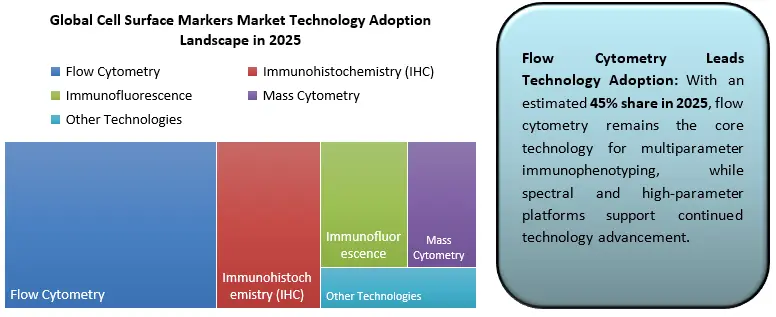
Global Cell Surface Markers Market Technology Adoption Landscape
Global Cell Surface Markers Market Trends
• Multiparameter Profiling Expands Cellular Characterization - Cell surface marker analysis is moving toward multiparameter workflows that evaluate numerous proteins simultaneously rather than relying on individual markers. For Example, Mass cytometry can measure 50 proteins or protein modifications at single-cell resolution, enabling researchers to characterize complex and heterogeneous cell populations in greater detail.
• Single-Cell Proteomics Deepens Surface Marker Analysis - The integration of cell surface marker analysis with single-cell proteomics strengthens the ability to identify cellular heterogeneity and disease-specific phenotypes. Recent advances allow substantially greater protein coverage at the individual-cell level, while improved sample preparation, instrumentation, and computational workflows increase the scalability and reproducibility of single-cell analysis.
• Spatial Profiling Connects Markers with Tissue Context - Cell surface marker analysis increasingly shifts from identifying which markers are present to understanding where marker-positive cells occur within tissues. Spatial proteomics and multiplexed imaging approaches preserve tissue architecture while profiling multiple proteins, creating opportunities to study tumor microenvironments, immune-cell interactions, and disease-associated cellular niches.
• Antibody-Tagging Integrates Surface Proteins with Genomic Data - CITE-seq and related antibody-based sequencing approaches combine surface-protein measurements with single-cell RNA sequencing. By using oligonucleotide-tagged antibodies, researchers can measure cell-surface proteins alongside gene-expression profiles from the same cells, improving cell-type identification and providing a more comprehensive view of cellular states. Recent research also focuses on normalization methods to reduce antibody-staining variability and improve cross-study comparability.
Global Cell Surface Markers Market Segment Analysis
By Product Type
Antibodies Lead the Product Type Segment Through Broad Immunophenotyping Use
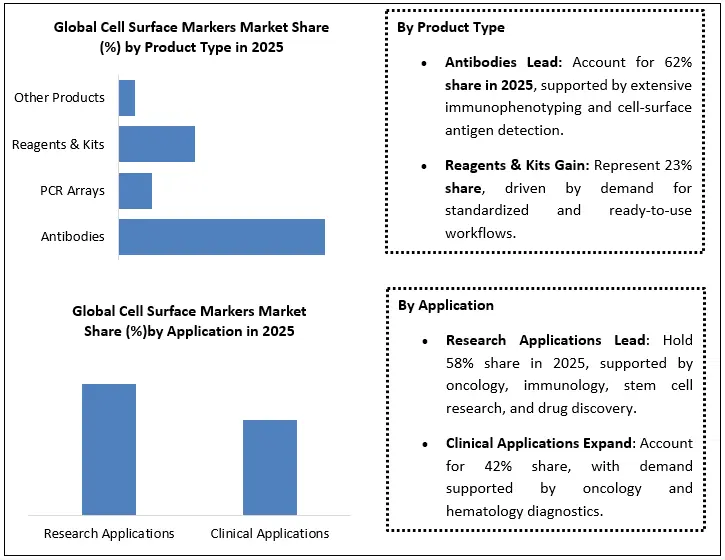
Antibodies dominated the Product Type segment in 2025 due to their central role in identifying and characterizing cell populations based on surface antigen expression. Their high specificity and compatibility with flow cytometry support extensive use across oncology, hematology, immunology, stem cell research, and drug discovery. Antibody-based immunophenotyping is also used for disease diagnosis and monitoring, strengthening demand across both research and clinical workflows.
Monoclonal antibodies maintain a strong position within the category because their specificity, consistency, and reproducibility support standardized marker panels and multiparameter analysis. Reagents and kits also represent an important product category as laboratories increasingly adopt ready-to-use and application-specific workflows that simplify testing and improve operational efficiency. PCR arrays remain comparatively specialized, primarily supporting applications that combine cell-surface characterization with gene-expression analysis. During 2026–2034, antibodies are expected to maintain strong demand, while reagents and kits gain traction through integrated assay formats and standardized workflows.
Global Cell Surface Markers Market: Key Segments, Growth Outlook
| Segment | 2025 position | 2026–2034 outlook | Primary growth rationale |
| Antibodies | Dominated | Strong growth | Broad marker identification and immunophenotyping use |
| Reagents & Kits | Secondary | Strong growth potential | Ready-to-use and application-specific workflows |
| PCR Arrays | Smaller | Moderate growth | Complementary molecular profiling |
| Research Applications | Dominates | Strong growth | Drug discovery, immunology, stem-cell and biomarker research |
| Clinical Applications | Secondary | Accelerating | Oncology, hematology and precision diagnostics |
By Application
Research Applications Lead as Cell Surface Markers Expand Across Discovery Workflows
Research Applications dominated the Application segment in 2025, supported by the widespread use of cell surface markers in immunology, stem cell research, drug discovery, biomarker development, and cellular characterization. Researchers rely on surface markers to distinguish cell populations, assess differentiation and activation states, and isolate specific cells for downstream analysis, creating recurring demand across academic institutions, biotechnology companies, pharmaceutical R&D, and translational research.
Clinical Applications represent the key growth counterpart, particularly in oncology and hematology, where immunophenotyping supports disease classification, diagnosis, treatment monitoring, and patient stratification. The growing development of cell and gene therapies further strengthens application opportunities, as cellular products require detailed characterization throughout research, development, and manufacturing. During 2026–2034, research applications are expected to retain a broad demand base, while clinical applications are expected to gain share as precision diagnostics and personalized treatment approaches expand. Cell and gene therapy development also creates additional demand for standardized cell characterization workflows.
Global Cell Surface Markers Market Regional Analysis
North America Leads Through Advanced Immunophenotyping Infrastructure
North America dominated the Cell Surface Markers Market in 2025, supported by a mature life-sciences ecosystem, extensive oncology research, advanced flow-cytometry infrastructure, and strong pharmaceutical and biotechnology R&D activity. The U.S. represents the core regional demand center because cell surface marker analysis is widely incorporated into cancer diagnostics, immune profiling, drug discovery, and translational research. The region also benefits from established clinical laboratories and the presence of major technology and reagent suppliers, which support rapid adoption of high-parameter and single-cell analytical workflows.
Global Cancer burden further sustains clinical demand, creating continued need for disease characterization and monitoring technologies. Regulatory requirements also support product quality and validation, particularly where marker-based products are incorporated into diagnostic workflows regulated as medical devices or IVDs. During 2026–2034, North America maintains strong growth potential as precision oncology, immunotherapy, cell therapy, and multiparameter cellular analysis expand.
Europe Strengthens Demand Through Precision Medicine and Cell Therapy
Europe maintains significant demand for cell surface markers due to its strong biomedical research base, established healthcare systems, and growing focus on precision medicine and advanced therapies. Germany, the UK, France, and other major markets support applications across oncology, immunology, hematology, drug discovery, and cellular research. The expansion of cell and gene therapy is particularly relevant because surface markers are used to characterize cell populations during development and manufacturing.
The European Medicines Agency regulates advanced therapy medicinal products (ATMPs), covering gene therapies, somatic-cell therapies, and tissue-engineered medicines, creating a structured environment for cellular product development. The EMA's current guidance also addresses quality, non-clinical, and clinical requirements for investigational ATMPs. During 2026–2034, demand strengthens as European laboratories increase adoption of high-dimensional cellular analysis and pharmaceutical companies expand cell and gene therapy pipelines. Regulatory emphasis on product characterization and quality supports continued use of standardized marker-based analytical workflows.
Asia Pacific Gains Momentum Through Expanding Biopharma Research
Asia Pacific represents a high-potential growth region as pharmaceutical manufacturing, biotechnology research, clinical diagnostics, and healthcare infrastructure expand across China, Japan, India, South Korea, and Australia. Increasing investment in oncology research and precision medicine creates additional applications for cell surface marker analysis, while the expansion of local biotechnology capabilities improves access to advanced flow-cytometry and molecular-analysis technologies.
China represents a particularly important market, supported by its large healthcare system and expanding biopharmaceutical industry. Its regulatory framework provides formal oversight for IVD reagents, including reagents, kits, calibrators, and control materials used for diagnosis and treatment monitoring. China's NMPA requires registration or filing according to product classification and maintains specific review procedures for Class II and Class III IVDs. During 2026–2034, Asia Pacific is expected to record strong regional growth, supported by increasing research expenditure, rising diagnostic capacity, development of domestic biotechnology companies, and growing adoption of precision and cell-based medicine.
South America Expands Through Improving Diagnostic Capacity
South America represents a developing market for cell surface markers, with Brazil accounting for a substantial share of regional demand because of its comparatively large healthcare system, pharmaceutical industry, research institutions, and diagnostic laboratory network. Demand is primarily connected with oncology, hematology, immunology, and academic research, where flow cytometry and antibody-based immunophenotyping provide important tools for cellular characterization. The region's expanding healthcare infrastructure and greater availability of specialized diagnostic services create opportunities for suppliers of antibodies, reagents, and kits.
However, adoption remains comparatively constrained by differences in laboratory infrastructure, equipment availability, specialist expertise, and healthcare spending across countries. During 2026–2034, the region offers moderate growth potential as diagnostic laboratories modernize and research institutions expand molecular and cellular testing capabilities. Regulatory requirements for diagnostic products and country-specific approval processes continue to influence market access, making local distribution capabilities and regulatory expertise important competitive factors.
Middle East & Africa Develops Through Healthcare Modernization
The Middle East & Africa market develops as governments and healthcare providers invest in advanced diagnostics, laboratory infrastructure, and specialized medical services. Gulf countries, particularly Saudi Arabia and the UAE, provide the strongest growth opportunities because healthcare modernization programs, investment in biotechnology, and development of specialized hospitals increase demand for sophisticated cellular-analysis technologies.
South Africa also represents an important research and diagnostic market within the region. Cell surface markers are primarily used in oncology, hematology, immunology, and research applications, although adoption varies substantially because laboratory capabilities and healthcare expenditure differ between countries. During 2026–2034, market potential increases as healthcare systems introduce more advanced diagnostic platforms and research institutions expand access to flow cytometry and related technologies. Regulatory frameworks remain fragmented across national markets, requiring suppliers to comply with individual medical-device and IVD registration requirements. Consequently, partnerships with local distributors and laboratories can improve market access while supporting technical training and adoption.
Global Cell Surface Markers Market Recent Developments
| Date | Company | Recent Development | Strategic Significance for Cell Surface Markers Market |
| June 2026 | Cytek Biosciences | Introduced the Cytek Borealis, a 7-laser full-spectrum flow cytometer with 120 detectors and capability for developing 60-color panels, supported by new DUV and IR cFluor reagents. | Expands high-parameter detection capacity and creates demand for more sophisticated fluorophore-conjugated antibodies and cell-surface marker panels. |
| June 2026 | Cytek Biosciences | Expanded Aurora Evo configurations with automation-ready capabilities and integration with robotic plate handling and third-party scheduling platforms. | Strengthens automation and high-throughput cellular profiling, particularly for biopharma and CRO workflows. |
| July 2026 | Cytek Biosciences | Opened a new Innovation Center in Bellevue, Washington, combining R&D laboratories, instrument-service training, customer demonstrations, assembly, and testing operations. | Indicates continued investment in R&D, customer support, and product development within advanced cell-analysis technologies. |
| 2026 | BD Biosciences | Expanded its BD Horizon Real Dyes portfolio, including fluorochromes designed to improve detection of low-expression surface markers and support high-parameter and spectral flow cytometry panels. | Strengthens competition in antibody–fluorophore solutions and supports increasingly complex multiparameter marker panels. |
| September 2026 | Cytek Biosciences | Highlighted the expanding use of spectral flow cytometry in clinical research at ESCCA and ICCS 2026, emphasizing complex panels, streamlined workflows, and deeper cellular insights. | Signals the movement of spectral marker analysis beyond research laboratories toward broader clinical-research applications. |
Global Cell Surface Markers Market Competitive Analysis
The Cell Surface Markers Market presents a moderately competitive and increasingly technology-driven landscape, with competition spanning global life-science companies, specialized antibody suppliers, flow-cytometry companies, and emerging single-cell technology providers. Competition is not based only on antibody catalog size; companies increasingly compete through marker specificity, validated conjugates, multiplexing capability, panel development, instrument–reagent compatibility, software, automation, and application support. Major participants identified across the cell-analysis and cell-surface-marker ecosystem include Thermo Fisher Scientific, Becton, Dickinson and Company (BD Biosciences), Bio-Rad Laboratories, Miltenyi Biotec, Merck KGaA, Agilent Technologies, Revvity, Danaher Corporation, and specialized players such as Cytek Biosciences and Sony Biotechnology.
Portfolio breadth and workflow integration remain the primary competitive strategies. Large suppliers increasingly connect antibodies and reagents with flow cytometers, cell sorters, software, sample preparation, and analytical services, creating integrated workflows and increasing customer retention. BD, for example, strengthened its high-parameter flow-cytometry proposition with its BD Research Cloud and AI-powered panel-design capabilities, while Thermo Fisher competes across flow cytometry platforms, antibodies, fluorophores, dyes, and cell-analysis reagents. Danaher competes through businesses including Beckman Coulter Life Sciences, combining instruments, reagents, and analytical workflows. This integrated approach creates switching costs because researchers can optimize panels, instruments, reagents, and software within a single ecosystem rather than sourcing each component independently.
Technology Focus Shapes Competitive Positioning
The competitive focus is increasingly shifting toward high-parameter and spectral flow cytometry, multiplexed marker panels, single-cell analysis, automation, and advanced data analytics. Spectral systems allow laboratories to characterize more complex cell populations, while improved software simplifies panel design and data interpretation. Companies with strong antibody portfolios are also developing fluorophore-conjugated products optimized for high-dimensional experiments. This trend favors suppliers capable of combining validated antibodies + high-performance fluorophores + instruments + software rather than competing solely on individual reagent pricing.
Specialized Players Differentiate Through Application Expertise
Specialized companies compete by targeting specific research workflows rather than matching the breadth of diversified life-science companies. Miltenyi Biotec, for instance, has a differentiated position around cell separation, cell sorting, immunology, and cell-therapy workflows, while Cytek focuses strongly on full-spectrum flow cytometry. Bio-Rad maintains strength in research antibodies and reagents alongside broader life-science technologies. This specialization allows smaller or focused competitors to differentiate through technical performance, application-specific panels, customer support, and faster innovation.
Global Cell Surface Markers Market Key Competitive Strategies
| Competitive focus | Strategic approach | Competitive purpose |
| Product breadth | Expand antibody, reagent, kit and fluorophore portfolios | Capture multiple research workflows |
| Workflow integration | Combine instruments, reagents and software | Increase customer retention and switching costs |
| High-parameter analysis | Develop spectral and multiplexed technologies | Address complex cellular profiling |
| AI & software | Automated panel design and data analysis | Reduce workflow complexity |
| Application specialization | Target oncology, immunology, cell therapy and drug discovery | Build niche expertise |
| Partnerships & acquisitions | Add complementary technologies and capabilities | Accelerate portfolio expansion |
| Geographic expansion | Strengthen distribution and local support | Improve access in emerging markets |
During 2026–2034, competition is expected to become increasingly centered on integrated cellular-analysis ecosystems rather than standalone markers. Companies that combine extensive validated antibody catalogs with high-parameter detection, automated panel design, single-cell capabilities, and analytical software are positioned to capture higher-value workflows. At the same time, specialized suppliers can gain share by offering differentiated markers, custom conjugation, application-specific panels, and competitive pricing. The market therefore retains opportunities for both diversified leaders and niche innovators, although established companies benefit from large installed bases, extensive product catalogs, technical support networks, and long-standing relationships with pharmaceutical, clinical, and academic customers.
| The most important competitive shift is from “selling markers” to “owning the cellular-analysis workflow.” This makes antibody validation, multiplexing, instrument compatibility, software integration, and application support important sources of differentiation through the forecast period. |
Cell Surface Markers Market Scope: Inquire before buying
| Cell Surface Markers Market | |||
|---|---|---|---|
| Report Coverage | Details | ||
| Base Year: | 2025 | Forecast Period: | 2026-2034 |
| Historical Data: | 2020 to 2025 | Market Size in 2025: | USD 584.75 Mn. |
| Forecast Period 2026 to 2034 CAGR: | 7.96% | Market Size in 2034: | USD 1079.13 Mn. |
| Segments Covered: | by Product Type | Antibodies Monoclonal Antibodies Polyclonal Antibodies PCR Arrays Reagents & Kits Other Products |
|
| by Cell Type | T Cell Surface Markers B Cell Surface Markers Natural Killer (NK) Cell Surface Markers Monocyte Surface Markers Other Cell Surface Markers Dendritic Cells Granulocytes Platelets Erythrocytes Endothelial Cells Fibroblasts Epithelial Cells |
||
| by Technology | Flow Cytometry Immunohistochemistry (IHC) Immunofluorescence Mass Cytometry Other Technologies |
||
| by Application | Research Applications Drug Discovery Stem Cell Research Immunology Cell Sorting & Isolation Other Research Applications Clinical Applications Oncology Hematology Immunodeficiency Diseases Infectious Diseases Other Clinical Applications |
||
| by End-User | Academic & Research Institutes, Pharmaceutical & Biotechnology Companies Hospitals & Clinical Testing Laboratories Contract Research Organizations Other End Users |
||
Global Cell Surface Markers Market by Region
North America (United States, Canada, and Mexico)
Europe (UK, France, Germany, Italy, Spain, Sweden, Austria, and the Rest of Europe)
Asia Pacific (China, South Korea, Japan, India, Australia, Indonesia, Malaysia, Vietnam, Taiwan, Bangladesh, Pakistan, and the Rest of APAC)
Middle East and Africa (South Africa, GCC, Egypt, Nigeria, and the Rest of ME&A)
South America (Brazil, Argentina Rest of South America)
Global Cell Surface Markers Market Key Players
North America
1. BD (Becton, Dickinson and Company)
2. Thermo Fisher Scientific Inc.
3. Bio-Rad Laboratories, Inc.
4. Danaher Corporation / Beckman Coulter
5. Agilent Technologies, Inc.
6. Bio-Techne Corporation
7. Cytek Biosciences, Inc.
8. Revvity, Inc.
9. Cell Signaling Technology, Inc.
10. BioLegend, Inc.
Europe
11. Miltenyi Biotec GmbH
12. Merck KGaA
13. Abcam plc
14. QIAGEN N.V.
15. F. Hoffmann-La Roche Ltd.
16. Sartorius AG
17. Apogee Flow Systems Ltd.
Asia Pacific
18. Sysmex Corporation
19. Sony Biotechnology Inc.
20. Sino Biological Inc.
21. GenScript Biotech Corporation
22. Nihon Kohden Corporation
23. Takara Bio Inc.
South America
24. Abbott Laboratories
25. DiaSorin S.p.A.
26. Grifols S.A.
27. Werfen
28. Siemens Healthineers
Middle East & Africa
29. Janssen Diagnostics
30. STEMCELL Technologies
31. Promega Corporation
32. Avantor, Inc.
33. GeneTex, Inc.
Cell Surface Markers Market Frequently Asked Questions
1. What is the Cell Surface Markers Market?
Ans. The Cell Surface Markers Market includes antibodies, reagents, kits, and analytical technologies used to identify, characterize, and analyze cell populations based on proteins and other markers expressed on the cell surface.
2. What factors drive the growth of the Cell Surface Markers Market?
Ans. Market growth is driven by the rising cancer burden, increasing use of immunophenotyping, expansion of precision medicine, growing cell and gene therapy research, and wider adoption of multiparameter cellular analysis.
3. Which product segment dominates the Cell Surface Markers Market?
Ans. Antibodies lead the market because they provide specific recognition of cell surface antigens and are widely used in flow cytometry, immunophenotyping, immunohistochemistry, and cellular research.
4. Which application segment dominates the Cell Surface Markers Market?
Ans. Research applications represent a leading application segment due to extensive use in immunology, oncology research, stem cell research, drug discovery, biomarker development, and cell characterization.
5. Which region dominates the Cell Surface Markers Market?
Ans. North America leads the market, supported by advanced life-science research infrastructure, strong pharmaceutical and biotechnology R&D, established clinical laboratories, and high adoption of flow cytometry and immunophenotyping.
6. What are the key trends in the Cell Surface Markers Market?
Ans. Key trends include multiparameter and spectral flow cytometry, single-cell proteomics, spatial profiling, automated cell analysis, high-dimensional immunophenotyping, and integration of surface protein analysis with genomic data.
7. Who are the key players in the Cell Surface Markers Market?
Ans. Major players include BD, Thermo Fisher Scientific, Bio-Rad Laboratories, Danaher/Beckman Coulter, Agilent Technologies, Merck KGaA, Miltenyi Biotec, Bio-Techne, Cytek Biosciences, Revvity, Abcam, and Sysmex Corporation.