
Brazil Makeup Market Industry Analysis, Demand Drivers, Segment Performance, Competitive Landscape & Brazil Market Size Forecast to 2032
Overview
The Brazil Makeup Market valued at USD 2.44 billion in 2025, projected to reach USD 3.41 billion by 2032 at a 4.9% CAGR. Explore consumer trends, beauty preferences, regulatory developments, leading brands, and emerging growth opportunities across Brazil’s dynamic cosmetics market.
Brazil Makeup Market Definition
The Brazil Makeup Market comprises cosmetic products used to enhance, define, and improve facial and nail appearance. It includes face makeup, lip makeup, eye makeup, and nail makeup, such as foundation, concealer, blush, powder, lipstick, lip gloss, eyeliner, eyeshadow, mascara, and nail polish.
The market covers the manufacturing, distribution, retail, and online sale of makeup products across Brazil. Demand is supported by changing beauty preferences, increasing product innovation, social media influence, and growing interest in premium, natural, and multifunctional makeup formulations. Online and offline retail channels both contribute to market accessibility and consumer purchasing.
| Parameter | Value |
| Market Size (2025) | USD 2.44 Bn |
| Forecast Market Size (2032) | USD 3.41 Bn |
| CAGR (2026–2032) | 4.9% |
| Base Year | 2025 |
| Forecast Period | 2026–2032 |
| Historical Period | 2020–2025 |
Brazil Makeup Market Growth and Share Analysis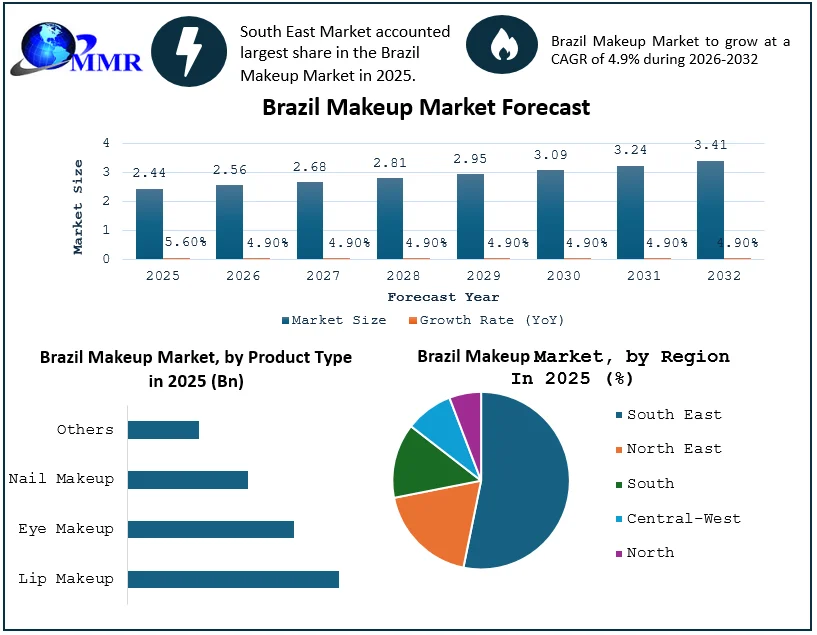
To know about the Research Methodology :- Request Free Sample Report
Brazil Makeup Market Overview
The Brazil Makeup Market represents a dynamic segment of the beauty and personal care industry, supported by rising beauty spending, changing consumer preferences, premiumization, and expanding digital commerce. Brazil Makeup Market Analysis indicates increasing demand for accessible, innovative, inclusive, and premium beauty offerings, with social media, beauty influencers, and e-commerce increasingly shaping product discovery and purchasing decisions. Grupo Boticário is a key player in the market, supported by its strong brand portfolio, extensive distribution network, and continued product innovation. Growing interest in inclusive beauty, skincare-oriented cosmetics, sustainable formulations, and digitally enabled beauty experiences is further supporting Brazil Makeup Market Growth and creating new opportunities across consumer segments and distribution channels.
The Brazil Makeup Market Report provides a comprehensive assessment of the market landscape, covering market size, growth trends, forecasts, competitive dynamics, and key growth drivers. The report evaluates the market across product type, category, ingredient type, and distribution channel, while analysing consumer preferences, pricing trends, brand positioning, purchasing behavior, and regional demand patterns. It also provides insights into emerging opportunities driven by premiumization, inclusive beauty, affordable cosmetics, clean and natural formulations, vegan and cruelty-free products, influencer-led marketing, social commerce, and e-commerce expansion. In addition, the report assesses the competitive environment, strategic initiatives, market challenges, supply-chain developments, regulatory factors, and evolving retail structures, helping manufacturers, investors, retailers, distributors, and new market entrants identify high-growth segments, evaluate competitive positioning, and develop informed expansion and investment strategies.
Brazil Makeup Market Historical Size (2020–2025)
| Year | Market Size | Growth Rate (YoY) |
| 2020 | USD 1.92 Bn | 2.5% |
| 2021 | USD 2.03 Bn | 5.7% |
| 2022 | USD 2.13 Bn | 4.9% |
| 2023 | USD 2.23 Bn | 4.7% |
| 2024 | USD 2.31 Bn | 3.6% |
| 2025 | USD 2.44 Bn | 5.6% |
Brazil Makeup Market Size Forecast (2026–2032)
| Year | Market Size | Growth Rate (YoY) |
| 2026 | USD 2.56 Bn | 4.9% |
| 2027 | USD 2.68 Bn | 4.9% |
| 2028 | USD 2.81 Bn | 4.9% |
| 2029 | USD 2.95 Bn | 4.9% |
| 2030 | USD 3.09 Bn | 4.9% |
| 2031 | USD 3.24 Bn | 4.9% |
| 2032 | USD 3.41 Bn | 4.9% |
Brazil Makeup Market Key Highlights
• Market Size (2025): USD 2.44 Billion, indicating strong market growth.
• Projected Market Size (2032): USD 3.41 Billion, reflecting accelerating market expansion.
• Forecast CAGR (2026–2032): 4.9%, demonstrating sustained growth during the forecast period.
• Dominant Product Segment: Face Makeup, accounting for 39.2% of the market share.
• Fastest-Growing Segment: Premium Makeup, driven by rapid consumer adoption and increasing demand for higher-value products.
• Leading Distribution Channel: Offline Retail, holding a 62.8% market share and remaining the primary channel for makeup sales.
Brazil Makeup Market Consumer Insights & Demand Analysis
| Consumer Dimension | Key Insights | Market Implication |
| Beauty Awareness | High beauty consciousness among Brazilian consumers | Supports premium product positioning |
| Social Media Influence | Influencer-driven purchasing across Instagram, TikTok, YouTube | Digital marketing and content creation essential |
| Price Sensitivity | Bifurcation between premium and mass-market buyers | Dual-tier product strategy required |
| Sustainability | Increasing preference for vegan, cruelty-free, and natural products | Green positioning and ethical certification beneficial |
| Digital Behavior | Growing online beauty discovery via e-commerce and DTC platforms | Digital marketing and DTC strategy essential |
Brazil Makeup Market Dynamics
Brazil Makeup Market Drivers
• Brazil’s strong beauty culture and high cosmetic consumption rate among Latin American consumers
• Rising disposable income in urban populations, particularly in Southeast and South Brazil
• Growth of influencer marketing and beauty content creators across social media platforms
Brazil Makeup Market Restraints
- High import taxes significantly increase final cosmetic product prices, limiting consumer access to international brands
- Counterfeit beauty products undermine brand trust and create safety concerns in the market
- Economic volatility affecting discretionary spending and consumer purchasing power
Brazil Makeup Market Opportunities
- Expansion of vegan and sustainable makeup product lines addressing growing ethical consumer demand
- Growing men’s grooming and cosmetic market representing an underpenetrated growth frontier
- AI-based personalized beauty recommendation platforms driving e-commerce engagement
- Social commerce and influencer-driven DTC models creating new distribution channels
Brazil Makeup Market Challenges
- Intense competition among domestic and global brands for shelf space and consumer loyalty
- ANVISA regulatory compliance requirements adding complexity for new product launches and imports
- Supply chain dependency on imported raw ingredients increasing production cost variability
Brazil Makeup Market Segment Analysis
Brazil Makeup Market by Product Type
The market includes Face Makeup, Lip Makeup, Eye Makeup, Nail Makeup, and Others. Face makeup remains an important category, supported by demand for foundations, concealers, blushes, bronzers, and highlighters. Lip makeup benefits from frequent product launches and changing Colour trends, while eye makeup continues to see demand for mascaras, eyeliners, and eyeshadows. Nail makeup also benefits from Brazil's strong beauty and personal-care culture, with consumers increasingly seeking innovative Colours, finishes, and long-lasting formulations.
Brazil Makeup Market by Ingredient Type
The market comprises Conventional, Natural, Organic, and Vegan & Cruelty-Free formulations. Conventional products continue to represent a significant portion of overall demand because of their affordability and established availability. However, natural and organic makeup is gaining popularity as consumers become more conscious of ingredients and product safety. Vegan and cruelty-free cosmetics are also expanding, supported by growing awareness of ethical sourcing, sustainability, and environmentally responsible beauty practices.

Brazil Makeup Market by Distribution Channel
Distribution includes Supermarkets/Hypermarkets, Specialty Beauty Stores, Pharmacies & Drugstores, Brand-Owned Stores, Online Retail/E-Commerce, and Direct Selling. Specialty beauty stores and pharmacies remain important for product discovery, expert recommendations, and physical product evaluation. Supermarkets and hypermarkets provide convenience and broad accessibility, particularly for mass-market products. Online retail and e-commerce are among the fastest-growing channels, supported by smartphone penetration, digital payments, social media influence, promotional campaigns, and the increasing popularity of direct-to-consumer beauty brands. Direct selling also remains relevant due to Brazil's established relationship-selling and beauty consultant networks.
Brazil Makeup Market Regional Analysis
Makeup demand within Japan varies significantly by region driven by differences in population density, income levels, consumer beauty culture maturity, and retail infrastructure. Metropolitan regions with high-income demographics represent the primary market, while regional cities offer growth potential.
| Region | Market Share | Key Demand Drivers & Trends |
| Southeast (São Paulo/Rio de Janeiro) | 53.20% | Largest market, high purchasing power, premium makeup adoption, strong specialty retail and e-commerce |
| Northeast (Bahia/Pernambuco/Ceará) | 18.70% | Large consumer base, strong beauty culture, rising aspirational spending, expanding e-commerce and direct sales |
| South (Paraná/Santa Catarina/Rio Grande do Sul) | 13.60% | Higher household incomes, established beauty retail, strong domestic brands, growing premium and clean beauty demand |
| Central-West (Brasília/Goiás/Mato Grosso) | 8.70% | Urbanization, rising middle-class consumption, expanding modern retail and e-commerce |
| North (Amazonas/Pará/Others) | 5.80% | Emerging demand, expanding distribution, growing beauty awareness and interest in natural/Amazon-inspired products |
Brazil Makeup Market Competitive Landscape
The Japan Makeup Market is highly competitive, with domestic beauty companies, international brands, and emerging niche players competing through product innovation, quality, brand reputation, pricing, and distribution reach. Domestic manufacturers maintain strong consumer loyalty through advanced formulations, established beauty expertise, and extensive retail networks, while international and Korean brands are increasing competition through trend-driven products, digital marketing, and innovative textures. In colour cosmetics, leading domestic players continue to hold strong positions, with Shiseido and Kanebo among the prominent competitors.
Competition is increasingly shaped by premiumization, functional makeup, clean and sustainable formulations, and digital commerce. Manufacturers are introducing products that combine makeup with skincare benefits, long-lasting performance, and lightweight textures. Social media, influencer marketing, and e-commerce are also accelerating product discovery and enabling niche brands to reach younger consumers. Overall, product innovation, premium positioning, brand heritage, affordability, digital engagement, and omnichannel distribution remain key factors shaping competitive dynamics in Japan's makeup market.
Brazil Makeup Market Key Players & Benchmarking
| Company | Headquarters | Key Products | Market Position | Revenue (Est.) |
| Natura &Co | São Paulo | Natura, Avon | Market Leader | ~BRL 10.8 Bn |
| Grupo Boticário | Curitiba | O Botic Ario, Eudora | Major Player | ~BRL 10.5 Bn |
| L’Oréal Brasil | São Paulo | Maybelline, L’Oréal Paris | Global Leader | Part of L’Oréal Group |
| Avon (Natura) | São Paulo | Avon Colour | Legacy Player | Part of Natura |
| Coty Brasil | São Paulo | Rimmel, CoverGirl | Growing Player | Part of Coty Inc. |
| Skala Cosméticos | São Paulo | Skala Makeup | Domestic Specialist | Private |
| MAC Cosmetics | São Paulo (ELC) | Premium Colour | Premium Brand | Part of ELC |
| Unilever Brasil | São Paulo | Beauty & Care | FMCG Major | Part of Unilever |
Brazil Makeup Market Technology & Innovation Trends
Brazil’s beauty technology ecosystem is evolving rapidly, supported by significant investment from domestic conglomerates including Natura &Co and Grupo Boticário in digital innovation, sustainable formulation, and AI-driven personalization. International players are bringing AR and smart cosmetic technologies to the Brazilian market, accelerating digital transformation in beauty retail.
| Innovation Area | Current Trend | Market Impact |
| AI Beauty Tech | AI-powered personalized shade matching and virtual try-on tools | Enhanced online conversion and reduced returns |
| Sustainable Packaging | Refillable, biodegradable, and recycled packaging for cosmetics | Aligns with ESG consumer preferences and regulatory trends |
| Hybrid Cosmetics | Skincare-infused makeup combining treatment and coverage | Addresses premiumization trend and simplifies beauty routines |
| AR Technology | Augmented reality virtual try-on via brand apps and social platforms | Boosts e-commerce engagement and digital sales conversion |
| Clean Beauty Formulation | Removal of harmful ingredients, natural and organic formulations | Drives premium segment growth and brand differentiation |
Brazil Makeup Market Regulatory Framework
Brazil’s cosmetic market is regulated by ANVISA (Agência Nacional de Vigilância Sanitária – Brazilian Health Regulatory Agency), which governs all aspects of cosmetic product safety, labelling standards, ingredient approvals, import procedures, and post-market surveillance. ANVISA classifies cosmetics into two risk categories: Grade 1 (low risk, notification-based) and Grade 2 (higher risk, requiring full registration). Makeup products typically fall under Grade 1, requiring pre-market notification via the ANVISA electronic system. The Brazilian cosmetic regulatory framework aligns increasingly with international standards, including those of the Mercosur Cosmetics Technical Regulation, facilitating regional trade within Latin America.
Brazil Makeup Market Investor Takeaway
The Brazil makeup market provides an attractive investment thesis driven by expanding beauty expenditure, strong domestic brand ecosystems, and accelerating premium product adoption. Brazil’s position as one of the world’s largest beauty markets, combined with significant digital transformation in beauty commerce, creates multiple high-growth entry points for investors across brand, manufacturing, technology, and distribution segments. The market is growing at a robust 7.9% CAGR through 2032, underpinned by structural demographic tailwinds and increasing consumer sophistication.
Brazil Makeup Market Scope: Inquire before buying
| Brazil Makeup Market | |||
|---|---|---|---|
| Report Coverage | Details | ||
| Base Year: | 2025 | Forecast Period: | 2026-2032 |
| Historical Data: | 2020 to 2025 | Market Size in 2025: | 2.44 USD Billion |
| Forecast Period 2026-2032 CAGR: | 4.9% | Market Size in 2032: | 3.41 USD Billion |
| Segments Covered: | by Product Type | Face Makeup Lip Makeup Eye Makeup Nail Makeup |
|
| by Category | Mass Market Products Premium Products Luxury Products Professional Makeup Products |
||
| by Ingredient Type | Conventional Natural Organic Vegan & Cruelty-Free |
||
| by Distribution Channel | Supermarkets / Hypermarkets Specialty Beauty Stores Pharmacies & Drugstores Brand-Owned Stores Online Retail / E-Commerce Direct Selling |
||
Frequently Asked Questions:
1. What is the size of Brazil’s makeup market?
The Brazil makeup market was valued at USD 2.44 Billion in 2025 and is projected to reach USD 3.41 Billion by 2032, growing at a CAGR of 4.9%.
2. Why is Brazil significant for the makeup and cosmetics industry?
Brazil is one of the world’s top five beauty markets globally, with a deeply embedded beauty culture, one of the largest consumer bases in Latin America, and strong domestic manufacturing capability through companies like Natura &Co and Grupo Boticário. Brazilian-origin beauty brands carry significant cachet in regional Latin American markets.
3. How does ANVISA regulate makeup products in Brazil?
ANVISA regulates cosmetic products under a two-tier risk classification system. Most makeup products are classified as Grade 1 (low risk) requiring pre-market notification. Grade 2 products with higher risk profiles require full registration. ANVISA also governs ingredient safety, labelling, and post-market surveillance for all cosmetic categories.
4. Which makeup product segment dominates in Brazil?
Face makeup leads with a 39.2% market share, reflecting the centrality of complexion products including foundation, concealer, and powder in Brazilian beauty routines. Lip makeup follows with 23.8% share, while eye makeup represents the fastest-growing subcategory.
5. Who are the key companies in Brazil’s makeup market?
Major players include Natura &Co (parent of Avon and The Body Shop), Grupo Boticário, L’Oréal Brasil, Coty Brasil, MAC Cosmetics, Maybelline New York, and Skala Cosméticos. The market features strong domestic conglomerates alongside premium international beauty brands.