
Japan Makeup Market Industry Analysis, Demand Drivers, Segment Performance, Competitive Landscape
Overview
Japan Makeup Market valued at USD 3.8 Bn in 2025, projected to reach USD 4.9 Bn by 2032 at 3.70% CAGR. Explore consumer behavior, premium beauty trends, regulatory landscape, key players, and growth opportunities shaping Japan’s cosmetics industry.
Japan Makeup Market Definition
The Japan makeup market was valued at USD 3.8 Billion in 2025 and is projected to reach USD 4.9 Billion by 2032, growing at a CAGR of 3.70% during the forecast period (2026–2032). Market growth is supported by premium beauty consumption, aging demographics, skincare-focused cosmetic preferences, strong domestic brands, and continuous innovation in beauty formulations. Japan remains among the world’s most sophisticated cosmetic markets due to high consumer expectations regarding quality, safety, formulation science, and product efficacy.
| Parameter | Value |
| Market Size (Base Year) | USD 3.8 Billion |
| Forecast Market Size (2032) | USD 4.9 Billion |
| CAGR (2026–2032) | 3.70% |
| Base Year | 2025 |
| Forecast Period | 2026–2032 |
| Historical Period | 2020–2025 |
| Key Growth Opportunity | Premium Anti-Aging & Skincare-Makeup Products |
Japan Makeup Market Overview
The Japan makeup market encompasses the production, distribution, and consumption of cosmetic products including foundations, lip products, eye makeup, skincare-infused cosmetics, anti-aging formulations, powders, and premium beauty products. Japan’s market is distinguished by exceptional product quality standards, advanced formulation science, and deep integration between skincare and makeup categories.
The Japan Makeup Market is a mature and highly competitive beauty market supported by sophisticated cosmetics manufacturing, strong domestic brands, advanced retail infrastructure, and consumers with high expectations for quality, safety, efficacy, and product performance. Market development is influenced by demographic changes, consumer spending patterns, premiumization, lifestyle shifts, tourism, and increasing digital engagement.
The competitive environment remains strong, with established Japanese companies competing alongside international and emerging brands. Distribution is evolving across specialty beauty stores, department stores, drugstores, supermarkets, and e-commerce platforms. Overall, the market offers opportunities through premium positioning, innovation, digital expansion, functional formulations, tourism-driven demand, and differentiated consumer experiences.
Japan Makeup Market Growth and Share Analysis
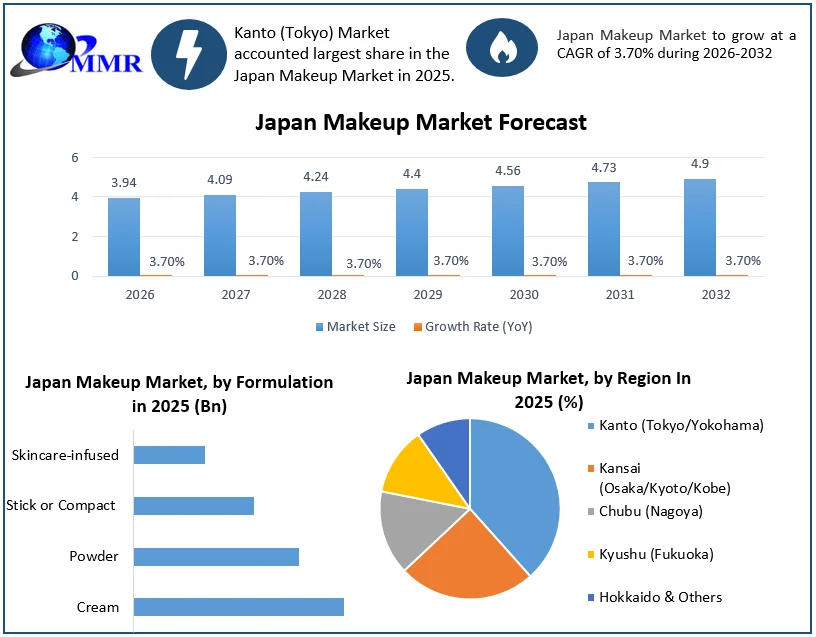
To know about the Research Methodology :- Request Free Sample Report
Japan Makeup Market Historical Size (2020–2025)
| Year | Market Size | Growth Rate (YoY) |
| 2020 | USD 3.07 Bn | 2.8% |
| 2021 | USD 3.24 Bn | 5.4% |
| 2022 | USD 3.43 Bn | 5.7% |
| 2023 | USD 3.55 Bn | 3.7% |
| 2024 | USD 3.69 Bn | 3.9% |
| 2025 | USD 3.80 Bn | 2.9% |
Japan Makeup Market Size Forecast (2026–2032)
| Year | Market Size | Growth Rate (YoY) |
| 2026 | USD 3.94 Bn | 3.70% |
| 2027 | USD 4.09 Bn | 3.70% |
| 2028 | USD 4.24 Bn | 3.70% |
| 2029 | USD 4.40 Bn | 3.70% |
| 2030 | USD 4.56 Bn | 3.70% |
| 2031 | USD 4.73 Bn | 3.70% |
| 2032 | USD 4.90 Bn | 3.70% |
Japan Makeup Market Key Highlights
• Market Size (2025): USD 3.8 Billion, reflecting stable demand in Japan's mature beauty market.
• Projected Market Size (2032): USD 4.9 Billion, supported by continued product innovation and premiumization.
• CAGR (2026–2032): 3.70%, indicating moderate and sustained market growth.
• Dominant Product Segment: Face Makeup, accounting for 34.8% share, driven by demand for complexion-enhancing products.
• Fastest-Growing Segment: Hybrid Beauty (Skincare-Makeup), benefiting from rising demand for multifunctional and skin-friendly products.
• Leading Distribution Channel: Offline Retail, holding 63.2% share due to strong consumer preference for in-store product testing and established retail networks.
• Key Trend: Growing preference for natural-looking, functional, premium, and skincare-infused makeup products.
Japan Makeup Market Consumer Insights & Demand Analysis
| Consumer Dimension | Key Insights | Market Implication |
| Aging Population | Rising demand for anti-aging and sensitive skin makeup formulations among Japan’s growing 60+ demographic | Supports premium anti-aging product positioning and higher ASPs |
| Quality Expectations | Exceptionally high standards for formulation safety, skin compatibility, and product performance | Strong R&D investment and premium ingredient sourcing required |
| Sustainability | Increasing demand for eco-friendly and sustainably packaged cosmetics | ESG investments and refillable packaging formats gaining traction |
| Minimalist Beauty | Strong preference for natural appearance and subtle cosmetic enhancement | Subtle finish, lightweight, and skin-like formulations growing |
| Digital Adoption | Increasing online beauty purchases particularly among younger demographics | Omnichannel and DTC e-commerce strategies becoming essential |
Japan Makeup Market Dynamics
Japan Makeup Market Drivers
• Japan’s aging demographic profile creating sustained demand for premium anti-aging cosmetics, sensitive skin formulations, and skincare-integrated makeup products
• World-class domestic beauty brands including Shiseido, Kao, Kosé, and POLA maintaining strong consumer loyalty and driving continuous product innovation
• Advanced product formulation capabilities in Japan enabling development of cutting-edge hybrid skincare-cosmetics delivering measurable skin benefits
Japan Makeup Market Restraints
• Market maturity limiting overall category growth rates relative to emerging Asian beauty markets such as China and Southeast Asia
• Intense domestic competition among established brands creating pricing pressure and compressing margins across mass-market cosmetics segments
• High consumer quality expectations increasing product development costs and time-to-market for new formulations
Japan Makeup Market Opportunities
• Premium and luxury cosmetics demand continuing to grow, particularly anti-aging and multifunctional skincare-makeup hybrid products targeting Japan’s affluent aging consumers
• Male cosmetics and grooming products representing a significantly underpenetrated segment with strong long-term growth potential
• Sustainable beauty packaging and clean formulations aligning with growing environmental awareness among Japanese consumers
Japan Makeup Market Challenges
• Slow overall population growth limiting the expansion of the total addressable domestic cosmetics consumer base
• Saturation of the domestic mass-market cosmetics segment intensifying competitive pressure on established players
• Premium pricing pressure as consumers balances quality expectations against macroeconomic headwinds
Japan Makeup Market Segment Analysis
Japan Makeup Market by Product
The market includes face makeup, lip products, eye makeup, and foundations & concealers. Face makeup remains an important category, supported by demand for complexion-enhancing products and natural-looking finishes. Lip products continue to benefit from product innovation, seasonal trends, and premium formulations, while eye makeup maintains steady demand across every day and occasion-based use. Foundations and concealers are also gaining attention as consumers increasingly seek lightweight, long-lasting, and personalized complexion products.

Japan Makeup Market by Price Tier
The market is divided into mass market, premium, and luxury segments. Mass-market products maintain a broad consumer base because of their affordability and accessibility, particularly through drugstores and general retail channels. The premium segment is supported by consumers seeking higher-quality formulations, established brands, and specialized benefits. Meanwhile, luxury makeup is driven by brand prestige, sophisticated packaging, innovative formulations, and demand for high-end beauty experiences, particularly among affluent consumers.
Japan Makeup Market Regional Analysis
Makeup demand within Japan varies significantly by region driven by differences in population density, income levels, consumer beauty culture maturity, and retail infrastructure. Metropolitan regions with high-income demographics represent the primary market, while regional cities offer growth potential.
| Region | Market Share | Key Demand Drivers & Trends |
| Kanto (Tokyo/Yokohama) | 38.4% | Largest market, premium beauty hub, international brand presence |
| Kansai (Osaka/Kyoto/Kobe) | 24.6% | Mature market, strong beauty culture, established retail network |
| Chubu (Nagoya) | 15.1% | Stable demand, industrial economy, growing premium segment |
| Kyushu (Fukuoka) | 12.2% | Emerging – Growing beauty consciousness and retail expansion |
| Hokkaido & Others | 9.7% | Niche – Regional demand with distinct seasonal beauty needs |
Japan Makeup Market Competitive Landscape
Key Players & Benchmarking
| Company | Headquarters | Segment | Market Position | Revenue (Est.) |
| Shiseido Company | Tokyo | Full Range Premium | Market Leader | ~JPY 1.1 Tn |
| Kao Corporation | Tokyo | Mass & Premium | Major Player | ~JPY 1.5 Tn (total) |
| Kosé Corporation | Tokyo | Premium & Luxury | Significant Player | ~JPY 320 Bn |
| POLA Orbis Holdings | Tokyo | Luxury Premium | Strong Player | ~JPY 180 Bn |
| Kanebo Cosmetics (Kao) | Tokyo | Premium | Established Player | Part of Kao Group |
| Covér Girl Japan (Coty) | Tokyo | Mass Market | International Brand | Part of Coty Group |
| L’Oréal Japan | Tokyo | Full Range | Major International | Part of L’Oréal Group |
| Estée Lauder Japan | Tokyo | Luxury | Premium Leader | Part of EL Group |
Japan Makeup Market Technology & Innovation Trends
| Innovation Area | Current Trend | Market Impact |
| Hybrid Skincare Cosmetics | Cosmetics integrating active skincare ingredients such as retinol, ceramides, and hyaluronic acid into makeup formulations | Premiumization and higher ASPs across foundation and BB cream categories |
| AI Skin Analysis | AI-powered skin diagnostics integrated into retail experiences and beauty apps enabling personalized product recommendations | Improved personalization and conversion in premium segment |
| Smart Beauty Devices | At-home beauty devices combining technology with complementary cosmetic products | Premium consumer engagement and repeat purchase loyalty |
| Sustainable Packaging | Refillable containers, biodegradable packaging, and reduced-plastic formulations responding to consumer ESG preferences | ESG differentiation and alignment with regulatory direction |
| Sensitive Skin Formulations | Advanced hypoallergenic, fragrance-free, and dermatologically tested formulations targeting Japan’s large sensitive-skin consumer demographic | Competitive differentiation in premium and luxury segments |
Japan Makeup Market Regulatory Framework
Japan’s cosmetics industry is regulated under a dual framework administered by the Pharmaceuticals and Medical Devices Agency (PMDA) and the Ministry of Health, Labour and Welfare (MHLW). The Pharmaceutical and Medical Device Act (PMD Act) governs product classification, ingredient approvals, manufacturing standards, and marketing claims for cosmetics and quasi-drugs (a category between cosmetics and pharmaceuticals unique to Japan).
Quasi-drug classification in Japan allows products to carry functional claims (such as whitening, hair growth, and anti-perspiration) not permitted for standard cosmetics. This regulatory category creates competitive advantages for domestic brands with established quasi-drug product portfolios and represents a significant barrier to entry for international brands unfamiliar with Japan’s regulatory framework.
Japan Makeup Market Investor Takeaway
Japan’s makeup market offers a stable, high-quality investment thesis underpinned by premium consumption trends, world-class domestic brand innovation, and a unique regulatory environment that creates durable competitive advantages for established players. The market’s combination of steady 3.70% CAGR growth, aging demographic tailwinds for anti-aging cosmetics, and Japan’s globally recognized premium brand equity makes it an attractive long-term investment destination. Investment in Japan’s beauty sector whether through domestic premium brands, hybrid skincare innovation, or expanding e-commerce infrastructure represents participation in one of the world’s most sophisticated and resilient beauty markets.
Japan Makeup Market Scope: Inquire before buying
| Japan Makeup Market | |
| Base Year | 2025 |
| Forecast Period | 2026–2032 |
| Historical Period | 2020–2025 |
| Market Size (Base Year) | USD 3.8 Billion |
| Forecast Market Size (2032) | USD 4.9 Billion |
| CAGR | 3.70% |
| Segment: By Product Type | Face Makeup, Lip Products, Eye Makeup, Foundations & Concealers, Hybrid Beauty (Skincare-Makeup) |
| Segment: By Price Tier | Mass Market, Premium, Luxury |
| Segment: By Formulation | Liquid / Cream, Powder, Stick / Compact, Skincare-infused |
| Segment: By Distribution Channel | Offline Retail (Department Stores/Drugstores/Specialty), E-commerce (Brand DTC/Amazon Japan/Rakuten) |
| Segment: By Consumer Group | Women, Men, Gender-neutral |
| Regional Analysis | Kanto, Kansai, Chubu, Kyushu & Okinawa, Hokkaido & Tohoku, Chugoku & Shikoku |
| Key Companies | L’Oréal Japan, Estée Lauder Japan, Chanel Beauty Japan, LVMH Beauty Japan, Menard Cosmetics, Fencl Corporation, Albion Co., Ltd., Noevir Holdings |
Frequently Asked Questions:
1. What is the size of Japan’s makeup market?
The Japan makeup market was valued at USD 3.8 Billion in 2025 and is projected to reach USD 4.9 Billion by 2032, growing at a CAGR of 3.70%.
2. What drives growth in Japan’s makeup market?
Growth is primarily driven by aging demographics supporting premium anti-aging cosmetics demand, product innovation in skincare-makeup hybrids, domestic tourism recovery boosting cosmetics retail, and incremental e-commerce adoption among younger consumer demographics.
3. How does Japan regulate the cosmetics market?
Japan’s cosmetics industry is regulated by the Ministry of Health, Labour and Welfare (MHLW) and the Pharmaceuticals and Medical Devices Agency (PMDA) under the Pharmaceutical and Medical Device Act. Japan’s unique quasi-drug category allows cosmetics-like products to carry functional claims not permitted for standard cosmetics, creating regulatory complexity for new market entrants.
4. Which product type dominates Japan’s makeup market?
Face makeup leads with a 34.8% market share. The Hybrid Beauty (Skincare-Makeup) segment is the fastest growing, reflecting Japan’s unique consumer preference for cosmetics delivering simultaneous skincare and makeup performance benefits.
5. Who are the key companies in Japan’s makeup market?
Major domestic players include Shiseido Company, Kao Corporation, Kosé Corporation, POLA Orbis Holdings, and Kanebo Cosmetics. International brands including L’Oréal Japan and Estée Lauder Japan hold strong positions in the premium and luxury segments.