
Bladder Cancer Market Size – Industry Structure Evaluation, Demand Drivers Analysis, Regional Growth Analysis and Identification, Competitive Positioning Review & Global Market Size Forecast to 2034
Overview
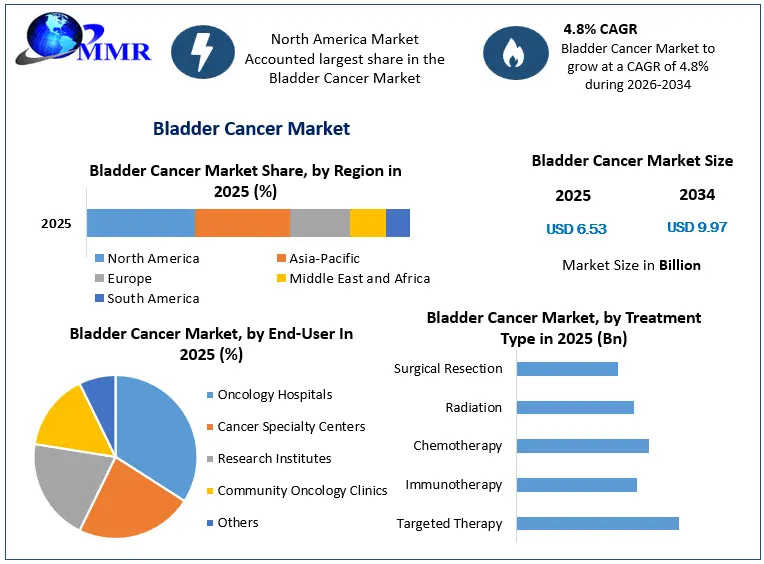
The Bladder Cancer Market size was valued at USD 6.53 Billion in 2025 and the total Bladder Cancer Market Size is expected to grow at a CAGR of 4.8% from 2026 to 2034, reaching nearly USD 9.97 Billion by 2034.
Bladder Cancer Market Overview
Bladder cancer begins when healthy cells in the bladder lining most commonly urothelial cells change and grow out of control, forming a mass called a tumor. Urothelial cells also line the renal pelvis, ureters, and urethra. Cancer that develops in the renal pelvis and ureters is also considered a type of urothelial cancer.
Bladder Cancer Market Growth and Share Analysis
To know about the Research Methodology :- Request Free Sample Report
1. Bladder cancer is most frequently diagnosed among people aged 65–74.
2. According to MMR analysis, among men in the United States, bladder cancer is the eighth most common cause of cancer death. However, the death rate for bladder cancer decreased by over 2% annually from 2016 to 2020.
The landscape of the Bladder Cancer Market is expected to evolve constantly owing to industry trends and market dynamics. The research objective of the bladder cancer market research is to examine the existing patterns, recognize unmet need areas, and enable stakeholders to enhance bladder cancer care and outcomes by offering practical suggestions. Market intelligence study indicates a growing prevalence of bladder cancer cases, driving demand for innovative treatments and diagnostic solutions. The report provides an analysis of market trends about advancements in technology, such as healthcare digital transformation offering promising opportunities for improving diagnosis, treatment, and patient care.
The report also provides market segmentation research that highlights the significance of consumer behavior, target markets, and customer preferences. Additionally, the report covers bladder cancer epidemiology and provides insights into the historical and current bladder cancer patient pool that has been analyzed for five different geographical regions. The bladder cancer market is a constantly changing environment marked by innovation, competition, and shifting consumer preferences. The report provides a comprehensive analysis that enables stakeholders to gain a deep understanding of the market landscape, identify potential growth areas, and address challenges.
Asia-Pacific region is the fastest-growing region, with a projected CAGR in the Bladder Cancer Market. The rising elderly population in this region is a key influencer, as bladder cancer incidence increases with age. The various key players in the region like Daiichi Sankyo Co., Ltd. (Japan), Hisamitsu Pharmaceutical Co., Inc. (Japan), Livzon Pharmaceutical Group (China), Sun Pharmaceutical Industries Ltd (India), Zydus Lifesciences (India), and Astellas Pharma Inc (Japan), etc actively contribute to the market advancements. Additionally, the region’s focus on personalized medicine, technological advancements, and collaborations among the industry participants further enhance the bladder cancer market growth potential.
Bladder Cancer Market Dynamics
Transformative Advances in Bladder Cancer Detection and Early Intervention
Next-generation sequencing (NGS) and advanced imaging techniques are transforming the way bladder cancer is detected on the diagnostic front. NGS allows for treatment plans based on a patient's specific genetic makeup. This personalized approach significantly improves treatment effectiveness and patient survival rates. Additionally, advancements in imaging techniques like cystoscopy with white light cystoscopy (WLC) and fluorescence cystoscopy (FC) have enhanced visualization of bladder lesions, leading to more accurate diagnoses and earlier intervention. These minimally invasive procedures allow for earlier detection of precancerous lesions and minimize the need for more invasive surgical procedures. Additionally, educational campaigns and increased media coverage have led to a population that is more informed about the risk factors, early signs, and importance of seeking early medical attention. The growing healthcare expenditure and increasing awareness about bladder cancer symptoms are leading to earlier diagnoses and more patients seeking treatment. Early detection not only improves the chances of successful treatment but also reduces the overall healthcare burden by minimizing the need for complex and expensive surgeries in later stages. With the growing emphasis on early detection, the market is witnessing the development and adoption of non-invasive and less burdensome diagnostic tools. As diagnostic techniques become more accurate and readily available, early detection rates rise, further emphasizing the importance of public awareness campaigns. This cycle of early detection and improved patient outcomes ultimately drives the growth of the bladder cancer market by creating a demand for a wider range of diagnostic tools, treatment options, and supportive care services.
High Treatment Costs & Drug Patent Expirations
Despite significant advancements in treatment and diagnosis, the bladder cancer market faces challenges that hinder its growth. The financial burden of bladder cancer treatment represents a major concern for both patients and healthcare systems. Chemotherapy, a mainstay treatment for bladder cancer, has been expensive, particularly when considering combination procedures and the potential need for multiple cycles. Additionally, newer targeted therapies and immunotherapies, while offering promising results, often come with immense price tags. The financial burden leads to treatment delays or even treatment abandonment, ultimately impacting patient outcomes and hindering the overall growth of the cancer bladder market. Patent uniqueness allows pharmaceutical companies to earn their research and development (R&D) investments and generate profits. However, once patents expire, generic versions of the drugs enter the market at significantly lower prices. This shift leads to decreased revenue for pharmaceutical companies, potentially impacting their R&D efforts for new and innovative bladder cancer therapies. Market barriers to entry, including stringent regulatory requirements and high research and development costs, pose challenges for new entrants seeking to penetrate the market. Therefore, balancing profit margins with affordability and fostering competition and innovation are key strategies to address these challenges and sustain the bladder cancer market growth.
Bladder Cancer Market Segment Analysis
Based on Treatment, the Chemotherapy segment holds the largest market share in the Global Bladder Cancer Market. According to MMR analysis, the segment is further expected to grow at a CAGR of 4.8% during the forecast period. It stands out as the dominant segment within the Global Bladder Cancer Market. Decades of research and clinical use have paved chemotherapy's role as a basis for the treatment of bladder cancer, particularly in advanced or metastatic stages. Cisplatin-based regimens have shown effectiveness in controlling tumor growth and enhancing survival rates, contributing to robust revenue trends and sales performance. Chemotherapy's adaptability across various treatment scenarios strengthens its dominance in the bladder cancer market. Additionally, chemotherapy serves as a backbone in adjuvant therapy to eliminate any microscopic cancer cells remaining and reduce the risk of recurrence. Also, for advanced or metastatic bladder cancer where curative options are limited, chemotherapy offers a comforting approach to manage symptoms and improve quality of life. The adaptability of chemotherapy across different treatment scenarios, coupled with its cost benefits compared to newer therapies, strengthens its market penetration strategies. Chemotherapy often works symbiotically with other treatment modalities, further solidifying its dominance in the bladder cancer market. In addition, the evolving landscape, marked by advancements in targeted therapies and immunotherapies, poses challenges to chemotherapy's established dominance, necessitating continual industry benchmarking and analysis to ensure sustained market leadership in the global bladder cancer market.
Additionally, the Radiation Therapy Segment holds a significant position in the Bladder Cancer Market. Radiation therapy plays a vital role in the bladder cancer market, with an emphasis on cost benefits that stand out as a pivotal factor in driving both profitability and market development. Manufacturers strategically position themselves within the market landscape, leveraging radiation therapy's efficacy to solidify market leadership positions. Additionally, the radiation therapy segment stands resilient and poised to meet the evolving demands of both patients and stakeholders, ensuring sustained market relevance and growth.
Bladder Cancer Market Regional Insights
North America dominated the Global Bladder Cancer Market with the highest share in 2025. The region is expected to grow at a CAGR of 4.8% during the forecast period and maintain its dominance. The North American region represents one of the largest healthcare markets globally, with a sizable patient population and healthcare expenditure. The region is home to numerous pharmaceutical and biotechnology companies, academic institutions, and research organizations dedicated to oncology research. The considerable investment in R&D translates into a constant flow of novel drugs and medical devices entering the market, driving innovation and expanding treatment options for bladder cancer patients. Also, the supply chain of cancer vaccines or drugs plays a crucial role in determining the profit margin of leading pharmaceutical companies in the region. Additionally, regulatory agencies such as the Food and Drug Administration (FDA) in the United States play a vital role in accelerating the approval process for bladder cancer treatments.
This regulatory support motivates pharmaceutical companies to invest in bladder cancer research and development, further driving North America's dominance in the bladder cancer market. The high demand for bladder cancer treatments and services in North America drives companies to invest in product development, marketing, and distribution, supporting the region's presence in the global market. Import-export policies significantly impact the economic feasibility of producing these essential treatments. Through a focus on prevention and early detection, North America successfully reduces the impact of bladder cancer and improves public health. The region’s dominance in the bladder cancer market is multifaceted, driven by its healthcare system, strong research and development network, favorable regulatory policies, focus on cancer prevention and screening, significant market size, and economic influence.
European Bladder Cancer is a mature market and is growing significantly with a CAGR during the forecast period in the global bladder cancer market. Robust healthcare infrastructure, characterized by advanced medical facilities, skilled healthcare professionals, and widespread access to innovative treatment modalities is driving the growth of the region. Additionally, Europe's favorable regulatory environment facilitates the timely approval and adoption of new bladder cancer therapies, ensuring that patients have access to the latest advancements in treatment. Market consolidation efforts and strategic partnerships among pharmaceutical companies and medical device manufacturers contribute to the growth and development of the bladder cancer market in Europe.
1. In 2022, the mortality rate of bladder cancer in Europe was, among men, 19.4 per 100,000, while among women it stood at 4.4 per 100,000.
Bladder Cancer Market Recent Industry Developments
| Date | Company | Development | Impact |
|---|---|---|---|
| 10 July 2026 | Pfizer | The U.S. FDA approved the Padcev and Keytruda combination regimen as the first platinum-free perioperative treatment for adults with muscle-invasive bladder cancer (MIBC), regardless of cisplatin eligibility. | Significantly reduces the risk of death by 35% and lowers tumor recurrence, setting a new clinical standard of care for earlier-stage bladder cancer treatment. |
| 04 June 2026 | Photocure ASA | Successfully completed the acquisition of Vesica Health in a transaction valued at USD 30.5 million to advance the urine-based molecular test AssureMDx. | Accelerates the commercialization of precision diagnostics for the early detection and management of bladder cancer within urology markets. |
| 05 March 2025 | AstraZeneca | Received regulatory approval for its PD-L1 inhibitor Imfinzi in combination with chemotherapy for perioperative muscle-invasive bladder cancer based on the Phase 3 Niagara trial. | Delivered a 32% improvement in event-free survival, providing a vital new immunotherapy option for cisplatin-eligible patients. |
| 12 February 2026 | UroGen Pharma | Reported a 109% surge in quarterly revenue reaching $29.2 million for its chemoablative therapy ZUSDURI targeting non-muscle invasive bladder cancer (NMIBC). | Highlights strong clinical workflow integration and market adoption, helping patients avoid repeated surgical interventions through office-based therapy. |
Bladder Cancer Market Competitive Landscapes
The market for Bladder Cancer is competitive for both well-established and emerging companies. The key players such as Johnson & Johnson Services Inc., F. Hoffmann, La Roche Ltd., Pfizer Inc., Abbott Laboratories, Novartis AG, Eli Lilly and Company, Gilead Sciences, Bristol Myers Squibb, AbbVie Inc., Zydus Pharmaceuticals Inc. have been concentrating on adopting new technology, product innovations, mergers & acquisitions, joint venture, alliances, and partnerships to improve their market position in the global bladder cancer market.
1. In 2024, Johnson & Johnson announced that the U.S. Food and Drug Administration (FDA) approved a supplemental New Drug Application (sNDA) for BALVERSA (erdafitinib) for the treatment of adult patients with locally advanced or metastatic urothelial carcinoma.
2. In 2023, Bristol Myers Squibb (BMS) completed its acquisition of Mirati Therapeutics, Inc., which is now a wholly-owned subsidiary of the company. The definitive merger agreement with BMS acquiring Mirati for $58 per share in cash, for a total equity value of $4.8 billion.
3. In 2023, Merck & Co. collaborated with Daiichi Sankyo to develop and commercialize three antibody-drug conjugate candidates demonstrating its commitment to expanding its oncology portfolio.
4. In 2023, Eli Lilly and Co. purchased Emergence Therapeutics, a German biotechnology startup focused on antibody-drug conjugates (ADCs). This acquisition was part of Eli Lilly's strategic efforts to bolster its cancer drug business and expand its focus on targeted cancer medicines.
Bladder Cancer Market Scope: Inquire before buying
| Bladder Cancer Market | |||
|---|---|---|---|
| Report Coverage | Details | ||
| Base Year: | 2025 | Forecast Period: | 2026-2034 |
| Historical Data: | 2020 to 2025 | Market Size in 2025: | 6.53 USD Billion |
| Forecast Period 2026-2034 CAGR: | 4.8% | Market Size in 2034: | 9.97 USD Billion |
| Segments Covered: | by Cancer Type | Transitional Cell Bladder Cancer/ Urothelial Carcinoma Squamous Cell Bladder Cancer Adenocarcinoma Other Rare Types |
|
| by Treatment Type | Targeted Therapy Immunotherapy Chemotherapy Radiation Surgical Resection |
||
| by Drug Class | Cytotoxic Chemotherapy Checkpoint Inhibitors Antibody-Drug Conjugates (ADCs) Small Molecules CAR-T / Cell Therapies Biosimilars |
||
| by Diagnosis | Urinalysis Urine Cytology Cystoscopy Biopsy Molecular Diagnostics Intravenous Pyelogram (Ivp) Other |
||
| by Distribution | Specialty Pharmacy Hospital Pharmacy Direct to Provider Government Health Programs |
||
| by End-User | Oncology Hospitals Cancer Specialty Centers Research Institutes Community Oncology Clinics Others |
||
Bladder Cancer Market, by Region
North America (United States, Canada, and Mexico)
Europe (UK, France, Germany, Italy, Spain, Sweden, Austria, and the Rest of Europe)
Asia Pacific (China, South Korea, Japan, India, Australia, Indonesia, Malaysia, Vietnam, Taiwan, Bangladesh, Pakistan, and the Rest of APAC)
Middle East and Africa (South Africa, GCC, Egypt, Nigeria, and the Rest of ME&A)
South America (Brazil, Argentina Rest of South America)
Bladder Cancer Market, Key Players
North America
1. AbbVie Inc.
2. Altor BioScience Corp.
3. Amgen Inc.
4. Amneal Pharmaceuticals Inc.
5. AndroScience Corp.
6. Array BioPharma Inc.
7. Asana BioSciences LLC
8. Bristol Myers Squibb
9. Celgene Corporation
10. CG Oncology, Inc.
11. Eli Lilly and Company
12. Endo International plc
13. Gilead Sciences, Inc.
14. ImmunityBio, Inc.
15. Incyte Corporation
16. Johnson & Johnson
17. Merck & Co., Inc.
18. Nanostics
19. Pfizer Inc.
20. Seagen Inc.
21. Vault Pharma Inc.
22. Vyriad Inc.
Europe
23. Adaptimmune Therapeutics plc
24. Alligator Bioscience AB
25. Archivel Farma S.L.
26. AstraZeneca plc
27. Bavarian Nordic A/S
28. Bayer AG
29. Boehringer Ingelheim GmbH
30. F. Hoffmann-La Roche Ltd.
31. Ferring Pharmaceuticals
32. GSK plc
33. Ipsen S.A.
34. Merck KGaA
35. Novartis AG
36. Roche Holding AG (Genentech, Inc.)
37. Sanofi
Asia-Pacific
38. Asieris Pharmaceuticals Co., Ltd.
39. Astellas Pharma Inc.
40. Eisai Co., Ltd.
41. MEDYRA PHARMACEUTICAL
42. Takeda Pharmaceutical Company Limited
South America
43. UroGen Pharma Ltd.
Middle East and Africa
44. Eurofarma
Others
Frequently Asked Questions:
1. What are the growth drivers for the Bladder Cancer Market?
Ans. Rising cancer prevalence and an increase in the aging population are the drivers of the Global Bladder Cancer Market.
2. What are the major challenges for the Bladder Cancer Market growth?
Ans. Limited effectiveness of current treatments and high cost are the major challenges for the Bladder Cancer Market.
3. Which region is expected to lead the global Bladder Cancer Market during the forecast period?
Ans. North America is expected to lead the global Bladder Cancer Market during the forecast period.
4. What is the projected market size & and growth rate of the Bladder Cancer Market?
Ans. The Bladder Cancer Market size was valued at USD 6.53 Billion in 2025 and the total Bladder Cancer revenue is expected to grow at a CAGR of 4.8% from 2026 to 2034, reaching nearly USD 9.97 Billion by 2034.
5. What segments are covered in the Bladder Cancer Market report?
Ans. The segments covered in the Bladder Cancer Market report are cancer type, treatment, diagnosis, and region.