
Global Biologics Market - Industry Structure Evaluation, Demand Drivers Analysis, Regional Growth Analysis and Identification, Competitive Positioning Review & Global Market Size Forecast to 2034
Overview
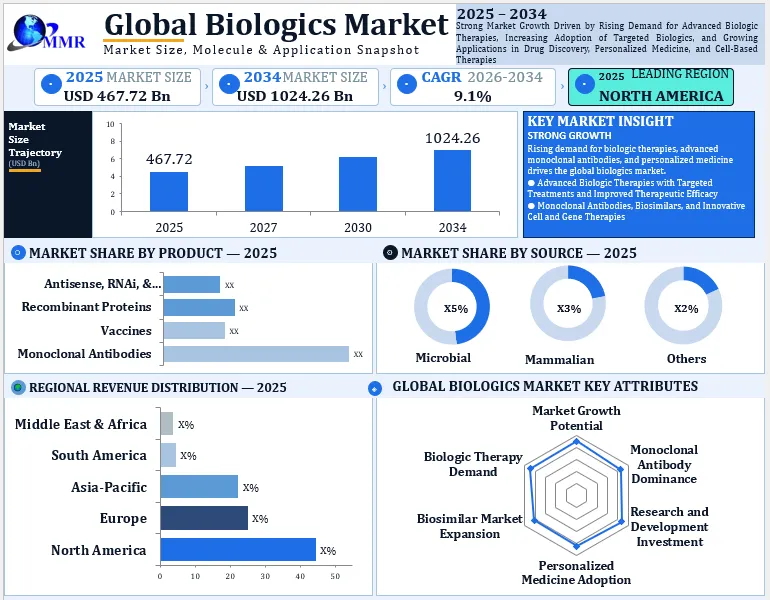
Global Biologics Market size valued at USD 467.72 Bn. in 2025, projected to reach USD 1024.26 Bn. by 2034, growing at 9.1% CAGR.
Biologics Market Overview
Biologics are pharmaceutical products derived from living organisms, including proteins, cells, or tissues, used to prevent, treat, or cure diseases. They include vaccines, monoclonal antibodies, and gene therapies.
The global biologics market is experiencing robust growth due to their increasing prevalence of chronic diseases, advancements in biotechnology, and rising demand for personalized medicine. A key market driver is the growing adoption of biosimilars, which gives a cost-effective alternative to expensive biologic therapies.
North America dominates the Biologics Market by its strong R&D investments, favorable regulatory policies, and presence of leading pharmaceutical companies like Johnson & Johnson, Roche, and AbbVie. Also, the Asia Pacific region is emerging as a high-growth market thanks to its expanding healthcare infrastructure and increasing biopharmaceutical production. Key players are focusing on innovation and strategic collaborations to strengthen their market position.
The report also helps in understanding the Global Biologics Market dynamics, structure by analyzing the market segments and projects the Global market. Clear representation of competitive analysis of key players by Application, price, financial position, Product portfolio, growth strategies, and regional presence in the Global Biologics Market makes the report an investor’s guide.
Global Biologics Market Size, Share and Growth Outlook
To know about the Research Methodology :- Request Free Sample Report
Global Biologics Market: Top Key Highlights
• Market Growth: The global biologics market is valued at USD 467.72 billion in 2025 and is projected to reach USD 1,024.26 billion by 2034, growing at a CAGR of 9.1% during the forecast period.
• Regional Dominance: North America leads the global biologics market, supported by advanced healthcare infrastructure, substantial R&D investments, and the presence of major biopharmaceutical companies.
• Leading Product Segment: Monoclonal antibodies hold the largest product segment share, accounting for 42.9% in 2025, driven by increasing demand for targeted treatments for cancer and autoimmune diseases.
• Fastest-Growing Region: Asia-Pacific is expected to experience the fastest growth, supported by expanding biopharmaceutical manufacturing, rising healthcare expenditure, and increasing demand for biologic therapies.
• Key Growth Drivers: Advancements in biotechnology, increasing prevalence of chronic diseases, rising adoption of personalized medicine, and growing demand for biosimilars drive market expansion.
Global Biologics Market Dynamics
Billion-Dollar Investments, Breakthrough Treatments, and Strong Revenue Potential to Drive the Biologics Market
The global biologics market is driven by substantial investments in biopharmaceutical research, manufacturing capacity expansion, and the development of advanced therapies. Pharmaceutical companies are increasing their investments in biologics to address complex diseases, including cancer, autoimmune disorders, and chronic inflammatory conditions. In 2025, the U.S. Food and Drug Administration (FDA) approves 46 novel drugs, including 12 biologics, highlighting the continuing contribution of biological therapies to pharmaceutical innovation. The growing demand for targeted treatments, improved therapeutic outcomes, and personalized medicine strengthens market growth. Furthermore, the introduction of innovative biologics and the expansion of product portfolios create new revenue opportunities for manufacturers. However, high research and development expenditure, complex manufacturing processes, and lengthy development timelines remain significant challenges for market participants.
Rising Product Approvals and Blockbuster Biologics to Accelerate Market Growth
Increasing regulatory approvals and a strong pipeline of biologic drugs support the expansion of the global biologics market. Advances in biotechnology enable the development of monoclonal antibodies, recombinant proteins, vaccines, and other innovative therapies for diseases that are difficult to treat. In 2025, the FDA approves 46 novel drugs through its Center for Drug Evaluation and Research (CDER), including 12 new biologics, demonstrating the continued development of innovative treatment options. Blockbuster biologics, including Humira (adalimumab), demonstrate the commercial potential of these treatments across major therapeutic areas. In addition, increasing investments in clinical trials and the growing adoption of biologics in oncology, immunology, and rare disease treatment strengthen market demand. Nevertheless, clinical trial failures, uncertain approval timelines, and high development costs limit the pace of product commercialization.
High Development Costs, Complex Manufacturing, and Regulatory Requirements to Restrain Market Growth
The biologics market faces significant barriers to entry because of the substantial financial, technical, and regulatory requirements associated with product development and commercialization. Developing a biologic requires specialized manufacturing facilities, advanced quality-control systems, skilled personnel, and extensive clinical testing. Unlike conventional small-molecule drugs, biologics are complex molecules produced using living systems, making manufacturing consistency, product stability, and contamination control particularly challenging. Regulatory authorities require comprehensive evidence of safety, efficacy, quality, and manufacturing consistency before granting approval. In 2025, the FDA continues to emphasize biosimilar development and regulatory efficiency, including measures to simplify certain biosimilarity studies and reduce unnecessary clinical testing to lower development costs. Additionally, stringent cold-chain requirements, high treatment costs, reimbursement limitations, and competition from biosimilars affect market accessibility and profitability, particularly in price-sensitive regions.
Competitive Pricing, Technological Innovation, and Strategic Alliances to Create Market Opportunities
Manufacturers pursue strategic partnerships, mergers and acquisitions, and technological innovation to strengthen their competitive positions in the global biologics market. Advances in cell culture technologies, bioprocessing, automation, and continuous manufacturing help companies improve production efficiency and optimize manufacturing costs. The development of biosimilars creates opportunities to expand treatment access and reach cost-sensitive patient populations. In 2025, the FDA approves 18 biosimilars in the United States, strengthening competition across therapeutic areas such as oncology, immunology, ophthalmology, and bone health. Furthermore, collaborations between pharmaceutical companies, biotechnology firms, and research institutions support the development of next-generation biologics, including antibody-drug conjugates, bispecific antibodies, and cell and gene therapies. Emerging markets offer additional growth opportunities through expanding healthcare infrastructure and increasing demand for advanced treatments. However, companies must balance competitive pricing with high development costs while maintaining product quality and regulatory compliance.
Key Challenges in the Biologics Market
The biologics market faces several challenges related to high research and development costs, complex manufacturing processes, and stringent regulatory requirements. Extensive preclinical studies, clinical trials, and specialized manufacturing facilities increase the financial burden on developers. Maintaining product consistency, purity, potency, and sterility across production batches also requires advanced technologies and rigorous quality-control procedures. In 2025, the FDA approves 12 biologics among 46 novel drugs, highlighting the importance of meeting strict regulatory requirements to commercialize innovative treatments.
Furthermore, high treatment costs create affordability challenges for patients and healthcare systems, particularly in developing economies. The growing availability of biosimilars intensifies competition and puts pressure on the prices and revenues of established manufacturers, with the FDA approving 18 biosimilars in 2025. Cold-chain requirements and supply chain constraints further increase distribution complexity, as many biologics require controlled storage and transportation conditions to maintain product stability. Additionally, clinical development risks remain significant because failures to demonstrate adequate safety or efficacy can result in substantial financial losses, delayed product launches, and discontinued development programs.
Global Biologics Market Key Trends
| Key Trends | Description |
| Rise of Biosimilars | Increased adoption of cost-effective biosimilars is intensifying competition and expanding access to biologic treatments globally. |
| Advancements in Monoclonal Antibodies | Monoclonal antibody innovations are enhancing precision in treatment, especially in oncology, autoimmune diseases, and chronic illnesses. |
| Personalized Medicine Growth | Biologics tailored to genetic profiles are driving demand for personalized therapies, improving treatment outcomes and patient compliance. |
Biologics Market Segment Analysis
Based on Product, the global market is segmented into Monoclonal Antibodies, Vaccines, Recombinant Hormones/Proteins, Cell Therapy, and Gene Therapy. The Monoclonal Antibodies segment held the largest market share of 42.9% in 2025. Extensive growth is credited to the increasing demand for personalized therapies in various regions.
Additionally, extensive research in antibodies to discover targeted therapies for a variety of diseases, like different types of infections, cancers, and various immunological disorders, is projected to propel the market.
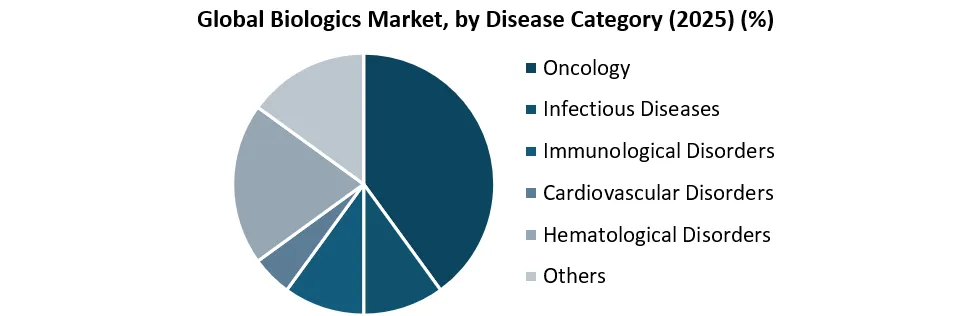
Based on disease category, the global Biologics market is segmented into Oncology, Infectious Diseases, Immunology, and Autoimmune Diseases. The Immunology segment held the largest market share of xx% in 2025, and it is expected to grow at the highest CAGR of xx% in the global Biologics market during the forecast period.
Biologics are utilised to treat autoimmune illnesses such as inflammatory arthritis, rheumatoid arthritis, and psoriatic arthritis, which is driving the market growth.
Global Biologics Market Regional Analysis
North America is the leading region in the global biologics market, accounting for maximum share in 2025. The region's dominance is supported by its well-established pharmaceutical and biotechnology industries, advanced healthcare infrastructure, significant research and development investments, and strong presence of leading biopharmaceutical companies. The United States plays a major role in regional growth through its advanced drug development capabilities, established regulatory framework, and high adoption of biologic therapies for cancer, autoimmune disorders, and chronic diseases. Furthermore, increasing investments in monoclonal antibodies, cell and gene therapies, precision medicine, and biopharmaceutical manufacturing strengthen North America's market position.
Europe represents a significant market for biologics, supported by its established pharmaceutical manufacturing infrastructure, strong biotechnology research capabilities, and increasing demand for advanced therapeutic treatments. Countries such as Germany, the United Kingdom, and France contribute to regional growth through pharmaceutical innovation, clinical research, and investments in biologics development. The growing adoption of biosimilars, targeted therapies, and monoclonal antibodies also supports market expansion by improving treatment availability and encouraging competition. In addition, regulatory initiatives, collaborations between research institutions and pharmaceutical companies, and investments in advanced biomanufacturing technologies strengthen Europe's position in the global biologics market.
Asia-Pacific is the fastest-growing region in the global biologics market, driven by expanding healthcare infrastructure, increasing pharmaceutical manufacturing capacity, and rising demand for advanced treatments. China, India, Japan, and South Korea contribute to regional expansion through investments in biotechnology research, biosimilar development, and biologics production. The region also benefits from a large patient population, increasing healthcare expenditure, and growing clinical research activities. Furthermore, the expansion of contract development and manufacturing organizations (CDMOs), cost-effective production capabilities, and biosimilar manufacturing creates additional growth opportunities.
South America demonstrates growing potential in the biologics market, supported by increasing demand for advanced treatments, improvements in healthcare infrastructure, and gradual expansion of access to biologic medicines. Brazil and Argentina represent important markets due to their patient populations and developing pharmaceutical industries. Growing awareness of biologic treatments for oncology, autoimmune diseases, and other chronic conditions supports regional demand. Additionally, biosimilar adoption, local pharmaceutical manufacturing, and healthcare investment create opportunities for market expansion. However, affordability concerns, differences in healthcare access, and regulatory complexities continue to influence regional growth.
The Middle East and Africa region presents emerging opportunities in the biologics market, driven by healthcare modernization, increasing demand for specialized treatments, and investments in pharmaceutical infrastructure. Countries such as Saudi Arabia, the United Arab Emirates, and South Africa contribute to regional development through healthcare investment and initiatives aimed at improving access to advanced medicines. The growing prevalence of chronic diseases and increasing adoption of biologic therapies support market demand. Furthermore, healthcare infrastructure development, biotechnology partnerships, and biosimilar availability create opportunities for market expansion. However, limited access to specialized treatments, high medicine costs, and supply chain constraints remain challenges across several markets.
Global Biologics Market Competitive Landscape
The global biologics market is highly competitive, with established pharmaceutical companies and biotechnology firms competing through product innovation, research and development (R&D), strategic collaborations, and manufacturing expansion. Major players focus on developing and commercializing monoclonal antibodies, recombinant proteins, vaccines, cell and gene therapies, and other advanced biologic treatments to address cancer, autoimmune disorders, metabolic diseases, and other chronic conditions. Key companies operating in the market include AbbVie Inc., Amgen Inc., F. Hoffmann-La Roche AG, Johnson & Johnson, Merck & Co., Inc., Pfizer Inc., Eli Lilly and Company, Bristol Myers Squibb, Sanofi, and AstraZeneca.
Companies strengthen their market positions by expanding their biologics portfolios, investing in advanced biomanufacturing technologies, improving production efficiency, and pursuing strategic partnerships and acquisitions. The growing demand for affordable treatments also encourages manufacturers to develop biosimilars, which provide alternatives to established biologic medicines and increase competition as patents expire. In addition, contract development and manufacturing organizations (CDMOs), including Samsung Biologics, Lonza Group AG, and WuXi Biologics, play an important role by providing specialized development and manufacturing services to pharmaceutical and biotechnology companies. Overall, continuous innovation, biosimilar development, manufacturing capacity, regulatory compliance, and strategic collaborations remain key competitive factors in the global biologics market.
Global Biologics Market: Recent Developments
| Date | Company | Development | Impact |
| October 13, 2026 | Zealand Pharma and Generate Biomedicines | The companies enter a collaboration worth up to USD 1.2 billion to develop AI-designed protein-based therapies for obesity and metabolic diseases. | The partnership strengthens innovation in protein therapeutics and supports the development of next-generation biologic treatments. |
| August 25, 2026 | WuXi Biologics | The company reports 18.4% year-on-year revenue growth in the first half of 2026 and expands its integrated biologics project portfolio. | The growth highlights rising demand for outsourced biologics development and manufacturing services. |
| July 22, 2026 | Repligen and BioLife Solutions | Repligen announces an agreement to acquire BioLife Solutions in a transaction valued at approximately USD 1.5 billion. | The acquisition strengthens capabilities in cell therapy processing, preservation technologies, and advanced biologics manufacturing. |
| July 14, 2026 | Formycon and OneSource Specialty Pharma | The companies establish a strategic manufacturing partnership to support Formycon's biosimilar programs through drug substance and drug product manufacturing in India. | The partnership expands biosimilar production capabilities and supports cost-efficient manufacturing for international markets. |
| July 1, 2026 | Lonza | The company expands a strategic collaboration with a U.S.-based biopharmaceutical company, adding two commercial biologics programs and options for two additional programs. | The agreement strengthens commercial-scale biologics manufacturing and supports long-term production capacity. |
| June 30, 2026 | AGC Biologics and Pyramid Pharma Services | The companies announce a strategic partnership to expand AGC Biologics' U.S. fill-finish capabilities. | The partnership strengthens end-to-end biologics manufacturing and improves support for commercial product supply. |
| June 8, 2026 | Alvotech and Teva Pharmaceutical Industries | The U.S. FDA accepts Alvotech's biologics license application for AVT16, a proposed interchangeable biosimilar to Entyvio (vedolizumab). | The development advances biosimilar competition in inflammatory disease treatment, subject to regulatory review and approval. |
| May 28, 2026 | Pfizer and Innovent Biologics | The companies enter a global collaboration to research and develop 12 oncology drug programs, including antibody-drug conjugates and multispecific antibodies. | The collaboration strengthens oncology biologics pipelines and combines innovative drug discovery with global development and commercialization capabilities. |
| May 11, 2026 | AGC Biologics and Orphan Therapeutics Accelerator | AGC Biologics joins the accelerator's clinical development network as a manufacturing partner for cell and gene therapies targeting ultra-rare diseases. | The partnership supports the development and manufacturing of advanced biologic treatments for patients with rare diseases. |
| May 3, 2026 | AGC Biologics and Novelty Nobility | AGC Biologics is selected to support the further development of a bispecific drug candidate. | The collaboration strengthens development capabilities for multispecific biologics and supports innovation in targeted therapies. |
Global Biologics Market Scope: Inquire before buying
| Biologics Market | |||
|---|---|---|---|
| Report Coverage | Details | ||
| Base Year: | 2025 | Forecast Period: | 2026-2034 |
| Historical Data: | 2020 to 2025 | Market Size in 2025: | USD 467.72 Bn. |
| Forecast Period 2026 to 2034 CAGR: | 9.1% | Market Size in 2034: | USD 1024.26 Bn. |
| Segments Covered: | by Disease Category | Oncology Infectious Diseases Immunological Disorders Cardiovascular Disorders Hematological Disorders Others |
|
| by Manufacturing | In-house Outsource |
||
| by Product | Monoclonal Antibodies Vaccines Recombinant Proteins Antisense, RNAi & Molecular Therapy Others |
||
| by Source | Microbial Mammalian Others |
||
Biologics Market, By Region
North America (United States, Canada and Mexico)
Europe (United Kingdom, France, Germany, Italy, Spain, Sweden, Russia, Rest of Europe)
Asia Pacific (China, Japan, South Korea, India, Australia, Malaysia, Thailand, Vietnam, Indonesia, Philippines, Rest of APAC)
Middle East and Africa (South Africa, GCC, Nigeria, Egypt, Turkey, Rest of MEA)
South America (Brazil, Argentina, Colombia, Chile, Peru, Rest of South America)
Global Biologics Market key Players are:
1. AbbVie Inc.
2. Amgen Inc.
3. Biogen Inc.
4. Coherus BioSciences
5. Eli Lilly and Company
6. Merck & Co., Inc.
7. Pfizer Inc.
8. Johnson & Johnson
9. Moderna Inc.
10. Bristol Myers Squibb
11. Regeneron Pharmaceuticals
12. Gilead Sciences
13. Abbott Laboratories
14. Genentech Inc.
15. Thermo Fisher Scientific
16. FUJIFILM Biotechnologies
17. Emergent BioSolutions
18. Catalent Inc.
19. Sandoz Inc.
20. Teva Pharmaceutical Industries
21. F. Hoffmann-La Roche AG
22. Novartis AG
23. GlaxoSmithKline plc
24. AstraZeneca plc
25. Bayer AG
26. Boehringer Ingelheim
27. Fresenius Kabi
28. Sanofi
29. Merck KGaA
30. Lonza Group AG
31. Sartorius AG
32. Evotec SE
33. Wacker Chemie AG
34. Rentschler Biopharma SE
35. Sandoz Group AG
36. Biocon Limited
37. Dr. Reddy’s Laboratories
38. Intas Pharmaceuticals
39. Lupin Limited
40. Celltrion Inc.
41. Samsung Biologics
42. LG Chem
43. Genor Biopharma
44. WuXi Biologics
45. Shanghai Fosun Pharmaceutical
46. Takeda Pharmaceutical Company
47. CSL Limited
48. Zydus Lifesciences
49. Sun Pharmaceutical Industries
50. FUJIFILM Holdings Corporation
Frequently Asked Questions
1] What segments are covered in the Biologics Market report?
Ans. The segments covered in the Biologics Market report are based on Product, Disease Category, Manufacturing, and Source.
2] Which region is expected to hold the highest share in the global Biologics Market?
Ans. North America is expected to hold the highest share in the global Biologics Market.
3] Who are the top key players in the global Biologics Market?
Ans. Sandoz, Pfizer, Teva Pharmaceutical, Celltrion, and Biocon are the top key players in the global Biologics Market.
4] What was the market size of the global Biologics Market in 2025?
Ans. The market size of the global Biologics Market in 2025 was USD 467.72 Bn.
5] What are the key factors driving the global biologics market?
Ans. The market is driven by the increasing prevalence of chronic diseases, rising demand for targeted therapies, advancements in biotechnology, growing investments in research and development, and increasing adoption of personalized medicine