
Belgium Cocoa Butter Market by Product, by Application, by End Use, by Form, by Grade, By Nature of Sourcing 2032
Overview
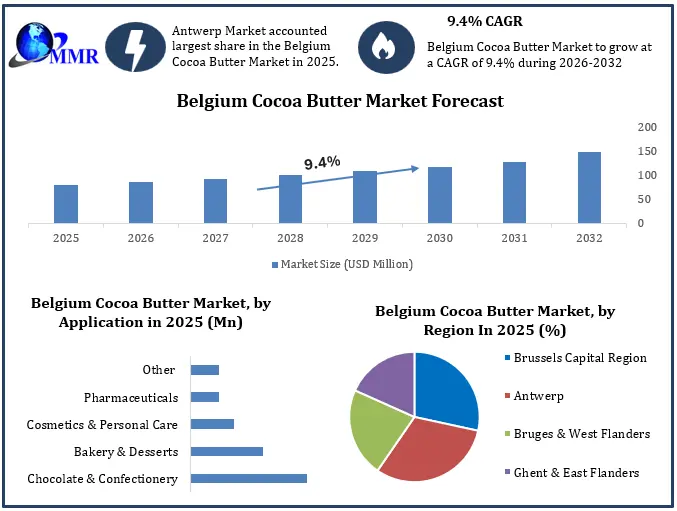
The Belgium Cocoa Butter Market was valued at USD 11.86 Million in 2025 and is estimated to grow till USD 22.25 Million by 2032, growing at 9.4 % CAGR. The market is primarily driven by the expanding premium chocolate industry, increasing demand for natural and plant-based cosmetic ingredients.
| Parameter | Value |
| Market Size (Base Year 2025) | USD 11.86 Million |
| Forecast Market Size (2032) | USD 22.25 Million |
| CAGR (2026–2032) | 9.4% |
| Base Year | 2025 |
| Forecast Period | 2026–2032 |
| Historical Period | 2020–2025 |
| Key Growth Opportunity | Premium Artisanal Chocolate Export & Industrial Processing Capacity Expansion |
Belgium Cocoa Butter Market Definition
The Belgium Cocoa Butter Market refers to the production, import, processing, distribution, and consumption of cocoa butter in Belgium. Cocoa butter is primarily used in chocolate and confectionery products, as well as in cosmetics, personal care, pharmaceuticals, and bakery applications. The market is supported by Belgium’s strong chocolate manufacturing industry, established cocoa-processing infrastructure, and well-developed trade network.
Belgium Cocoa Butter Market Size, Growth & Share Analysis
To know about the Research Methodology :- Request Free Sample Report
Belgium Cocoa Butter Market Overview
The Belgium Cocoa Butter Market covers the production, import, processing, distribution, and consumption of cocoa butter, a natural fat extracted from cocoa beans and used as a functional ingredient in chocolate and confectionery, bakery, cosmetics and personal care, pharmaceuticals, and other specialty products. The market serves manufacturers that require cocoa butter for its melting properties, texture, stability, and formulation performance. Belgium maintains a strong position in the European cocoa industry, supported by its large chocolate manufacturing base and the Port of Antwerp-Bruges, which serves as an important gateway for cocoa imports and trade.
The report provides an assessment of the market size, segmentation, demand trends, competitive landscape, applications, distribution channels, market forecast, and growth potential of Belgium's cocoa butter market. It identifies the key market opportunities associated with premium, sustainably sourced, certified, and traceable cocoa butter, while highlighting the gaps in the market of specialized and value-added cocoa butter products. Flanders (mainly the Antwerp area) is the dominant player in the country's cocoa-processing and trading industry, supported by major infrastructure and industrial facilities.
Barry Callebaut is one of the key market players of Belgium's cocoa butter market, with its major operations in Wieze and Halle. In 2026, the company announces a €250 million investment in its Wieze facility, reinforcing Belgium's importance to its cocoa and chocolate operations. The industry forecast included in the report evaluates future demand, investment opportunities, competitive landscape, and new growth areas for the Belgian cocoa butter industry.
Belgium Cocoa Butter Historical Market Size (2020–2025)
| Year | Market Size | Growth Rate (YoY) |
| 2020 | USD 7.57 Mn | 9.35% |
| 2021 | USD 8.28 Mn | 9.38% |
| 2022 | USD 9.06 Mn | 9.42% |
| 2023 | USD 9.91 Mn | 9.38% |
| 2024 | USD 10.84 Mn | 9.38% |
| 2025 | USD 11.86 Mn | 9.4% |
Belgium Cocoa Butter Market Key Highlights
• The Belgium Cocoa Butter Market is valued at USD 11.86 million in 2025, reflecting strong growth.
• The market is projected to reach USD 22.25 million by 2032, indicating continued expansion.
• The market is expected to register a CAGR of 9.4% from 2026 to 2032, demonstrating sustained growth.
• Food-grade cocoa butter is the dominant segment, accounting for approximately 68% of the market by value.
• Single-origin and traceable cocoa butter is the fastest-growing segment, driven by increasing demand for premium products.
• Premium and industrial chocolate is the dominant application, representing approximately 60% of the market share.
• Belgium's position as the “World's Chocolate Capital” strengthens its brand heritage and supports growing global export demand.
Belgium Cocoa Butter Market Consumer Insights & Demand Analysis
| Consumer Dimension | Key Insights | Market Implication |
| Chocolate Capital Identity | Belgium's chocolate reputation drives demand for premium cocoa butter. | Supports premium-priced, origin-specific cocoa butter. |
| Industrial + Artisanal Quality | Belgium combines industrial processing with artisanal chocolate production. | Creates demand for both bulk and specialty cocoa butter. |
| Export-Oriented Manufacturing | High chocolate exports increase demand for consistent quality. | Strengthens premium cocoa butter demand. |
| Sustainability & Certification | Manufacturers increasingly prioritize sustainable and traceable sourcing. | Creates opportunities for certified cocoa butter suppliers. |
Belgium Cocoa Butter Market Dynamics
Belgium Cocoa Butter Market Drivers
• Belgium's well-established reputation as a major chocolate-producing and exporting country creates sustained demand for cocoa butter as an essential ingredient in chocolate and confectionery manufacturing.
• The presence of major cocoa and chocolate companies, including Barry Callebaut, Cargill, and Puratos, supports a strong industrial ecosystem and consistent demand for cocoa-derived ingredients.
• Belgium's extensive chocolate exports to European and international markets support demand for cocoa butter beyond domestic consumption, strengthening the market's long-term growth potential.
• Belgium's position as an important European cocoa-processing and trading hub supports the development of a well-established supply chain for cocoa butter and other semi-finished cocoa products.
Belgium Cocoa Butter Market Restraints
• Belgium's cocoa butter supply is strongly connected to international and European trade flows, making the market vulnerable to changes in cocoa availability, international prices, and logistics conditions. Belgium imports substantial quantities of cocoa butter from countries such as the Netherlands, Germany, and France.
• High cocoa prices can increase procurement and production costs for chocolate manufacturers, potentially putting pressure on margins and finished-product prices.
• Competition from other European cocoa-processing hubs can limit the ability of Belgian suppliers to expand market share solely through conventional cocoa butter products.
• Belgium's cocoa butter market is significantly dependent on imported semi-finished cocoa products, creating a supply-chain dependency that can affect procurement costs and availability.
Belgium Cocoa Butter Market Opportunities
• The projected 9.4% CAGR through 2032 creates opportunities for suppliers to expand premium, specialty, sustainably sourced, and visible cocoa butter offerings.
• The growing demand for visible cocoa supply chains provides opportunities for suppliers that can provide reliable origin information, certification, and sustainability documentation.
• Belgium's strong chocolate export industry creates opportunities for cocoa butter suppliers to serve manufacturers producing premium and specialty chocolate products for European and international markets.
• The market has an opportunity to address the supply gap for specialized and sustainably sourced cocoa butter, particularly for premium chocolate and specialty confectionery manufacturers.
• Increasing demand for premium and specialty chocolate products can support higher-value cocoa butter products with specific quality, flavor, melting, and processing characteristics.
Belgium Cocoa Butter Market Challenges
• Smaller chocolate manufacturers and artisan producers may face greater difficulty absorbing the costs associated with traceability, due diligence, certification, and sustainability compliance.
• Strong competition from European cocoa-processing countries can make it challenging for Belgian suppliers to maintain competitive pricing while preserving premium quality.
• The market must balance growing demand for sustainably sourced cocoa butter with the availability and cost of compliant raw materials.
• Meeting the projected USD 22.25 million market size by 2032 while maintaining consistent product quality, supply security, sustainability credentials, and competitive pricing will remain a key industry challenge.
Belgium Cocoa Butter Market Segment Analysis
By Application, The Belgium Cocoa Butter Market is segmented by application into Chocolate & Confectionery, Bakery & Desserts, Cosmetics & Personal Care, Pharmaceuticals, and Others. Chocolate & Confectionery is the main cocoa butter application, as cocoa butter is essential for the desired melting characteristics, texture, gloss, and mouthfeel in chocolate bars, pralines, truffles, fillings, coatings, and premium confectionery. Bakery & Desserts call for cocoa butter in specialty fillings, creams, coatings, pastries, and dessert formulations that require a rich cocoa profile and stable texture. Cosmetics & Personal Care is an important non-food application, as cocoa butter is used in moisturizers, body creams, lip balms, soaps, and other skin-care products for its emollient properties. Pharmaceuticals use cocoa butter in selected formulations in which its physical properties are a requirement for its use as a base or excipient. Other applications are cocoa butter in specialty food formulations and niche industrial applications, which may provide additional opportunities for product diversification.
By End-User, The Belgium Cocoa Butter Market is segmented by end user into Industrial Chocolate Manufacturers, Artisanal & Premium Chocolatiers, Food Manufacturers, Cosmetics & Personal Care Manufacturers, and Pharmaceutical Manufacturers. Industrial Chocolate Manufacturers are a major end-user group, as they require large and consistent volumes of cocoa butter for mass-market chocolate, compound products, coatings, fillings, and confectionery production. Artisanal & Premium Chocolatiers place a higher demand for high-quality, specialty, single-origin, and organic cocoa butter, in order to elevate the quality of their chocolate, distinguish their products, and maintain unique flavor and texture profiles. Food Manufacturers use cocoa butter in a variety of applications, including bakery products, desserts, fillings, spreads, and specialty food formulations, and this can create opportunities beyond traditional chocolate production. Cosmetics & Personal Care Manufacturers use cocoa butter in a range of skincare, lip-care, and body-care formulations, such as soaps and moisturizing products, and have a preference for naturally derived ingredients. Pharmaceutical Manufacturers represent a specialty segment, as they only use suitably qualified cocoa butter in selected pharmaceutical and healthcare formulations.

Belgium Cocoa Butter Market Regional Analysis
| Region | Market Share | Key Demand Drivers & Trends |
| Brussels Capital Region | 28.4% | Artisan chocolatier cluster; Neuhaus, Marcolini, Wittamer; luxury confectionery and tourism-driven consumption |
| Antwerp | 31.2% | Major port entry and industrial processing; Barry Callebaut and Cargill major facilities; European cocoa distribution hub |
| Bruges & West Flanders | 22.1% | Dense artisan chocolate manufacturing; major export confectionery brands; tourism chocolate economy |
| Ghent & East Flanders | 18.3% | Industrial chocolate and confectionery manufacturing; growing premium segment; cosmetics ingredient users |
Belgium Cocoa Butter Market Competitive Landscape
Key Players & Benchmarking
| Company | Product | Market Position |
| Barry Callebaut AG (Belgium) | World's Largest Chocolate Factory | Dominant Market Leader |
| Cargill Cocoa & Chocolate (BE) | Industrial Processing & Supply | Major Player |
| Puratos Group | Bakery & Patisserie Ingredients | Major Consumer |
| Godiva Chocolatier | Premium Chocolate | Major Premium Brand |
| Neuhaus | Luxury Pralinés | Heritage Premium Leader |
| Pierre Marcolini | Ultra-Premium Artisan Chocolate | Premium Niche |
| Callebaut (B2B Division) | Industrial Chocolate Ingredients | Major B2B Player |
| Corné Port-Royal | Premium Gifting Confectionery | Growing Premium Player |
Belgium Cocoa Butter Market Technology & Innovation Trends
| Innovation Area | Current Trend | Market Impact |
| Cocoa Horizons Foundation | Farmer training and traceable cocoa sourcing. | Improves sustainability and cocoa butter quality. |
| Ruby Chocolate Cocoa Butter | Demand for precision-grade cocoa butter for ruby chocolate. | Supports specialty cocoa butter demand. |
| Forever Chocolate Programme | Focus on sustainable and deforestation-free cocoa sourcing. | Strengthens sustainable procurement practices. |
| Artisan Traceability Platforms | Digital farm-to-bar traceability adoption. | Helps SMEs demonstrate sourcing transparency. |
| Praline Innovation R&D | Advanced cocoa butter crystallisation techniques. | Improves texture, quality, and shelf life. |
Belgium Cocoa Butter Market Scope: Inquire before buying
| Belgium Cocoa Butter Market | |||
|---|---|---|---|
| Report Coverage | Details | ||
| Base Year: | 2025 | Forecast Period: | 2026-2032 |
| Historical Data: | 2020 to 2025 | Market Size in 2025: | 11.86 USD Million |
| Forecast Period 2026-2032 CAGR: | 9.4% | Market Size in 2034: | 22.25 USD Million |
| Segments Covered: | by Product | Natural Cocoa Butter Deodorized Cocoa Butter Semi-Deodorized Cocoa Butter |
|
| by Application | Chocolate & Confectionery Bakery & Desserts Cosmetics & Personal Care Pharmaceuticals Other |
||
| by End Use | Industrial Chocolate Manufacturers Artisanal & Premium Chocolatiers Food Manufacturers Cosmetics & Personal Care Manufacturers Pharmaceutical Manufacturers |
||
| by Form | Blocks Liquid Powder |
||
| by Grade | Food Grade Cosmetic Grade Pharmaceutical Grade |
||
| by Nature of Sourcing | Conventional Cocoa Butter Organic Cocoa Butter Certified Sustainable Cocoa Butter |
||
Frequently Asked Questions (FAQs)
Q1. What is the current size of the Belgium Cocoa Butter Market?
The Belgium Cocoa Butter Market was valued at USD 11.86 million in 2025 and is projected to reach USD 22.25 million by 2032, growing at a CAGR of 9.4% during 2026–2032.
Q2. What are the key factors driving the growth of the Belgium Cocoa Butter Market?
The market is primarily driven by Belgium's strong premium chocolate industry, expanding chocolate exports, established cocoa-processing infrastructure, and increasing demand for natural and plant-based ingredients in cosmetics and personal care.
Q3. Which application segment holds the largest share of the Belgium Cocoa Butter Market?
The Chocolate & Confectionery segment holds the largest share, supported by Belgium's extensive chocolate manufacturing industry and the use of cocoa butter in chocolate bars, pralines, truffles, fillings, coatings, and premium confectionery.
Q4. Which region dominates the Belgium Cocoa Butter Market?
Antwerp accounts for the largest regional share, at 31.2% in 2025, supported by its major port infrastructure, industrial cocoa-processing facilities, and role as a European cocoa distribution hub.
Q5. Who are the major players operating in the Belgium Cocoa Butter Market?
Key companies operating in the market include Barry Callebaut AG, Cargill Cocoa & Chocolate, Puratos Group, Godiva Chocolatier, Neuhaus, Pierre Marcolini, Callebaut (B2B Division), and Corné Port-Royal.