Automotive Aftermarket Market Size by Vehicle Replacement Part, Distribution channel, Service, Region – Revenue Pool Analysis, Margin Structure Assessment, Capital Flow Trends, Competitive Benchmarking & Forecast to 2034

4.8%
CAGR (2026-2034)
600.68 USD Bn.
Forecast Market Size
313
Report Pages
122
Market Tables

Overview

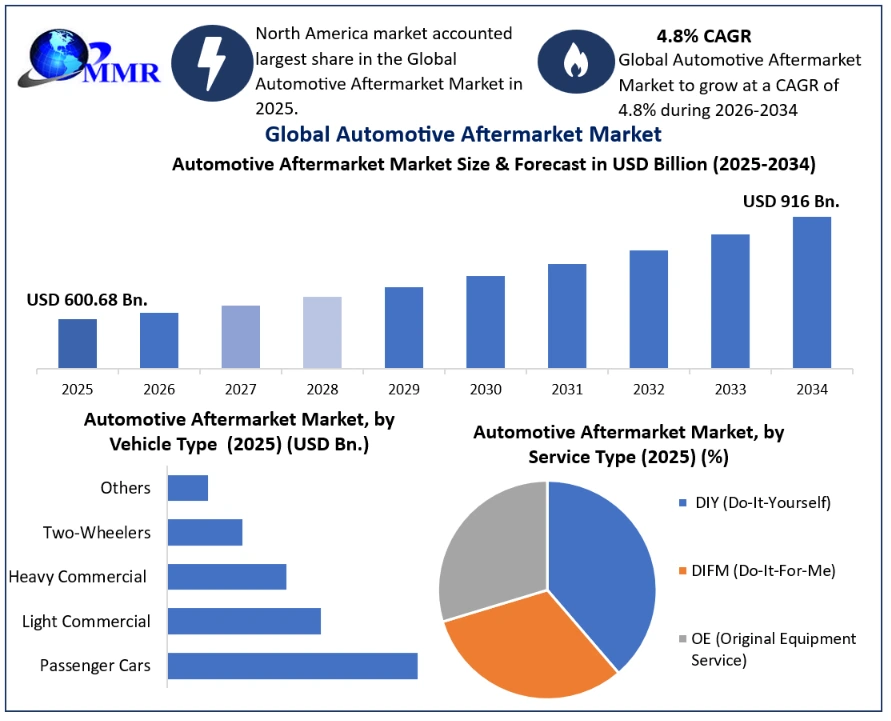
Global Automotive Aftermarket Market size was valued at 600.68 Bn in 2025 and is expected to reach USD 916 Bn by 2034, at a CAGR of 4.8 %.

Global Automotive Aftermarket Market Overview:

The industry that supplies parts, accessories, maintenance, repairs and modifications to cars after their initial sale is known as the automotive aftermarket. The global trade and commerce of automotive aftermarket products and services such as parts, accessories, maintenance, repair and customization is called the automotive aftermarket market.

Technological advances, regulatory changes, and changing customer tastes fueled strong growth and intense competition in the global automotive aftermarket in 2025. Notable developments included the rapid adoption of advanced automotive technology such as autonomous driving assistance systems (ADAS) and electric powertrains. Demand for special aftermarket services such as battery replacement and ADAS calibration is increasing, boosting the automotive aftermarket market.

The automotive aftermarket market was dominated by large companies such as Bosch and 3M, which emphasized innovation and a wide range of products. Bosch has proven its ability to combine cutting-edge technology with aftermarket solutions, ensuring optimal vehicle performance and adherence to strict standards. Meanwhile, 3M has responded to changing environmental regulations and customer sustainability needs by leveraging its wide range of maintenance and repair solutions.

North American Automotive Aftermarket Market dominated the global aftermarket car market due to its large fleet and high maintenance and modification needs. As a result of rising middle-class wages, urbanization, and car ownership, as well as the significant expansion of e-commerce and changes in the regulatory environment, the Asia-Pacific region has become the fastest-growing region. The import-export dynamic highlighted the world's dependence on interdependent supply chains. While major markets such as Germany, Japan and South Korea exported specialty auto components around the world, Europe and North America imported various aftermarket parts, including high-tech parts, from Asia-Pacific hubs.

Automotive Aftermarket Market Growth and Share AnalysisAutomotive Aftermarket Market Growth
To know about the Research Methodology :- Request Free Sample Report

Global Automotive Aftermarket Market Dynamics:

The addition of new technologies to cars has greatly affected the automotive aftermarket market.

The specialized automotive aftermarket market has expanded significantly due to the rapid integration of innovative automotive technologies such as connectivity features, ADAS and electric and hybrid powertrains. Automotive Aftermarket services, including battery replacement, repair and maintenance, are in high demand on electric and hybrid cars.

Company named Tesla offer automotive aftermarket battery replacement services to meet the needs of the growing number of electric car owners who need to upgrade or replace due to damage or technological advances.

Advanced Driver Assistance Systems (ADAS) require precise calibration after repair or maintenance, which increases the demand for specialized ADAS calibration services and tools which boosts the demand of automotive aftermarket market.

Companies like Bosch offer ADAS calibration equipment to ensure that these safety systems are working properly after repairs.
Automotive aftermarket market is driving due to its connectivity features. Advanced infotainment systems with Android Auto or Apple CarPlay integration are enhancements sought after by consumers, as they enable seamless smartphone connection and access to entertainment and navigation features.

Companies that meet these criteria with aftermarket infotainment systems are Pioneer and Alpine.

A major development in the automotive industry is the significant increase in demand for performance components and aftermarket accessories due to increased consumer interest in vehicle customization and customization. This modification includes functional changes that improve the functionality and efficiency of the vehicle in addition to its appearance.

The automotive aftermarket market is affected by consumer’s growing desire to customize and personalize their cars

Customers nowadays have many options to customize their cars, from exterior modifications such as spoilers, bodywork, and custom paint jobs to interior upgrades such as entertainment systems, better padding, and advanced lighting. Performance-enhancing parts such as exhaust systems, suspension kits, turbochargers, and engine tuning modules are examples of performance improvements which increases the demand of automotive aftermarket components contributing to the growth of the automotive aftermarket market.

According to the recently released “2025 SEMA Market Report” by the Specialty Equipment Marketing Association, automotive specialty equipment sales reached USD 52.3 billion in 2025, up nearly 1% from 2022, highlighting strong demand for performance components and aftermarket modifications. This illustrates the significant economic impact of consumer interest in vehicle customization.

Automotive Aftermarket accessory and performance parts companies such as HKS, Borla Performance Industries and Eibach have capitalized on this trend by offering innovative, high-performance products designed to meet consumer preferences. These companies not only serve enthusiasts looking to improve the aesthetics and performance of their vehicles, but also contribute to the growth and innovation of the automotive aftermarket market.

A strong market for performance components and aftermarket accessories has created a growing interest among consumers in customizing and customizing their cars. This trend is fueling innovation and growth in the automotive aftermarket market and satisfying consumer desires to customize and enhance vehicles.

Evolving environmental regulations and safety standards are significant compliance issues for the global automotive aftermarket market.
Globally, governments are pushing sustainability programs and tightening emissions regulations, affecting automotive aftermarket supplies.

For example, in Europe, Euro 6 emissions requirements for cars require aftermarket vendors to design and certify particulate filters and catalytic converters that meet strict specifications. To meet these regulations and maintain performance standards, companies such as Bosal and Tenneco have focused on improving their emission control products.

The use of Advanced Driver Assistance Systems (ADAS) has led UNECE and other regulatory organizations to develop strict safety guidelines for aftermarket parts. These regulations mandate that products such as replacement mirrors and lighting must meet specific criteria to ensure they integrate safely and effectively with modern vehicle technologies. Maintaining safety and functionality while meeting the changing needs of car owners to integrate advanced safety features and technology requires aftermarket suppliers to meet these criteria which is the global issue of the automotive aftermarket market.

Global Automotive Aftermarket Market Segment Analysis

According to MMR Analysis, in 2025 based on Vehicle Replacement Part, Tire subsegment dominated the Global Automotive Aftermarket Market owing to its high replacement frequency which ensures the steady and consistent demand for the tires in the automotive aftermarket market, its critical role in the vehicle safety and performance and its board application.

Due to innovations in the tire manufacturing industry, high-quality tires have been developed to suit different types of vehicles and driving conditions. As consumers increase safety, comfort and fuel economy, they choose specialty or premium tires that improve their car's performance. For example, improvements in tire materials and tread design influence consumer choices and aftermarket preferences by increasing grip, durability and reducing noise.

1.Bridgestone Potenza RE-71R: A performance tire with exceptional grip and handling, ideal for sports cars and performance enthusiasts.

For example, at the November 2023 Electrify Expo in Austin, Texas, Yokohama Tire presented ADVAN Sport EV A/S, a high-performance tire specifically designed for electric vehicles (EV).

The widespread use of electric cars has increased the demand for tires made specifically for electric cars, with an emphasis on efficiency and range. To address performance and environmental concerns, tire manufacturers such as Michelin and Bridgestone have created eco-friendly tires designed specifically for electric and hybrid vehicles.

In the global automotive aftermarket, the battery subsegment especially electric vehicle (EV) battery category is expected to grow fastest at fastest rate during the forecast period. This growth is driven by the global adoption of electric vehicles, and as these vehicles age, so does the need for battery replacement. Consumer confidence in electric vehicles (EVs) has increased due to advances in battery technology that have also improved efficiency and range. To support the growing electric vehicle market, companies like Tesla and Panasonic are actively involved in aftermarket battery solutions, offering upgrades and replacement options. The model highlights the importance of electric vehicle batteries in the automotive industry's transition to sustainable development and innovation.

According to MMR Analysis, in 2025 based on Distribution Channel, the Retailers subsegment dominated the global automotive aftermarket market owing to consumer's accessibility and convenience such as retailers provide direct access to customers buying automotive aftermarket parts and accessories, especially those with online platforms. Nowadays consumers want to be able to easily research and purchase products from the comfort of their own home, so this convenience appeals to them. Retailers offer a wide range of options and better product knowledge than wholesalers because they often specialize in certain vehicle segments or product categories. Due to this specialization, stores can successfully satisfy the various needs of their customers.

For example, Online sellers like Amazon and eBay, have completely revolutionized the aftermarket auto parts market by offering extensive catalogs, user reviews and bargain prices. With a wide reach and leveraged logistics infrastructure, these platforms continue to strengthen their superiority, ensuring fast deliveries and delighting customers.

Global Automotive Aftermarket Market Regional Analysis

According to MMR, North American Automotive Aftermarket Market dominated the Global Automotive Aftermarket Market in 2025.With many active cars in the North American Automotive Aftermarket Market, there is a constant demand for aftermarket maintenance, accessories and parts. Due to the size of the market, manufacturers and retailers benefit from economies of scale that enable a strong supply chain and competitive pricing.

North American consumers have clear preferences when it comes to car maintenance, performance enhancement and vehicle customization. Do-it-yourself (DIY) repairs are popular among enthusiasts and are facilitated by a network of independent repair shops, franchise dealers and online resources. This consumer behavior fuels the continued need for a wide range of aftermarket products, from high-performance components to aesthetic innovations leading to growth of the automotive aftermarket market.

Electric vehicles (EVs), connected cars, and advanced driver assistance systems (ADAS) are among the most used automotive technologies in North America. The increased use of these technologies increases the need for specialized aftermarket components and services. As the use of electric cars increases, the aftermarket for battery management systems and charging infrastructure is growing rapidly which in turn gives rise to growth of the automotive aftermarket market.

Asia Pacific is expected to be the fastest growing region in the automotive aftermarket market due to a growing middle class, growing disposable income and rapid urbanization. The number of cars owned by people has increased in China and India, for example, which has increased the demand for accessories, service parts and customization options. The region's regulatory environment has been highly volatile, affecting both product development and market entry tactics due to changing emissions and safety standards. E-commerce platforms, which allow easy access to a wide range of products and promote market expansion, have been important in changing the aftermarket.

Import and Export Analysis

The import and export analysis of the global automotive aftermarket market were remarkable in 2025. Major importing regions such as Europe and North America acquired a wide range of aftermarket parts, including parts for performance enhancement, customization and car maintenance. These regions import goods, especially specialty products such as electric vehicle (EV) components and advanced automotive technologies, from several industrial hubs in the Asia-Pacific region. Major automotive markets such as Germany, Japan and South Korea used their strong manufacturing capabilities to meet various regional demands, and aftermarket parts and accessories were exported around the world. In 2025, the flow of goods has highlighted the industry's reliance on interdependent supply chains and the growing global need for traditional and innovative aftermarket solutions.

According to the Automobile Component Manufacturers Association (ACMA) by 2026, India's automotive component exports are expected to cross USD 30 billion. By 2026, the auto components sector is expected to generate revenues of $200 billion. Domestic original and aftermarket industries and strong foreign demand are expected to support 20-23% growth in the automotive components industry in FY22.

Global Automotive Aftermarket Market Competitive Analysis

Many important factors such as customer demand for performance and quality, market expansion strategies and technological innovations have contributed to the intense competition in the global automotive aftermarket market. Well-known companies such as Bosch and 3M have focused on the development of diagnostic equipment, emission control systems and many aftermarket products. The purpose of this development was to improve the performance and durability of the vehicle while meeting strict regulatory standards.

Market Comparison between Bosch and 3M

1. Bosch has proven its ability to incorporate the latest technology into its aftermarket products to optimize the efficiency and effectiveness of vehicles. While 3M also placed a strong emphasis on innovation, its main advantage was that it offered a wide range of maintenance and repair options to meet current environmental trends.

2. Both companies claimed to have a strong distribution network and a large global presence. While 3M's broad product portfolio allowed it to effectively enter multiple markets, Bosch was able to gain a competitive advantage in terms of direct market access through its strategic agreements with OEMs and automotive service providers.

3. Technical customers and experienced technicians were drawn to Bosch's emphasis on technological innovation and customer-centric solutions. Strong customer loyalty has been fostered by 3M's reputation for reliability and environmental responsibility, especially among environmentally conscious companies and consumers.

Strong distribution networks and strategic alliances with OEMs and aftermarket distributors have clearly demonstrated the company’s efforts to expand into new markets and improve customer access to their products. A customer-centric strategy was important as companies adapted their products to meet the needs of a wide range of customers, from do-it-yourself (DIY) to professional mechanics, with a strong emphasis on environmental sustainability, quality and reliability.

1. In August 2023, Bosch planned to spend an additional Rs. 480 billion (USD 58.11 million) for investment and R&D.
2. In May 2023, Apollo tyres made an investment around Rs. 1,100 crore (USD 133.17 million) in FY24.
3. In May 2023, With Tesla proposing a manufacturing plant in India, the government planned to come out with a modified production-linked incentive scheme (PLI 2.0) for electric vehicles and advanced chemistry cell batteries to invite fresh investments.

Automotive Aftermarket Market Recent Industry Developments

Date Company Development Impact
18 February 2026 Brightpick Formed a strategic partnership with NAPA Auto Parts to deploy over 100 AI-powered warehouse robots across NAPA's U.S. distribution network. Optimizes warehouse throughput and order picking accuracy to support growing e-commerce demand for automotive replacement parts.
21 April 2026 Holley Performance Brands Launched the Holley High-Performance Car Care line in partnership with Malco Automotive to supply premium vehicle detailing and appearance care products. Expands the manufacturer's chemical footprint into high-frequency purchase categories, increasing share of wallet across vehicle lifecycles.
03 June 2026 Mighty Distributing System of America Acquired PREMA Canada to directly integrate its established customer network and product line of OE-quality automotive parts and shop supplies. Drives geographical expansion into the Canadian automotive aftermarket while establishing new distribution pathways for regional franchisees.
24 June 2026 ZF Friedrichshafen AG Launched PowerFluid Gold 1 and PowerFluid Pro 1 high-performance transmission oils engineered for heavy-duty off-highway automotive and construction equipment. Broadens the brand's aftermarket presence into specialized fluids, enhancing clutch performance, wear protection, and driveline longevity.
04 August 2026 Frost & Sullivan Extended its multi-year global partnership with Automechanika as the official Knowledge Partner across international aftermarket trade fairs. Delivers market intelligence and strategic forecasts regarding EV transition, AI diagnostics, and digital supply chains to industry stakeholders worldwide.

Automotive Aftermarket Market Scope: Inquire before buying

Automotive Aftermarket Market
Report Coverage Details
Base Year: 2025 Forecast Period: 2026-2034
Historical Data: 2020 to 2025 Market Size in 2025: US $ 600.68 Bn.
Forecast Period 2026 to 2034 CAGR: 4.8 % Market Size in 2034: US $ 916 Bn.
Segments Covered: by Replacement Part Type Tires
Batteries
Brake Parts
Filters
Body Parts
Interior Components
   Exterior Components
Lighting & Electronic Components
Engine Components
Suspension & Steering Parts
Gaskets & Seals
Lubricants & Fluids
Wheels
Others
by Vehicle Type Passenger Cars
Light Commercial Vehicles (LCVs)
Heavy Commercial Vehicles (HCVs)
Two-Wheelers
Others
by Service Type DIY (Do-It-Yourself)
DIFM (Do-It-For-Me)
OE (Original Equipment Service)
by Propulsion Type Internal Combustion Engine (ICE)
Hybrid Electric Vehicle (HEV)
Plug-in Hybrid Electric Vehicle (PHEV)
Battery Electric Vehicle (BEV)
by Distribution Channel Retailers
Wholesalers
OEM Authorized Dealers
Online/E-commerce
Independent Workshops
Others

Automotive Aftermarket Market, by Region

North America (United States, Canada and Mexico)
Europe (UK, France, Germany, Italy, Spain, Sweden, Austria and Rest of Europe)
Asia Pacific (China, South Korea, Japan, India, Australia, Indonesia, Malaysia, Vietnam, Taiwan, Bangladesh, Pakistan and Rest of APAC)
Middle East and Africa (South Africa, GCC, Egypt, Nigeria and Rest of ME&A)
South America (Brazil, Argentina Rest of South America)

Automotive Aftermarket Market, Key Players

Tier 1 Companies (Global Market Leaders)
1.Bridgestone Corporation
2.Michelin
3.The Goodyear Tire & Rubber Company
4. Continental AG
5. Pirelli & C. S.p.A.
6. Sumitomo Rubber Industries, Ltd.
7. Yokohama Rubber Co., Ltd.
8. Hankook Tire & Technology Co., Ltd.
9. Zhongce Rubber Group Co., Ltd. (ZC Rubber)
10. Sailun Group Co., Ltd.
11. Shandong Linglong Tire Co., Ltd.
12. Giti Tire
Tier 2 Companies (Strong Regional & International Presence)
13. Toyo Tire Corporation
14. Kumho Tire Co., Inc.
15. Nexen Tire Corporation
16. Apollo Tyres Ltd.
17. CEAT Limited
18. MRF Limited
19. Maxxis International
20. Nokian Tyres plc
21. Balkrishna Industries Limited (BKT)
22. Triangle Tyre Co., Ltd.
23. JK Tyre & Industries Ltd.
24. Cheng Shin Rubber Industry Co., Ltd. (CST)
Tier 3 Companies (Regional & Niche Players)
25. Double Coin Holdings Ltd.
26. Federal Corporation
27. Titan International, Inc.
28. Carlisle Companies Incorporated
29. Trelleborg AB
30. Prometeon Tyre Group
31. Falken Tire
32. General Tire
33. Uniroyal
34. Vredestein
35. Kenda Rubber Industrial Co., Ltd.
36. Petlas Tire Corporation
37. Linglong Specialty Tires
38. Deestone Limited
39. Eurogrip Tyres
40. TVS Srichakra Ltd.
41. Roadstone Tires
42. GT Radial
43. Ralson Tyres
44. Doublestar Group
Others

Frequently Asked Questions:

1) What was the market size of Global Automotive Aftermarket Market markets in 2025?
Ans - Global Global Automotive Aftermarket Market was worth US$ 600.68 Bn. in 2025.

2) What is the market segment of the Automotive Aftermarket Market?
Ans -The market segments are based on Vehicle replacement parts, Distribution channel and Service channel.

3) What is the forecast period considered for Global Automotive Aftermarket Market?
Ans -The forecast period for Global Automotive Aftermarket Market is 2026 to 2034.

4) What is the market size of Global Automotive Aftermarket Market markets in 2034?
Ans – Global Automotive Aftermarket Market is estimated as worth US$ 916 Bn.

5) Which region is dominated in Global Automotive Aftermarket Market?
Ans -In 2025, the Asia pacific region dominated the Global Automotive Aftermarket Market.

Table of Contents

1. SECTION A – GLOBAL AUTOMOTIVE AFTERMARKET MARKET INTRODUCTION 1.1. Global Automotive Aftermarket Market Landscape and Industry Overview 1.1.1. Global Automotive Aftermarket Market Size Analysis by Value (USD Billion & Volume in 000 Units) Across Major Regions and Key Countries During 2025–2034 1.1.2. Historical Market Performance Assessment Covering Revenue Growth, Vehicle Parc Expansion, Average Vehicle Age, Vehicle Sales, and Replacement Parts Demand Across Passenger and Commercial Vehicles (2020–2025) 1.1.3. Forecast Analysis of Market Revenue, CAGR, Vehicle Ownership Trends, Aftermarket Parts Consumption, Distribution Network Expansion, and Future Growth Opportunities Through 2034 1.1.4. Assessment of Global Vehicle Production, Vehicle Sales, Fleet Aging, Electric Vehicle Adoption, and Their Impact on Demand for Tires, Batteries, Brake Components, Filters, Lighting Components, Body Parts, and Other Automotive Aftermarket Products 1.1.5. Evaluation of Market Demand-Supply Balance, Manufacturing Capacity, Distribution Network Efficiency, Inventory Management, and Supply Chain Performance Across Major Automotive Aftermarket Regions 1.1.6. Future Market Outlook Covering Digitalization, E-commerce Expansion, Connected Vehicle Maintenance, Sustainability Initiatives, and Strategic Growth Roadmap Through 2034 1.2. Global Automotive Aftermarket Market Dynamics 1.2.1. Market Trends 1.2.2. Market Dynamics 1.2.3. Market Drivers 1.2.4. Market Restraints 1.2.5. Opportunities 1.2.6. Challenges 1.2.7. PORTER’s Five Forces Analysis 1.2.8. PESTLE Analysis 1.3. Automotive Aftermarket Value Chain & Ecosystem Analysis 1.3.1. Assessment of Raw Materials Used in Automotive Replacement Parts Manufacturing 1.3.2. Analysis of Component Manufacturers Supplying Tires, Batteries, Brake Parts, Filters, Lighting Components, Suspension Systems, Steering Components, Body Parts, Engine Components, and Other Automotive Aftermarket Products 1.3.3. Evaluation of OEMs, Independent Manufacturers, Authorized Dealers, Distributors, Wholesalers, Retailers, Workshops, Service Centers, and E-commerce Platforms Across the Automotive Aftermarket Ecosystem 1.3.4. Assessment of Product Development, Engineering, Testing, Certification, Quality Assurance, and Regulatory Compliance Supporting Product Reliability and Performance 1.4. Production Analysis & Manufacturing Capacity Overview (2025) 1.4.1. Global Automotive Aftermarket Production Analysis by Region, Country, Manufacturing Clusters, and Major Automotive Component Production Hubs 1.4.2. Comparative Assessment of Manufacturing Capacity, Installed Production Facilities, Capacity Expansion Projects, and Capacity Utilization Rates Across Leading Automotive Aftermarket Manufacturers 1.4.3. Evaluation of Regional Production Distribution Across North America, Europe, Asia Pacific, South America, and Middle East & Africa Along with Major Export-Oriented Manufacturing Centers 1.4.4. Detailed Assessment of Manufacturing Processes Including Tire Manufacturing, Battery Assembly, Brake Component Production, Filter Manufacturing, Metal Fabrication, Plastic Molding, Electronics Assembly, Quality Testing, and Packaging 1.4.5. Analysis of Smart Manufacturing, Automation, Robotics, Digital Production Systems, and Industry 4.0 Technologies Supporting Higher Production Efficiency and Cost Optimization 1.5. Industry Supply Chain Analysis 1.5.1. Evaluation of Supply Chain De-risking Strategies Including Supplier Diversification and Regional Manufacturing Expansion 1.5.2. Analysis of Critical Raw Material Dependency, Supplier Risk Assessment, Procurement Resilience, Inventory Planning, and Supply Continuity Across Tires, Batteries, Brake Components, Filters, Body Parts, and Other Automotive Aftermarket Products 1.5.3. Assessment of Digital Procurement Platforms, AI-Based Demand Forecasting, Warehouse Automation, Real-Time Inventory Visibility, and Supplier Performance Monitoring Supporting Supply Chain Excellence 1.5.4. Evaluation of Logistics Optimization, Distribution Network Efficiency, Transportation Management, Safety Stock Strategies, Business Continuity Planning, and Risk Mitigation Frameworks Across the Global Automotive Aftermarket Industry 1.6. Cost Structure Analysis (2025) 1.6.1. Detailed Breakdown of Raw Material Cost Structure Including Rubber, Steel, Aluminum, Plastics, Electronic Components, Chemicals, Lubricants, and Packaging Materials Across Major Manufacturing Regions 1.6.2. Assessment of Manufacturing and Assembly Cost Components Including Fabrication, Molding, Machining, Component Assembly, Quality Inspection, Packaging, and Operational Activities 1.6.3. Comparative Analysis of Labor Costs, Utility Expenses, Plant Overheads, Administrative Costs, and Production Economics Across Developed and Emerging Markets 1.6.4. Evaluation of Research & Development, Product Engineering, Testing, Certification, and Innovation Costs Associated with Advanced Automotive Aftermarket Products 1.6.5. Analysis of Logistics, Warehousing, Transportation, Inventory Management, and Distribution Costs Influencing Overall Product Pricing 1.7. Pricing Analysis & Regional Benchmarking (2025) 1.7.1. Comprehensive Average Selling Price (ASP) Analysis Across Tires, Batteries, Brake Components, Filters, Lighting Systems, Body Parts, and Other Automotive Aftermarket Products 1.7.2. Comparative Pricing Assessment by Product Category, Vehicle Type, Distribution Channel, and Regional Market 1.7.3. Regional Price Benchmarking Across North America, Europe, Asia Pacific, South America, and Middle East & Africa 1.7.4. Historical Automotive Aftermarket Product Pricing Trend Assessment Across Major Product Categories During 2020–2025 1.7.5. Forecast Pricing Outlook Considering Raw Material Costs, Supply Chain Dynamics, Market Competition, and Demand Trends Through 2034 1.7.6. Strategic Pricing Approaches Supporting Revenue Growth, Market Expansion, and Long-Term Profitability 1.8. Regulatory Landscape 1.8.1. Assessment of Global Automotive Safety Standards, Product Quality Regulations, and Certification Requirements Governing Automotive Aftermarket Components 1.8.2. Analysis of Emission Regulations, Vehicle Inspection Standards, and Environmental Compliance Affecting Replacement Parts Demand 1.8.3. Evaluation of Circular Economy Initiatives Including Recycling, Remanufacturing, Waste Reduction, and Sustainable Resource Utilization 1.8.4. Assessment of Product Labeling, Warranty Standards, Consumer Protection Regulations, and Counterfeit Product Prevention Measures 1.8.5. Analysis of Government Policies Supporting Domestic Manufacturing, Localization Programs, and Sustainable Automotive Aftermarket Development 1.9. Demand Analysis by Vehicle Type (2025) 1.9.1. Passenger Car Aftermarket Demand Assessment Covering Economy, Mid-Range, Premium, Luxury, Hybrid, and Electric Vehicle Segments 1.9.2. Light Commercial Vehicle Demand Analysis Across Logistics, Fleet Operations, Urban Transportation, and Last-Mile Delivery Applications 1.9.3. Medium & Heavy Commercial Vehicle Aftermarket Demand Assessment Across Freight Transportation, Construction, Mining, Agriculture, and Industrial Applications 1.9.4. Assessment of Electric Vehicle Growth and Its Impact on Replacement Batteries, Tires, Brake Systems, Filters, and Electronic Components 1.9.5. Evaluation of Fleet Maintenance Trends, Vehicle Aging, and Replacement Cycles Driving Automotive Aftermarket Demand 1.10. Automotive Aftermarket Product Landscape & Category Insights 1.10.1. Comprehensive Market Assessment of Tire Replacement, Performance Tires, Commercial Vehicle Tires, and Specialty Tire Segments Across Global Markets 1.10.2. Detailed Analysis of Automotive Batteries Including Lead-Acid Batteries, AGM Batteries, Lithium-Ion Batteries, and Emerging Battery Technologies 1.10.3. Evaluation of Brake Components, Filters, Suspension Systems, Steering Components, Engine Parts, and Their Demand Across Passenger and Commercial Vehicles 1.10.4. Assessment of Lighting Components, Body Parts, Wheels, Gaskets & Seals, Wiper Systems, Lubricants, and Other High-Demand Automotive Aftermarket Products 1.10.5. Analysis of Product Innovation, Premium Replacement Parts, Smart Components, Sustainable Materials, and Technology Advancements Supporting Market Growth 1.10.6. Future Product Development Roadmap Covering Connected Vehicle Components, EV-Compatible Replacement Parts, Digital Diagnostics, and Next-Generation Automotive Aftermarket Solutions 1.11. Capacity Expansion & Investment Landscape 1.11.1. Comprehensive Assessment of Manufacturing Capacity Expansion Initiatives Undertaken by Leading Automotive Aftermarket Manufacturers Across Major Production Regions 1.11.2. Analysis of Greenfield and Brownfield Manufacturing Projects Focused on Increasing Production Capacity, Operational Efficiency, and Regional Market Presence 1.11.3. Evaluation of Capital Expenditure Investments Across Manufacturing Facilities, Automation Technologies, Distribution Centers, and Warehousing Infrastructure 1.11.4. Assessment of Industry 4.0 Adoption Including Smart Manufacturing, Robotics, Artificial Intelligence, Digital Inventory Management, and Predictive Maintenance Solutions 1.11.5. Analysis of Research & Development Investments Supporting High-Performance Replacement Parts, EV-Compatible Components, Sustainable Materials, and Product Innovation 1.12. Technology & Innovation Outlook 1.12.1. Assessment of Advanced Automotive Aftermarket Technologies Including Smart Batteries, Connected Diagnostics, TPMS, LED Lighting Systems, and Intelligent Vehicle Monitoring Solutions 1.12.2. Analysis of Lightweight Components, High-Performance Materials, Advanced Coatings, and Durable Replacement Parts Supporting Improved Vehicle Performance 1.12.3. Evaluation of Digital Vehicle Diagnostics, Predictive Maintenance, Telematics, and AI-Based Service Solutions Enhancing Aftermarket Efficiency 1.12.4. Assessment of Sustainable Product Innovations Including Recycled Materials, Eco-Friendly Lubricants, Remanufactured Components, and Circular Economy Practices 1.12.5. Analysis of E-commerce Platforms, Digital Service Networks, Connected Workshops, and Online Parts Distribution Transforming the Automotive Aftermarket 1.12.6. Evaluation of Future Technology Trends Supporting EV Aftermarket Growth, Smart Mobility, Autonomous Vehicles, and Connected Automotive Ecosystems 1.13. Trade & Import-Export Analysis (2025) 1.13.1. Comprehensive Global Trade Flow Analysis of Automotive Aftermarket Components by Value (USD Million) Across Major Manufacturing and Consumption Regions 1.13.2. Assessment of Leading Exporting Countries Based on Production Capacity, Manufacturing Competitiveness, Product Quality, and Global Supply Networks 1.13.3. Analysis of Major Importing Countries Based on, Replacement Demand, Domestic Manufacturing Capacity, and Distribution Infrastructure 1.13.4. Comparative Evaluation of Regional Trade Balance, Cross-Border Supply Chains, Import Dependency, and Localization Strategies 1.13.5. Assessment of International Trade Agreements, Tariff Structures, Customs Regulations, and Their Impact on Automotive Aftermarket Trade 1.13.6. Evaluation of Export Competitiveness Based on Manufacturing Costs, Technology Capabilities, Supply Chain Efficiency, and Brand Positioning 1.14. Consumer Behavior & Purchasing Analysis 1.14.1. Assessment of Consumer Preferences for Product Quality, Durability, Brand Reputation, Performance, Pricing, and Warranty Across Different Vehicle Categories 1.14.2. Analysis of Purchasing Decision Factors Including Vehicle Age, Maintenance Costs, Product Availability, Service Quality, and Distribution Channels 1.14.3. Evaluation of Consumer Preference for OEM Parts, Genuine Parts, Certified Aftermarket Parts, and Low-Cost Alternatives 1.14.4. Assessment of Customer Satisfaction Based on Product Performance, Reliability, Service Experience, and Long-Term Vehicle Ownership 1.14.5. Analysis of Online Purchasing Trends, Digital Marketplaces, Workshop Preferences, and E-commerce Adoption Across Global Automotive Aftermarket Markets 1.14.6. Evaluation of Replacement Cycles, Preventive Maintenance Practices, and Consumer Spending Patterns Across Passenger and Commercial Vehicle Owners 1.15. Regional Market Assessment 1.15.1. North America Market Analysis Covering Vehicle Parc, Aging Vehicle Fleet, Replacement Parts Demand, Distribution Network, E-commerce Growth, and Technological Advancements 1.15.2. Europe Market Assessment Including Automotive Production, Stringent Emission Regulations, Sustainability Initiatives, Premium Vehicle Demand, and Independent Aftermarket Growth 1.15.3. Asia Pacific Market Evaluation Covering Rising Vehicle Ownership, Expanding Automotive Production, Growing Aftermarket Distribution Network, EV Adoption, and Regional Growth Potential 1.15.4. Middle East & Africa Market Assessment Including Increasing Vehicle Imports, Infrastructure Development, Commercial Vehicle Demand, and Emerging Aftermarket Opportunities 1.15.5. South America Market Analysis Covering Automotive Industry Recovery, Vehicle Maintenance Trends, Import Dependency, Manufacturing Expansion, and Future Growth Prospects 1.15.6. Comparative Assessment of Regional Market Attractiveness Based on Vehicle Parc, Regulatory Environment, Distribution Network, Consumer Demand, and Investment Opportunities 1.15.7. Future Regional Growth Outlook Highlighting High-Growth Countries, Emerging Automotive Hubs, Digital Retail Expansion, and Strategic Business Opportunities Through 2034 1.16. Risk Assessment & Market Challenges 1.16.1. Comprehensive Assessment of Raw Material Price Volatility and Its Impact on Manufacturing Costs, Product Pricing, and Industry Profitability 1.16.2. Analysis of Supply Chain Disruptions Related to Raw Material Availability, Transportation Constraints, Semiconductor Shortages, and Global Logistics 1.16.3. Evaluation of Regulatory Compliance Risks Associated with Product Quality Standards, Environmental Regulations, Safety Requirements, and Certification Frameworks 1.16.4. Assessment of Counterfeit Automotive Parts, Pricing Pressure, Intense Competition, and Their Impact on Brand Reputation and Consumer Confidence 1.16.5. Analysis of Technological Disruptions Arising from Electric Vehicles, Connected Mobility, Digital Service Platforms, and Changing Consumer Preferences 1.16.6. Strategic Risk Mitigation Framework Supporting Supply Chain Resilience, Business Continuity, Product Innovation, and Sustainable Market Growth 1.17. Future Opportunity Assessment 1.17.1. Assessment of Emerging Business Opportunities Driven by Growing Global Vehicle Parc, Increasing Vehicle Age, and Rising Demand for Replacement Parts 1.17.2. Evaluation of Electric Vehicle Growth Creating New Opportunities for Batteries, Tires, Thermal Management Components, Charging Accessories, and Digital Diagnostics 1.17.3. Analysis of Revenue Opportunities Associated with Online Aftermarket Platforms, Digital Retailing, Connected Workshops, and Predictive Maintenance Services 1.17.4. Assessment of High-Growth Potential Across Emerging Automotive Markets Including Asia Pacific, Latin America, Middle East, and Africa 1.17.5. Evaluation of Investments Supporting Smart Manufacturing, Sustainable Products, Advanced Distribution Networks, and Next-Generation Automotive Aftermarket Solutions 1.18. SWOT Analysis – Global Automotive Aftermarket Market 1.18.1. Comprehensive Strength Assessment Covering Expanding Global Vehicle Parc, Strong Distribution Networks, Continuous Product Innovation, and Increasing Replacement Demand 1.18.2. Weakness Analysis Including Raw Material Price Fluctuations, Counterfeit Products, Supply Chain Dependencies, and High Competitive Intensity 1.18.3. Opportunity Assessment Covering Electric Vehicle Aftermarket, Digital Sales Channels, Sustainable Products, Fleet Maintenance Services, and Emerging Automotive Markets 1.18.4. Threat Analysis Including Economic Uncertainty, Regulatory Changes, Technology Shifts, Pricing Pressure, and Increasing OEM Competition 1.18.5. Strategic Assessment of Competitive Positioning, Product Portfolio, Manufacturing Capabilities, Distribution Strength, and Long-Term Market Sustainability 1.18.6. Comparative SWOT Benchmarking of Leading Industry Participants Based on Business Strategy, Regional Presence, Product Innovation, and Financial Performance 1.18.7. Future Strategic Outlook and Business Recommendations Supporting Sustainable Growth Through 2034 1.19. Global Automotive Aftermarket Market: Market Size and Forecast by Segmentation (by Value USD Million & Volume in 000 Units) (2025-2034) 1.19.1. Global Automotive Aftermarket Market Size and Forecast, By Replacement Part Type 1.19.1.1. Tires 1.19.1.2. Batteries 1.19.1.3. Brake Parts 1.19.1.4. Filters 1.19.1.5. Body Parts 1.19.1.6. Interior Components 1.19.1.7. Exterior Components 1.19.1.8. Lighting & Electronic Components 1.19.1.9. Engine Components 1.19.1.10. Suspension & Steering Parts 1.19.1.11. Gaskets & Seals 1.19.1.12. Lubricants & Fluids 1.19.1.13. Wheels 1.19.1.14. Others 1.19.2. Global Automotive Aftermarket Market Size and Forecast, By Service Type 1.19.2.1. DIY (Do-It-Yourself) 1.19.2.2. DIFM (Do-It-For-Me) 1.19.2.3. OE (Original Equipment Service) 1.19.3. Global Automotive Aftermarket Market Size and Forecast, By Vehicle Type 1.19.3.1. Passenger Cars 1.19.3.2. Light Commercial Vehicles (LCVs) 1.19.3.3. Heavy Commercial Vehicles (HCVs) 1.19.3.4. Two-Wheelers 1.19.3.5. Others 1.19.4. Global Automotive Aftermarket Market Size and Forecast, By By Propulsion Type 1.19.4.1. Internal Combustion Engine (ICE) 1.19.4.2. Hybrid Electric Vehicle (HEV) 1.19.4.3. Plug-in Hybrid Electric Vehicle (PHEV) 1.19.4.4. Battery Electric Vehicle (BEV) 1.19.5. Global Automotive Aftermarket Market Size and Forecast, By Distribution Channel 1.19.5.1. Retailers 1.19.5.2. Wholesalers 1.19.5.3. OEM Authorized Dealers 1.19.5.4. Online/E-commerce 1.19.5.5. Independent Workshops 1.19.5.6. Others 1.19.6. Global Automotive Aftermarket Market Size and Forecast, By Region 1.19.6.1. North America 1.19.6.1.1. United States 1.19.6.1.2. Canada 1.19.6.1.3. Mexico 1.19.6.2. Europe 1.19.6.2.1. United Kingdom 1.19.6.2.2. France 1.19.6.2.3. Germany 1.19.6.2.4. Italy 1.19.6.2.5. Spain 1.19.6.2.6. Sweden 1.19.6.2.7. Russia 1.19.6.2.8. Rest Of Europe 1.19.6.3. Asia Pacific 1.19.6.3.1. China 1.19.6.3.2. South Korea 1.19.6.3.3. Japan 1.19.6.3.4. India 1.19.6.3.5. Australia 1.19.6.3.6. Indonesia 1.19.6.3.7. Philippines 1.19.6.3.8. Malaysia 1.19.6.3.9. Vietnam 1.19.6.3.10. Thailand 1.19.6.3.11. Rest of Asia Pacific 1.19.6.4. Middle East and Africa 1.19.6.4.1. South Africa 1.19.6.4.2. UAE 1.19.6.4.3. Saudi Arabia 1.19.6.4.4. Qatar 1.19.6.4.5. Kuwait 1.19.6.4.6. Egypt 1.19.6.4.7. Nigeria 1.19.6.4.8. Rest of Middle East and Africa 1.19.6.5. South America 1.19.6.5.1. Brazil 1.19.6.5.2. Argentina 1.19.6.5.3. Chile 1.19.6.5.4. Colombia 1.19.6.5.5. Rest Of South America 2. SECTION B – COMPETITIVE INTELLIGENCE & INDUSTRIAL ECOSYSTEM 2.1. Automotive Aftermarket Market: Competitive Landscape 2.1.1. MMR Competition Matrix 2.1.2. Competitive Positioning of Key Players 2.1.3. Company Profiles: Key Players 2.1.3.1. Overview 2.1.3.2. Business Portfolio 2.1.3.3. Financial Overview 2.1.3.4. SWOT Analysis 2.1.3.5. Strategic Analysis 2.1.3.6. Recent Developments 2.1.3.6.1 Tier 1 Companies (Global Market Leaders) 2.1.4. Bridgestone Corporation 2.1.5. Michelin 2.1.6. The Goodyear Tire & Rubber Company 2.1.7. Continental AG 2.1.8. Pirelli & C. S.p.A. 2.1.9. Sumitomo Rubber Industries, Ltd. 2.1.10. Yokohama Rubber Co., Ltd. 2.1.11. Hankook Tire & Technology Co., Ltd. 2.1.12. Zhongce Rubber Group Co., Ltd. (ZC Rubber) 2.1.13. Sailun Group Co., Ltd. 2.1.14. Shandong Linglong Tire Co., Ltd. 2.1.15. Giti Tire 2.1.15.1 Tier 2 Companies (Strong Regional & International Presence) 2.1.16. Toyo Tire Corporation 2.1.17. Kumho Tire Co., Inc. 2.1.18. Nexen Tire Corporation 2.1.19. Apollo Tyres Ltd. 2.1.20. CEAT Limited 2.1.21. MRF Limited 2.1.22. Maxxis International 2.1.23. Nokian Tyres plc 2.1.24. Balkrishna Industries Limited (BKT) 2.1.25. Triangle Tyre Co., Ltd. 2.1.26. JK Tyre & Industries Ltd. 2.1.27. Cheng Shin Rubber Industry Co., Ltd. (CST) 2.1.27.1 Tier 3 Companies (Regional & Niche Players) 2.1.28. Double Coin Holdings Ltd. 2.1.29. Federal Corporation 2.1.30. Titan International, Inc. 2.1.31. Carlisle Companies Incorporated 2.1.32. Trelleborg AB 2.1.33. Prometeon Tyre Group 2.1.34. Falken Tire 2.1.35. General Tire 2.1.36. Uniroyal 2.1.37. Vredestein 2.1.38. Kenda Rubber Industrial Co., Ltd. 2.1.39. Petlas Tire Corporation 2.1.40. Linglong Specialty Tires 2.1.41. Deestone Limited 2.1.42. Eurogrip Tyres 2.1.43. TVS Srichakra Ltd. 2.1.44. Roadstone Tires 2.1.45. GT Radial 2.1.46. Ralson Tyres 2.1.47. Doublestar Group 2.1.47.1 Others 2.2. Competitive Landscape and Market Structure Analysis – Global Automotive Aftermarket Market 2.2.1. Assessment of Market Concentration, Competitive Intensity, and Industry Structure Across the Global Automotive Aftermarket Industry 2.2.2. Tier-Wise Classification of Market Participants Including Global Tier-1 Manufacturers, Regional Suppliers, OEM-Affiliated Companies, Independent Aftermarket Brands, and Emerging Market Players 2.2.3. Competitive Benchmarking Based on Product Portfolio, Manufacturing Capabilities, Distribution Network, Brand Strength, Innovation, and Global Market Presence 2.2.4. Comparative Analysis of Company Positioning Across Tires, Batteries, Brake Components, Filters, Lighting Components, Body Parts, and Other Replacement Parts 2.2.5. Market Fragmentation Assessment Across Passenger Cars, Light Commercial Vehicles, Heavy Commercial Vehicles, and Electric Vehicle Aftermarket Segments 2.2.6. Regional Competitive Dynamics, Distribution Footprint, Market Penetration Strategies, and Business Expansion Initiatives Across Major Automotive Markets 2.3. Market Share Analysis and Strategic Positioning (2025) 2.3.1. Revenue-Based Market Share Analysis of Leading Automotive Aftermarket Companies Across Global Markets 2.3.2. Market Share Assessment by Replacement Parts Category Based on Sales Revenue, Distribution Reach, and Product Portfolio 2.3.3. Comparative Market Share Analysis Across Passenger Cars, Commercial Vehicles, Electric Vehicles, and Fleet Maintenance Segments 2.3.4. Regional Market Share Assessment Across North America, Europe, Asia Pacific, South America, and Middle East & Africa 2.3.5. Competitive Positioning Matrix Based on Product Innovation, Brand Value, Distribution Network, Manufacturing Scale, and Global Presence 2.3.6. Future Market Share Outlook Based on Capacity Expansion, Digital Transformation, Product Innovation, and Strategic Investments 2.4. Strategic Initiatives and Business Expansion Analysis 2.4.1. Assessment of Mergers, Acquisitions, Joint Ventures, Strategic Alliances, and Partnership Activities Across the Global Automotive Aftermarket Industry 2.4.2. Evaluation of Manufacturing Capacity Expansion Projects, New Production Facilities, Distribution Center Expansion, and Regional Market Development Strategies 2.4.3. Analysis of Research & Development Investments Supporting Smart Automotive Components, EV-Compatible Parts, Sustainable Materials, and High-Performance Replacement Products 2.4.4. Evaluation of Product Innovation Strategies Including Advanced Tires, Smart Batteries, Digital Diagnostics, Connected Vehicle Solutions, and Sustainable Automotive Aftermarket Products 2.5. Manufacturing Capabilities and Production Footprint Analysis 2.5.1. Comprehensive Assessment of the Global Manufacturing Footprint of Leading Automotive Aftermarket Manufacturers Across Major Automotive Production Regions 2.5.2. Comparative Analysis of Regional Production Capacity, Manufacturing Facilities, Capacity Utilization Rates, and Supply Network Efficiency 2.5.3. Evaluation of Manufacturing Capabilities for Tires, Batteries, Brake 2.5.4. Assessment of Automation, Robotics, Smart Manufacturing, Digital Production Systems, and Industry 4.0 Technologies Across Manufacturing Facilities 2.5.5. Comparative Benchmarking of Manufacturing Scalability, Operational Efficiency, Product Quality, Production Flexibility, and Cost Competitiveness 3. SECTION C – STRATEGIC OUTLOOK 3.1. Key Findings 3.2. Analyst Recommendation 3.3. Research Methodology

Custom Market Research Services

We Will Customise The Research For You, In Case The Report Listed Above Does Not Meet With Your Requirements