
Australia Processed Snacks Market Size by Product Type, Ingredient Type, Nature and Distribution Channel
Overview
Australia Processed Snacks Market valued at USD 10.2 Bn in 2025, forecast to reach USD 14.8 Bn by 2032 at 5.47 % CAGR.
Australia Processed Snacks Market Definition
The Australia Processed Snacks Market refers to the market for ready-to-eat snack products that undergo processing such as frying, baking, extrusion, drying, seasoning, or other food-processing techniques before consumption. It includes products such as corn chips, tortilla chips, extruded snacks, potato and vegetable-based snacks, rice snacks, popcorn, pretzels, and other savory packaged snacks.
The market focuses on packaged snacks designed for convenient, on-the-go consumption and covers products sold through supermarkets, convenience stores, specialty retailers, vending channels, and online platforms. Processing helps improve shelf life, texture, flavor, consistency, and convenience, while changing consumer preferences are encouraging manufacturers to introduce products with varied flavors, healthier ingredients, reduced sodium, and alternative grain or vegetable bases.
| Parameter | Value |
| Market Size (Base Year 2025) | USD 10.2 Billion |
| Forecast Market Size (2032) | USD 14.8 Billion |
| CAGR (2026–2032) | 5.47% |
| Base Year | 2025 |
| Forecast Period | 2026–2032 |
| Historical Period | 2020–2025 |
| Key Growth Opportunity | Better-for-You & Functional Snack Innovation |
| Leading Segment (Type) | Savory Snacks |
| Leading Segment (Application) | Retail / Grocery |
Australia Processed Snacks Market Share Outlook
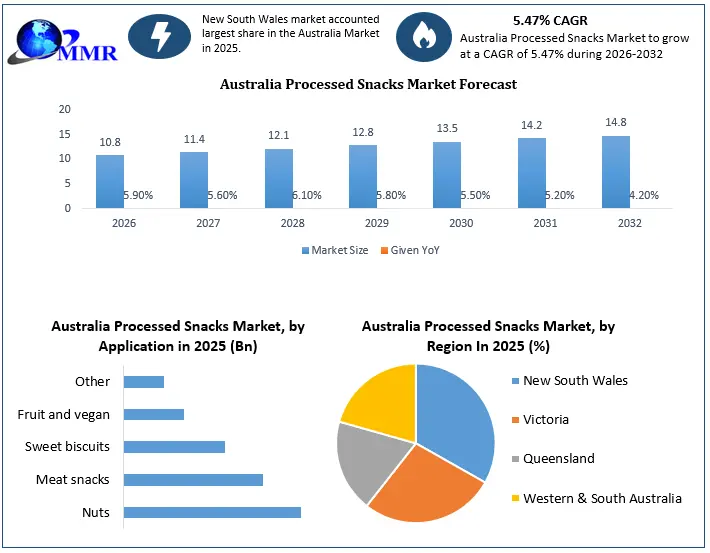
To know about the Research Methodology :- Request Free Sample Report
Australia Processed Snacks Market Overview
The Australia Processed Snacks Market refers to the production, processing, packaging, distribution, and sale of packaged snack products, including chips, crackers, popcorn, nuts, extruded snacks, tortilla chips, rice snacks, and other ready-to-eat formats. The market serves diverse consumer groups through supermarkets, convenience stores, specialty retailers, foodservice outlets, and e-commerce channels. Australia represents a mature and competitive snack market, supported by established food manufacturing capabilities, extensive retail networks, high consumer purchasing power, and strong demand for convenient food products.
The market is increasingly shaped by changing consumer lifestyles, on-the-go consumption, product innovation, health awareness, and demand for diverse flavors and formats. Manufacturers are focusing on healthier formulations, portion-controlled packaging, natural ingredients, reduced sodium and sugar, and plant-based alternatives while maintaining taste and affordability. At the same time, premiumization, sustainable packaging, digital retail, and international snack varieties are creating new growth opportunities. The evolving landscape highlights differences across product categories, consumer preferences, distribution channels, and price segments, shaping competition and innovation across Australia’s processed snacks industry.
Australia Processed Snacks Market Historical Size (2020–2025)
| Year | Market Size | Growth Rate (YoY) |
| 2020 | USD 7.8 Bn | 2.6% |
| 2021 | USD 8.2 Bn | 5.1% |
| 2022 | USD 8.8 Bn | 7.3% |
| 2023 | USD 9.3 Bn | 5.7% |
| 2024 | USD 9.8 Bn | 5.4% |
| 2025 | USD 10.2 Bn | 4.1% |
Australia Processed Snacks Market Key Highlights
• Market Size (2025): The market was valued at USD 10.2 Billion in 2025, reflecting strong market activity and increasing consumer demand across key product categories.
• Projected Market Size (2032): The market is projected to reach USD 14.8 Billion by 2032, indicating accelerating expansion supported by evolving consumer preferences and broader product availability.
• CAGR (2026–2032): The market is expected to grow at a 5.47% CAGR from 2026 to 2032, demonstrating sustained growth throughout the forecast period.
• Dominant Type Segment: Savory Snacks held the leading position with a 38.6% market share, supported by their broad consumer acceptance, convenience, and diverse product offerings.
• Fastest-Growing Type: Better-for-You & Natural Snacks represent the fastest-growing category, driven by increasing consumer interest in healthier ingredients, nutritional value, and clean-label products.
Australia Processed Snacks Market Consumer Insights & Demand Analysis
| Consumer Dimension | Key Insights | Market Implication |
| Health Awareness | High health consciousness among urban Australians driving 'better-for-you' snack demand | Premium health snack positioning and clean-label NPD essential |
| Price Sensitivity | Dual market between premium health-conscious consumers and value-seeking households amid cost-of-living pressures | Both premium and private-label strategies viable |
| Demand Patterns | Growing multicultural snack demand driven by large Asian diaspora population in major cities | Asian-inspired flavors and formats gaining market share |
| Sustainability | Strong consumer preference for sustainably sourced, clean-label ingredients and eco-packaging | Organic certification and sustainable sourcing premium viable |
Australia Processed Snacks Market Dynamics
Australia Processed Snacks Market Drivers
• Australia's outdoor lifestyle culture and high health awareness driving strong demand for natural and better-for-you snack formats
• FSANZ health claim framework providing regulatory clarity for functional and fortified snack positioning
• Growing multicultural population (particularly Asian-Australian community) supporting diverse snack Flavor demand
Australia Processed Snacks Market Restraints
• Small domestic population (26 million) limiting total addressable market scale versus major global markets
• High retail concentration (Woolworths and Coles duopoly) limiting manufacturer bargaining power
• Geographic isolation increasing import costs for internationally sourced snack inputs
Australia Processed Snacks Market Opportunities
• Australia's premium clean-and-green brand equity in Asian markets creates significant export opportunity for natural snack brands
• Growing sports nutrition and active lifestyle snack segment driven by Australia's outdoor and sports culture
• Indigenous Australian ingredient incorporation (wattle seed, Kakadu plum, lemon myrtle) creating unique and premium snack differentiation
Australia Processed Snacks Market Challenges
• Woolworths-Cole’s retail duopoly limiting promotional space and pricing flexibility for manufacturers
• Regulatory complexity from TGA for therapeutic-grade snack claims and FSANZ for health claim substantiation
• Competition from international snack brands leveraging cost advantages and scale economies
Australia Processed Snacks Market Segment Analysis
Australia Processed Snacks Market by Product
The Australia Processed Snacks Market can be segmented into chips, popcorn, crackers, nuts, pretzels, biscuits, rice snacks, extruded snacks, tortilla chips, vegetable and pulse snacks, and other processed snack products. Chips and savory snack products represent an important product category, supported by their convenience, wide availability, and popularity as quick consumption options. Extruded snacks and tortilla chips are also gaining attention due to their variety of flavors, textures, and convenient packaging. At the same time, demand for rice snacks, vegetable-based snacks, nuts, and pulse-based products is increasing as Australian consumers show greater interest in products perceived as healthier and more nutritious. Industry segmentation studies specifically identify corn chips, extruded snacks, rice snacks, tortilla chips, pork scratchings, and vegetable/pulse/bread snacks as key processed-snack categories in Australia.
Australia Processed Snacks Market by Application
The market can be analyzed across ready-to-eat, on-the-go, snack consumption, and foodservice applications. On-the-go consumption represents a key application area, supported by busy lifestyles, commuting, work routines, and increasing demand for convenient portion-controlled foods. Ready-to-eat snacks are also widely consumed because they require little or no preparation and provide convenient options between meals. Foodservice applications create additional demand through cafés, restaurants, catering operations, and institutional food channels. The increasing preference for convenient foods is an important factor supporting processed snack consumption in Australia, while growing health consciousness is simultaneously encouraging demand for better-for-you processed snack options.
Australia Processed Snacks Market Regional Analysis
| Region | Market Share | Key Demand Drivers & Trends |
| New South Wales (Sydney) | 33.2% | Largest market, premium and multicultural snack hub |
| Victoria (Melbourne) | 27.4% | Health food culture and coffee lifestyle snack market |
| Queensland | 18.8% | Active lifestyle and outdoor snack format demand |
| Western & South Australia | 20.6% | Grain and nut production hub, agri-snack processing base |
Australia Processed Snacks Market Competitive Landscape
The Australia Processed Snacks Market is highly competitive, with manufacturers focusing on product innovation, pricing, brand differentiation, and distribution expansion. Companies are introducing diverse snack formats, flavors, portion sizes, and healthier formulations to meet changing consumer preferences. Demand for reduced-sodium, low-fat, natural, plant-based, and nutrient-rich snacks is encouraging product development across major categories. Sustainable and convenient packaging is also becoming an important competitive factor. Manufacturers are strengthening their presence through supermarkets, convenience stores, specialty retailers, and e-commerce platforms. Private-label products are increasing pricing pressure, while premium and specialty snacks create opportunities for differentiation. Overall, innovation, affordability, quality, convenience, and sustainability are shaping competition in the Australian processed snacks market.
Australia Processed Snacks Market Key Players & Benchmarking
| Company | Snack Type | Market Position |
| Snack Brands Australia (Snyder's) | Chips, Pretzels, Savory | Market Leader |
| Smith's Snack food (PepsiCo) | Chips, Crisps | Major Player |
| Arnott's (Campbell Soup) | Biscuits, Crackers | Major Player |
| Carmans Fine Foods | Muesli Bars, Health Snacks | Premium Health Leader |
| Freedom Foods | Allergen-Free, Health Snacks | Specialty Player |
| Cobs Popcorn | Premium Popcorn | Challenger Brand |
| Piranha Snacks | Pork Rinds, Savory | Niche Challenger |
| The Happy Snack Company | BFY/Kids Snacks | Growing Challenger |
Australia Processed Snacks Market Technology & Innovation Trends
| Innovation Area | Current Trend | Market Impact |
| Indigenous Ingredient Innovation | Incorporation of native Australian botanicals (wattle seed, Kakadu plum) into snack formulations | Unique global differentiation for export premium positioning |
| Grain-Free Formulation | Paleo and grain-free snack formulations for health-oriented Australian consumers | Aligns with low-carb and allergen-free market demand |
| High-Pressure Processing (HPP) | Cold-press HPP technology for preservative-free premium snacks | Enables clean-label and fresh-style formats for premium market |
| Sustainable Packaging | Compostable and recycled-content packaging to meet Australian Packaging Covenant obligations | Reduces environmental footprint and meets retailer sustainability requirements |
| AI-Driven Export Market Analysis | Data-driven Flavor profiling and market analysis for Asian export market targeting | Enables efficient market entry and product localization strategies |
Australia Processed Snacks Market Regulatory Framework
Australia's processed snacks market is regulated by Food Standards Australia New Zealand (FSANZ) under the Australia New Zealand Food Standards Code. FSANZ governs food labelling, nutritional information panels, health claims, and permitted ingredient use. Health claims for functional snack ingredients require substantiation under FSANZ Standard 1.2.7. The Australian Packaging Covenant Organisation (APCO) administers voluntary and mandatory sustainable packaging commitments. The Australian Competition and Consumer Commission (ACCC) monitors advertising claims and consumer protection for snack marketing. Organic certification is governed by the National Standard for Organic and Biodynamic Produce (DAFF).
Australia Processed Snacks Market Investor Takeaway
The Australia processed snacks market offers a compelling investment thesis: a market growing at 5.47% CAGR through 2032, with significant untapped opportunities in health-oriented, functional, and culturally relevant snack innovation. The combination of established distribution infrastructure, evolving consumer preferences toward better-for-you formats, and expanding e-commerce channels creates multiple value creation levers for investors and operators.
Australia Processed Snacks Market Scope: Inquire before buying
| Report Coverage | Details |
| Report Title | Australia processed snacks market Report |
| Base Year | 2025 |
| Forecast Period | 2026–2032 |
| Historical Period | 2020–2025 |
| Market Size (Base Year) | USD 10.2 Billion |
| Forecast Market Size (2032) | USD 14.8 Billion |
| CAGR | 5.47% |
| Segment: By Product Type | Chips & Crisps Extruded Snacks Nuts & Seeds Snacks Popcorn Products Meat Snacks Snack Bars Biscuits & Crackers Dried Fruit Snacks Other Processed Snacks |
| Segment: By Ingredient Type | Grain-Based Snacks Fruit-Based Snacks Protein-Based Snacks Vegetable-Based Snacks Dairy-Based Snacks Mixed Ingredient Snacks |
| Segment: By Nature | Conventional Organic |
| Segment: Distribution Channel | New South Wales Victoria Queensland Western & South Australia |
| Segment: Consumer Group | Children Teenagers Adults Senior Consumers |
| Segment: Packaging Type | Pouches Boxes Cans Flexible Packaging Others |
Australia Processed Snacks Market FAQ’s
1. What is the size of Australia's processed snacks market?
The Australian processed snacks market was valued at USD 10.2 billion in 2025 and is projected to reach USD 14.8 billion by 2032, growing at a CAGR of 5.47%.
2. What are the dominant snack types in Australia?
Savory snacks dominate with 38.6% share, followed by crackers and rice crackers at 22.4%. Better-for-you and natural snacks represent the fastest-growing segment.
3. How does the Woolworths-Coles duopoly affect the Australian snack market?
The retail duopoly gives these two chains significant pricing and promotional power, limiting manufacturer margins. However, their online grocery platforms also provide major distribution reach for snack brands.
4. What are unique Australian snack product opportunities?
Indigenous Australian ingredients (wattle seed, Kakadu plum, lemon myrtle) offer globally unique and premium snack differentiation with significant Asian export market potential.
5. Who are the key snack companies in Australia?
Smith's Snack food (PepsiCo), Arnott's (Campbell's), Snack Brands Australia, Carmans, and Freedom Foods are major players alongside a growing ecosystem of challenger health snack brands.