
Augmented Industrial Reality MarketSize by Techology , Component, Application, End User, and Region – Segment-Level Market Assessment, Growth Opportunity Analysis, Competitive Mapping & Forecast to 2032
Overview
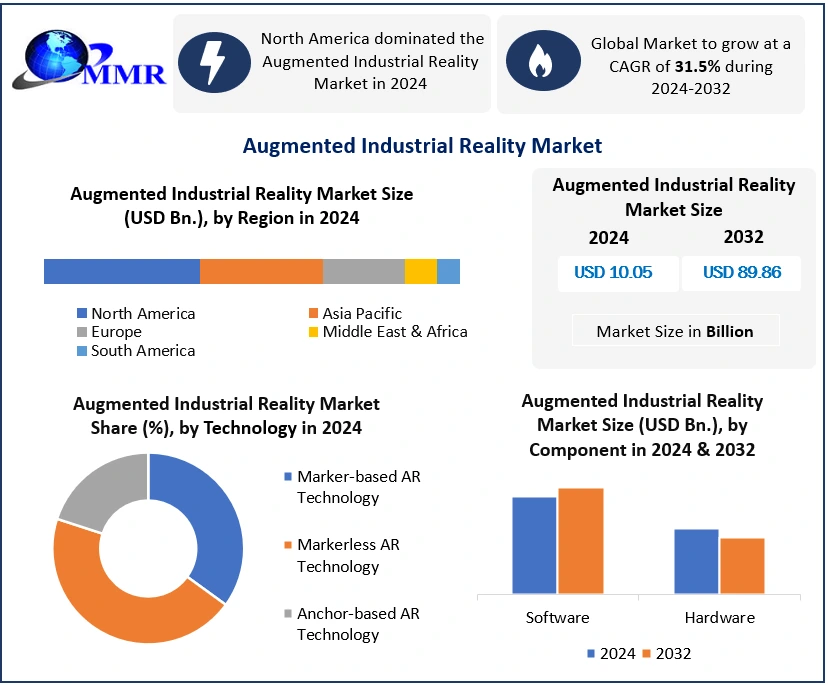
The Augmented Industrial Reality Market was valued at USD 10.05 Bn in 2024, and the total revenue of the Augmented Industrial Reality Market is expected to grow at a CAGR of 31.5% from 2025 to 2032, reaching nearly USD 89.86 Bn by 2032. Driven by AR integration in manufacturing and IoT-enabled industrial applications worldwide.
Augmented Industrial Reality Market Overview:
The Augmented Industrial Reality Market has witnessed significant growth in the last 10 years. Augmented reality (AR) technology has emerged as a valuable tool for various industries, like manufacturing, and has enhanced user satisfaction. Augmented industrial reality refers to the integration of digital information and virtual objects into the real-world environment of industrial settings. It combines computer-generated images and uses this data to discover a new form of reality. AR can also be integrated with IoT sensors and devices to collect and analyse real-time data and manage processes by enhancing its efficiency. North America has been the leading market share, while Asia Pacific has shown the highest growth. Augmented industrial reality improves industrial efficiency, and productivity, and is a crucial factor in developing many industries. Augmented industrial reality will transform the usual operations as technology would initiate this change. Thus, such a high CAGR of 31.5% is only possible because of the increase in acceptance of technology and its growing applications in many industries.
 To know about the Research Methodology :- Request Free Sample Report
Augmented Industrial Reality Market Dynamics
Acceptance of Technology in Industrial Applications will Drive the Market
The most crucial component for driving the augmented industrial reality market is technology. The shape of today’s Augmented industrial reality market is carved by the use of technological solutions. The field of augmented industrial reality has witnessed remarkable technological advancements in recent years. These advancements have been instrumental in fuelling the growth of the market and expanding its possibilities. With the advent of powerful hardware and sophisticated software solutions, augmented reality has become a crucial part of many industries. The main goal of AR has been in ensuring efficiency which it has done through such applications. AR-assisted assembly processes, virtual safety training, and simulations have been some crucial changes that have increased efficiency for many industries. Also, the use of IoT integration has enabled the collection of real-time data from diverse sources. These IoT devices can help track and monitor the processes happening in industries and also showcase data to improve any anomalies.
Complexity in the Process can be a Major Challenge for the Augmented Industrial Reality Market. One of the primary challenges in the augmented industrial reality market relates to its complexity in technical aspects. Hardware limitations, such as processing power, battery life, and form factor, can impact the user experience and hinder widespread adoption. Compatibility issues between different hardware components and software systems also pose some challenges. Implementing augmented industrial reality solutions can involve significant upfront costs, including the purchase of hardware, software development, training, and infrastructure upgrades. Another important challenge is regarding the design of economical AR headsets and user awareness about AR technology. Augmented reality has several fields, which increases the complexity of the process. Cost-effectiveness becomes an important factor that is posing a challenge in this market. For any industry, setting up an AR technology is not a cost-effective solution. Ensuring a seamless user experience is vital for the successful implementation of augmented industrial reality.
Trends in the Augmented Industrial Reality Market
The advent of technology has given rise to many applications which would govern the future trend of the augmented industrial reality market. The integration of AR with digital twin technology is one such application that takes this visualization to a new level, creating virtual replicas of physical assets and enabling real-time monitoring and analysis. Using a digital twin enables smart manufacturers to predict the quality of the end product, helping them make more informed decisions about issues such as material upgrades and process enhancements. Also, it has assisted companies in reducing costs and improving customer experience.
Augmented industrial reality serves as a powerful training tool for industrial workers. It allows the companies to train the employees without any extra caution or harm. Even the employees can work freely and learn new things quickly. The employees can learn about the parts of a product or piece of equipment or a step in a process by actually clicking on a button rather than incurring huge costs of setup.
Augmented reality can be seamlessly integrated with IoT devices and big data analytics, opening up new possibilities for industrial applications in the augmented industrial reality market. By combining AR with real-time data from sensors and analytics platforms, operators can visualize and analyse complex information in context. From asset locating to tracking real-time data across a factory floor, all can be done by using IoT. Another application of it in the warehouse is AR eyewear, which can provide order pickers with the barcodes of objects they need to select and ship them accordingly.
Augmented Industrial Reality Market Segment Analysis:
Based on the Application, the Warehouse, Manufacturing, Inventory Management, and Quality Control are the 4 main processes that use augmented industrial reality solutions. The manufacturing sector has seen the highest growth in terms of other applications. Modifying the old ways of manufacturing with new AR technologies has been the new trend in the manufacturing industry. Even Quality control has become more efficient since the use of technology, which has reduced errors.
Based on Component, Hardware and Software are the two segments that can be classified as major components. Augmented industrial reality relies a lot on these 2 components, but the higher share is seen in the case of Software. The software has seen an increasing percentage of market share than hardware. The software segment holds a larger market share due to its critical role in delivering advanced features, customisation, and scalability across industries. Additionally, increasing adoption of cloud-based AR solutions and continuous software innovations are fueling the growth of this segment at a faster pace compared to hardware.
Augmented Industrial Reality Market Segmentation, by Region
Global
The global market for Augmented Industrial Reality is still in its early days. Companies like Siemens, PTC, and Dassault Systems are dominant players in AR in the Industrial sector. The number of companies who are entering this market is huge, which will make the market more competitive in the future. The race is against technology and new emerging features are a part of it. There are not many companies competing in the augmented industrial reality sector. The technology has enough potential but will require time, investments, and enormous research to fulfill its optimal potential. The North American region has a hold over the Augmented Industrial Reality Market and has nearly 27% of the market share. Being a developed nation has given the advantage to many countries like Germany, the US, and Switzerland. Thus, the entry barriers are high in the augmented industrial reality market and require huge financial investments to succeed new entrants in the market.
North America
The North American region enjoys a share of nearly 27% of the augmented industrial reality market. The US has been the dominant player among the nations. Advancements in research and a developed ecosystem have given many opportunities for US companies to sustain and thrive. The US nearly has 80% of the market in the North American region and is expected to grow soon. Companies like Honeywell, and Upskill have ensured that the US stays as a leading market player in the augmented industrial reality market. The markets in Mexico and Canada aren’t much developed as they both lack a proper ecosystem to sustain
Asia Pacific
Asia Pacific has been the fastest-growing market with the highest CAGR among the 5 regions. Developed nations like Japan, and China have taken huge steps in the development of AR in the industrial sector. The Chinese government is investing heavily in AR technology to support the growth of its manufacturing sector while Japanese companies are using AR technology to improve the efficiency and productivity of their manufacturing. Developing countries like India have shown good signs and are emerging markets with huge potential in the augmented industrial reality market. Increasing adoption of AR technology by businesses in the region, and the growing demand for AR solutions in the manufacturing sector are some crucial factors in the growth of the industry
Europe
Europe has been at the forefront throughout this technology revolution. Germany known for its manufacturing is also using Augmented Reality in their processes. France is another dominant force in the augmented industrial reality market. For example, PTC is a UK company that is developing AR solutions for use in the training of industrial workers. Sweden is another emerging market that is enjoying a good market share as companies like Hexagon is developing AR solutions for use in the inspection of industrial equipment. These are just a few countries in Europe, but only a few can sustain such a program
Middle East and Africa
The market has huge potential in this region, but the market isn’t well developed in the current scenario. The market has increased since countries like UAE, Saudi Arabia have invested, but the lack of technical expertise has been a matter of concern. Despite the progress that has been made in the MEA region, the Middle East and Africa have a lesser share in the augmented industrial reality market. Research and development activities have flourished in the last 10 years, but the market will take time to develop an ecosystem for augmented reality
South America
South America is not a huge market for Augmented Industrial reality and has many may reason for it. One such reason is the disparity between the countries living on a similar continent. The region has a diverse economic landscape and resources required for Augmented reality are restricted to very few areas like Brazil and Argentina. Thus, the market has potential but it needs to focus on finding useful solutions which can help in increasing its market share.
Competitive Landscape in Augmented Industrial Reality Market
The market has high entry barriers and is difficult for new players to enter. Companies like Microsoft, Magic Leap, Honeywell, PTC, and DAQRI are working in the Augmented industrial reality market.
Microsoft's HoloLens AR headset allows workers to access real-time information, communicate remotely, and visualize digital stuff in their physical environment.
Magic Leap One headset device allows industrial users to overlay digital content onto the real world, enabling improved design visualization, training, and maintenance.
PTC's Vuforia platform lets industrial firms build and deploy AR apps. Vuforia's object detection, tracking, and content generation tools enable AR solutions.
DAQRI created industrial AR and smart helmets which delivered contextual information, safety alarms, and real-time data visualisation for workers wearing them
Thus, each company holds its strategic position and makes complete use of one part of a segment from Augmented industrial reality. All these projects require huge backing from investors, the government, and financial institutions. UpSkill raised funds from investors such as Boeing HorizonX Ventures, GE Ventures, and Cisco Investments, while Magic Leap had investors from companies like Google, Alibaba Group, and Qualcomm. Thus, backing from such huge technology giants has helped the augmented reality market. Collaborations and partnerships have also been crucial to the success of this industry. Notable collaborations were PTC and Microsoft, Siemens and SAP, and Dassault Systèmes and Google. These partnerships are helping the development and adoption of Augmented reality in the industrial sector.
Augmented Industrial Reality Market Scope: Inquire before buying
| Augmented Industrial Reality Market | |||
|---|---|---|---|
| Report Coverage | Details | ||
| Base Year: | 2024 | Forecast Period: | 2025-2032 |
| Historical Data: | 2019 to 2024 | Market Size in 2024: | USD 10.05 Bn. |
| Forecast Period 2025 to 2032 CAGR: | 31.5% | Market Size in 2032: | USD 89.86 Bn. |
| Segments Covered: | by Techology | Marker-based AR technology Markerless AR technology Anchor-based AR Technology |
|
| by Component | Hardware Software |
||
| by Application | Warehouse Manufacturing Inventory Management Quality Control Others |
||
| by End User | Large Enterprises SMEs |
||
Augmented Industrial Reality Market, by Region
North America (United States, Canada and Mexico)
Europe (UK, France, Germany, Italy, Spain, Sweden, Austria and Rest of Europe)
Asia Pacific (China, South Korea, Japan, India, Australia, Indonesia, Malaysia, Vietnam, Taiwan, Bangladesh, Pakistan and Rest of APAC)
Middle East and Africa (South Africa, GCC, Egypt, Nigeria and Rest of ME&A)
South America (Brazil, Argentina Rest of South America)
Key Players Operating in Augmented Industrial Reality Market:
North America
1. PTC
2. Honeywell
3. Microsoft
4. Oracle
5. IBM
6. amazon web services
7. Unity Technologies
8. Unreal Engine
9. Magic Leap (United States)
10. ARHT Media
11. simx vr
12. scopr AR
Europe
13. Dassault Systèmes
14. ABB
15. Augmented Reality Holdings
16. imerys
17. 3D signals
APAC
18. Infosys
19. Huawei
20. sony semicon
21. samsung electronics
22. simx vr
Middle East
23. arms group
FAQ
Q.1) What is the CAGR of the Augmented Industrial Reality market?
Ans: The CAGR for the Augmented Industrial Reality market is 31.5%.
Q.2) Which are the leading companies in the Augmented Industrial Reality market?
Ans: Microsoft, Oracle, and IBM are some of the leading companies in the Augmented industrial reality market.
Q.3) Which region shows maximum potential in the Augmented Industrial Reality market
Ans: North America is expected to grow exponentially and is likely to dominate the Augmented Industrial Reality market in future.
Q 4) Which is the leading region in the Augmented Industrial Reality market?
Ans: North America leads the market of Augmented Industrial Reality market significantly.
Q.5) What was the forecasted period of this report?
Ans: The forecasted period for the Augmented Industrial Reality market research was 2025 – 2032.