
Warehouse Management System Market by Component, by Deployment, by Function, by End-User Industry and Regional Insights 2034
Overview
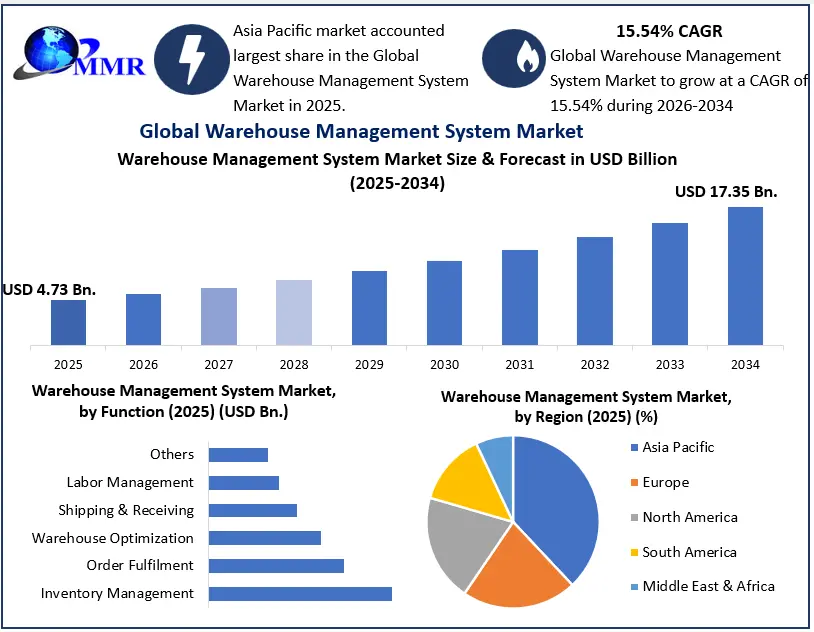
Warehouse Management System Market was valued US$ 4.73 Bn in 2025 and is expected to reach US$ 17.35 Bn by 2034, at a CAGR of 15.54% during a forecast period.
Recent developments in global logistics, such as delivery KPIs, enhanced supply chain flexibility, and cost-cutting, are driving the third-party logistics and supply chain industries to adopt warehouse management systems. The rise of e-commerce and online purchasing habits among consumers is driving the growth of the warehouse management systems industry. Favorable trade and government policies, as well as lower company taxation, are some of the drivers promoting foreign investment in developing economies. As a result, emerging nations are one of the WMS market's key growth areas.
The growing use of real-time WMS software systems for effective order processing, picking, packaging, shipping tracking, and route planning has come from a dramatic shift in consumer purchasing behavior. In the e-commerce and online retail industry, WMS enables businesses to swiftly respond to changing client demand. Also, the deployment of WMS aids in the optimal management of warehouses, with greater productivity and efficiency of warehouse operations and decreased product delivery time.
Major Key Players in the Warehouse Management System market are identified through secondary research and their market revenues are determined through primary and secondary research. Some of the leading key players in the global Warehouse Management System market include IBM, SAP, and 3PL Central. They are continuously strategizing on mergers and acquisitions, strategic alliances, joint ventures, and partnerships for the growth of their market shares.
Warehouse Management System Market Size, Growth & Share Analysis
To know about the Research Methodology :- Request Free Sample Report
Warehouse Management System Market Dynamics
An exponential growth of omnichannel shopping and demand for faster merchandise deliveries are expected to drive the market growth. A warehouse management system is a strong part supply and logistics IT solution and offers a real-time warehouse infrastructure, which is trustworthy and robust. As a wave of next generation, technology-enhanced warehouses are bringing extraordinary levels of real-time visibility into organizations’ assets, people and transactions across a myriad of industries like automotive, electronics, machinery and beverage, healthcare and pharmaceutical sectors. The supply chain networks are expected to undergo an extreme makeover during the forecast period. The retail, wholesale, transportation and logistics sectors are transitioning to “best-of-breed” warehouse management systems, which take atomization to new heights.The global Warehouse Management System market was valued at USD 4.73 billion in 2025 and is projected to reach USD 17.35 billion by 2034, with a CAGR of 15.54% during 2025–2034.
The warehousing software assists in centralizing the critical tasks like maintaining healthy stock levels automatically and location-allocation in multiple warehouse sites along with real-time inventory management, automated purchase management, routing and tracking of shipments, order management from multiple POS etc. In addition to new wave of connected devices, Internet of Things is expected to grant warehouses a heightened level of visibility into every facet of the supply chain. IoT technologies deliver the promise of facilitate real-time workforce interaction to raise productivity at a new level of precision to track the route of inventory throughout the supply chain. Cloud-based WMS platforms accounted for 55.21% of market revenue in 2025, reflecting the increasing shift toward scalable and connected warehouse management solutions.
Warehouse Management System Market Segment Analysis
Based on Component, the Warehouse Management System Market is segmented into Software and Services. Software forms the core of WMS solutions by supporting inventory control, order processing, warehouse operations, and supply chain visibility, while services include implementation, integration, consulting, maintenance, and support. The increasing need for customized warehouse solutions and seamless integration with enterprise and logistics systems is supporting demand for both software and associated services.
Based on Deployment, the market is segmented into On-cloud and On-premise. The On-cloud segment is gaining strong adoption as cloud-based WMS solutions reduce upfront infrastructure requirements and provide scalable access to warehouse data and applications. Cloud deployment also supports easier system updates, remote access, integration with connected devices, and flexible expansion across multiple warehouse locations, while on-premise solutions continue to be used by organizations requiring greater control over their IT infrastructure and data.
Based on Function, the market is segmented into Inventory Management, Order Fulfilment, Warehouse Optimization, Shipping & Receiving, Labor Management, and Others. Inventory Management and Order Fulfilment are important functions as businesses require accurate stock visibility, faster order processing, and efficient movement of goods within warehouses. Warehouse Optimization, Shipping & Receiving, and Labor Management functions further help organizations improve storage utilization, coordinate inbound and outbound activities, allocate workforce efficiently, and enhance overall warehouse productivity.
Warehouse Management System Market Regional Analysis
Region-wise, Asia Pacific region is projected to be leading region in the global warehouse management market. The growth in the purchasing power of consumers in the developing countries is witnessing a significant growth in the market. Rapid expansion of the manufacturing sector in the region is positively influencing the demand for WMS for uninterrupted supply of products. The benefits of the WMS solution like lower entry cost and risk, cost-effective growth, access to the best technology, and dynamic and advanced software features are seizing the attention of manufacturers in the region.
The prominent key players in the warehouse market are focusing on new product developments, strategic mergers and acquisitions (M&A), and gaining venture capital investments to consolidate their market presence. For instance, In 2018, the Infor signs a contract with ELSEN GmbH & Co., who is a logistics and personnel service provider. The ELSEN Company has implemented warehouse and transport management solution of the Infor SCE to advance its digitization strategy.
The objective of the report is to present a comprehensive analysis of the global market including all the stakeholders of the industry. The past and current status of the industry with forecasted market size and trends are presented in the report with the analysis of complicated data in simple language. The report covers all the aspects of the industry with a dedicated study of key players that includes market leaders, followers and new entrants by region. PORTER, SVOR, PESTEL analysis with the potential impact of micro-economic factors by region on the market has been presented in the report. External as well as internal factors that are supposed to affect the business positively or negatively have been analyzed, which will give a clear futuristic view of the industry to the decision-makers.
The report also helps in understanding global market dynamics, structure by analyzing the market segments and projects the Global market size. Clear representation of competitive analysis of key players by Application, price, financial position, Product portfolio, growth strategies, and regional presence in the Global market make the report investor’s guide.
Warehouse Management System Market Competitive Landscape:
The Warehouse Management System Market is highly competitive, with major players focusing on software innovation, cloud-based solutions, automation, artificial intelligence, and supply chain integration to strengthen their market positions. Key companies such as Manhattan Associates, Blue Yonder, SAP, Oracle, Infor, Infios, Tecsys, Softeon, Mecalux, SSI SCHAEFER, Körber Supply Chain Software, and Zebra Technologies compete by offering solutions for inventory management, order fulfillment, warehouse optimization, labor management, shipping, and receiving. Companies are increasingly integrating AI, IoT, robotics, real-time analytics, and cloud technologies into WMS platforms to improve warehouse visibility, operational efficiency, and decision-making. Strategic partnerships, acquisitions, product enhancements, and expansion of cloud-based platforms remain key strategies adopted by market participants to address the growing demand for automated, scalable, and digitally connected warehouse operations across retail, manufacturing, logistics, healthcare, and food & beverage industries.
Warehouse Management System Market Recent Development:
| Date | Company | Development | Impact |
| 02 March 2026 | IFS | IFS completed its acquisition of Softeon, combining Industrial AI with Softeon's established warehouse management software capabilities under IFS Softeon. | The combination strengthens AI-powered warehouse execution, robotics orchestration, and unified visibility across manufacturing, logistics, and retail operations. |
| 19 March 2026 | Cordance | Cordance announced a strategic investment in Royal 4 to expand its portfolio of warehouse management and supply chain execution software. | The investment expands capabilities in warehouse visibility, inventory accuracy, throughput, and operational efficiency for distributors, manufacturers, and 3PL providers. |
| 29 April 2026 | Gartner-recognized WMS Vendors | The 2026 Gartner Magic Quadrant for Warehouse Management Systems evaluated leading vendors including Blue Yonder, Dematic, IFS Softeon, Infor, Manhattan Associates, Oracle, SAP, and Tecsys. | The assessment highlights growing competition around cost reduction, warehouse automation, robotics, AI support, adaptability, and ease of deployment. |
| 06 May 2026 | Manhattan Associates | Manhattan Associates announced its recognition as a Leader in the 2026 Gartner Magic Quadrant for Warehouse Management Systems, with Manhattan Active WM evaluated across 11 critical capabilities. | The recognition reinforces the company's position in cloud-native, AI-enabled warehouse management and highlights continued demand for scalable WMS technology. |
Warehouse Management System Ecosystem
Warehouse Management System Market Scope: Inquire before buying
| Warehouse Management System Market | |||
|---|---|---|---|
| Report Coverage | Details | ||
| Base Year: | 2025 | Forecast Period: | 2026-2034 |
| Historical Data: | 2020 to 2025 | Market Size in 2025: | 4.73 USD Billion |
| Forecast Period 2026-2034 CAGR: | 15.54% | Market Size in 2034: | 17.35 USD Billion |
| Segments Covered: | by Component | Software Service |
|
| by Deployment | On-cloud On-premise |
||
| by Function | Inventory Management Order Fulfilment Warehouse Optimization Shipping & Receiving Labor Management Others |
||
| by End-User Industry | Retail Manufacturing Logistics & Transportation Healthcare Food & Beverage Others |
||
Warehouse Management System Market, by Region
North America (United States, Canada and Mexico)
Europe (UK, France, Germany, Italy, Spain, Sweden, Austria and Rest of Europe)
Asia Pacific (China, South Korea, Japan, India, Australia, Indonesia, Malaysia, Vietnam, Taiwan, Bangladesh, Pakistan and Rest of APAC)
Middle East and Africa (South Africa, GCC, Egypt, Nigeria and Rest of ME&A)
South America (Brazil, Argentina Rest of South America)
Warehouse Management System Market Key Players are:
1. Manhattan Associates, Inc.
2. Blue Yonder Group, Inc.
3. SAP SE
4. Oracle Corporation
5. Infor
6. Infios
7. Tecsys Inc.
8. Softeon
9. Made4net
10. Generix Group
11. Synergy Logistics
12. Mantis
13. Mecalux S.A.
14. Ehrhardt Partner Group (EPG)
15. SSI SCHAEFER
16. Vinculum Solutions
17. Microsoft Corporation
18. Dematic
19. Reply S.p.A.
20. Körber Supply Chain Software
21. Deposco
22. Logiwa
23. Extensiv
24. Microlistics
25. IBM Corporation
26. Epicor Software Corporation
27. PSI Logistics GmbH
28. Descartes Systems Group
29. Zebra Technologies Corporation
30. Honeywell International Inc.
31. Swisslog Holding AG
32. Vanderlande Industries
33. Daifuku Co., Ltd.
34. JDA Software Group, Inc.
35. HighJump Software
36. 3PL Central
37. Camelot 3PL Software
38. Fishbowl
39. Cin7
40. Unicommerce eSolutions Ltd.
Frequently Asked Questions:
1. Which region is expected to hold the largest share in the Global Warehouse Management System Market?
Ans: Asia Pacific is expected to hold the largest market share by 2034.
2. What is the growth rate of the Global Warehouse Management System Market?
Ans: The Global market is growing at a CAGR of 15.54% during the forecast period 2026-2034.
3. What segments are covered in the Global Warehouse Management System market?
Ans: Warehouse Management System Market is segmented into offering, deployment, function, end-user industry, and region.
4. Who are the key players in the Global Warehouse Management System market?
Ans: The important key players in the Warehouse Management System Market are – Epicor Software, JDA Software, Infor, Manhattan Associates, IBM, SAP, PSI, PTC, Tecsys, Blujay Solutions, HighJump, 3PL Central, Snapfulfil, Synergy Ltd., Produmex, ERCIM, Indigo Software
5. What is the study period of the Warehouse Management System market?
Ans: The Global Warehouse Management System Market is studied from 2020 to 2034.