
3D Reconstruction Technology and Solutions Market Size by Component, Type, Construction Method, Deployment Model, Application, Region – Segment-Level Market Assessment, Growth Opportunity Analysis, Competitive Mapping & Forecast to 2032
Overview
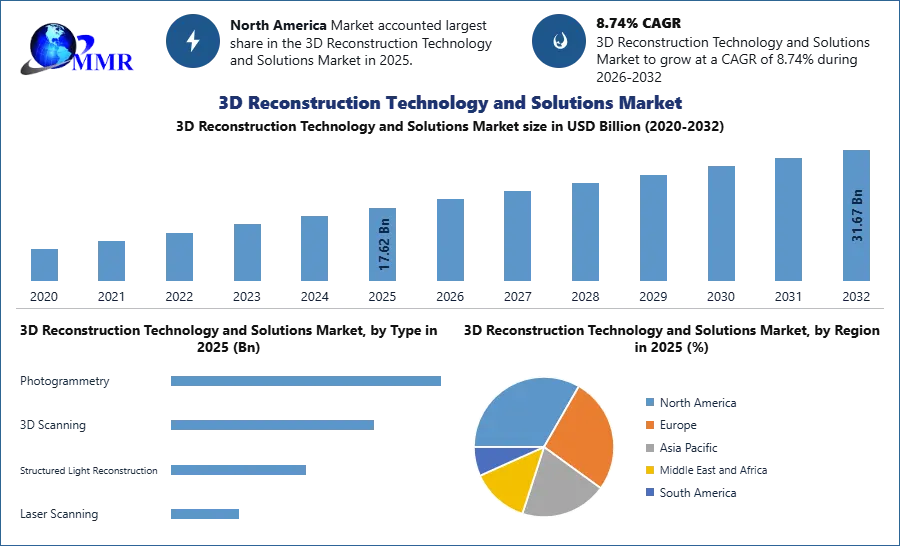
The 3D Reconstruction Technology and Solutions Market was valued at USD 17.62 Bn in 2025, and the total revenue of the Global 3D Reconstruction Technology and Solutions Market is expected to grow at a CAGR of 8.74% from 2026 to 2032, reaching nearly USD 31.67 Bn by 2032.
3D Reconstruction Technology and Solutions Market Overview:
3D reconstruction refers to the method of transforming two-dimensional data, for example, images or videos, into three-dimensional models. This is achieved through different techniques such as photogrammetry, which uses multiple photographs taken from different angles, or laser scanning, which uses laser beams to measure distances to the object's surface. 3D reconstruction is the process of converting 2D images or videos into detailed 3D models using techniques such as photogrammetry, laser scanning, and LiDAR. These models enable precise visualization, analysis, and simulation across multiple industries.
 To know about the Research Methodology :- Request Free Sample Report
The 3D Reconstruction Technology and Solutions industry growth is fueled by AR/VR integration for interactive visualization, adoption of high-resolution imaging, and active reconstruction methods like LiDAR for industrial precision. Top competitors Autodesk and Matterport dominate through cloud-based solutions, AI analytics, and scalable, user-friendly platforms. Emerging trends include digital twins, AR/VR-enabled workflows, and software-driven cross-industry adoption, highlighting the sector’s transformative potential.
3D Reconstruction Technology and Solutions Market Dynamics
Advancements in 3D Technology to boost 3D Reconstruction Technology and Solutions Market Growth
The 3D Reconstruction Technology and Solutions Market is expanding due to significant advancements in 3D technologies, including Multi-Jet Fusion (MJF), bioprinting, sensor integration, and advanced materials. These innovations enhance precision, efficiency, and cost-effectiveness, enabling broader adoption across industries such as manufacturing, healthcare, and aerospace. For example, HP’s MJF-based 3D printers deliver parts ten times faster and at less than half the cost of competitors, improving operational efficiency and reducing production costs.
Cutting-edge hardware, including high-resolution cameras, LiDAR scanners, and drone-based imaging systems, enables accurate capture of complex 3D data. Simultaneously, improvements in computer vision and machine learning algorithms allow rapid reconstruction of intricate 3D models, enhancing quality and streamlining workflows.
The market growth is further driven by increasing adoption across construction, heritage preservation, healthcare, and entertainment sectors. Applications such as building information modeling (BIM), medical imaging, virtual reality (VR), and augmented reality (AR) are enhancing visualization, decision-making, and immersive experiences, positioning 3D reconstruction solutions as a critical tool for industrial and creative applications worldwide.
Regulatory Challenges to limit the growth of the 3D Reconstruction Technology and Solutions Market
Regulatory challenges, such as GDPR and CCPA in data protection, intellectual property laws, safety and security regulations, and healthcare standards, pose hurdles for the 3D reconstruction technology and Solutions market. Compliance complexities increase costs and deployment times, particularly in the healthcare, finance, and construction sectors. Also, differing regulations across regions hinder global standardization and interoperability. These regulations demand significant resources, restricting market entry for smaller players and slowing overall industry growth.
Some Important Regulations Related 3D Reconstruction Technology and Solutions Market
| Regulation | Description | Relevant Sectors |
| GDPR (General Data Protection Regulation) | Regulates the handling and protection of personal data, crucial for 3D reconstruction applications. | Healthcare, Finance, Retail, Any sector with EU data |
| CCPA (California Consumer Privacy Act) | Regulates the handling and protection of personal data, similar to GDPR but specific to California. | Healthcare, Finance, Retail, Tech |
| Intellectual Property Laws | Protect intellectual property rights (patents, copyrights) of companies developing 3D reconstruction tech. | Tech, Manufacturing, Research and Development |
| Safety and Security Regulations | Govern the safe and secure use of technology, including drones and aerial vehicles. | Construction, Entertainment, Agriculture |
| Environmental Regulations | Govern the sustainable use of materials and energy consumption, important for tech development. | Manufacturing, Construction, Energy |
| Healthcare Regulations | Govern the use of medical imaging and patient data, crucial for healthcare applications of 3D reconstruction. | Healthcare, Medical Imaging |
| Healthcare Regulations | Govern the use of medical imaging and patient data, crucial for healthcare applications of 3D reconstruction. | Healthcare, Medical Imaging |
Integration with VR and AR technologies Creates Lucrative Growth Opportunities for the 3D Reconstruction Technology and Solutions Market
The integration of Virtual Reality (VR) and Augmented Reality (AR) technologies is creating significant growth opportunities in the 3D Reconstruction Technology and Solutions Market. By delivering immersive experiences and high-fidelity visualizations, these solutions enable practical applications across industries such as gaming, construction, education, healthcare, and industrial training. AR overlays digital information onto real-world environments, facilitating navigation, maintenance, and operational efficiency, while VR provides fully immersive simulations that enhance interaction, decision-making, and problem-solving capabilities. The rising adoption of VR and AR devices globally is driving demand for advanced 3D reconstruction solutions compatible with these platforms, expanding the market potential for providers targeting enterprise and consumer segments.
For instance, HQSoftware exemplifies strategic innovation in the market through its AR/VR-enabled 3D reconstruction solutions. Their platform ensures cross-device compatibility, bridging physical and digital environments to enhance operational workflows and user engagement. In enterprise settings, HQSoftware’s interactive simulations accelerate workforce training and skills development, while in gaming, they deliver highly immersive experiences that blur the boundaries between virtual and real-world interactions. Leveraging computer vision, sensor data, and IoT integration, HQSoftware transforms complex spatial and operational data into actionable insights, optimizing performance and enhancing decision-making.
3D Reconstruction Technology and Solutions Market Segment Analysis
Based on Type, the 3D Reconstruction Technology and Solutions Market is segmented into Photogrammetry, 3D Scanning, Structured Light Reconstruction, and Laser Scanning. The 3D Scanning segment dominated the market in 2025 due to its ability to capture highly accurate spatial data and generate detailed digital representations of real-world environments. Advanced scanning technologies such as LiDAR and depth sensors enable rapid data acquisition and high-resolution modeling, which is widely used in industries like construction, manufacturing, and healthcare. The growing demand for precise measurement and digital mapping solutions has further accelerated the adoption of 3D scanning technologies. Additionally, improvements in scanning hardware and integration with advanced reconstruction software enhance processing efficiency and model accuracy. The increasing use of portable and automated scanning systems also contributes to the expansion of this segment. These factors collectively support the strong position of the 3D scanning segment in the market.
Based on Application, the market is segmented into Construction & Infrastructure, Healthcare & Medical Imaging, Media & Entertainment, Manufacturing & Industrial Design, Cultural Heritage & Archaeology, and Gaming & Virtual Reality. The Construction & Infrastructure segment dominated the application segment in 2025 due to the increasing use of 3D reconstruction technologies in building design, infrastructure planning, and urban development. These technologies enable professionals to create accurate digital models of buildings, construction sites, and infrastructure assets, improving project visualization and planning. The integration of drones, LiDAR scanning, and photogrammetry further enhances site monitoring and digital documentation. Governments and private organizations are increasingly adopting these solutions for smart city initiatives and infrastructure modernization projects. The ability to reduce construction errors and improve project efficiency also supports the adoption of 3D reconstruction technologies. As a result, the construction and infrastructure sector continues to be a major contributor to market growth.
Based on Component, the 3D Reconstruction Technology and Solutions Market is segmented into Software, Hardware, and Services. The Software segment dominated the component segment in 2025 due to continuous advancements in reconstruction algorithms, artificial intelligence, and cloud-based computing technologies. These software solutions enable the transformation of images, videos, and scanning data into highly detailed and accurate 3D models. They are widely used across industries such as architecture, healthcare, gaming, and industrial design for visualization and simulation purposes. The flexibility and scalability of reconstruction software make it a cost-effective option compared to hardware-intensive solutions. Integration with technologies such as CAD platforms, BIM systems, drones, and 3D scanners further enhances its functionality. User-friendly interfaces and regular software updates also support broader adoption among organizations of different sizes.
Based on Reconstruction Method, the market is segmented into Active and Passive methods. The Active reconstruction segment dominated the market in 2025 due to its superior accuracy, speed, and reliability in capturing spatial data. Active methods use technologies such as LiDAR, structured light scanning, and laser triangulation to generate highly precise point cloud data. These technologies are widely used in applications such as industrial inspection, urban mapping, robotics, and autonomous vehicle navigation. Active reconstruction methods also perform effectively in challenging environmental conditions where passive techniques may struggle to capture accurate depth information. The integration of active sensing technologies with advanced reconstruction software further improves processing speed and model quality. These advantages make active reconstruction methods highly preferred across commercial and industrial applications, strengthening their dominance in the market.
3D Reconstruction Technology and Solutions Market Regional Analysis
North America dominated the 3D Reconstruction Technology and Solutions Market in 2025, accounting for around 35.36% of the global market share. The region’s leadership is driven by strong investments in advanced technologies and the presence of major companies such as Google, Microsoft, and Autodesk, which are actively developing innovative 3D reconstruction solutions.
The region’s well-developed healthcare sector also supports market growth, as 3D reconstruction is widely used in medical imaging, diagnostics, and surgical planning. In addition, the strong construction and infrastructure industry in the U.S. and Canada increasingly uses 3D reconstruction for project visualization, site mapping, and design accuracy.
Government support for advanced manufacturing, smart city projects, and digital transformation initiatives further promotes the adoption of these technologies. These factors collectively contribute to North America maintaining its leading position in the market.
3D Reconstruction Technology and Solutions Market Competitive Landscape
The 3D Reconstruction Technology and Solutions Market witnessed significant growth in 2025 as industries increasingly demanded high-precision digital models for applications such as construction, cultural heritage preservation, gaming, and healthcare. Government and research institutions also supported innovation in this field. For instance, the U.S. National Science Foundation funded several research initiatives focusing on AI-based 3D reconstruction technologies, reflecting strong institutional interest in advancing this technology.
In response to the growing demand, companies focused on enhancing technological capabilities, expanding product portfolios, and forming strategic partnerships. These strategies helped organizations strengthen their market presence and accelerate the development of advanced 3D reconstruction solutions across multiple industries.
Autodesk Inc. leverages ecosystem integration, combining its 3D modeling software with cloud platforms and AI analytics to create seamless workflows for enterprises. This focus on interoperability and enterprise adoption allows Autodesk to maintain dominance in architecture, engineering, and construction verticals.
Matterport Inc. has positioned itself as a leader by emphasizing user-friendly digital twin platforms and scalable cloud-based services. Its strategy focuses on expanding enterprise adoption across real estate, insurance, and facilities management sectors, where accuracy, ease of use, and AI automation drive value.
3D Reconstruction Technology and Solutions Market Recent Industry Developments (2025–2026)
| Exact Date | Company | Development | Impact |
|---|---|---|---|
| 19 March 2025 | Autodesk, Inc. | Launched an upgraded Autodesk ReCap Pro 2025 platform with enhanced AI-driven point-cloud processing and photogrammetry capabilities. | Strengthens Autodesk’s position in construction and infrastructure digital modeling workflows and improves accuracy of 3D reconstruction. |
| 18 September 2025 | Trimble Inc. | Expanded its Trimble Reality Capture platform with advanced laser scanning and photogrammetry integration for large-scale infrastructure modeling. | Improves construction site digitization and BIM integration, increasing adoption of reconstruction technologies. |
| 14 February 2026 | Matterport, Inc. | Released an upgraded AI-powered digital twin and 3D spatial data platform supporting automated 3D reconstruction from images and LiDAR scans. | Accelerates adoption of 3D spatial mapping in real estate, construction, and facility management. |
| 22 April 2026 | Pix4D SA | Announced the launch of Pix4Dmatic 2026 with improved drone-based photogrammetry processing and large-dataset reconstruction. | Enables faster processing of large aerial datasets, supporting infrastructure mapping and geospatial analysis. |
3D Reconstruction Technology and Solutions Market Key Trends
Neural Rendering Gains Industry Attention
In 2025, 3D reconstruction technologies are increasingly integrating AI-driven neural rendering techniques to create highly realistic digital environments and characters. These methods enable faster model generation with improved visual accuracy compared to traditional photogrammetry. Gaming studios, film production companies, and AR/VR developers are adopting neural rendering to accelerate content creation for immersive experiences and metaverse applications.
Growing Adoption of Digital Twins in Infrastructure
Construction and infrastructure companies are increasingly adopting 3D reconstruction technologies to develop digital twins of buildings, bridges, and urban infrastructure. By converting scanned environments into real-time digital models, organizations can monitor structural conditions, simulate potential risks, and optimize maintenance strategies. This approach is gaining traction in smart city development and large-scale infrastructure projects across multiple regions.
Expansion of 3D Reconstruction in Healthcare
Healthcare institutions are expanding the use of 3D reconstruction technologies for medical imaging, surgical planning, and personalized treatment solutions. By transforming MRI and CT scan data into accurate 3D anatomical models, surgeons can visualize complex structures before procedures and improve surgical precision. The technology is also being used in prosthetics design and patient-specific implant development, supporting the broader adoption of digital healthcare solutions.
3D Reconstruction Technology and Solutions Market Scope: Inquiry Before Buying
| 3D Reconstruction Technology and Solutions Market | |||
|---|---|---|---|
| Report Coverage | Details | ||
| Base Year: | 2025 | Forecast Period: | 2026-2032 |
| Historical Data: | 2020 to 2025 | Market Size in 2025: | 17.62 USD Billion |
| Forecast Period 2026-2032 CAGR: | 8.74% | Market Size in 2032: | 31.67 USD Billion |
| Segments Covered: | by Type | Photogrammetry 3D Scanning Structured Light Reconstruction Laser Scanning |
|
| by Application | Construction & Infrastructure Healthcare & Medical Imaging Media & Entertainment Manufacturing & Industrial Design Cultural Heritage & Archaeology Gaming & Virtual Reality |
||
| by Component | Software Hardware Services |
||
| by Reconstruction Method | Active Reconstruction Passive Reconstruction |
||
Global 3D Reconstruction Technology and Solutions Market, by Region
North America (United States, Canada and Mexico)
Europe (UK, France, Germany, Italy, Spain, Sweden, Austria and Rest of Europe)
Asia Pacific (China, South Korea, Japan, India, Australia, Indonesia, Malaysia, Vietnam, Taiwan, Bangladesh, Pakistan and Rest of APAC)
Middle East and Africa (South Africa, GCC, Egypt, Nigeria and Rest of ME&A)
South America (Brazil, Argentina Rest of South America)
3D Reconstruction Technology and Solutions Market: Key Players are
1. Autodesk Inc. (USA)
2. Intel Corporation (USA)
3. Matterport Inc. (USA)
4. Bentley Systems, Incorporated (USA)
5. FARO Technologies Inc. (USA)
6. Skyline Software Systems Inc. (USA)
7. Thermo Fisher Scientific (USA)
8. Vi3DIM Technologies (USA)
9. Quorum Technologies Inc. (USA)
10. Unity Technologies (USA)
11. Trimble Inc. (USA)
12. PhotoModeler Technologies (Canada)
13. Pix4D SA (Switzerland)
14. Koninklijke Philips N.V. (Netherlands)
15. Agisoft LLC (Russia)
16. Capturing Reality s.r.o. (Slovakia)
17. 3DHISTECH Ltd. (Hungary)
18. Reconstruct Me (Germany)
19. GeoSLAM (UK)
20. RealityCapture (Slovakia)
21. Artec 3D (Luxembourg)
22. Dassault Systèmes (France)
23. Siemens AG (Germany)
24. Mensi (France)
25. 4DAGE Ltd (China)
26. Maptek (Australia)