
Global Citric Acid Market by Form, Application, Function and Region 2034
Overview
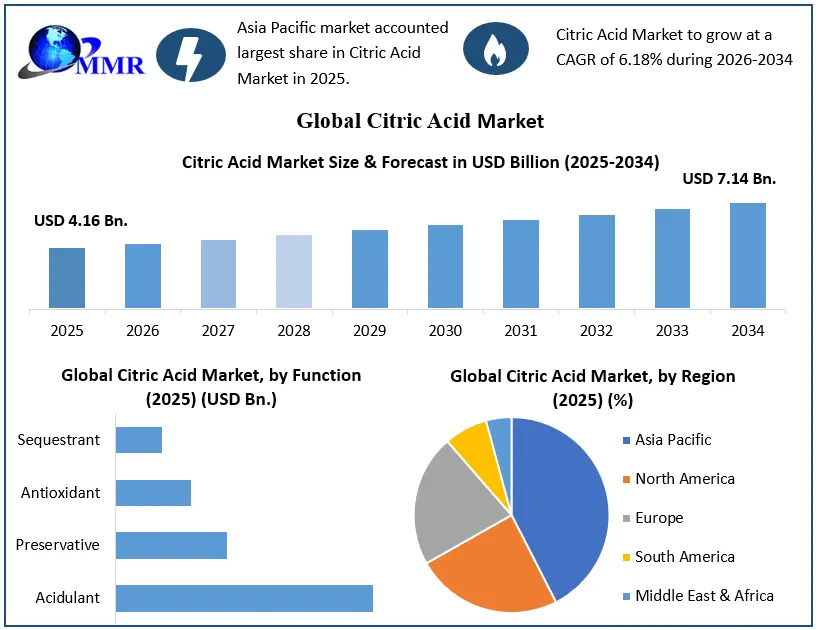
The Global citric acid market was valued at USD 4.16 Bn. in 2025, and it is expected to reach USD 7.14 Bn. by 2034 with a CAGR of 6.18% during the forecast period 2026-2034.
Global Citric Acid Market Overview:
Citric acid is a weak organic acid that naturally occurs in citrus fruits such as lemons and oranges. It is widely used as an acidulant, pH regulator, preservative, and chelating agent in food and beverages, pharmaceuticals, cosmetics, cleaning products, and other industrial applications. Commercial citric acid is mainly produced through fermentation of carbohydrate-based raw materials. Its ability to add acidity, improve flavor, control pH, and support product stability makes it an important ingredient in many consumer and industrial products.
Food and beverages account for the largest share of citric acid demand because of its use in soft drinks, confectionery, processed foods, sauces, and other products. Pharmaceuticals and cosmetics are also important application areas, while cleaning and industrial products provide additional demand. By function, acidulant is the leading segment, followed by preservatives, antioxidants, and sequestrants. Asia Pacific is the leading regional market, supported by its large manufacturing base, food-processing industry, raw material availability, and growing consumption in China, India, and Southeast Asia. North America and Europe also have steady demand from food, pharmaceutical, personal care, and cleaning industries.
The market continues to benefit from the wide use of citric acid across different industries. Growing consumption of processed food and beverages, pharmaceutical products, personal care products, and cleaning products is supporting demand. Manufacturers are also improving fermentation and production processes to increase efficiency and maintain a stable supply. The combination of established applications and growing demand from different end-use industries is expected to support the development of the global citric acid market during the forecast period.
Citric Acid Market Growth and Share Analysis
To know about the Research Methodology :- Request Free Sample Report
Key Points:
In Europe, the approved list of Regulation (EC) No. 1925/2006 on food fortification includes citric acid. They're also mentioned as vitamins and mineral substances that can be used in the production of food supplements in the European Parliament and Council's Directive 2002/46/EC on food supplements. Also, it is defined as a nutrient in EU Regulation (EC) No. 609/2013 on food for babies and young kids, food for relevant medical purposes, and total diet substitute for weight control.
In the USA, according to the FDC Act, citric acid is a compound that can be considered a dietary ingredient. When it comes to oral care products, citric acid is a Class I active component in terms of safety and a Class III active ingredient in terms of effectiveness.
Citric Acid Market Dynamics:
Key Growth Drivers:
The global citric acid market is mainly driven by growing demand from the food and beverage industry, where citric acid is widely used in beverages, confectionery, sauces, processed foods, and other products to control acidity, improve flavor, and support product freshness. Rising pharmaceutical production is also increasing demand for citric acid in formulations that require acidity and pH control. In addition, its use in skincare and cosmetic products for pH adjustment and exfoliating formulations is supporting demand from the personal care industry.
Key Market Restraints:
The market faces restraints from fluctuations in raw material, energy, and manufacturing costs, which can increase production expenses and put pressure on product prices. The availability of alternative acidulants such as lactic acid, malic acid, and tartaric acid also creates substitution pressure in applications where these ingredients can perform similar functions. In addition, citric acid production mainly depends on fermentation, requiring manufacturers to carefully control production conditions to maintain consistent output and product quality.
Key Growth Opportunities
Manufacturers have opportunities to improve fermentation processes, reduce resource consumption, and develop more sustainable production methods. Growing demand from the food, pharmaceutical, and personal care industries is also creating opportunities for specialized citric acid grades designed for specific quality and application requirements. Furthermore, increasing food processing, pharmaceutical production, and personal care consumption in emerging markets can provide new opportunities for citric acid manufacturers and suppliers.
Key Market Challenges
The market faces challenges from international trade restrictions and changing trade policies, which can affect the movement, availability, and pricing of citric acid across countries. Maintaining consistent product quality is another challenge because food, pharmaceutical, cosmetic, and industrial customers have different purity and specification requirements. Manufacturers must also comply with changing regulatory requirements across different countries, covering food safety, pharmaceuticals, cosmetics, and environmental standards, which can increase compliance costs and operational requirements.
Citric Acid Market Segment Analysis:
Global Citric Acid Market, by Form
Anhydrous: The anhydrous form of acid held the larger share of the market in 2025. Because it has no water it works well in products. This includes drinks, candies, medicine tablets and other mixtures where keeping moisture under control is important. Its dry nature also makes it easier to handle during production.
Liquid: Liquid citric acid had a share in 2025. It is mostly used when manufacturers need a to-use ingredient that can be mixed easily into liquids. It is commonly used in drinks, medicines, skincare products and other items that are made in form.

by Application
Food: The food segment was the largest in 2025. Citric acid is used widely in food products. This includes drinks, sweets, breads, dairy items, sauces and processed foods. Its ability to add sourness and help keep products makes it valuable, in a wide variety of food items.
Pharmaceuticals: The use of acid in pharmaceuticals was supported by applications such as effervescent tablets, supplements, electrolyte products and formulations that require pH adjustment. Demand in this sector is also growing due to the rising production of pharmaceutical products and nutraceutical products.
Cosmetics: Cosmetics was an application segment, with citric acid mainly used in skincare and personal-care formulations for pH adjustment and to improve formulation performance. Its use in cosmetics helps create demand outside the food and pharmaceutical industries.

by Function
Acidulant: The acidulant function segment was the leading one in 2025. Citric acid is widely used to provide control acidity in food and beverage products. The FDA recognizes acid as a pH-control agent and an acid-related ingredient, in food applications.
Antioxidant: Citric acid is used as an antioxidant-related ingredient. It helps control oxidation and keeps product quality stable in the formulations. As an ingredient it supports demand in food and other uses.
Preservative: Citric acid helps with preservation by making the environment acidic. This acidity can stop growth and make products last longer. It is often used in food and beverage items to improve stability.
Sequestrant: Citric acid works as a sequestrant by attaching to metal ions. These ions can harm product quality and stability. By binding them citric acid helps protect the product. This function is especially important, in formulations where controlling metal ions matters.
Global Citric Acid Market Regional Insights:
Asia Pacific:
Asia Pacific is the leading region in Global Citric Acid Market. This region was supported by food and beverage manufacturing. It was also supported by pharmaceutical production. Personal-care consumption was another factor. China is particularly important because of its production and export base. India and other Asian markets are supported by expanding food-processing and consumer-product industries.
North America:
North America is a major region in the Global Citric Acid Market. Demand is supported by the well-established food and beverage, pharmaceutical, nutraceutical, and household cleaning industries. The United States represents the major market in the region, with citric acid widely used as an acidulant, preservative, flavor enhancer, and pH-control agent.
Europe:
Europe is an established region in the Global Citric Acid Market. The region benefits from strong food processing, pharmaceutical, personal care, and cleaning product industries. Citric acid is widely used for acidity control, formulation requirements, product stability, and cleaning applications, supporting steady regional demand.
South America:
South America is a growing region in the Global Citric Acid Market. Demand is mainly supported by food and beverage processing, particularly beverages and processed food products. Brazil is an important market due to its large food processing industry and expanding consumer goods sector.
Middle East & Africa:
Middle East & Africa is an emerging region in the Global Citric Acid Market. Demand is supported by food and beverage production, pharmaceuticals, cleaning products, and expanding consumer markets. Increasing processed food and beverage manufacturing is creating additional opportunities for citric acid consumption across the region.
Global Citric Acid Market Recent Developments
| Date | Recent Developments |
| July-2026 | Hubei MicroNexa Biotech Co., Ltd. launched its latest innovation, the CCA90P Encapsulated Citric Acid with a vegetable-oil coating that allows for the controlled release of acidity, minimizes the risk of moisture-related issues and enhances overall ingredient quality and stability. The product finds application in food processing, confectionery and specialized formulations. |
| June-2026 | Ingredion Incorporated announced its proposed all-cash acquisition of Tate & Lyle PLC for a value of approximately USD 5.0 billion, representing a significant strategic move for the company that aims to diversify and expand its portfolio of specialty food ingredients, technologies and global sales channels, although it is not directly related to the citric-acid sector. |
| February-2026 | Jungbunzlauer announced the start-up operations of its second Mechanical Vapor Recompression Evaporator at its Port Colborne manufacturing site in Canada, which will contribute to enhanced energy efficiency and sustainability at the facility that is engaged in citric acid and specialty salts production. |
| February-2026 | Citron LLC announced the updated launch timeline for its citric acid manufacturing facility in Voronezh, Russia, with the approximately RUB 4 billion investment expected to enable the production of 10,000 tonnes of citric acid per annum through corn processing, with the first production start-up scheduled for the end of the second quarter of 2026, although completion of the project was not confirmed in the report. |
| January-2026 | LS Additives launched its High Purity Anhydrous Citric Acid, a food-grade product with a purity level of above 99.5% that is suitable for food processing, pharmaceutical formulations, cleaning products and industrial applications where stable levels of acidity are required. |
Global Citric Acid Market Competitive Landscape
Companies in the Citric Acid Market offer citric acid and its products for food, beverages, pharmaceuticals, cosmetics, and other industrial applications. A large number of regional and international players compete with each other by providing products with high quality, advanced production methods, competitive pricing, and sustainable manufacturing to gain a higher market share. Jungbunzlauer, Cargill Incorporated, Archer Daniels Midland Company (ADM), Weifang Ensign Industry, RZBC Group, Gadot Biochemical Industries, and others are well-established in the market.
The growing demand for citric acid in the food and beverage industry for its applications as a preservative, acidity regulator, and flavoring agent increases the market size. Moreover, the rising need for natural and healthy food ingredients provides an additional growth opportunity. Companies are investing in advanced technologies to produce citric acid efficiently, cut down production costs, and meet the demand for clean-label ingredients. The cost of production depends on the availability of raw materials and energy, which can be controlled by improving technological processes in the production unit. The gap between the supply-demand of citric acid in various countries creates the potential for manufacturers to provide their products at competitive prices. At the same time, the limited production facilities hinder the local manufacturing of the product, creating opportunities for other companies with advanced production technologies to invest in the market. The rising food processing industry, pharmaceutical applications, and demand in the Asia Pacific region will drive the market growth and motivate manufacturers to expand their operations.
Global Citric Acid Market Scope: Inquire before buying
| Citric Acid Market | |||
|---|---|---|---|
| Report Coverage | Details | ||
| Base Year: | 2025 | Forecast Period: | 2026-2034 |
| Historical Data: | 2020 to 2025 | Market Size in 2025: | US $ 4.16 Bn. |
| Forecast Period 2026 to 2034 CAGR: | 6.18% | Market Size in 2034: | US $ 7.14 Bn. |
| Segments Covered: | by Form | Anhydrous Liquid |
|
| by Application | Food Pharmaceuticals Cosmetics |
||
| by Function | Acidulant Antioxidant Preservative Sequestrant |
||
Global Citric Acid Market, by Region
North America (United States, Canada and Mexico)
Europe (UK, France, Germany, Italy, Spain, Sweden, Austria and Rest of Europe)
Asia Pacific (China, South Korea, Japan, India, Australia, Indonesia, Malaysia, Vietnam, Taiwan, Bangladesh, Pakistan and Rest of APAC)
Middle East and Africa (South Africa, GCC, Egypt, Nigeria and Rest of ME&A)
South America (Brazil, Argentina Rest of South America)
Global Citric Acid Market Key Players are:
1. Archer Daniels Midland Company (ADM)
2. Cargill, Incorporated
3. Tate & Lyle PLC
4. Jungbunzlauer Suisse AG
5. COFCO Biochemical (Anhui) Co., Ltd.
6. RZBC Group Co., Ltd.
7. Shandong Ensign Industry Co., Ltd.
8. Gadot Biochemical Industries Ltd.
9. Citrique Belge N.V.
10. TTCA Co., Ltd.
11. Huangshi Xinghua Biochemical Co., Ltd.
12. Jiangsu Guoxin Union Energy Co., Ltd.
13. Laiwu Taihe Biochemistry Co., Ltd.
14. Shandong Juxian Hongde Citric Acid Co., Ltd.
15. Foodchem International Corporation
16. Merck KGaA
17. Pfizer Inc.
18. Danisco A/S
19. Kenko Corporation
20. Natural Biological Group
21. BBCA Group
22. Yixing-Union Biochemical Co., Ltd.
23. Shandong Lemon Biochemical Co., Ltd.
24. Sucroal S.A.
25. FBC Industries, Inc.
26. Fuso Chemical Co., Ltd.
27. Citrofrut S.A. de C.V.
28. Niran Biochemical Limited
29. Saudi Bio-Acids Company
30. Posy Pharmachem Pvt. Ltd.
31. Hawkins, Inc.
32. Ingredion Incorporated
33. Brenntag SE
34. Roquette Frères
35. Corbion N.V.
36. Xitrical Co., Ltd.
37. ECSA Chemicals AG
38. Hubei Xingfa Chemicals Group Co., Ltd.
39. Arshine Group Co., Ltd.
40. Global Bio-Chem Technology Group Company Limited
41. Metagenics
42. MP Biomedicals
43. Polifar Group
44. Vivion Inc.
45. Sunshine Biopharma Inc.
Frequently Asked Questions:
1. What is the global citric acid market size?
The global citric acid market was valued at USD 4.16 billion in 2025 and is projected to reach USD 7.14 billion by 2034, growing at a CAGR of 6.18% during the forecast period.
2. Which application dominates the global citric acid market?
The food segment dominates the market due to the extensive use of citric acid in beverages, confectionery, processed foods, sauces, dairy products, and other food applications.
3. Which region holds a major share of the global citric acid market?
Asia Pacific represents a major regional market, supported by its large food and beverage manufacturing base, pharmaceutical production, and expanding personal care industry.
4. What are the major factors driving the citric acid market?
The market is mainly driven by increasing demand for processed food and beverages, growing pharmaceutical applications, and wider use of citric acid in cosmetics, personal care, and cleaning products.
5. What are the major challenges for the citric acid market?
Key challenges include fluctuations in production costs, availability of alternative acidulants, international trade restrictions, and the need to meet changing regulatory and quality
requirements.