
Modular Furniture, Affordable Housing, and Sustainable Construction Are Quietly Driving a USD 28.57 Billion Particleboard Industry
Behind modern modular kitchens, ready-to-assemble furniture, office interiors, and affordable housing projects lies one engineered wood product rapidly becoming essential to global construction and furniture manufacturing:
Particleboard.
Made from wood chips, sawdust, and recycled wood materials compressed with resins and adhesives, particleboard has evolved from a low-cost alternative into a critical material supporting modern interior design and sustainable construction.
According to Maximize Market Research, the Global Particleboard Market was valued at USD 19.26 Billion in 2025 and is projected to reach nearly USD 28.57 Billion by 2032, expanding at a 5.8% CAGR during the forecast period.
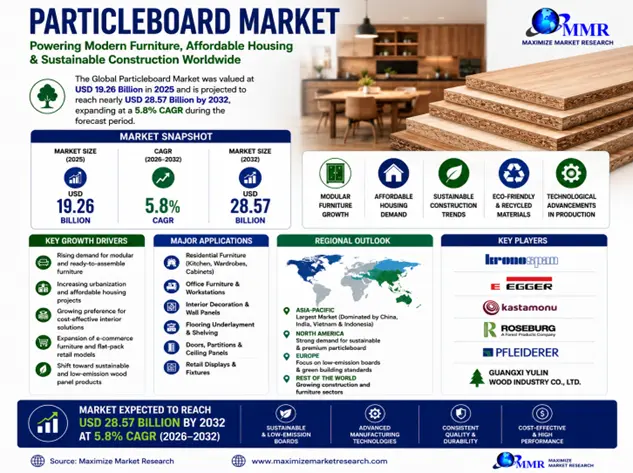
And increasingly, rising urbanization, eco-friendly construction trends, and booming furniture demand are transforming particleboard into one of the fastest-growing engineered wood segments worldwide.
Modular Furniture Is Becoming the Market’s Biggest Growth Driver
The global furniture industry is undergoing a major transformation. Consumers increasingly prefer:
- Affordable Furniture
- Space-Saving Designs
- Ready-To-Assemble Products
- Modern Interior Solutions
- Lightweight Wood Panels
Particleboard has become a preferred material because it offers cost efficiency, smooth finishing, and compatibility with laminates and veneers. The rapid expansion of e-commerce furniture platforms and flat-pack retail models is significantly accelerating global demand for particleboard-based products.
According to Maximize Market Research, rising demand for modular furniture and laminated particleboard remains one of the industry’s strongest growth drivers.
Kronospan continues expanding engineered wood manufacturing capacity to support growing furniture demand, while EGGER Group is strengthening sustainable wood-panel production for modern interior and commercial applications.
MMR Insight: Particleboard is increasingly becoming the backbone of affordable and modular furniture manufacturing worldwide.
Sustainable Construction Is Reshaping the Industry
The push toward environmentally responsible construction is creating major new opportunities for engineered wood products. Builders and architects are increasingly adopting particleboard because it supports:
- Efficient Wood Utilization
- Recycled Material Integration
- Low-Cost Construction
- Lightweight Interior Applications
- Sustainable Building Practices
Manufacturers are also investing heavily in:
- Low-Emission Adhesives
- E0 & E1 Grade Boards
- Formaldehyde Reduction Technologies
- Recycled Wood Content
- Circular Economy Production Models
China recently expanded low-emission particleboard production capacity in Jiangsu and Guangxi to support home décor and furniture demand. Meanwhile, tightening environmental regulations across Europe and North America are accelerating innovation in ultra-low-emission wood panels.
Affordable Housing and Urbanization Are Fueling Demand
Rapid urbanization across Asia-Pacific, Latin America, and the Middle East is driving substantial growth in residential construction. Particleboard is increasingly used in:
- Kitchen Cabinets
- Wardrobes
- Wall Panels
- Office Furniture
- Flooring Systems
- Interior Decoration
because it offers an attractive balance between affordability and functionality.
According to industry analysis, growing construction activity and rising housing demand continue supporting long-term market expansion globally.
India’s expanding building and construction sector, along with increasing investments in smart housing and urban infrastructure, is expected to remain a major growth catalyst for engineered wood products.
Asia-Pacific Continues to Dominate Global Production
Asia-Pacific currently leads the global particleboard industry due to:
- Massive Furniture Manufacturing Capacity
- Rapid Urbanization
- Strong Construction Growth
- Large Consumer Base
- Expanding Middle-Class Population
China remains the world’s largest production hub, while India, Vietnam, and Indonesia are witnessing strong growth in furniture manufacturing and residential infrastructure development.
The region’s growing demand for affordable home furnishings and modular interiors continues accelerating particleboard consumption across residential and commercial applications.
Smart Manufacturing and Automation Are Transforming Competition
Manufacturers are increasingly investing in:
- Automated Pressing Systems
- Digital Production Technologies
- Advanced Surface Finishing
- Moisture-Resistant Boards
- Fire-Resistant Panels
to improve quality, durability, and manufacturing efficiency.
According to Maximize Market Research, more than 220 new furniture manufacturing units in India adopted automated particleboard production lines in 2025 to meet rising interior-design demand. Companies capable of producing high-quality low-emission boards at scale are expected to gain major competitive advantages over the next decade.
Kastamonu Entegre and Roseburg Forest Products are also strengthening investments in advanced wood-panel technologies aimed at supporting sustainable construction and interior applications.
Final Take
Particleboard is no longer merely a low-cost wood substitute. It is becoming foundational infrastructure supporting:
- Modern Furniture Manufacturing
- Affordable Housing Projects
- Sustainable Construction
- Commercial Interiors
- Modular Design Systems
- Urban Infrastructure Development
And as global demand for affordable, eco-friendly, and design-flexible materials continues rising, the companies controlling advanced particleboard manufacturing technologies may quietly become some of the most influential players in the future engineered wood economy.
Explore the full competitive and forecast analysis: